Best CFD Brokers 2026: Regulation, Costs and Platforms
Choosing a CFD broker comes down to three questions in order: Is the broker regulated by an authority I can verify independently? What will it actually cost me per trade, including overnight charges?...
Reviewed using our forex & CFD broker review methodology
Checked on: 2026-08-17 | Broker terms, regulation, and pricing can change. Always verify at the official PU Prime site before opening an account.
Affiliate Disclosure: HNL Growth may earn a commission if you open an account through our links, at no additional cost to you. Risk Warning: CFDs and leveraged forex products are complex instruments and carry a high risk of losing money rapidly due to leverage. 62.2% of retail investor accounts lose money when trading CFDs with this provider. Trading forex and CFDs may not be suitable for all investors. Consider your objectives, experience, and risk appetite before trading, and ensure you understand the risks involved. Broker Disclosure: PU Prime is a live, regulated multi-entity broker (not a simulated prop-firm evaluation) — trades are executed with real capital in live market conditions, subject to normal market risk. Which PU Prime entity holds your account depends on your country of residence and determines your leverage cap and protections.
Last verified: August 2026 | Editorial Team
Best CFD Brokers 2026: Regulation, Costs and Platforms
Choosing a CFD broker comes down to three questions in order: Is the broker regulated by an authority I can verify independently? What will it actually cost me per trade, including overnight charges? Does the platform and account structure fit how I trade? This page works through those questions systematically—leading with regulation and entity clarity, then cost structure, then account fit. PU Prime data is drawn from official source pages. Competitor data in the comparison matrix requires independent verification from each broker's own official pages before you rely on it for a deposit decision. No spread figures on this page have been independently measured on funded accounts; all are advertised or typical figures as published by each broker.
Disclosure: This page may contain affiliate links. We may earn a commission if you open an account through our links, at no extra cost to you.
Verdict at a Glance
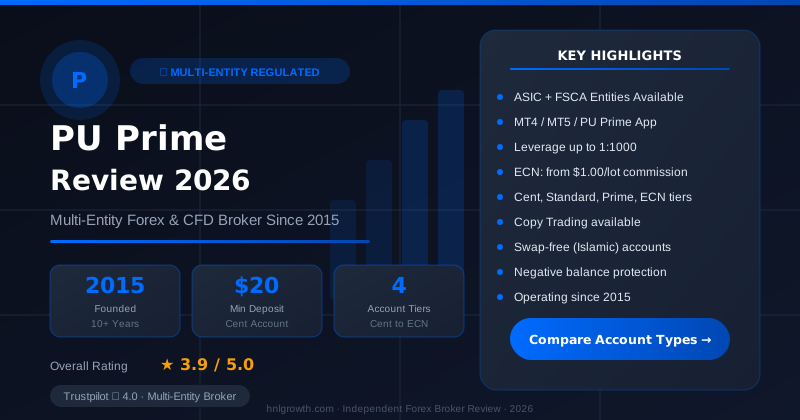
PU Prime — Multi-Entity Forex & CFD Broker
ASIC (AU) + FSCA (ZA) entities available · $20 min deposit (Cent) · MT4, MT5, PU Prime App · 4 account tiers
The table below organises brokers by use case rather than a subjective ranking. Regulation and reference numbers appear first because they are the gatekeeping criterion.
| Broker | Regulator (Entity) | Licence / Reference | Execution Model | EUR/USD Spread (Advertised) | Min Deposit | Best Suited For |
|---|---|---|---|---|---|---|
| PU Prime | FSA Seychelles / FSC Mauritius / FSCA South Africa / CMA UAE | Verify at puprime.com/regulation | Market Maker (Standard); STP/ECN (Prime/ECN) | From 1.3 pips (Standard, advertised); from 0.0 pips + commission (Prime/ECN, advertised) | $20 (Cent); $50 (Standard) — Prime/ECN: verify at account opening | Global traders seeking multi-regulator oversight and tiered account structure |
| IG | FCA (IG Index Ltd) | FRN 114059 — verify at register.fca.org.uk | Market Maker / DMA (Pro) | From 0.6 pips (advertised) — verify at ig.com | £250 — verify at ig.com | Established traders wanting deep market access and FCA/FSCS protection |
| Pepperstone | FCA (Pepperstone Ltd) / ASIC / CySEC | FRN 684312 — verify at register.fca.org.uk | STP/ECN (Razor); Market Maker (Standard) | From 0.0 pips + commission (Razor, advertised) — verify at pepperstone.com | £200 — verify at pepperstone.com | Active traders prioritising tight raw spreads with FCA oversight |
| CMC Markets | CMC Markets UK Plc (FCA) | FRN 173730 — verify at register.fca.org.uk | Market Maker | From 0.7 pips (advertised) — verify at cmcmarkets.com | No formal minimum — verify at cmcmarkets.com | Multi-asset traders wanting a wide instrument range with FCA protection |
| Saxo | Saxo Capital Markets UK Ltd (FCA) | FRN 551422 — verify at register.fca.org.uk | Market Maker / STP | From 0.9 pips (advertised) — verify at home.saxo | £500 (Classic) — verify at home.saxo | Professional and high-volume traders wanting multi-asset access |
All FRN numbers for non-PU Prime brokers are drawn from publicly available secondary sources and have not been independently spot-checked against the live FCA register for this publication. Verify each number directly at register.fca.org.uk before relying on it for any deposit decision.
All spread figures are advertised or typical. Live spreads widen during news events, low-liquidity periods, and market open/close. Competitor spread, deposit, and regulatory data must be independently verified at each broker's official website and the relevant live regulator register before any deposit decision.
How Regulation Actually Protects You—and Where It Doesn't
Regulation does not mean identical protection. What matters is which specific legal entity you contract with, and which regulator governs that entity.
The regulator comparison
| Regulator | Jurisdiction | Deposit Protection Scheme | Compensation Limit | Negative Balance Protection (Retail) | Retail Leverage Cap (Forex Majors) | Classification |
|---|---|---|---|---|---|---|
| FCA | United Kingdom | FSCS | £85,000 per eligible person per firm — verify current limit at fscs.org.uk | Yes (mandatory for retail clients) | 1:30 | Tier 1 |
| CySEC | Cyprus / EEA | ICF (Investor Compensation Fund) | €20,000 per eligible client — verify current limit at cysec.gov.cy | Yes | 1:30 | Tier 1 |
| ASIC | Australia | No equivalent deposit insurance | N/A | Not currently mandated — verify current rules at asic.gov.au | Verify current rules at asic.gov.au | Tier 1 |
| FSA Seychelles | Seychelles | None | N/A | Not mandated | Up to 1:500 (broker-set) | Offshore |
| FSC Mauritius | Mauritius | None | N/A | Not mandated | Broker-set | Offshore |
| FSCA | South Africa | None | N/A | Not mandated | Broker-set | Mid-tier (improving) |
| CMA UAE | United Arab Emirates | None equivalent to FSCS | N/A | Not mandated for all entities | Broker-set | Regional |
What this means in practice
FCA (UK): Clients of an FCA-authorised firm receive the highest available retail protection in this comparison. FSCS covers up to £85,000 per eligible person per firm if the firm fails—confirm the current limit at fscs.org.uk before relying on this figure, as it has changed historically. Retail clients also benefit from mandatory negative balance protection and can escalate unresolved complaints to the Financial Ombudsman Service (FOS). These protections apply only to the FCA-authorised entity specifically. If your account is with an overseas subsidiary of the same group, FCA protections do not apply.
For UK retail clients, the practical gap when trading with an offshore-regulated broker rather than an FCA-authorised one is significant: no FSCS compensation if the firm fails, no FCA leverage caps, and no access to the Financial Ombudsman Service. Dispute resolution would fall to the broker's internal processes or the oversight of the relevant offshore regulator.
CySEC (Cyprus): Comparable retail protections under EU regulation, including a 1:30 leverage cap for forex majors and negative balance protection. The ICF compensates up to €20,000—verify the current ceiling at cysec.gov.cy. CySEC-regulated brokers serving EEA clients fall under MiFID II; those serving non-EEA clients may route accounts through a separate entity with different terms.
ASIC (Australia): A tier-1 regulator for governance and compliance standards, but Australia has no FSCS equivalent. ASIC's retail product intervention rules changed materially in 2021 and may have been further updated since. Confirm current leverage caps and protections at asic.gov.au rather than relying on any earlier summary, including statements on this page.
Offshore regulators (FSA Seychelles, FSC Mauritius): Typically offer higher leverage and lower compliance overhead, but no deposit insurance, no mandatory negative balance protection, and no independent ombudsman with binding authority. This represents a deliberate jurisdictional trade-off. The question is whether the higher leverage available is worth the reduced protection relative to your account size and trading style.
PU Prime's regulated entities: Based on the official regulation page, PU Prime operates under the FSA Seychelles, FSC Mauritius, FSCA South Africa, and CMA UAE. No FCA or CySEC entity is listed. UK and EEA retail clients contracting through PU Prime are therefore not covered by FSCS or the ICF, are not subject to FCA-mandated retail leverage caps, and cannot access the FOS for complaint escalation. Verify the current licence details and the specific entity you will contract with directly on the regulation page before opening an account.
Understanding the Real Cost: Spreads, Commissions, and Overnight Charges
Execution model determines your cost structure
There are three execution models you will encounter across CFD brokers, and they determine not just what you pay but who sits on the other side of your trade.
Market Maker: The broker sets bid/ask prices and acts as your direct counterparty. You pay through the spread—no per-trade commission. Because the broker profits when positions close unfavourably for clients, a structural conflict of interest exists. This does not mean prices are manipulated—regulated brokers are subject to best execution rules—but it is a relationship worth factoring into your assessment. PU Prime's Standard account operates on this model. The Cent account execution model is not confirmed in the available official source material; verify directly with PU Prime before opening a Cent account.
STP/ECN: The broker routes your order to external liquidity providers (banks, institutional desks). You pay a narrow raw spread plus a per-lot commission per side. The broker's revenue is the commission rather than the spread, which removes the direct counterparty conflict. PU Prime's Prime and ECN accounts operate on this model.
DMA (Direct Market Access): Orders go directly to an exchange order book. Typically restricted to listed equities, requires higher minimum capital, and is available primarily at institutional or professional-tier brokers. Not listed as a current PU Prime offering.
Why advertised spreads differ from what you pay
Advertised spreads are minimum or typical figures measured under optimal liquidity conditions—usually during the London session, away from data releases, with normal market depth. During major news events (NFP, central bank decisions), EUR/USD spreads can widen from their typical level to multiples of that within seconds. During Asian-session illiquidity, many spreads are structurally wider. All spread figures on this page are advertised unless explicitly stated otherwise. No independent funded-account spread sampling has been conducted for this publication.
A practical consequence for active traders: if your strategy runs during off-hours or around news events, the gap between an advertised minimum spread and the spread you actually execute on can be material. Advertised minimums are not a reliable basis for comparing real-world trading costs between brokers without live data.
Overnight financing: the cost that compounds
Overnight financing (also called swap or rollover) is charged on leveraged positions held past the daily rollover, typically 22:00 or 00:00 server time. The calculation follows a standard formula:
Overnight cost = (Notional position value × annual financing rate) ÷ 365
The annual rate is typically a benchmark rate (SOFR for USD pairs, €STR for EUR, SONIA for GBP) plus or minus a broker markup. Long and short rates differ, and triple-swap Wednesday accounting is common. The following example uses a fully hypothetical rate for illustration only—it does not represent PU Prime's actual rates or any real market rate:
For a £10,000 notional EUR/USD position held for 3 days at a hypothetical annual rate of 7% (benchmark plus markup, illustrative only):
- Daily overnight cost = £10,000 × 7% ÷ 365 = approximately £1.92
- 3-day hold = approximately £5.75
For a trader running 10 such trades per month with the same holding pattern, the overnight charge alone adds roughly £57.50 per month—before spreads or commissions. Over six months that reaches approximately £345. This cost is frequently absent from advertised spread comparisons yet can be the largest component of total cost for position traders.
PU Prime publishes swap rates on its spread and costs page, but specific rate values must be verified directly in MT4/MT5 or the PU Prime app, as the page notes that listed values are for reference only.
All-in cost scenario (advertised data only)
| Broker / Account | EUR/USD Spread (Advertised) | Commission per Lot/Side | Estimated Round-Turn Cost on 1 Standard Lot | Overnight | Data Source |
|---|---|---|---|---|---|
| PU Prime Standard | 1.3 pips | None | ~$13 spread cost | Broker markup above benchmark; verify current rates in MT4/MT5 or PU Prime app | puprime.com/spread-and-costs |
| PU Prime Prime | From 0.0 pips | Not confirmed in available source material — verify at puprime.com/spread-and-costs | Commission (unconfirmed) + live spread | Same as above | puprime.com/spread-and-costs |
| PU Prime ECN | From 0.0 pips | Not confirmed in available source material — verify at puprime.com/spread-and-costs | Commission (unconfirmed) + live spread | Same as above | puprime.com/spread-and-costs |
| Competitors | Verify on each broker's pricing page | Verify on each broker's pricing page | Requires independent verification | Requires independent verification | Not independently verified for this publication |
Commission values for PU Prime's Prime and ECN accounts are not confirmed in the available official source material. The spread-and-costs page notes that all listed values are for reference only and should be confirmed in the trading platform or app. The Prime and ECN rows above are included to show that a commission structure applies; the cost comparison is incomplete without the confirmed commission figure.
Broker Comparison: Regulation, Costs and Account Fit
| Broker | Regulated Entity (Key) | FRN / Licence | Min Deposit | Execution Model | Platforms | Leverage (Retail) | Retail Loss Rate |
|---|---|---|---|---|---|---|---|
| PU Prime | FSA Seychelles; FSC Mauritius; FSCA; CMA UAE | Verify at puprime.com/regulation | $20 (Cent); $50 (Standard); Prime/ECN: verify at account opening | Market Maker (Standard); STP/ECN (Prime/ECN) | MT4, MT5, PU Prime App | Offshore entities: broker-set (up to 1:500 per broker terms); no FCA/CySEC retail cap applies | Not located in available official source material — verify on puprime.com |
| IG | IG Index Ltd (FCA) | FRN 114059 — verify at register.fca.org.uk | £250 — verify at ig.com | Market Maker / DMA (Pro) | MT4, L2 Dealer, IG proprietary | 1:30 (FCA retail) | Verify current disclosure at ig.com |
| Pepperstone | Pepperstone Ltd (FCA); also ASIC / CySEC entities | FRN 684312 (FCA) — verify at register.fca.org.uk | £200 — verify at pepperstone.com | STP/ECN (Razor); Market Maker (Standard) | MT4, MT5, cTrader, TradingView | 1:30 (FCA retail) | Verify current disclosure at pepperstone.com |
| CMC Markets | CMC Markets UK Plc (FCA) | FRN 173730 — verify at register.fca.org.uk | No formal minimum — verify at cmcmarkets.com | Market Maker | MT4, CMC Next Generation | 1:30 (FCA retail) | Verify current disclosure at cmcmarkets.com |
| Saxo | Saxo Capital Markets UK Ltd (FCA) | FRN 551422 — verify at register.fca.org.uk | £500 (Classic) — verify at home.saxo | Market Maker / STP | SaxoTraderPRO, SaxoTraderGO | 1:30 (FCA retail) | Verify current disclosure at home.saxo |
On retail loss rates: FCA and CySEC require each broker to publish the percentage of retail CFD accounts that lost money during a recent period. This is a regulatory disclosure requirement. The correct figure for each broker must come from that broker's own current regulatory disclosure—industry-wide averages are not a compliant substitute and are not used here. For PU Prime, the specific retail loss rate was not located in the available official source material; the figure may appear on their site for clients in jurisdictions where disclosure is required. Check directly.
On PU Prime's regulated entities: The official regulation page confirms FSA Seychelles, FSC Mauritius, FSCA South Africa, and CMA UAE. No FCA-authorised entity is confirmed from this source. UK readers receive no FSCS compensation protection, no FCA-mandated leverage caps, and no FOS access through a PU Prime account. This is a material distinction from the FCA-regulated brokers also listed in this table.
Before opening an account with any broker, verify that the entity you are contracting with is actively authorised—not merely registered or appointed—on the relevant regulator's live register.
Compare PU Prime account types and open a live account
Risk warning: CFDs and leveraged forex products are complex instruments and carry a high risk of losing money rapidly due to leverage. The percentage of retail investor accounts that lose money when trading CFDs varies by broker and period—check PU Prime's current regulatory disclosure on their website for their specific figure. Consider whether you understand how these products work and whether you can afford to take the high risk of losing your capital. Check the entity, terms and protections that apply in your jurisdiction before trading.
Matching Broker to Trading Style and Account Size
Not every broker suits every trader. The table below presents criteria filters, not endorsements.
| Profile | Priority Criteria | Execution Model Fit | Regulation Tier Consideration | Recommended Account Type |
|---|---|---|---|---|
| First-time CFD trader | Low minimum deposit, simple cost structure, negative balance protection | Market Maker (no per-trade commission to track) | Tier 1 (FCA/CySEC) strongly recommended for UK/EU residents; offshore regulators for traders outside these jurisdictions who have assessed the protection trade-offs | Standard or Cent (PU Prime); Standard-equivalent at FCA broker |
| Active short-term trader (5+ trades/week) | Tight spreads, low commission, fast execution, low overnight exposure | STP/ECN | Tier 1 or reputable offshore; depends on leverage requirements | Prime or ECN (PU Prime); Razor-equivalent at STP/ECN broker |
| Professional / high-volume trader | Very tight ECN spreads, margin efficiency, broad instrument access | STP/ECN or DMA | Tier 1 preferred for capital protection at scale; note FCA professional status removes negative balance protection | ECN (PU Prime); Pro/DMA accounts at FCA-regulated brokers |
The Market Maker vs. STP/ECN breakeven
When an STP/ECN account charges commission per lot per side and a Market Maker equivalent charges through the spread alone, there is a trade volume at which the commission-based account becomes the lower-cost option. The crossover depends on the actual live spreads during your trading hours, your typical position size, and your trade frequency. Below a certain volume threshold, the Market Maker's no-commission structure is often simpler and comparably priced; above it, raw-spread accounts with commission typically win on cost. This calculation requires actual live spread data to determine precisely—advertised minimums alone are not a reliable input.
Demo Accounts: Useful But Limited
Demo account conditions routinely differ from funded account conditions. Spreads are often tighter on demo, orders fill at displayed prices without slippage, and there is no real liquidity depth to contend with. Live account execution depends on real market conditions, which vary by session, volatility, and available liquidity. PU Prime makes a demo account available while your live account awaits verification—this is useful for learning platform mechanics, but demo performance is not a predictor of funded account outcomes. Treat it as a tool for practising strategy logic, not a benchmark for real trading costs.
Explore PU Prime's Prime and ECN account conditions
Risk warning: CFDs and leveraged forex products are complex instruments and carry a high risk of losing money rapidly due to leverage. The percentage of retail investor accounts that lose money when trading CFDs varies by broker—check PU Prime's current disclosure on their website for their specific figure. Consider whether you understand how these products work and whether you can afford to take the high risk of losing your capital. Check the entity, terms and protections that apply in your jurisdiction before trading.
How to Verify a CFD Broker's Licence Before Depositing
Verifying a licence takes under five minutes and is the single most important step before funding any account.
Step 1: Identify which legal entity you are contracting with. This is stated in the broker's terms and conditions or on their regulation page—not always in the signup flow. For PU Prime, this is at puprime.com/regulation.
Step 2: Go directly to the regulator's own register—not the broker's description of it.
- FCA (UK): register.fca.org.uk — search by firm name or Firm Reference Number. Status must show "Authorised," not "Registered" or "Appointed Representative," for full FSCS and negative balance protection eligibility.
- CySEC (Cyprus): cysec.gov.cy/en-GB/entities/ — verify licence number and current status.
- ASIC (Australia): asic.gov.au or the ASIC Connect register — also check moneysmart.gov.au.
- FSA Seychelles, FSC Mauritius, FSCA, CMA UAE: Each maintains an online public register. The broker's regulation page should link to the relevant register entry. Confirm the link goes to the official regulator's domain, not a third-party site.
Step 3: Verify by reference number, not just name. Searching by firm name can return near-matches or similarly named entities. Always cross-check the licence or reference number the broker provides against the actual register entry.
Step 4: Check for clone firm warnings. The FCA publishes a list of unauthorised firms and clones at fca.org.uk/scamsmart. A firm claiming FCA regulation that does not appear on the register—or whose reference number matches a different company name—is a serious red flag.
Step 5: Understand status categories. "Authorised" means the firm is directly licensed and holds full obligations including FSCS eligibility. "Registered" (for example, as a cryptoasset firm) and "Appointed Representative" status carry fewer protections. For CFD trading, you need "Authorised."
Withdrawals, Complaints and What Happens If Something Goes Wrong
Withdrawals: what official sources confirm
The PU Prime account opening page confirms supported payment methods include credit and debit cards, bank wire, Skrill, and Neteller. For deposits, card and e-wallet transactions are described as typically instant; bank transfers as typically 1–3 business days. Specific withdrawal processing timelines by payment method are not separately detailed in the official source material reviewed for this publication. For current stated withdrawal timelines, check the PU Prime client portal directly.
When evaluating any broker's withdrawal statements, distinguish between the broker's internal processing time—which is within their control—and payment processor or bank clearance time, which is not. Both contribute to the total time before funds reach your account.
Complaint resolution by regulator
FCA-regulated brokers: Under the FCA's Dispute Resolution (DISP) sourcebook, firms must acknowledge a complaint within five business days and issue a final response within eight weeks. If the response is unsatisfactory or eight weeks pass without resolution, you can escalate to the Financial Ombudsman Service at financial-ombudsman.org.uk. This escalation path applies only to accounts held through the FCA-authorised entity. Verify current complaint timelines against the FCA DISP sourcebook at handbook.fca.org.uk, as rules may be updated.
CySEC-regulated brokers: The Cyprus Financial Ombudsman handles unresolved complaints. Procedures are published on the ombudsman's official site.
Offshore entities (FSA Seychelles, FSC Mauritius, FSCA, CMA UAE): No independent ombudsman with binding resolution authority exists in most offshore jurisdictions. Resolution typically follows internal mediation, arbitration terms specified in the contract, or civil litigation in the broker's home jurisdiction. For PU Prime, which operates exclusively under offshore and regional regulators, the FOS escalation path is not available. This is a material practical difference from FCA or CySEC accounts and should factor into your deposit decision.
Risk Disclosure and Client Protections
Retail loss rates
FCA and CySEC require brokers to publish the percentage of retail CFD accounts that lost money over a recent period. This is a regulated disclosure requirement, not an editorial scare tactic. The correct figure for each named broker must be sourced from that broker's own current disclosure—industry-wide averages are not a compliant substitute and are not used here. For PU Prime's current retail loss rate, check their website directly. This publication was unable to locate a specific PU Prime retail loss rate in the available official source material; the figure may appear on their site for clients in jurisdictions where disclosure is required.
Negative balance protection
Under FCA rules, retail clients cannot lose more than the funds in their account. If a leveraged position moves against you so sharply that your balance turns negative before it can be liquidated, the broker must absorb the difference. This protection is mandatory for FCA retail clients and for CySEC retail clients under MiFID II. It is not mandated under FSA Seychelles or FSC Mauritius rules. If you elect professional client status with an FCA broker, this protection is removed—the higher leverage available to professional clients comes at the cost of exposure beyond your deposited funds.
Leverage caps by jurisdiction
Under FCA PS19/18 (retained post-Brexit from ESMA measures), retail client leverage caps are:
- Forex major pairs: 1:30
- Forex minors and gold: 1:20
- Major indices: 1:20 (verify current FCA asset classification rules at fca.org.uk)
- Non-gold commodities: 1:10
- Individual equities: 1:5
- Cryptocurrencies: 1:2
Verify current classifications and whether post-Brexit rules remain unchanged at fca.org.uk, as these rules may be updated. FCA-assessed professional clients can access higher leverage, but negative balance protection and certain mandated risk warnings no longer apply. Outside FCA/CySEC jurisdictions, leverage is set by the broker within their regulatory cap. PU Prime's offshore entities offer leverage up to 1:500 depending on account type and instrument; verify current limits on the spread and costs page.
How to Open a PU Prime Account
The account opening page describes the process as taking approximately 10–15 minutes of active work, plus a waiting period for document verification.
You will need a valid government-issued ID (passport, national identity card, or driving licence), proof of address dated within the last three months (utility bill, bank statement, or similar), and a minimum deposit matching your chosen account type.
PU Prime offers four main account tiers: Cent ($20 minimum), Standard ($50 minimum), Prime, and ECN. Minimum deposits for Prime and ECN are not confirmed in the available official source material and should be verified at account opening. Per PU Prime's own guidance, most beginners are directed toward the Standard account.
The verification step—uploading your ID and address proof—typically takes a few hours during business days according to the account opening page, though up to 24–48 hours is possible. While your live account is being reviewed, a demo account is available for platform familiarisation.
Once verified, fund your account via credit or debit card, bank wire, Skrill, Neteller, or other supported local methods, then download MT4, MT5, or the PU Prime app and log in with your account credentials.
Frequently Asked Questions
Which regulator offers the strongest protection for UK retail CFD traders? The FCA provides the strongest protection for UK retail clients: FSCS compensation up to £85,000 per eligible person per firm (verify the current limit at fscs.org.uk), mandatory negative balance protection, leverage caps by asset class, and access to the Financial Ombudsman Service for unresolved complaints. These protections apply only to accounts held with the FCA-authorised entity, not with overseas subsidiaries of the same group.
Is PU Prime FCA regulated? Based on the official regulation page, PU Prime's regulated entities are the FSA Seychelles, FSC Mauritius, FSCA South Africa, and CMA UAE. No FCA-authorised entity is listed. UK clients contracting through PU Prime are not covered by FSCS, are not subject to FCA leverage caps, and cannot escalate complaints to the Financial Ombudsman Service. Verify the current entity list and the specific entity you will contract with directly before depositing.
What is the difference between a Market Maker and an STP/ECN broker? A Market Maker acts as your direct counterparty—it quotes both sides of the market and earns the spread. A structural conflict of interest exists because the broker profits when client positions close at a loss, though regulated brokers are required to manage this under best execution rules. An STP/ECN broker routes your order to external liquidity providers and earns a commission per trade; the direct counterparty conflict is removed. Neither model is inherently dishonest, but understanding the relationship helps you evaluate cost claims and risk disclosures more accurately.
Can I lose more than I deposit when trading CFDs? With an FCA-regulated retail account, no—negative balance protection prevents losses exceeding your deposited funds. With an offshore-regulated account (such as FSA Seychelles or FSC Mauritius), this protection is not mandated; verify the specific terms in your account agreement. Professional client status with an FCA broker removes the protection even within the FCA framework.
Why do advertised spreads look different from what I see when I trade? Advertised spreads are minimum or typical figures measured under favourable conditions. During economic data releases, central bank decisions, market opens and closes, and periods of low liquidity, spreads widen—sometimes to multiples of the advertised figure. All spread figures on this page are advertised; no independent funded-account sampling has been conducted for this publication.
What platforms does PU Prime offer? PU Prime supports MT4, MT5, and the proprietary PU Prime mobile trading app. Per PU Prime's own guidance, MT5 is the recommended starting point as it offers a broader range of asset classes, additional order types, and a more advanced strategy tester. MT4 remains available for traders who prefer it or rely on existing Expert Advisors built in MQL4. Platform pages: MT4, MT5, Trading App.
What is the minimum deposit for PU Prime? Based on the account opening page, the Cent account starts at $20 and the Standard account at $50. Minimum deposits for the Prime and ECN tiers are not confirmed in the official source material reviewed here and should be verified directly at account opening.
How do I escalate a complaint if I cannot resolve it with my broker? For FCA-regulated accounts, escalate to the Financial Ombudsman Service after eight weeks without resolution or if the broker's response is unsatisfactory. For CySEC accounts, escalate to the Cyprus Financial Ombudsman. For offshore-regulated accounts, no equivalent independent ombudsman with binding authority exists; dispute resolution is typically internal or via contractual arbitration. This distinction is a significant practical difference between tier-1 and offshore regulation.
Checklist Before You Open an Account
No funded-account testing or audits were conducted for this publication. Use the following checklist to conduct your own verification before depositing:
- Confirm the specific legal entity you are contracting with from the broker's terms or regulation page
- Search that entity's name and licence number on the relevant regulator's official live register—not the broker's own description
- Confirm the entity's status is "Authorised" (for FCA); verify equivalent active-licence status on other registers
- Check for clone firm or unauthorised firm warnings at fca.org.uk/scamsmart if the broker claims FCA regulation
- Confirm whether FSCS, ICF, or equivalent compensation applies to your account
- Confirm whether negative balance protection applies to your account type
- Verify current leverage caps for the instruments you plan to trade
- Check the broker's current retail loss rate disclosure on their own website
- Confirm current minimum deposit requirements and commission rates for your intended account type in the trading platform
- Review current swap/overnight financing rates in MT4, MT5, or the broker's app before running overnight positions
- Confirm the complaint resolution process and escalation path available for your entity and jurisdiction
Open a PU Prime account — view current account types and minimum deposit
What We Could Not Verify
In the interest of editorial transparency, the following data points could not be confirmed from official sources at the time of writing and are either absent from this article or explicitly flagged as requiring independent verification:
- PU Prime's current retail loss rate. Not located in the available official source material. Must be sourced from PU Prime's own regulatory disclosure. This is a mandatory disclosure for brokers regulated in FCA and CySEC jurisdictions; its availability for PU Prime's offshore entities is unconfirmed.
- Commission rates for PU Prime Prime and ECN accounts. Not confirmed from the available source material; specific figures must be verified in MT4/MT5 or the PU Prime app.
- Minimum deposits for PU Prime Prime and ECN accounts. Not confirmed in the official source material reviewed; verify at account opening.
- Execution model for PU Prime's Cent account. The Standard account is confirmed as Market Maker; the Cent account execution model is not documented in the available sources.
- Live spread measurements for any broker listed. No funded-account sampling has been conducted. All spread figures are advertised or typical as stated by each broker.
- Specific withdrawal processing timelines for PU Prime by payment method. Not detailed in the official source material reviewed. Check the PU Prime client portal directly.
- Overnight financing rates by asset class for PU Prime. The spread and costs page confirms rates should be checked in MT4/MT5 or the PU Prime app; exact rates are not extractable from the source material available.
- FRN numbers for non-PU Prime brokers. Drawn from publicly available secondary sources; not independently spot-checked against the live FCA register for this publication. Verify each at register.fca.org.uk.
- All competitor broker spread, deposit, and regulatory data. Must be independently verified from each broker's official website and the relevant live regulator register.
- ASIC current retail leverage and protection rules. ASIC's product intervention measures have evolved since 2021. Confirm the current position at asic.gov.au.
- FSCS limit and FCA DISP complaint timelines. The £85,000 FSCS limit and FCA DISP timelines cited in this article should be confirmed against current official sources at fscs.org.uk and handbook.fca.org.uk respectively, as both have changed historically.
- Whether FCA PS19/18 leverage caps remain unchanged post-2025. The article cites this policy statement; confirm current rules at fca.org.uk before relying on the specific figures stated.
- Whether PU Prime holds active (not suspended) licences across all four regulatory jurisdictions. The official regulation page confirms operation under these regulators but does not provide licence numbers or active-status confirmation in the source material reviewed. Verify directly on each regulator's public register.
Risk warning: CFDs and leveraged forex products are complex instruments and carry a high risk of losing money rapidly due to leverage. Consider whether you understand how these products work and whether you can afford to take the high risk of losing your capital. Check the entity, terms and protections that apply in your jurisdiction before trading.
Ready to Compare PU Prime Account Types?
PU Prime is a multi-entity broker — ASIC (Australia) and FSCA (South Africa) regulated entities offer stronger oversight, while most international clients are onboarded to the FSA Seychelles or FSC Mauritius entities. Four account tiers (Cent, Standard, Prime, ECN) range from a $20 minimum deposit to full ECN pricing.
Risk disclaimer: PU Prime is a live, regulated multi-entity broker — trading forex and CFDs is done with real capital under normal market risk (this is not a simulated prop-firm evaluation). PU Prime operates under multiple separate licenses (ASIC, FSCA, FSA Seychelles, FSC Mauritius); which entity holds your account depends on your country of residence and determines your leverage cap and protections — confirm this before funding. CFDs and leveraged forex products are complex instruments and carry a high risk of losing money rapidly due to leverage; 62.2% of retail investor accounts lose money when trading CFDs with this provider. Consider whether you understand how CFDs/forex work and whether you can afford the high risk of losing your money. Affiliate disclosure: HNL Growth earns a commission when you open a PU Prime account through links on this page.