Best Brokers for Currency Trading 2026
There is no single 'best broker for currency trading.' The right one depends on which regulatory tier you actually need, the all-in cost on a trade you'd realistically place, whether the platform...
Reviewed using our forex & CFD broker review methodology
Checked on: 2026-08-17 | Broker terms, regulation, and pricing can change. Always verify at the official PU Prime site before opening an account.
Affiliate Disclosure: HNL Growth may earn a commission if you open an account through our links, at no additional cost to you. Risk Warning: CFDs and leveraged forex products are complex instruments and carry a high risk of losing money rapidly due to leverage. 62.2% of retail investor accounts lose money when trading CFDs with this provider. Trading forex and CFDs may not be suitable for all investors. Consider your objectives, experience, and risk appetite before trading, and ensure you understand the risks involved. Broker Disclosure: PU Prime is a live, regulated multi-entity broker (not a simulated prop-firm evaluation) — trades are executed with real capital in live market conditions, subject to normal market risk. Which PU Prime entity holds your account depends on your country of residence and determines your leverage cap and protections.
Last verified: August 2026 | Editorial Team
Best Brokers for Currency Trading 2026
There is no single "best broker for currency trading." The right one depends on which regulatory tier you actually need, the all-in cost on a trade you'd realistically place, whether the platform fits your style, and how practical funding and withdrawals are from where you live. This guide compares those four factors directly, uses PU Prime as a fully-sourced reference point, and gives you a checklist for shortlisting alternatives such as IG, XTB, Interactive Brokers, Saxo, FOREX.com, CMC Markets or Pepperstone. Rather than crowning one universal winner, the verdict below is segmented by trader profile, because a beginner testing strategies with $50 has different priorities than a high-volume trader running an ECN account.
Disclosure: This page may contain affiliate links. We may earn a commission if you open an account through our links, at no extra cost to you.
Methodology note: this comparison only considers brokers that publish a verifiable license on an official regulator register. We don't repeat unverified forum or review-site scam allegations against any named broker — if you have concerns about a specific entity, check that broker's status directly on the regulator's own register rather than relying on third-party claims. Figures and regulatory details for PU Prime below are drawn directly from its official pages, cited inline. Where a competitor's specific spread, fee or license detail isn't independently confirmed at the time of writing, we say so explicitly rather than estimate it.
Quick Verdict by Trader Profile
PU Prime — Multi-Entity Forex & CFD Broker
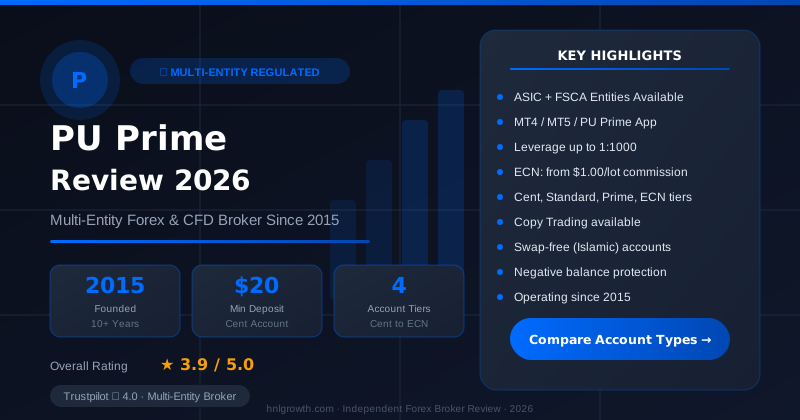
ASIC (AU) + FSCA (ZA) entities available · $20 min deposit (Cent) · MT4, MT5, PU Prime App · 4 account tiers
| Trader profile | What matters most | Where PU Prime fits | What to do |
|---|---|---|---|
| Beginner, small starting capital | Low minimum deposit, simple pricing, no commission | Standard account: no commission, spreads from 1.3 pips on EUR/USD, $50 minimum deposit (PU Prime spreads and costs, account opening guide) | Open a PU Prime Standard account |
| Cost-conscious, frequent trader | Tight raw spreads, transparent commission | Prime account: spreads from 0.0 pips plus $3.50 per lot per side, $1,000 minimum deposit (source) | Compare PU Prime account types |
| Professional or high-volume trader | Lowest per-lot cost at scale | ECN account: 0.0 pip spreads plus $1.50 per lot per side, $10,000 minimum deposit (source) | Confirm current ECN terms before funding |
| Needs tier-1 regulatory protection (FCA/ASIC-style compensation scheme) | Home-market oversight, statutory investor compensation fund | PU Prime's listed licenses are FSA Seychelles, FSC Mauritius, FSCA South Africa and CMA UAE — none of these are commonly classified as tier-1 regulators (source) | Shortlist brokers regulated by FCA, ASIC or an equivalent tier-1 authority and verify their compensation scheme directly on the regulator's register |
| Wants a broad instrument range beyond forex | Access to indices, metals, shares, ETFs, bonds in one account | PU Prime lists forex, indices, commodities, metals, shares, ETFs, bonds and synthetic indices (source) | Check margin and leverage terms per asset class before trading |
This table intentionally does not assign specific spread, fee or license figures to IG, XTB, Interactive Brokers, Saxo, FOREX.com, CMC Markets or Pepperstone. Those numbers change and vary by account tier and jurisdiction, so we're not going to guess. Use the same criteria in this article against each broker's own current pages before deciding.
Regulation and Client Protection, Side by Side
Regulation is the single most important filter in this category, and not all licenses carry the same weight. A "tier-1" regulator (commonly used to describe authorities like the FCA in the UK or ASIC in Australia) typically comes with stricter capital adequacy rules and, in some cases, a statutory investor compensation scheme. Other regulators provide oversight and licensing but may not carry the same compensation guarantees or enforcement history.
According to PU Prime's own regulation page, the group holds licenses with:
| Regulator | Jurisdiction |
|---|---|
| Financial Services Authority (FSA) | Seychelles |
| Financial Services Commission (FSC) | Mauritius |
| Financial Sector Conduct Authority (FSCA) | South Africa |
| Capital Market Authority (CMA) | United Arab Emirates |
Source: PU Prime Regulation page
PU Prime's regulation page states that clients trade under entities regulated by these four authorities, and describes the aim as protecting client funds and maintaining transparent operational standards and audited compliance. It also notes regional restrictions apply, meaning PU Prime and its affiliated entities are not established or operating in every jurisdiction — the site itself flags this with a reverse-solicitation notice for visitors outside its permitted markets. The page does not name a specific investor compensation fund (comparable to the UK's FSCS) attached to any of the four licenses; if that protection matters to you, confirm directly with the relevant regulator's register.
For any competitor you're considering, look up the specific licensing entity that applies to your country of residence (many brokers use different legal entities for the UK, EU, Australia and other regions, each with different protections), not just the group's headline regulator. A broker being "regulated" somewhere is not the same as being regulated in a way that covers you.
The Same Trade, Real Cost
Spread alone doesn't tell you the real cost of a position. A fair cost comparison needs the spread, any commission, and the overnight financing (swap) if you hold past the rollover, plus any account-specific fees. PU Prime's own pricing page is explicit that published spread, commission and swap values are for reference only and can move — it directs traders to check the live MT4/MT5 terminal or the PU Prime app for the values that actually apply at the time of the trade (source).
| Account type | Spread type | Commission | Minimum deposit | Notes |
|---|---|---|---|---|
| Cent | Same pricing as Standard | None | $20 | Balance shown in cents; useful for testing with small size |
| Standard | From 1.3 pips on EUR/USD | None | $50 | Cost paid entirely through the spread |
| Prime | From 0.0 pips | $3.50 per lot per side | $1,000 | Aimed at frequent traders wanting a tighter spread |
| ECN | From 0.0 pips | $1.50 per lot per side | $10,000 | Lowest per-lot cost, aimed at high-volume/professional use |
Source: PU Prime account opening guide and PU Prime spreads and costs page
Two practical points most cost comparisons skip:
- Overnight swap isn't a flat number. It's set per instrument and direction (long vs short) and can change daily, including around weekend rollover when brokers often apply a multi-day charge. Don't assume the number you see on a Tuesday still applies on a Friday close.
- Account tier changes the real winner. A trader placing occasional small trades may pay less overall on the commission-free Standard account, while a high-frequency trader benefits from the raw spread plus commission structure on Prime or ECN. There isn't one "cheapest" account type across all trading styles.
We can't publish a like-for-like EUR/USD cost figure for IG, XTB, Interactive Brokers, Saxo, FOREX.com, CMC Markets or Pepperstone here, because doing so responsibly requires pulling each broker's current spread and commission from their own pricing page at the same timestamp — a step we haven't performed for this article. If cost is your deciding factor, pull the current Standard/Raw-equivalent spread from each shortlisted broker's own pricing page on the same day and compare it against the PU Prime table above.
Compare PU Prime trading costs and account types
Platforms and Execution
PU Prime's account opening guide confirms the group offers MetaTrader 4 and MetaTrader 5, selectable at registration, plus a PU Prime mobile app. Its own guidance suggests MT5 for traders who are unsure which to pick, describing it as the newer platform with more built-in features. The same page also confirms PU Prime supports copy trading, with a stated minimum of $25 per signal provider for traders who want to mirror another trader's activity instead of placing every trade manually (source).
What the official pages reviewed for this article do not detail: specific order-type support (e.g., guaranteed stops), execution speed statistics, or a breakdown of charting tools beyond what's native to MT4/MT5. If execution style is central to your decision — scalping, EA/algorithmic trading, or high-frequency order placement — verify the account type's execution model and any restrictions directly on the platform pages before funding.
For comparison purposes, know that the broader market includes brokers offering MT4/MT5 alongside proprietary platforms, and some offer institutional-grade API access that others don't. Which combination you need depends on whether you trade manually, run automated strategies, or need programmatic access — confirm this on each shortlisted broker's own platform page rather than assuming feature parity across brokers that "offer MetaTrader."
Funding and Withdrawal in Practice
According to PU Prime's account opening guide, deposits can be made via credit or debit card, bank wire, and e-wallets including Skrill and Neteller, along with other local payment methods depending on region. Card and e-wallet deposits are described as typically arriving instantly, while bank transfers can take 1 to 3 business days. Verification (KYC) after document submission is described as usually completed within a few hours during business days, though the guide notes some brokers can take up to 24–48 hours (source).
Required documents for account opening: a valid government-issued ID (passport, national ID or driving licence) and a proof of address dated within the last three months (utility bill, bank statement, or equivalent government-issued document).
What we could not confirm from the pages reviewed: specific withdrawal processing time ranges, any inactivity fee, or any wire/withdrawal charge schedule. If those matter to your decision — and for a switcher comparing total cost of ownership, they should — check PU Prime's current fee schedule and the equivalent page for any competitor before moving funds, since inactivity and withdrawal fees are exactly the kind of cost that gets left out of headline spread comparisons.
Match Your Profile
If you're a beginner or testing with small capital: the practical entry points are a Cent account ($20 minimum) to get comfortable with a live environment at low risk, or the Standard account ($50 minimum, no commission) once you're ready to trade at normal size. The appeal here is a low deposit threshold and pricing that's easy to reason about, since your only cost is the spread.
Open a PU Prime account and compare Cent vs Standard
If you're cost-conscious and trade frequently: the Prime account's raw spread plus fixed per-lot commission structure is generally more transparent at volume than a wider all-in spread, but it requires a $1,000 minimum deposit. Run the math on your typical trade size and frequency against both the Standard and Prime cost structures before committing capital, since the "cheaper" account depends entirely on how often and how large you trade.
If you're a professional or high-volume trader: the ECN account's lower per-lot commission is built for scale, but the $10,000 minimum deposit is a meaningful barrier and only makes sense if your trading volume actually offsets it.
If tier-1 regulatory protection is non-negotiable for you: PU Prime's current regulatory footprint (FSA Seychelles, FSC Mauritius, FSCA South Africa, CMA UAE) is not what's typically described as tier-1. This isn't a judgment on legitimacy — it's a factual difference in regulatory tier that matters for compensation-scheme coverage and enforcement powers. If this is your priority, PU Prime is not the right fit; shortlist brokers regulated by FCA, ASIC or an equivalent authority in your home market and verify their license status on the regulator's own register.
If you want a wide range of instruments in one account: PU Prime's platform covers forex, indices, commodities, metals, shares, ETFs, bonds and synthetic indices, which may reduce the need to hold multiple broker accounts for different asset classes — but leverage, margin and available symbols still vary by instrument, so confirm those on the live platform.
What This Comparison Could Not Verify
In the interest of not overstating what this article can responsibly claim:
- Specific regulatory entities, license numbers and jurisdiction-by-jurisdiction coverage for IG, XTB, Interactive Brokers, Saxo, FOREX.com, CMC Markets and Pepperstone were not independently pulled from each broker's own regulation page for this article. Any claim about "who regulates whom" for these names should be confirmed directly on the relevant regulator's register.
- Current spread and commission figures for those same brokers were not sourced from their own pricing pages at a matching timestamp, so no like-for-like cost table against PU Prime could be responsibly published here.
- Platform and order-type specifics for competitor brokers (proprietary platforms, API access, guaranteed stop availability) were not confirmed from official sources for this piece.
- PU Prime's specific withdrawal processing times, inactivity fees and wire fees are not detailed in the official pages reviewed here. Confirm current terms directly before relying on them.
- Retail client loss percentages (the "X% of retail accounts lose money" disclosures common in this industry) vary by broker entity and are typically disclosed by each broker in its own regulatory risk warning. We have not aggregated or assumed a single figure across brokers in this article, and you should treat any comparison site that quotes one universal percentage for every broker with caution.
This comparison reflects the criteria and sources available at the time of publication and is reviewed on a quarterly basis; regulatory status, pricing and platform features can change in the interim.
FAQ
Is currency trading legal and regulated? Yes, in most jurisdictions retail forex/CFD trading is legal when conducted through a properly licensed broker, but the specific rules, leverage caps and investor protections depend on the regulator that covers your country of residence. Always confirm which legal entity of a broker services your jurisdiction and what that entity's license actually covers.
How do spreads actually compare between brokers? Spreads vary by account type (commission-free vs raw-plus-commission), by instrument, and by market conditions — they widen around news events and can behave differently on weekend rollover. A single "spread from X pips" headline number is a starting point, not a guarantee of what you'll pay on every trade.
Which platform is best for currency trading? It depends on your trading style. MT4 remains popular for algorithmic/EA-based strategies with a large existing library of tools; MT5 adds more built-in order types and asset classes. If you need proprietary charting, research integration or API access, check whether your shortlisted broker offers that specifically, since not all do.
What should I check before funding an account? Confirm the exact legal entity that will hold your account (not just the group brand), the license that entity holds, the minimum deposit for your intended account type, the deposit and withdrawal methods available in your country, and any inactivity or withdrawal fees. Do this on the broker's own official pages rather than relying on a review site's summary.
How was this comparison built, and why doesn't it name one overall "best" broker? The criteria are regulation and client protection, all-in cost on a like-for-like trade, platform/execution fit, and funding practicality — disclosed above rather than compressed into a proprietary score. Because those four factors trade off differently depending on your account size, trading frequency and jurisdiction, a single universal winner would oversimplify the decision. That's why the verdict is segmented by trader profile instead.
How do I avoid unregulated or high-risk brokers? Only consider brokers that publish a specific, checkable license number on an official regulator register, and verify that number yourself on the regulator's site rather than trusting a screenshot or a broker's own claim. If a broker's regulatory information is vague, hard to find, or doesn't name a specific license number and jurisdiction, treat that as a reason to look elsewhere.
Risk Warning
Risk warning: CFDs and leveraged forex products are complex instruments and carry a high risk of losing money rapidly due to leverage. Consider whether you understand how these products work and whether you can afford to take the high risk of losing your capital. Check the entity, terms and protections that apply in your jurisdiction before trading.
Ready to Compare PU Prime Account Types?
PU Prime is a multi-entity broker — ASIC (Australia) and FSCA (South Africa) regulated entities offer stronger oversight, while most international clients are onboarded to the FSA Seychelles or FSC Mauritius entities. Four account tiers (Cent, Standard, Prime, ECN) range from a $20 minimum deposit to full ECN pricing.
Risk disclaimer: PU Prime is a live, regulated multi-entity broker — trading forex and CFDs is done with real capital under normal market risk (this is not a simulated prop-firm evaluation). PU Prime operates under multiple separate licenses (ASIC, FSCA, FSA Seychelles, FSC Mauritius); which entity holds your account depends on your country of residence and determines your leverage cap and protections — confirm this before funding. CFDs and leveraged forex products are complex instruments and carry a high risk of losing money rapidly due to leverage; 62.2% of retail investor accounts lose money when trading CFDs with this provider. Consider whether you understand how CFDs/forex work and whether you can afford the high risk of losing your money. Affiliate disclosure: HNL Growth earns a commission when you open a PU Prime account through links on this page.