Best Forex Brokers for Beginners 2026
Disclosure: This page may contain affiliate links. We may earn a commission if you open an account through our links, at no extra cost to you.
Reviewed using our forex & CFD broker review methodology
Checked on: 2026-08-17 | Broker terms, regulation, and pricing can change. Always verify at the official PU Prime site before opening an account.
Affiliate Disclosure: HNL Growth may earn a commission if you open an account through our links, at no additional cost to you. Risk Warning: CFDs and leveraged forex products are complex instruments and carry a high risk of losing money rapidly due to leverage. 62.2% of retail investor accounts lose money when trading CFDs with this provider. Trading forex and CFDs may not be suitable for all investors. Consider your objectives, experience, and risk appetite before trading, and ensure you understand the risks involved. Broker Disclosure: PU Prime is a live, regulated multi-entity broker (not a simulated prop-firm evaluation) — trades are executed with real capital in live market conditions, subject to normal market risk. Which PU Prime entity holds your account depends on your country of residence and determines your leverage cap and protections.
Last verified: August 2026 | Editorial Team
Best Forex Brokers for Beginners 2026
Disclosure: This page may contain affiliate links. We may earn a commission if you open an account through our links, at no extra cost to you.
If you're new to forex, the "best broker" isn't the one with the flashiest homepage or the highest star rating. It's the one that keeps things simple: a verifiable regulator, a free demo account with real market prices, clear costs on ordinary trades, and a mobile app you can actually use without a finance degree. This guide gives you a framework to test any broker on your shortlist against those four filters, then walks through PU Prime as a fully sourced worked example so you can see exactly how the checks are done.
We're not going to hand you a single aggregate score like "9.9/10" and ask you to trust it. Ratings without a visible methodology don't tell you anything you can act on. Instead, every claim below is either sourced to an official broker page or flagged as something you need to verify yourself before funding an account.
Verdict in one table
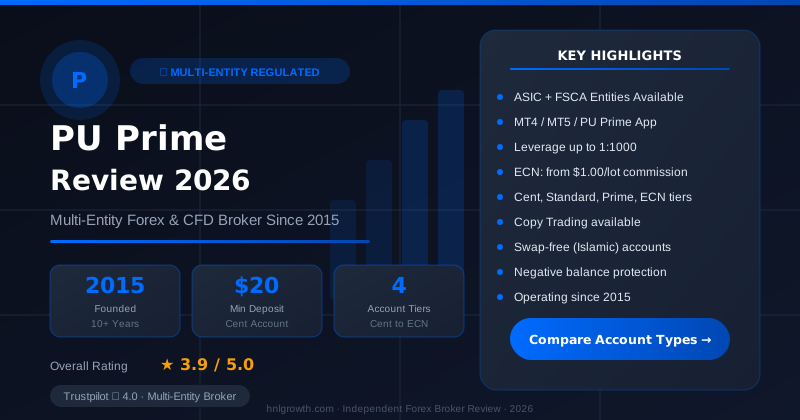
PU Prime — Multi-Entity Forex & CFD Broker
ASIC (AU) + FSCA (ZA) entities available · $20 min deposit (Cent) · MT4, MT5, PU Prime App · 4 account tiers
Use this as your first filter before you look at any specific broker. If a broker fails two or more of these, move on.
| Beginner filter | Why it matters | How PU Prime measures up |
|---|---|---|
| Verifiable regulation | Confirms who is legally accountable for your funds | Regulated by the Financial Services Authority of Seychelles, the Financial Services Commission of Mauritius, the Financial Sector Conduct Authority of South Africa, and the Capital Market Authority of the UAE (source) |
| Low, clear minimum deposit | Reduces the cost of learning if a strategy fails | Cent account from $20, Standard account from $50 (source) |
| Demo account before live capital | Lets you learn order types without risking money | A demo account can be opened while your live account is being verified, using live market pricing (source) |
| Transparent, published cost structure | Avoids hidden fee surprises on your first trades | Spreads and commissions by account type published on the official costs page (source) |
| Mainstream platform | Means tutorials, indicators, and support content already exist | MetaTrader 4, MetaTrader 5, and a proprietary mobile app (source) |
Important caveat: PU Prime's regulators (Seychelles, Mauritius, South Africa, UAE) are not the same protection tier as the UK's FCA or Australia's ASIC. That distinction matters enough that it gets its own section next — don't skip it.
Regulation and client protections side by side
"Is this broker regulated?" is the wrong first question. The right question is "regulated by whom, for which entity, and what does that actually protect?" Regulation isn't a single yes/no badge — different regulators require different levels of client fund protection, and a broker group can have several legal entities, each licensed separately and serving different regions.
Here's how to check any broker yourself, in under five minutes:
- Find the regulator's name and license number on the broker's own regulation or "about" page.
- Go to the regulator's public register directly (type the URL yourself rather than clicking a link from the broker) — for example the FCA register, the CySEC license search, or the ASIC professional register.
- Search the license number and confirm the entity name matches exactly what the broker states, including which country's version of the broker you'd actually be signing up with.
- Check the register for any warnings, restrictions, or lapsed status attached to that license.
For PU Prime specifically, the official regulation page lists oversight from the Financial Services Authority of Seychelles (FSA), the Financial Services Commission of Mauritius (FSC), the Financial Sector Conduct Authority of South Africa (FSCA), and the Capital Market Authority of the UAE (CMA). The page states these licenses require client fund protection, transparent operational standards, and audited compliance processes.
What this means practically for a beginner:
- These are legitimate, checkable licenses, but they sit outside the small group of regulators (FCA, ASIC, CySEC under MiFID) that mandate the strictest retail protections. Those top-tier regulators typically enforce statutory negative balance protection (your account cannot go below zero, even in volatile markets), participation in government-backed compensation schemes with published payout caps (often £85,000 in the UK or €20,000 in the EU if a broker fails), and strict segregated account rules that legally separate client funds from the broker's operating capital.
- PU Prime's regulation page describes "protection of client funds" and "audited compliance processes" but does not specify whether negative balance protection is guaranteed, what compensation limit applies if the broker becomes insolvent, or the exact legal structure of fund segregation. These details vary by the specific PU Prime entity you register with, which in turn depends on your country of residence.
- Before funding any account, read the terms for the entity you're actually signing up with, not a general marketing summary. Check whether negative balance protection is explicitly stated in your contract, whether a compensation scheme covers your deposits, and how client funds are held.
This is true of every broker, not just PU Prime. A broker can be genuinely regulated and still not offer the same compensation scheme as a UK-licensed bank-owned broker. Neither situation is inherently "unsafe" — they're just different, and you should know which one you're getting before you deposit.
Demo account primer: practice before you risk money
A demo account trades with virtual money at live market prices. It exists so you can learn the mechanics — placing an order, setting a stop-loss, reading a chart — before any of it costs you real capital.
According to PU Prime's own account-opening guide, a demo account can typically be opened while your live account documents are still being verified, and it uses live market pricing so the experience resembles the real platform (source). What the publicly available page does not specify is the demo's exact duration, virtual balance, or reset limits — that's a detail to confirm directly with the broker before you rely on it as your only practice window.
Two things a demo account cannot fully replicate, regardless of broker:
- Psychology. Losing virtual money and losing your own money trigger different emotional responses. Treat demo performance as a floor for platform competence, not a prediction of live results.
- Execution conditions. Demo servers sometimes fill orders differently from live servers during fast markets. Don't assume identical slippage or speed.
Use the demo account to answer three questions before you ever fund a live account: Can you place and modify an order without hesitation? Do you understand what a stop-loss actually does? Can you calculate, in advance, the maximum you'd lose if a trade goes against you?
Once you're comfortable navigating orders and reading your account balance in a demo environment, see PU Prime's account opening steps and start a demo before considering any live deposit.
All-in cost on the same trade
The real cost of a forex trade isn't just the spread. It's spread plus commission (if any) plus overnight swap if you hold the position past the daily rollover. Any comparison that only shows spread is incomplete.
PU Prime publishes four account types with different cost structures on the same instruments. Here's how a EUR/USD trade is priced across them, based on the official costs and account pages:
| Account | Typical EUR/USD spread* | Commission | Minimum deposit | Best suited to | |---|---|---|---| | Cent | Same pricing as Standard | None | $20 | Testing the platform with minimal capital at stake | | Standard | From 1.3 pips | None | $50 | Most beginners | | Prime | From 0.0 pips (raw spread) | $3.50 per lot, per side | $1,000 | Frequent traders comfortable with commission math | | ECN | From 0.0 pips (raw spread) | $1.50 per lot, per side | $10,000 | High-volume, experienced traders |
*Spreads are indicative and vary with market conditions. Check MT4, MT5, or the mobile app for live values before trading.
Source: PU Prime spreads and costs page and account opening guide. PU Prime states these values are for reference and advises checking MT4, MT5, or the mobile app for live, exact figures.
Overnight swap charges apply if you hold a position past the platform's daily rollover, and they vary by instrument and by whether you're long or short. PU Prime does not publish a single flat swap figure — you need to check the live swap value inside the platform for the specific instrument you're trading before holding overnight. Swap can add or subtract from your position depending on interest rate differentials, so factor it into your cost calculation if you plan to hold trades for more than one day.
For a beginner starting small, the Standard account's no-commission structure is easier to reason about than commission-based accounts: your cost is simply the spread you see on screen, with no separate calculation needed. That simplicity is worth more than a marginally tighter raw spread when you're still learning position sizing.
Applying this to other brokers on your shortlist: pull the same three numbers — spread on your instrument, commission per lot, and minimum deposit for the account tier you'd actually use — from each broker's own pricing page, not from a third-party summary. Spreads move with market conditions, so a page marked "as of [date]" is more trustworthy than a static "from X pips" claim with no date.
Understanding leverage before you touch it
Leverage lets you control a larger position than your account balance would otherwise allow, and it magnifies both profits and losses equally. This is the single most important risk concept to understand before placing a live trade.
Here's a generic illustration (not tied to any specific broker's exact leverage offering — use it to understand the mechanics, then check your own broker's leverage and margin call rules):
| Leverage | Margin required for a 0.01 lot EUR/USD position (~$1,100 notional) | Effect on a $100 account |
|---|---|---|
| 1:30 | Approximately $37 | Uses over a third of your balance in margin for one small position |
| 1:100 | Approximately $11 | Leaves more free margin but still exposed to the full notional value |
| 1:500 | Approximately $2 | Frees up capital, but the same price move affects a proportionally larger position relative to your account |
Now the loss side: a 0.01 lot EUR/USD position moves roughly $0.10 per pip. A 1% adverse move in EUR/USD near 1.1000 is about 110 pips — roughly an $11 loss on that single micro position, regardless of which leverage ratio you used to open it. Leverage changes how much margin you tie up and how large a position you can open; it does not change the dollar loss for a given price move on a given position size. The danger for beginners isn't leverage itself — it's using leverage to open a position size that's too large for the account, which is what actually triggers a margin call.
Every broker sets its own margin call and stop-out levels (the account equity percentage at which the platform starts closing positions automatically). For PU Prime, these thresholds are set in the account terms and conditions for your specific entity and account type. Check those exact figures before you trade with leverage — don't assume they match what another broker or a generic guide states. Knowing at what equity percentage your positions will be automatically closed is essential for managing risk on a small account.
Platforms and execution: what to check on mobile
Most beginners will do at least some of their trading and monitoring from a phone. Before you rely on a mobile app for anything beyond checking balances, run through this checklist yourself on the broker's actual app:
- Can you place a market order, a limit order, and a stop order, or only some of these?
- Can you attach or modify a stop-loss and take-profit on an open position without switching to desktop?
- Does the chart support the indicators and drawing tools you'll actually use, or only a stripped-down view?
- Do you get push notifications for price alerts, margin warnings, or order fills?
- Can you log in with biometric authentication (Face ID / fingerprint) rather than re-typing a password each session?
PU Prime offers MetaTrader 4, MetaTrader 5, and a dedicated PU Prime mobile app, according to its account opening guide. MT5 is described there as the newer platform with more features, and is the recommended default if you're unsure which to pick at signup. Treat the checklist above as your own five-minute test on any broker before you commit — download the demo version of the app and try each function with virtual money before funding a live account.
Funding and withdrawal: what to expect
Deposits and withdrawals are where friction tends to show up after you've already committed, so set expectations before you fund an account, not after.
According to PU Prime's own guide, card and e-wallet deposits (Skrill, Neteller, and similar) usually arrive instantly, while bank transfers typically take one to three business days (source). The same page notes that identity verification (a government-issued ID plus a proof of address dated within the last three months) is required before your account is fully active, and that verification with PU Prime usually takes a few hours during business days, though some brokers can take up to 24–48 hours.
For withdrawals, the general pattern across regulated brokers is: funds are typically returned via the same method used to deposit (a compliance requirement designed to prevent money laundering, not a broker-specific inconvenience), and your first withdrawal request commonly triggers an extra identity check even if you were already verified for deposits. Processing speed itself depends on both the broker's internal handling and the settlement time of your payment method — a card refund can take longer to appear than the broker's own processing time because card networks add their own settlement window.
We have not processed a live withdrawal from PU Prime, so we can't state the broker's exact withdrawal timeline as observed fact. Confirm current processing times directly on PU Prime's official site, or by asking support before you deposit, and treat any broker-stated "same day" or "instant" withdrawal claim as an estimate, not a guarantee, since it depends on your specific payment method and verification status.
Who should pick which account — and who shouldn't sign up yet
A beginner with under $100 to start and no trading history yet is best served by the smallest-friction option: a Cent or Standard-equivalent account with no commission, paired with real demo practice first. PU Prime's Cent account (from $20) and Standard account (from $50, no commission) fit this profile (source).
A trader who already understands margin, has practiced position sizing, and trades frequently enough that commission math is worth it is better suited to a raw-spread, commission-based account like PU Prime's Prime or ECN tiers — but these require $1,000 and $10,000 minimums respectively, well above what a first-time trader should risk.
Who this guide is not for: anyone looking for a system that cannot lose money, a "best broker" ranking with no verification steps attached, or someone ready to deposit more than they can afford to lose because a demo account performed well. If you haven't yet placed a single demo trade, that's the actual next step — not opening a live account.
Beginner mistake patterns worth naming explicitly, based on common failure points rather than any single broker: opening a live account before finishing demo practice, sizing a position based on how much you could make rather than how much you could lose, trading through major news releases without knowing volatility typically spikes then, and increasing position size after a loss to "win it back" rather than sticking to a predetermined plan.
12-point demo-to-live readiness checklist
Answer honestly before funding any live account:
- I can explain what margin and margin call mean, in my own words.
- I have placed at least 10 demo trades using the platform I'd actually use live.
- I know the exact dollar loss a stop-loss will lock in before I place a trade, not after.
- I size each position as a small, fixed percentage of account balance, not a fixed dollar amount regardless of balance.
- I have looked up my broker's license number on the regulator's own public register, not just the broker's page.
- I know which legal entity I'll actually be trading with, based on my country of residence.
- I understand the spread, commission, and swap that apply to my chosen account type.
- I have a funding method I can also use to withdraw (same card, same e-wallet, same bank).
- I know my broker's stated verification requirements and have my ID and address proof ready.
- I have not increased my planned position size after a losing demo trade.
- I know roughly how a 1% move in my traded instrument affects my account balance.
- I am funding with money I could lose entirely without affecting my rent, bills, or savings.
If you answered no to more than two or three of these, more demo practice — not a live deposit — is the right next step.
Once you can tick off most of the checklist above using PU Prime's demo environment, open a PU Prime demo account to test your plan before any live capital is involved.
What we could not verify
In the interest of accuracy, here's what this guide does not claim, because the evidence isn't available from public official sources:
- We have not opened or funded a live PU Prime account, so we cannot state observed execution speed, real slippage, or actual withdrawal timelines from personal experience.
- PU Prime's official pages do not publish an exact demo account duration, virtual balance amount, or reset policy — confirm these directly with the broker before treating demo access as unlimited.
- Exact overnight swap values per instrument are not published as static figures; PU Prime itself directs users to check MT4, MT5, or the app for current values.
- Margin call and stop-out percentage thresholds are set in account terms rather than the pages reviewed here — verify the exact figure for your account type before trading with leverage.
- We have not benchmarked customer support response times under real support-ticket load.
- Regulatory protections (compensation scheme limits, negative balance protection) can vary by the specific legal entity you register with based on your location — this guide describes the general concept, not a jurisdiction-by-jurisdiction guarantee.
FAQ
What makes a broker suitable for beginners? Verifiable regulation you can check on a public register, a demo account with real market pricing, a low or no-commission account tier, clear published costs, and a mobile app that supports basic order management — not a high star rating alone.
How much money do I need to open an account? It depends entirely on the broker and account type. PU Prime's Cent account starts at $20 and its Standard account at $50 (source). Other brokers set their own minimums — always confirm the current figure on the broker's own account page, since these change.
What's the real difference between a demo and a live account? A demo account uses virtual money at live prices so you can learn the platform mechanics without real financial consequences. A live account uses your own capital, and psychological pressure and, occasionally, execution conditions can differ from what you experienced in demo.
Are forex brokers regulated and safe? "Regulated" isn't binary. A broker can hold a genuine license while offering a different protection tier than a broker regulated by, say, the FCA or ASIC. Always identify the specific entity and regulator behind the account you'd actually open, and check that license number on the regulator's own public register rather than taking the broker's word for it.
Should I trust a broker's advertised rating, like "9.9/10"? Treat single aggregate scores with caution unless the methodology behind them is fully disclosed. It's more useful to check specific, verifiable attributes yourself — license number, published spreads, minimum deposit — than to rely on a headline score.
Which broker has the best mobile app? This depends on features that matter to your workflow specifically — order types, stop-loss editing, and chart tools on a small screen. Test any broker's app yourself in demo mode using the checklist in this guide rather than relying on a general claim.
Is leverage dangerous? Leverage itself isn't dangerous — trading a position size that's too large for your account, enabled by leverage, is what causes outsized losses relative to a small balance. Understand margin and stop-out mechanics before using leverage above 1:30 or 1:50 as a beginner.
Ready to test the platform yourself before funding a live account? Compare PU Prime account types and start with a demo to confirm the fit before any deposit.
Risk warning: CFDs and leveraged forex products are complex instruments and carry a high risk of losing money rapidly due to leverage. Consider whether you understand how these products work and whether you can afford to take the high risk of losing your capital. Check the entity, terms and protections that apply in your jurisdiction before trading.
Ready to Compare PU Prime Account Types?
PU Prime is a multi-entity broker — ASIC (Australia) and FSCA (South Africa) regulated entities offer stronger oversight, while most international clients are onboarded to the FSA Seychelles or FSC Mauritius entities. Four account tiers (Cent, Standard, Prime, ECN) range from a $20 minimum deposit to full ECN pricing.
Risk disclaimer: PU Prime is a live, regulated multi-entity broker — trading forex and CFDs is done with real capital under normal market risk (this is not a simulated prop-firm evaluation). PU Prime operates under multiple separate licenses (ASIC, FSCA, FSA Seychelles, FSC Mauritius); which entity holds your account depends on your country of residence and determines your leverage cap and protections — confirm this before funding. CFDs and leveraged forex products are complex instruments and carry a high risk of losing money rapidly due to leverage; 62.2% of retail investor accounts lose money when trading CFDs with this provider. Consider whether you understand how CFDs/forex work and whether you can afford the high risk of losing your money. Affiliate disclosure: HNL Growth earns a commission when you open a PU Prime account through links on this page.