Best Forex Brokers in India 2026: Legality and Options
Disclosure: This page may contain affiliate links. We may earn a commission if you open an account through our links, at no extra cost to you.
Reviewed using our forex & CFD broker review methodology
Checked on: 2026-08-17 | Broker terms, regulation, and pricing can change. Always verify at the official PU Prime site before opening an account.
Affiliate Disclosure: HNL Growth may earn a commission if you open an account through our links, at no additional cost to you. Risk Warning: CFDs and leveraged forex products are complex instruments and carry a high risk of losing money rapidly due to leverage. 62.2% of retail investor accounts lose money when trading CFDs with this provider. Trading forex and CFDs may not be suitable for all investors. Consider your objectives, experience, and risk appetite before trading, and ensure you understand the risks involved. Broker Disclosure: PU Prime is a live, regulated multi-entity broker (not a simulated prop-firm evaluation) — trades are executed with real capital in live market conditions, subject to normal market risk. Which PU Prime entity holds your account depends on your country of residence and determines your leverage cap and protections.
Last verified: August 2026 | Editorial Team
Best Forex Brokers in India 2026: Legality and Options
Disclosure: This page may contain affiliate links. We may earn a commission if you open an account through our links, at no extra cost to you.
India's forex trading landscape splits into two distinct legal lanes: SEBI-regulated domestic currency derivatives traded on the NSE, and offshore CFD/forex trading that operates in a regulatory grey area under the Foreign Exchange Management Act (FEMA). Which broker is "best" depends entirely on which lane you are entering. If you want NSE-traded INR pairs with full SEBI oversight, you need a domestic broker registered as an intermediary with India's securities regulator. If you want access to offshore major pairs like EUR/USD with higher leverage, you are looking at international brokers regulated outside India—potentially accessible under FEMA's Liberalised Remittance Scheme (LRS), but not supervised by SEBI or the Reserve Bank of India (RBI).
Last updated: August 2026. Regulatory status, payment rails, and servicing entities change frequently. Verify current terms on each broker's official regulation page before opening an account. This article will be reviewed for accuracy on a quarterly basis; check the date above before relying on any claim.
Quick Answer: Which Lane Are You In?
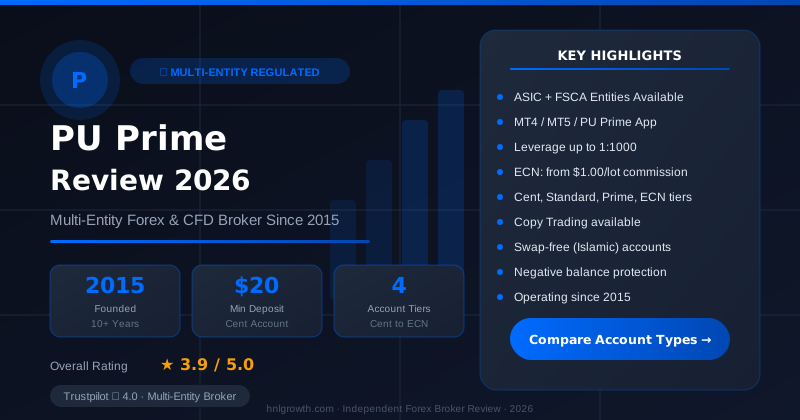
PU Prime — Multi-Entity Forex & CFD Broker
ASIC (AU) + FSCA (ZA) entities available · $20 min deposit (Cent) · MT4, MT5, PU Prime App · 4 account tiers
- You want INR pairs, Indian regulatory protection, and local funding (UPI/Netbanking): use a SEBI-registered domestic broker for NSE currency derivatives. The offshore sections of this article are not relevant to your situation.
- You want EUR/USD, GBP/USD, indices, commodities, or higher leverage: you are in the offshore CFD lane. This means remitting funds under LRS, accepting that RBI and SEBI do not supervise the broker, and confirming the specific regulated entity that will service your account.
There is no single broker that serves both lanes with the same protections. Pick the lane first, then the broker.
Before exploring further, work through the two-step eligibility check below. If either step returns a "stop," the offshore lane carries material risks you should resolve before proceeding.
Step 1 — Legal lane check Are you comfortable remitting funds under FEMA's LRS, knowing RBI and SEBI do not supervise the broker? If no, use the domestic SEBI lane instead.
Step 2 — Entity check Can you confirm which specific entity of your chosen broker will service your account, which regulator oversees that entity, and whether India is within that entity's permitted markets? If not yet, gather that confirmation directly from the broker before funding.
Only after both steps return a clear answer should you compare costs, platforms, and funding options.
Verdict at a Glance
The table below maps each option to its lane, primary regulation, and key open questions. Three things this table does not assert: (1) that any offshore broker is currently available to open accounts for Indian residents; (2) that any offshore broker is locally regulated in India; (3) that using any offshore broker is unambiguously legal for a specific Indian resident. Those are three distinct questions, and the answer to each depends on your circumstances, the broker's current servicing terms, and applicable law at the time you trade.
| Broker | Lane | Regulators (official source) | Tier | Min Deposit | Deposit methods per official guide | India servicing confirmed? |
|---|---|---|---|---|---|---|
| PU Prime | Offshore CFD | FSA (Seychelles), FSC (Mauritius), FSCA (South Africa), CMA (UAE) — per puprime.com/regulation | 2–3 depending on servicing entity | $50 Standard; $20 Cent | Card, bank transfer, Skrill, Neteller per official guide; India-specific rails not confirmed | Not confirmed — ask PU Prime directly |
| Interactive Brokers | Offshore CFD | Not independently verified for this article | Not rated here | Not verified here | Not verified here | Confirm directly with broker |
| IG Group | Offshore CFD | Not independently verified for this article | Not rated here | Not verified here | Not verified here | Confirm directly with broker |
| Domestic NSE brokers | SEBI domestic | SEBI (India) | N/A | Varies by broker | UPI, Netbanking, RTGS | Yes — SEBI-registered |
Notes on Interactive Brokers and IG Group: this article's evidence pack did not include their official regulation or pricing pages. Tier ratings, minimum deposits, and India availability cannot be verified here. Visit each broker's own site for current terms before comparing.
Note on PU Prime's reverse-solicitation notice: PU Prime's own website includes a notice stating the company "is neither established nor operating in your home jurisdiction" for visitors outside its licensed markets. This reinforces the need to confirm your servicing entity directly with PU Prime before assuming any of the above applies to you.
Understanding India's Two-Lane Model
Lane 1: SEBI-Regulated Domestic Trading
SEBI supervises currency derivatives traded on Indian exchanges—primarily the NSE and BSE. Products are limited to INR pairs: USD/INR, EUR/INR, GBP/INR, and JPY/INR. Leverage is capped by SEBI regulation. Trading is conducted through SEBI-registered brokers, with client funds held under SEBI's oversight framework.
Limitation: major pairs such as EUR/USD or GBP/USD are not available, and CFD products do not exist in this lane. If the domestic lane is right for you, search SEBI's official intermediary registry at sebi.gov.in for registered stock brokers, then compare account-opening requirements, brokerage fees, and platform options directly on each broker's site. Some well-known domestic platforms include Zerodha, Upstox, and Angel One—verify current SEBI registration status and product availability on each broker's site before opening an account, as this article has not independently verified their current terms.
Lane 2: Offshore CFD Trading Under FEMA
FEMA permits Indian residents to remit funds abroad under the Liberalised Remittance Scheme for lawful purposes, which can include funding accounts with offshore brokers. The RBI does not regulate these brokers, SEBI does not supervise them, and trades are not protected by Indian consumer law. Whether a specific broker can legally accept and service Indian residents depends on that broker's own terms—some offshore brokers explicitly restrict or exclude certain jurisdictions.
Limitation: you are trading in a regulatory grey area. If the broker fails, you have no recourse through Indian regulators. You are responsible for reporting remittances and gains to Indian tax authorities. The broker may change its servicing policy for Indian residents at any time.
The grey area exists on a spectrum. At one end: an LRS-compliant remittance to a multi-regulated broker that openly confirms it services Indian residents. At the other: platforms the RBI has explicitly flagged on its alert list. Most offshore brokers fall somewhere between those poles, and the distance matters considerably.
Regulation and Client Protections
The RBI Alert List
The RBI maintains a public alert list of entities operating unauthorised money-transfer services and unregulated trading platforms. Being absent from this list is not an approval, endorsement, or legality certification. It means only that the RBI has not issued a specific warning about that entity as of the list's last update. This article did not access the live list during preparation. Check rbi.org.in directly and note the list's publication date before funding any account.
Regulator Tier Classification
Regulator strength varies widely. The framework below is a general industry reference and not an official ranking issued by any single authority. Confirm a regulator's actual powers, capital requirements, and investor-protection mechanisms on that regulator's own site.
| Tier | Example authorities | Typical features |
|---|---|---|
| Tier 1 | FCA (UK), ASIC (Australia), MAS (Singapore), SEC (US) | Capital adequacy requirements, mandatory client fund segregation, formal dispute resolution or compensation mechanisms in home market |
| Tier 2 | CySEC (Cyprus), FSCA (South Africa), FSC (Mauritius), CMA (UAE) | Regulatory requirements exist; enforcement capacity and investor-compensation mechanisms generally more limited than Tier 1 |
| Tier 3 | FSA (Seychelles) and similar offshore licensing regimes | Lower capital and disclosure requirements; formal investor compensation schemes usually absent |
You can verify ASIC's consumer guidance at asic.gov.au/for-consumers.
Mapping PU Prime's Multi-Entity Structure
PU Prime's official regulation page lists four licensed entities: FSA (Seychelles), FSC (Mauritius), FSCA (South Africa), and CMA (UAE). Each falls into a different tier. The tier that applies to your account is determined by which entity actually onboards you—not by the existence of other entities in the group.
| PU Prime entity | Regulator | Approximate tier | What to ask PU Prime |
|---|---|---|---|
| PU Prime (Seychelles) | FSA (Seychelles) | Tier 3 | Is this the entity that would service my account as an Indian resident? |
| PU Prime (Mauritius) | FSC (Mauritius) | Tier 2 | Same question |
| PU Prime (South Africa) | FSCA (South Africa) | Tier 2 | Same question |
| PU Prime (UAE) | CMA (UAE) | Tier 2 | Same question |
PU Prime's regulation page does not specify which entity services India-resident accounts. You need a written answer to that question before you can know which regulator's rules protect your funds.
Fund Segregation and Negative Balance Protection
Fund segregation means client money is held separately from the broker's operating capital. PU Prime's regulation page references "protection of client funds" and "transparent operational standards" as general principles. The sources reviewed for this article do not include India-specific segregation arrangements or entity-level segregation percentages. Confirm the exact fund-protection terms for your servicing entity directly with PU Prime before depositing.
Negative balance protection limits your losses to your account balance so you cannot owe the broker more than you deposited. This protection is commonly required under Tier 1 regulation but is frequently conditional or absent under lighter-touch regimes. Verify in writing whether it applies to your specific PU Prime entity and account type before trading with leverage. PU Prime's terms of service for the applicable entity are the authoritative source; this article does not reproduce their exact wording because the servicing entity for Indian residents is not confirmed.
PU Prime: What the Official Sources Confirm
If you have worked through the eligibility gate above and decided to explore offshore CFD trading, PU Prime is one option operating under the four licensed entities described above. The following claims are drawn from PU Prime's official pages only.
Confirmed by official sources:
- Operating since 2015, per PU Prime's regulation page
- Regulated by FSA (Seychelles), FSC (Mauritius), FSCA (South Africa), and CMA (UAE)
- Compliance processes described as audited on the regulation page
- Four account types: Cent, Standard, Prime, and ECN — per the official account-opening guide
- Cent account minimum deposit: $20
- Standard account minimum deposit: $50
- Minimum deposits for Prime and ECN accounts are not stated in the sources reviewed; check PU Prime's account types page directly
- Platform support: MetaTrader 4 and MetaTrader 5, selectable at registration; PU Prime also offers a proprietary mobile app
- Instrument categories: Forex, Indices, Metals, Commodities, Shares, ETFs, Bonds, and Synthetic Indices (including 24/7 gold trading per the spreads page)
- Account opening described as taking approximately 10 to 15 minutes; KYC requires a government-issued ID and proof of address dated within three months
- Deposit methods per the official account-opening guide: credit or debit card, bank transfer, Skrill, Neteller, and unspecified local payment methods; card and e-wallet deposits described as typically arriving instantly; bank transfers described as taking one to three business days
Not confirmed by official sources reviewed:
- Which entity services Indian-resident accounts
- Whether India is within that entity's permitted markets
- India-specific deposit or withdrawal methods (UPI, Paytm, Netbanking)
- Withdrawal processing times
- Negative balance protection status for the India-servicing entity
- Prime and ECN account minimum deposits
- Professional account eligibility for Indian residents
Because PU Prime's reverse-solicitation notice states that "PU Prime and its affiliated entities are neither established nor operating in your home jurisdiction" for visitors from outside its licensed markets, it is particularly important to ask PU Prime directly which entity services your account and whether you are an eligible client before funding. Do not infer eligibility from the fact that the site is accessible.
If the confirmed account structure and regulatory framework above match what you are looking for, compare PU Prime account types — but complete the eligibility and entity checks first.
Cost Structure: What to Check Before Trading
PU Prime's official spreads and costs page publishes spread, commission, and swap tables by account type (Standard, Prime, ECN) and explicitly states that listed values are "for reference only," directing traders to check the MT4/MT5 platform or PU Prime mobile app for accurate live figures. Because spreads move with market conditions and the source page does not publish fixed figures suitable for a static table, this article does not reproduce specific pip or dollar values—doing so would risk presenting stale data.
For any cost comparison, check the live spread and commission figures in PU Prime's own platform or app, and calculate your all-in cost—spread plus commission plus overnight swap—for your actual trade size. This applies to every broker you are evaluating, not just PU Prime.
A side-by-side cost comparison with Interactive Brokers and IG Group is not included because this article has not independently verified their official pricing pages. Visit each broker's own pricing page, calculate the all-in cost for your typical trade size and instrument, and compare directly. That gives you current figures rather than a snapshot that may already be outdated.
Platforms and Execution
PU Prime supports MetaTrader 4 and MetaTrader 5, both selectable during account registration per its official account-opening guide. Both platforms are available on desktop, web browser, and mobile. MT5 is the newer platform, offering more timeframes and order types; MT4 remains widely used for its simplicity and Expert Advisor compatibility. PU Prime also offers a proprietary mobile app that includes live spread and cost data.
If you rely on a specific platform ecosystem such as cTrader, confirm availability directly with PU Prime before opening an account.
No independent execution data is available for this article. Execution speed and slippage depend on the servicing entity, account type, and prevailing market conditions; no claim about execution quality should be accepted without independent corroboration.
Funding and Withdrawal
What PU Prime's Official Guide States
PU Prime's account-opening guide describes depositing using a credit or debit card, bank transfer, or e-wallets including Skrill and Neteller. Card and e-wallet deposits are described as typically arriving instantly; bank transfers are described as taking one to three business days. This text is drawn from PU Prime's guide and describes general deposit mechanics, not India-specific payment arrangements.
What this article could not confirm: whether UPI, Paytm, or Indian Netbanking are supported for Indian-resident accounts, and actual withdrawal processing timeframes. PU Prime's account-opening guide addresses deposits rather than withdrawals in the sources reviewed, so this article does not state a withdrawal timeline. Check PU Prime's own deposit and withdrawal pages for current India-specific terms before funding.
Before Funding Any Offshore Account
- Confirm current India-specific deposit and withdrawal options directly with the broker
- Ask your bank about outbound wire fees and LRS declaration requirements
- Declare your remittance under FEMA's LRS — your bank will typically require a declaration form
- Keep complete records of all remittances and trading activity for tax reporting purposes
For current LRS annual limits and applicable Tax Collected at Source (TCS) rates — both of which are revised periodically by RBI and CBDT circulars — verify figures directly with your bank, the RBI website at rbi.org.in, or a qualified tax professional before remitting. This article does not state specific limits or rates without a directly cited, current official source.
A Note on Tax Reporting
Gains from offshore trading are generally taxable in India. The applicable Income Tax Return schedule and any reporting requirements under Foreign Asset Disclosure rules depend on the nature of the instrument, how it is classified, and your individual circumstances. This article does not provide tax advice. Consult a qualified tax professional familiar with FEMA and Indian income-tax rules before remitting funds or realising gains.
Who Should Pick Which Lane
Consider the Domestic Lane If
- You want oversight by an Indian regulator and recourse through Indian consumer law
- You mainly need INR pairs (USD/INR, EUR/INR, GBP/INR, JPY/INR)
- You prefer the leverage limits mandated by SEBI for exchange-traded derivatives
- You want to fund via UPI, Netbanking, or RTGS without cross-border remittance
- You want to keep all trading activity within Indian tax-reporting frameworks from the outset
Limitation: no access to major forex pairs or non-INR CFDs.
Consider the Offshore Lane If
- You want major forex pairs, commodities, indices, shares, or other CFD instruments not available domestically
- You are comfortable with the leverage levels offered by the specific entity that would service your account
- You accept the FEMA grey-area status and that RBI and SEBI do not supervise your broker
- You are willing to remit funds within current LRS limits and report gains for Indian tax purposes
- You can confirm a specific broker entity that services Indian residents, discloses its regulatory tier, and publishes verifiable cost structures
Limitation: you are outside Indian regulatory protection. Disputes rely on the foreign regulator's own processes, which may be difficult to access from India. Tax and reporting obligations fall entirely on you.
Choosing Within the Offshore Lane
Prioritise brokers that:
- Disclose their regulatory structure clearly and let you confirm in writing which entity services your account
- Confirm India servicing explicitly, not through general marketing pages
- Publish transparent, verifiable cost structures accessible in real time on their own platform
- Offer deposit and withdrawal methods that are practical for Indian residents
- State negative balance protection terms explicitly for your entity and account type
PU Prime is a multi-licensed offshore CFD broker with MetaTrader infrastructure and confirmed card, bank transfer, and e-wallet funding described in its own guide. Its India-specific servicing entity, local payment support, withdrawal timelines, and negative balance protection terms for Indian-resident clients are not fully confirmed in the sources reviewed here. Treat those open questions as due-diligence items that need answers before you commit funds — not as automatic disqualifiers, but not as minor details either.
What We Could Not Verify
The following items represent material gaps in the evidence available to this article. Absence of a negative finding here is not confirmation of eligibility, availability, or approval.
- Which PU Prime entity services Indian-resident accounts, and whether India is within that entity's permitted markets under PU Prime's reverse-solicitation framework. Ask PU Prime directly and get the answer in writing.
- SEBI intermediary registration for offshore brokers: none of the offshore brokers named here are SEBI-registered for domestic currency derivatives; they operate outside SEBI's jurisdiction by definition. For domestic brokers, verify registration at sebi.gov.in.
- Current RBI alert list contents and update date: this article did not access the live list during preparation. Check rbi.org.in directly.
- India-specific local funding rails (UPI, Paytm, Netbanking) for PU Prime.
- PU Prime withdrawal processing times.
- Minimum deposits for PU Prime's Prime and ECN account types.
- Current FEMA LRS annual limit and applicable TCS rate: determined by RBI and CBDT circulars and revised periodically. Verify current figures with the RBI, your bank, or a tax professional.
- Regulatory and pricing details for Interactive Brokers and IG Group: included in the summary table for general context only; not independently verified against their official pages in this article. Do not compare them with PU Prime using any figures from this article.
- Whether PU Prime's account-opening page content was current as of this article's preparation date. Page content changes; verify details directly on PU Prime's site before acting.
- Professional account eligibility: some offshore brokers offer a professional or elective-professional classification that may unlock different leverage levels or alter protections. Whether this pathway is available to Indian-resident clients through any PU Prime entity is not confirmed here. If leverage levels matter to your trading strategy, ask PU Prime whether a professional client classification is available and what eligibility criteria apply.
Verification Checklist for Readers
Before opening any offshore brokerage account as an Indian resident, work through these steps independently:
- Confirm in writing which entity will service your account and check its regulator's official public register
- Check the RBI alert list at rbi.org.in and note the date it was last updated
- Confirm the broker explicitly accepts Indian-resident clients under its current servicing terms — not through a general "available worldwide" marketing claim
- Confirm fund segregation terms and negative balance protection status for your specific servicing entity
- Confirm LRS declaration requirements and current applicable TCS rate with your bank before remitting
- Consult a tax professional about ITR reporting obligations before your first remittance
- Calculate your all-in trading cost (spread + commission + overnight swap) for your typical instrument and trade size using live platform data
Summary
India's two-lane model means there is no universally "best" forex broker for Indian residents — only the best fit for your specific lane, risk tolerance, and compliance situation. The domestic lane offers SEBI oversight and local funding but limits you to INR pairs. The offshore lane opens up global instruments but places you outside Indian regulatory protection and requires you to manage LRS compliance and tax reporting independently.
PU Prime is a multi-licensed offshore CFD broker with a multi-year operating history, MetaTrader infrastructure, and a range of instruments confirmed on its official pages. Key India-specific questions — which entity services Indian residents, local payment method availability, withdrawal timelines, and negative balance protection terms — are not answered in the sources this article reviewed. Those are not reasons to automatically exclude PU Prime from your shortlist, but they are due-diligence questions that need definitive answers before you fund an account.
Once you have worked through the verification checklist above and confirmed your servicing entity, open a PU Prime account to review the full account-opening steps and current terms directly on PU Prime's site.
Frequently Asked Questions
Is offshore forex/CFD trading illegal for Indian residents? It is not automatically illegal, but it sits in a regulatory grey area. FEMA's LRS framework generally permits remitting funds abroad for lawful investment purposes; however, RBI and SEBI do not supervise or protect trades placed with offshore brokers. Whether a specific broker can legally onboard an Indian-resident client depends on that broker's own jurisdictional terms and current servicing policy. The answer is not the same for every broker, every entity, or every Indian resident.
Does being absent from the RBI alert list mean a broker is safe or approved? No. Absence from the list means no specific warning has been issued as of the list's last update — nothing more. It is not an approval, endorsement, or safety certification.
Can I use UPI to fund an offshore broker like PU Prime? This article could not confirm that. Check the broker's own deposit page for current India-specific payment methods, and ask the broker directly if UPI or Netbanking are supported.
Which PU Prime entity would my account fall under? This article could not determine that from the sources reviewed. Ask PU Prime directly before opening an account. The entity name and its regulator should be stated in your account documentation.
Are the spread figures on PU Prime's website reliable for comparison? PU Prime's own spreads page explicitly states that listed values are "for reference only" and directs traders to check live figures in the MT4/MT5 platform or mobile app. Use live platform data for any cost comparison, not screenshots or third-party tables including this article.
What is the difference between the Cent and Standard accounts? The Cent account requires a $20 minimum deposit and is designed for smaller position sizes. The Standard account requires $50. Both are confirmed by PU Prime's official account-opening guide. Minimum deposits for the Prime and ECN account types are not stated in the sources reviewed here — check PU Prime's account types page directly for current figures and a full feature comparison.
Do I need to report offshore trading gains in India? Gains from offshore trading are generally taxable in India, but the reporting requirements, applicable tax schedule, and any foreign asset disclosure obligations depend on your individual circumstances and the current rules set by the Income Tax Act and CBDT circulars. Consult a qualified tax professional before your first remittance.
Risk warning: CFDs and leveraged forex products are complex instruments and carry a high risk of losing money rapidly due to leverage. Consider whether you understand how these products work and whether you can afford to take the high risk of losing your capital. Check the entity, terms and protections that apply in your jurisdiction before trading.
Ready to Compare PU Prime Account Types?
PU Prime is a multi-entity broker — ASIC (Australia) and FSCA (South Africa) regulated entities offer stronger oversight, while most international clients are onboarded to the FSA Seychelles or FSC Mauritius entities. Four account tiers (Cent, Standard, Prime, ECN) range from a $20 minimum deposit to full ECN pricing.
Risk disclaimer: PU Prime is a live, regulated multi-entity broker — trading forex and CFDs is done with real capital under normal market risk (this is not a simulated prop-firm evaluation). PU Prime operates under multiple separate licenses (ASIC, FSCA, FSA Seychelles, FSC Mauritius); which entity holds your account depends on your country of residence and determines your leverage cap and protections — confirm this before funding. CFDs and leveraged forex products are complex instruments and carry a high risk of losing money rapidly due to leverage; 62.2% of retail investor accounts lose money when trading CFDs with this provider. Consider whether you understand how CFDs/forex work and whether you can afford the high risk of losing your money. Affiliate disclosure: HNL Growth earns a commission when you open a PU Prime account through links on this page.