Best Forex Brokers in Nigeria 2026
There is no single best forex broker for every Nigerian trader. The right choice depends on your capital size, preferred platform, and whether you prioritise tight spreads, low...
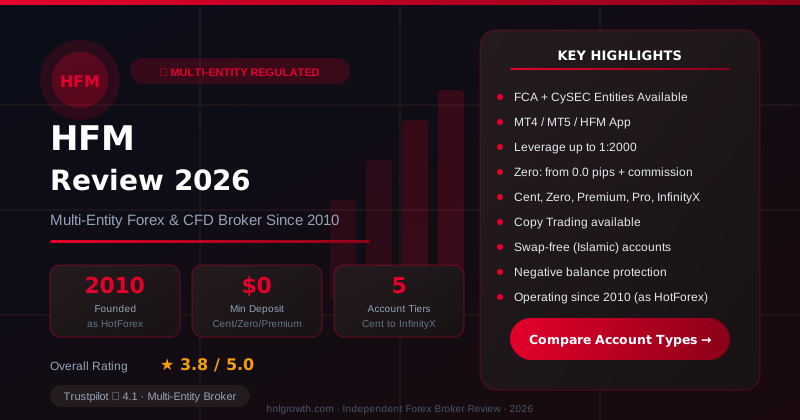
Checked on: 2026-08-13 | Broker terms, regulation, and pricing can change. Always verify at the official HFM site before opening an account.
Affiliate Disclosure: HNL Growth may earn a commission if you open an account through our links, at no additional cost to you. Risk Warning: CFDs and leveraged forex products are complex instruments and carry a high risk of losing money rapidly due to leverage. Between 65-95% of retail investor accounts lose money when trading CFDs, depending on the HFM entity and account type. Trading forex and CFDs may not be suitable for all investors. Consider your objectives, experience, and risk appetite before trading, and ensure you understand the risks involved. Broker Disclosure: HFM (HF Markets Group) is a live, regulated multi-entity broker (not a simulated prop-firm evaluation) — trades are executed with real capital in live market conditions, subject to normal market risk. Protections vary significantly by the specific legal entity that onboards your account.
Best Forex Brokers in Nigeria 2026: A Side-by-Side Comparison
There is no single best forex broker for every Nigerian trader. The right choice depends on your capital size, preferred platform, and whether you prioritise tight spreads, low minimum deposits, or tier-1 offshore regulation. Because Nigeria's Central Bank (CBN) and Securities and Exchange Commission (SEC) do not currently operate a retail forex broker licensing regime, trader protection rests entirely on the broker's offshore regulator — making the choice of jurisdiction as important as the choice of brand.
This guide compares five internationally regulated brokers that accept Nigerian clients across five decision-critical dimensions: all-in trading cost on a standardised EUR/USD trade, regulatory trust tier, platform availability, funding practicality from Nigeria, and account-type fit. Data points reference each broker's official website and are dated where possible.
Disclosure: This page may contain affiliate links. We may earn a commission if you open an account through our links, at no extra cost to you.
Verdict at a Glance
HashHedge — Crypto Futures Prop Firm
Up to $200K funded accounts · 85% profit split · Instant USDT payouts · 160+ assets
| Broker | EUR/USD Spread (pips, std. account) | Commission per Lot (USD) | Min. Deposit (USD) | Top-Tier Regulator | Platforms | Accepts Nigerian Clients | Swap-Free |
|---|---|---|---|---|---|---|---|
| HFM (Premium) | From 1.4 | Included in spread | $0 | CySEC, FSCA | MT4, MT5, HFM App, WebTrader | Yes | Yes (select instruments) |
| Exness (Standard) | From 1.0 | Included in spread | $10 | CySEC, FCA, FSA | MT4, MT5, Exness Terminal | Yes | Yes |
| Pepperstone (Standard) | From 1.0 | Included in spread | $0 (recommended $200) | FCA, ASIC, CySEC | MT4, MT5, cTrader, TradingView | Yes | Yes |
| XM (Standard) | From 1.6 | Included in spread | $5 | CySEC, ASIC, FSC | MT4, MT5, XM App | Yes | Yes |
| IC Markets (Standard) | From 0.6 | Included in spread | $200 | ASIC, CySEC, FSA | MT4, MT5, cTrader, TradingView | Yes | Yes |
Spreads shown are broker-stated typicals for standard retail accounts and vary with market conditions. Commission column reflects whether spreads are mark-up-inclusive; raw/ECN accounts carry separate per-lot commission.
Quick verdict:
- Best all-round for Nigerian traders: HFM — NGN account currency on InfinityX, FSCA + CySEC regulation, strong African-market focus.
- Best for lowest all-in cost: IC Markets or Exness on raw-spread accounts.
- Best for platform choice: Pepperstone (cTrader + TradingView alongside MetaTrader).
- Best for absolute beginners: XM — $5 minimum and extensive education.
Open an HFM account in minutes
Why Broker Choice Is Different for Nigerian Traders
Nigeria's Regulatory Gap
The Central Bank of Nigeria (CBN) regulates banks and authorised dealers for foreign exchange, while the Securities and Exchange Commission (SEC) oversees capital market operators. Neither body currently licenses retail forex brokers that offer leveraged CFD trading to individual Nigerian residents. The SEC has previously issued public warnings about unauthorised online investment platforms, and the CBN's foreign-exchange framework governs institutional FX flows — but neither framework creates a local retail-forex licensing regime comparable to the FCA in the UK or ASIC in Australia.
The practical consequence: when a Nigerian trader opens an account with an international broker, the contract, fund custody, and dispute resolution are governed by the broker's offshore regulator — not by Nigerian law.
What Each Regulator Actually Provides
| Regulator | Jurisdiction | Tier | Investor Compensation Limit | What This Means for You |
|---|---|---|---|---|
| FCA (UK) | United Kingdom | Tier-1 | £85,000 (FSCS) | Eligible retail clients protected if the firm fails |
| ASIC (Australia) | Australia | Tier-1 | No statutory compensation scheme; strong conduct rules | Relies on capital requirements and client-money segregation |
| CySEC (Cyprus) | EU (Cyprus) | Tier-1 | €20,000 (ICF) | Eligible clients of ICF-member firms covered |
| FSCA (South Africa) | South Africa | Tier-2 | No statutory compensation fund | Conduct and capital-adequacy supervision |
| FSA / FSC (offshore) | Seychelles, Mauritius, etc. | Tier-3 | Varies; typically none | Lighter-touch supervision; lower operating costs passed to clients |
Nigerian clients are typically onboarded to a broker's offshore or international entity even when the group holds tier-1 licences. Always check which specific entity your account is opened with — the FCA entity's £85,000 FSCS protection, for example, generally applies only to clients of that UK entity, not to clients of the broker's Seychelles or SVG subsidiary.
How We Evaluated These Brokers
Each broker in this comparison was assessed against the same template using the following criteria:
- Regulation: licences held, entity the Nigerian client is contracted with, investor compensation availability.
- All-in cost: published typical EUR/USD spread, commission structure, overnight swap rates.
- Platforms: availability of MT4, MT5, cTrader, TradingView, and proprietary mobile apps.
- Account types: minimum deposit, base currencies (USD, EUR, NGN where available), leverage caps.
- Funding practicality: stated deposit/withdrawal methods and processing windows for Nigerian clients.
- Non-trading fees: inactivity, deposit, withdrawal, and currency-conversion charges.
Data points are drawn from each broker's official website and public regulator registers. Spreads are broker-published typicals captured at a point in time — they are not independent live-market snapshots and will fluctuate during volatile sessions. Where a data point could not be confirmed from an official source, it is marked as "check with broker" rather than guessed. Readers should verify conditions on a demo account before committing capital.
Broker Profiles — Detailed Breakdown
HFM (HF Markets)
Key facts
- Founded: 2010 · HQ: Dubai / Cyprus (group)
- Regulators: CySEC (EU), FSCA (South Africa), FSC (Mauritius), DFSA (Dubai), CMA (Kenya)
- Nigerian clients: accepted; NGN available as account currency on the InfinityX account type (source)
- Platforms: MT4, MT5, HFM WebTrader, HFM App
- Minimum deposit: from $0 on Premium and Cent; $500 on InfinityX; $100 on Pro
HFM's standout feature for Nigerian traders is the NGN-denominated account option on InfinityX, which removes the need to convert Naira into USD at deposit time — though traders should weigh this against the long-term benefit of holding USD exposure given Naira depreciation trends. The Zero account offers raw-style spreads from 0 pips on forex, while the Premium account bundles costs into the spread from 1.4 pips with no separate commission.
Pros
- NGN account currency available — rare among international brokers
- Broad African-market presence with localised support
- Five account types covering cent, raw, and premium models
- Swap-free option on select instruments (source)
Cons
- No cTrader or TradingView integration
- InfinityX's $500 minimum may be above what many Nigerian beginners want to commit
- The NGN account is limited to one account type; other accounts are USD/EUR only
Best for: Traders who want an NGN-denominated account or an FSCA + CySEC regulated broker with strong African-market focus.
Compare HFM account types and open an account
Exness
Key facts
- Founded: 2008 · HQ: Limassol / Seychelles (group)
- Regulators: FCA (UK), CySEC (Cyprus), FSA (Seychelles), FSCA (South Africa), others
- Nigerian clients: accepted
- Platforms: MT4, MT5, Exness Terminal
- Minimum deposit: from $10 (Standard); higher for Pro/Raw accounts
Exness is known for aggressive pricing and fast, automated withdrawals. The Standard account quotes EUR/USD from around 1.0 pip with no separate commission, and the broker offers instant withdrawals to supported e-wallets — a practical advantage for Nigerian traders wary of bank-wire delays. Leverage is uncapped on several account types for qualifying clients.
Pros
- Very low minimum deposit
- Automated, near-instant withdrawals on e-wallets
- Transparent spread reporting on the broker's website
- Long operating history
Cons
- FCA/UK entity typically does not onboard Nigerian clients — most Nigerians are contracted to offshore entities (Seychelles, BVI) without compensation-fund coverage
- No cTrader
- High-leverage availability can encourage over-exposure for undercapitalised traders
Best for: Cost-conscious traders who value fast withdrawal processing and are comfortable contracting with an offshore entity.
Pepperstone
Key facts
- Founded: 2010 · HQ: Melbourne / London (group)
- Regulators: FCA (UK), ASIC (Australia), CySEC (Cyprus), BaFin (Germany), DFSA, CMA, SCB
- Nigerian clients: accepted
- Platforms: MT4, MT5, cTrader, TradingView
- Minimum deposit: $0 (broker recommends $200+)
Pepperstone's strength is platform breadth — it is one of the few brokers offering cTrader and TradingView integration alongside MetaTrader. The Razor account provides raw spreads from 0.0 pips plus a commission of roughly $7 per round lot, while the Standard account bundles costs from around 1.0 pip.
Pros
- Broadest tier-1 regulator coverage in this list
- Excellent cTrader and TradingView execution for scalpers
- Strong educational content and market research
- DFSA-regulated Dubai entity offers a Middle East / Africa-friendly option
Cons
- No NGN account currency
- Standard account spreads are mid-range, not the cheapest
- Recommended $200 starting capital may stretch beginners
Best for: Active day traders and scalpers who prefer cTrader or TradingView over MetaTrader.
XM
Key facts
- Founded: 2009 · HQ: Limassol (group)
- Regulators: CySEC (Cyprus), ASIC (Australia), FSC (Belize), DFSA
- Nigerian clients: accepted
- Platforms: MT4, MT5, XM App
- Minimum deposit: from $5
XM has a strong presence across Africa and offers one of the lowest entry points in the industry at $5. The Standard account includes costs in the spread (EUR/USD from ~1.6 pips), while the Ultra Low account quotes tighter spreads from around 0.6 pips. XM is known for its extensive education hub and regular webinars.
Pros
- Very accessible $5 minimum deposit
- Extensive beginner education and webinars
- Long track record serving African retail clients
- Micro and Standard lot sizing
Cons
- Standard account spreads are wider than competitors in this list
- No cTrader or TradingView integration
- Nigerian clients typically onboarded to non-EU entity
Best for: First-time traders with limited capital who want structured education alongside their account.
IC Markets
Key facts
- Founded: 2007 · HQ: Sydney (group)
- Regulators: ASIC (Australia), CySEC (Cyprus), FSA (Seychelles)
- Nigerian clients: accepted
- Platforms: MT4, MT5, cTrader, TradingView
- Minimum deposit: $200
IC Markets is one of the largest retail FX brokers globally by volume, with a reputation for raw-spread ECN-style pricing. The Raw Spread account quotes EUR/USD from 0.0 pips with a commission of roughly $7 per round lot on MT4/MT5 (slightly less on cTrader). It is a natural fit for systematic and high-volume traders.
Pros
- Consistently tight raw spreads on majors
- cTrader and TradingView support
- Strong reputation among algorithmic traders
- ASIC-tier supervision on the Australian entity
Cons
- $200 minimum deposit is higher than several rivals here
- No NGN account currency
- Offshore (Seychelles) entity likely for Nigerian clients, without compensation-fund coverage
- Less localised African-market support than HFM or XM
Best for: Higher-volume and algorithmic traders who prioritise execution quality and tight raw spreads over low minimum deposits.
What a Typical Trade Actually Costs
Spreads alone do not tell the full story. The table below estimates the round-trip cost of a EUR/USD trade at each broker using published typical spreads, standard commission structure, and an indicative overnight swap. Values are approximate and will vary with account type, market conditions, and the broker's current swap schedule.
| Broker (Account) | Spread Cost (0.1 lot) | Commission (0.1 lot, RT) | 1-Night Swap (0.1 lot, approx.) | Total (0.1 lot) | Total (1.0 lot) |
|---|---|---|---|---|---|
| HFM Premium | ~$1.40 | $0 | ~$0.20 (indicative) | ~$1.60 | ~$16.00 |
| Exness Standard | ~$1.00 | $0 | ~$0.25 | ~$1.25 | ~$12.50 |
| Pepperstone Standard | ~$1.00 | $0 | ~$0.20 | ~$1.20 | ~$12.00 |
| XM Standard | ~$1.60 | $0 | ~$0.25 | ~$1.85 | ~$18.50 |
| IC Markets Raw | ~$0.10 | ~$0.70 | ~$0.20 | ~$1.00 | ~$10.00 |
Notes on reading this table:
- Spread cost is calculated as: spread in pips × pip value (≈$10 per standard lot, $1 per 0.1 lot per pip).
- Round-trip commission shown where applicable (per-lot × 0.1 or 1.0).
- Swap rates are directional and vary nightly; the values above are indicative long-position estimates. Always check the current swap schedule inside the platform before holding overnight.
- Raw-spread accounts (IC Markets, HFM Zero, Pepperstone Razor) consistently outperform standard accounts on pure cost — but require the trader to be comfortable with commission-based pricing.
Non-Trading Fees That Catch Small-Account Traders
Before depositing, check each broker's:
- Inactivity fee — typically $10–$15/month after 6–12 months of no trading activity.
- Withdrawal fee — bank wires often carry $15–$30 fees below certain thresholds; e-wallet withdrawals are frequently free above a minimum amount.
- Currency conversion fee — depositing NGN into a USD account may incur a 1–3% conversion spread through the payment processor.
These fees disproportionately affect accounts under $500. If your starting capital is small, prefer brokers with no inactivity fee and free e-wallet withdrawals.
Platforms and Mobile Experience
| Broker | MT4 | MT5 | cTrader | TradingView | Proprietary App | Mobile Notes |
|---|---|---|---|---|---|---|
| HFM | ✓ | ✓ | — | — | HFM App | HFM App rated well for usability; MT4/MT5 mobile apps widely used in Nigeria |
| Exness | ✓ | ✓ | — | — | Exness Terminal | Lightweight terminal app suited to budget Android devices |
| Pepperstone | ✓ | ✓ | ✓ | ✓ | — | cTrader mobile is strong for charting; TradingView via broker integration |
| XM | ✓ | ✓ | — | — | XM App | Functional app; MT4 mobile remains the default for most users |
| IC Markets | ✓ | ✓ | ✓ | ✓ | — | Relies on third-party platforms; cTrader mobile recommended |
Android dominates smartphone ownership in Nigeria, and most retail traders execute on mobile. MetaTrader 4 Mobile remains the most widely installed trading app in the market, followed by MT5. Where brokers offer proprietary apps (HFM, Exness, XM), these tend to be lighter on data consumption than MetaTrader — a practical consideration on metered mobile networks.
For traders who rely on advanced charting on mobile, cTrader's mobile app (available via Pepperstone and IC Markets) offers more drawing tools and timeframe options than MetaTrader's mobile client.
Which Broker Matches Your Approach
| Trader Profile | Priority Criteria | Recommended Broker | Key Reason |
|---|---|---|---|
| Just starting out (low capital, learning focus) | Low minimum, education, simple platform | XM | $5 minimum and structured learning resources |
| Active day trader / scalper | Tight spreads, fast execution, cTrader | Pepperstone | Razor account + cTrader + tier-1 regulation |
| Cost-conscious trader | Lowest all-in round-trip cost | IC Markets (Raw) or Exness | Raw-spread pricing and low commissions |
| NGN-account or African-market focus | Local currency, regional support | HFM | NGN account currency on InfinityX; FSCA + CySEC |
| Swap-free / Islamic account | No overnight interest charges | HFM or Exness | Both offer swap-free on select instruments (terms apply) |
Swap-free accounts are relevant to traders in Nigeria's northern states and any trader who prefers not to earn or pay overnight interest. Both HFM and Exness offer swap-free options, but the specific instruments covered and any admin-fee substitution vary — read the broker's current swap-free terms directly before opening the account, as these conditions change.
Getting Money In and Out from Nigeria
Most international brokers accept deposits via:
- International bank wire — widely supported but slow (3–5 business days) and often carries a $15–$30 correspondent-bank fee. Nigerian banks may apply their own outbound-wire charges.
- Debit/credit card (Visa, Mastercard) — usually instant, but some Nigerian-issued cards are declined for international FX transactions. Check with your bank whether cross-border payments are enabled.
- E-wallets (Skrill, Neteller) — often the fastest route for both deposit and withdrawal. Processing times stated as "instant" to a few hours on most brokers.
- Local processors — availability varies by broker and changes frequently. Confirm current options on the broker's funding page before depositing.
Naira volatility note: The NGN has depreciated significantly against the USD over recent years. Funding a USD-denominated account with Naira converts your capital at the prevailing rate — if the Naira weakens further while your capital is in USD, your local-currency purchasing power on withdrawal increases; if it strengthens, it decreases. Traders concerned about currency risk may prefer an NGN-denominated account where available (HFM InfinityX) — but should recognise that the account value in USD terms still fluctuates with the pair.
What to verify yourself before your first withdrawal:
- Minimum withdrawal threshold and any fee below that threshold
- Whether your chosen deposit method is also available for withdrawal (anti-money-laundering rules often require "same method" settlement)
- KYC documents required — most brokers require ID and proof of address before the first withdrawal, and delays here are the most common cause of slow payouts
- Stated processing time vs. actual settlement time (processing time is the broker's internal approval; bank-side settlement is additional)
Best Trading Hours for Nigerian Traders
Nigeria operates on West Africa Time (WAT, UTC+1). The highest-liquidity windows for major pairs overlap with the London and New York sessions:
- London session: opens 08:00 GMT / 09:00 WAT — strong EUR/USD, GBP/USD liquidity
- New York session: opens 13:00 GMT / 14:00 WAT
- London–New York overlap: 13:00–16:00 GMT / 14:00–17:00 WAT — typically the tightest spreads and deepest liquidity of the day
For Nigerian-based traders, the 14:00–17:00 WAT window is generally the most favourable for executing EUR/USD and GBP/USD trades, with spreads at their narrowest. Avoid opening positions in the thin Asian-session hours (roughly 23:00–06:00 WAT) unless you specifically trade JPY pairs.
FAQ: Questions Nigerian Traders Ask
Is forex trading legal in Nigeria?
Forex trading is not prohibited for Nigerian residents, but Nigeria does not currently operate a retail-forex broker licensing regime. Nigerian traders typically open accounts with offshore-regulated brokers. The CBN oversees authorised dealers for institutional FX, and the SEC has issued warnings about unauthorised online platforms — neither body regulates leveraged retail forex. This article is informational, not legal advice; consult a qualified professional for guidance specific to your circumstances.
How much do I need to start trading forex in Nigeria?
Minimum deposits across the brokers in this comparison range from $5 (XM) to $200 (IC Markets). In practice, traders should consider starting with enough capital to withstand normal drawdowns at sensible lot sizes — a $5 account cannot meaningfully risk-manage even a 0.01-lot position. Many experienced traders suggest starting with at least $200–$500 to allow proper risk management at micro-lot size.
Which forex broker is safest for Nigerian traders?
Safety is a function of the regulator overseeing the specific entity your account is with, the broker's operational history, and whether client funds are held in segregated accounts. Among the brokers listed here, Pepperstone carries the broadest tier-1 regulator coverage (FCA, ASIC, CySEC, BaFin, DFSA). HFM holds CySEC and FSCA licences, and has operated since 2010. Always verify a broker's licence number directly on the regulator's official register — never rely on the broker's marketing page alone.
Are forex profits taxed in Nigeria?
The tax treatment of retail forex trading profits for individual Nigerian residents is not clearly addressed in publicly available FIRS guidance. Nigeria's Capital Gains Tax Act provides for a 10% rate on chargeable gains, but whether and how this is applied to individual retail forex trading is ambiguous. This article does not provide tax advice. Consult a Nigerian-qualified tax professional regarding your obligations.
Can I deposit and withdraw in Naira?
Most international brokers denominate accounts in USD or EUR. HFM offers NGN as an account currency on its InfinityX account type (source). When depositing NGN into a USD account, a currency conversion occurs at the processor's rate — factor this cost into your funding decision.
What is the best time to trade forex from Nigeria?
The 14:00–17:00 WAT window — when the London and New York sessions overlap — offers the tightest spreads and deepest liquidity on major pairs. See the trading-hours section above for full session breakdowns.
Do these brokers accept Nigerian clients?
Yes — all five brokers profiled in this guide accept Nigerian residents as clients, based on their published terms and country-availability pages at the time of writing. Nigerian clients are typically onboarded to the broker's international or offshore entity rather than its EU/UK entity. Confirm the contracting entity during registration.
Can I trade forex without a broker in Nigeria?
No. Retail forex CFD and spot-margin trading require an account with a licensed broker or liquidity provider. Trading directly on the interbank market is not accessible to individual retail traders.
Risk Disclosure
Risk warning: CFDs and leveraged forex products are complex instruments and carry a high risk of losing money rapidly due to leverage. Retail investor accounts lose money when trading CFDs with most providers; the exact percentage varies by HFM entity and account type. You should consider whether you understand how CFDs work and whether you can afford to take the high risk of losing your money. Check the entity, terms and investor protections that apply in your jurisdiction before opening an account or trading.
Ready to Start Your Funded Trading Journey?
Join traders backed by $11M+ in verified payouts and a 4.7/5 Trustpilot rating. Compare HashHedge challenge plans, drawdown rules, and payout terms — apply code ha25 for the current discount.
Risk disclaimer: Challenge fees are non-refundable if you breach the rules. Prop trading involves significant financial risk. Past performance in a simulated environment does not guarantee results on a funded account. Only purchase if you understand the rules fully and can afford to lose the fee. Affiliate disclosure: HNL Growth earns a commission when you purchase a HashHedge challenge through links on this page.