Best Forex Brokers 2026: Compared on Cost, Regulation and Platforms
There is no single 'best forex broker' that fits every trader. The right broker depends on which regulator can actually protect you, what the trade costs after spread, commission and overnight...
Reviewed using our forex & CFD broker review methodology
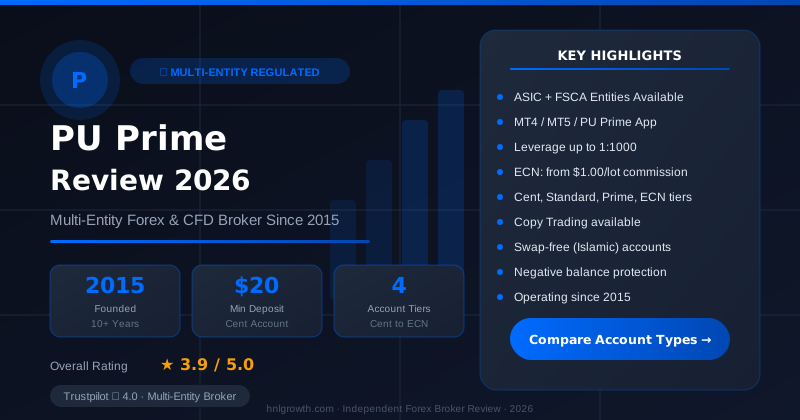
Checked on: 2026-08-17 | Broker terms, regulation, and pricing can change. Always verify at the official PU Prime site before opening an account.
Affiliate Disclosure: HNL Growth may earn a commission if you open an account through our links, at no additional cost to you. Risk Warning: CFDs and leveraged forex products are complex instruments and carry a high risk of losing money rapidly due to leverage. 62.2% of retail investor accounts lose money when trading CFDs with this provider. Trading forex and CFDs may not be suitable for all investors. Consider your objectives, experience, and risk appetite before trading, and ensure you understand the risks involved. Broker Disclosure: PU Prime is a live, regulated multi-entity broker (not a simulated prop-firm evaluation) — trades are executed with real capital in live market conditions, subject to normal market risk. Which PU Prime entity holds your account depends on your country of residence and determines your leverage cap and protections.
Last verified: August 2026 | Editorial Team
Best Forex Brokers 2026: Compared on Cost, Regulation and Platforms
There is no single "best forex broker" that fits every trader. The right broker depends on which regulator can actually protect you, what the trade costs after spread, commission and overnight financing are added together, and whether the platform and withdrawal process match how you trade. This guide gives you a repeatable framework for comparing brokers on those three axes, then applies it in full — with citations — to PU Prime as a worked example, so you can run the same checks on any other broker you're considering before you fund an account.
Disclosure: This page may contain affiliate links. We may earn a commission if you open an account through our links, at no extra cost to you.
How we compare brokers (and why rankings without this are marketing, not evidence)
PU Prime — Multi-Entity Forex & CFD Broker
ASIC (AU) + FSCA (ZA) entities available · $20 min deposit (Cent) · MT4, MT5, PU Prime App · 4 account tiers
Most "best broker" lists rank by advertised spread or by which brand pays the highest affiliate commission. Neither tells you what you'll actually pay or whether your funds are protected if something goes wrong. We use four criteria, each checked against a broker's own regulatory disclosures and pricing pages rather than review-site star ratings:
- Regulatory tier — which specific legal entity within the broker group holds your account, which regulator supervises that entity, and what compensation scheme or fund-segregation rule actually applies to you.
- All-in trading cost — spread plus commission plus overnight financing on an identical trade, not the headline "spreads from" number.
- Platform and execution transparency — which platforms are available, and whether the broker publishes any execution-quality data (most do not).
- Funding and withdrawal terms — documented methods, minimums and processing windows from the broker's own terms pages, not forum anecdotes.
Two important caveats before the tables. First, a broker group often operates several legal entities, and the protections that matter to you depend entirely on which entity holds your account, not on the group's marketing brand. Second, this article names PU Prime with full sourcing because we have verified its official regulatory and pricing pages. We have not fabricated matching figures for other brands, because doing so without an equivalent official source would be a guess dressed up as a fact. Where we describe other brokers, we describe regulatory categories (what a Tier-1 EU regulator requires, for example) rather than specific unverified numbers for a specific named competitor.
Verdict in one framework
| Regulatory category | What it typically means for client protection | How costs are usually structured | Platform expectation | Best suited for |
|---|---|---|---|---|
| Tier-1 EU/UK regulator (e.g. FCA, CySEC) | Compensation scheme eligibility and mandatory client-money segregation rules set by statute | Costs vary by entity; leverage is capped for retail clients | MT4/MT5 or proprietary, usually with negative-balance protection | Traders who prioritise a domestic regulator and statutory compensation scheme over marginal cost savings |
| Tier-1 non-EU regulator (e.g. ASIC) | Segregation and reporting rules set by the regulator; compensation scheme availability varies by jurisdiction | Similar structure to EU entities, leverage caps differ | MT4/MT5 typically standard | Traders in that regulator's home jurisdiction who want local recourse |
| Offshore-focused regulator (e.g. FSA Seychelles, FSC Mauritius, FSCA South Africa) | Segregation rules apply but statutory investor-compensation schemes are usually absent or limited | Often higher leverage ceilings and lower minimum deposits | MT4/MT5 commonly offered, sometimes plus a proprietary app | Traders outside Tier-1 coverage areas who accept higher leverage and fewer statutory protections in exchange for accessibility |
| PU Prime (entity depends on your region) | Regulated by FSA Seychelles, FSC Mauritius, FSCA South Africa and CMA UAE, depending on which entity onboards you | Four account types: Cent, Standard (from 1.3 pips, no commission), Prime and ECN (raw spread plus commission) — see cost table below | MT4, MT5 and a mobile trading app | Traders who want account-type flexibility (from a $20 Cent account up to ECN) and are comfortable operating under offshore-category regulation |
This is a decision framework, not a forced ranking — PU Prime sits in the offshore-regulated category above, and whether that fits you depends on where you live and what protection you need. Read the regulation section below before assuming any tier is automatically "safer" for your specific circumstances.
Regulation and client protections side by side
Regulation is not a single yes/no fact. What matters is which legal entity within a broker group actually opens your account, because that entity — not the group's global brand — determines your regulator, your compensation scheme eligibility, and your leverage limits.
Tier-1 regulators (FCA, CySEC, ASIC and similar): these regulators typically require segregation of client funds from company funds, set maximum leverage for retail clients, and in some cases connect account holders to a statutory compensation scheme that can pay out if the firm fails. The tradeoff is usually lower maximum leverage and, in some cases, higher minimum costs.
Offshore-category regulators (FSA Seychelles, FSC Mauritius, FSCA South Africa, CMA UAE and comparable authorities): these regulators still impose licensing and, in many cases, fund-segregation requirements, but a statutory investor-compensation scheme equivalent to the UK's FSCS or a similar EU scheme is generally not part of the framework. PU Prime discloses that it is authorised and regulated by the Financial Services Authority of Seychelles, the Financial Services Commission of Mauritius, the Financial Sector Conduct Authority of South Africa, and the Capital Markets Authority of the UAE, with the applicable entity depending on the client's region. Before opening an account with any broker in this category, confirm on the regulator's own public register — not the broker's marketing page — that the specific entity you'll be contracting with is currently licensed.
How to verify any broker's licence yourself:
- Find the exact legal entity name on the broker's regulation or legal-documents page (not just the brand name).
- Search that entity name directly on the regulator's official register (FCA Register, CySEC register, ASIC Connect, or the equivalent offshore regulator's licensee list).
- Confirm the licence status is active and the licence number matches what the broker states.
- Check whether that specific licence category includes a client-money segregation requirement and whether a compensation scheme applies to it.
This single check resolves most of the "is this broker legitimate" uncertainty faster than reading reviews, because it relies on the regulator's own record rather than the broker's claims about itself.
Verify PU Prime's regulatory entities before deciding whether the offshore-regulated category fits your risk tolerance, then compare it against account setup at PU Prime's account opening guide if it does.
All-in cost on the same trade
Advertised spreads are the least useful number on a pricing page, because they usually exclude commission and never include overnight financing. To compare costs properly, add all three components for the same trade.
Using PU Prime's published spread and commission schedule as a fully sourced example:
| Account type | Typical EUR/USD spread | Commission | Minimum deposit | Best fit |
|---|---|---|---|---|
| Cent | Same spread/execution as Standard | None | $20 | Testing strategies or the live environment with minimal capital at risk |
| Standard | From 1.3 pips | None | $50 | Traders who want simple, spread-only pricing without a commission line |
| Prime | Raw spread from 0.0 pips | $3.50 per lot per side | $1,000 | Frequent traders who benefit from tighter spreads despite the commission |
| ECN | Raw spread from 0.0 pips | $1.50 per lot per side | $10,000 | High-volume or professional traders where the lowest per-lot cost matters more than deposit size |
PU Prime states that these figures are for reference and directs traders to check live pricing in MT4/MT5 or the mobile app for exact values, since spreads are variable rather than fixed. Overnight financing (swap) rates are published separately by symbol and direction on the same pricing page and should be checked for the specific instrument and side (long or short) you intend to hold overnight, since they change with market conditions.
To calculate your own all-in cost on any broker, including ones not covered here: take the spread in pips, convert it to money at your trade size, add any per-lot commission, and if you're holding overnight, add the published swap rate for that pair and direction. Do this for a day trade and separately for an overnight hold, because a broker with a wider spread but no commission can be cheaper for a small trade than a raw-spread-plus-commission account, while the reverse is often true at higher volumes.
Compare PU Prime's four account types against your own typical trade size and holding period before choosing one, and run the same spread-plus-commission-plus-swap calculation on any competitor account you're weighing against it.
Platforms and execution
Platform choice affects order types, automation support and mobile access, but very few brokers in any regulatory tier publish independent execution-quality data such as slippage statistics or order-fill rates. Treat the absence of that data as an industry norm to verify yourself, not as a red flag specific to one broker.
PU Prime offers:
- MetaTrader 4 — supports Expert Advisors, custom indicators and automated strategies.
- MetaTrader 5 — multi-asset trading across forex, indices, commodities, metals, shares, ETFs, bonds and synthetic indices, with additional order types and a multi-asset strategy tester.
- A mobile trading app — account management, funding and trading from a phone, alongside MetaTrader Web access.
Both MT4 and MT5 route orders through the broker's own servers, so platform choice alone does not guarantee execution quality — that depends on the broker's infrastructure and liquidity arrangements, which are rarely disclosed publicly by any broker. If execution quality (fill speed, requote frequency, slippage on news events) matters to your strategy, the only reliable approach is to test it on a live or demo account under real market conditions and track it yourself, since no broker in this comparison has published third-party-audited execution statistics that we could independently verify.
Funding and withdrawal
Documented terms and actual user experience are two different things, and we're only reporting the former here. According to PU Prime's own account opening guide, deposits can be made via credit or debit card, bank transfer, or e-wallets including Skrill and Neteller. Card and e-wallet deposits are described as usually arriving instantly, while bank transfers are stated to take one to three business days. Identity verification (KYC) typically requires a valid government ID and a proof-of-address document dated within the last three months, and PU Prime states that verification usually takes a few hours during business days, though it can extend to 24–48 hours.
We could not independently verify actual withdrawal processing times, since that requires a live account transaction we have not performed and no such evidence was available for this article. Treat any documented "processing window" you find on a broker's terms page as the broker's stated commitment, not a guarantee of your personal experience.
Neutral withdrawal verification checklist, for any broker:
- Read the withdrawal section of the broker's official terms, not a summary on a review site.
- Note whether the withdrawal method must match the original deposit method (a common industry requirement).
- Check whether identity re-verification is required before a first withdrawal.
- Confirm whether any bonus or promotion you accepted carries withdrawal restrictions or trading-volume conditions.
- Keep your own timestamped record of your withdrawal request and the funds landing, so you have evidence if there's a dispute.
Who should pick which
- If you need a statutory compensation scheme and are based in the UK or EU: prioritise brokers whose entity serving your country holds an FCA or CySEC licence, and confirm the specific entity (not just the brand) on the regulator's register.
- If you're based in Australia: the same logic applies to an ASIC-licensed entity and the AFCA complaints scheme.
- If you're outside Tier-1 jurisdictions or want higher leverage and lower minimum deposits: an offshore-regulated broker like PU Prime, under its Seychelles, Mauritius, South Africa or UAE licensing depending on your region, may fit — provided you've read the segregation and compensation terms for that specific entity and accept that a statutory compensation scheme is generally not part of that framework.
- If you're testing a strategy with minimal capital: PU Prime's $20 Cent account or a comparable low-minimum account elsewhere lets you trade live conditions without committing meaningful capital.
- If you trade high volume and cost-per-lot matters most: compare raw-spread-plus-commission accounts (PU Prime's Prime or ECN tiers, for example) against the equivalent tier at any Tier-1 broker you're considering, using the all-in cost method above.
This comparison is not a fit for you if you require a specific single-country compensation scheme as a non-negotiable condition and the broker you're evaluating doesn't hold a licence in that scheme's jurisdiction — no amount of low cost or platform quality substitutes for that if it's a hard requirement for you.
What we could not verify
In the interest of transparency: we did not name specific competitor brokers with matching cost, regulation or withdrawal figures in this article, because doing so without an equivalent official source for each one would mean presenting a guess as fact. We also could not verify actual (as opposed to documented) withdrawal processing times for any broker, execution-quality statistics such as slippage or requote frequency for any broker in this comparison, or how consistently advertised spreads hold during high-volatility events. Where user forums or review sites raise withdrawal or scam concerns about brokers generally, we've treated that as a reason to direct you to the regulator's own complaint or register lookup, not as evidence against any specific brand, since unverified claims shouldn't be presented as fact in either direction.
FAQ
How do I verify a broker's regulation myself? Find the exact legal entity name on the broker's regulation page, then search that name on the regulator's official public register. Confirm the licence number matches and the status is active.
What protections apply to my jurisdiction specifically? It depends on which entity within the broker group serves your country. A Tier-1 EU or UK entity usually carries segregation rules and may include a statutory compensation scheme; an offshore entity usually carries segregation requirements but typically not an equivalent compensation scheme. Always check the entity, not the brand.
How are total trading costs actually calculated? Add the spread cost at your trade size, any per-lot commission, and overnight financing if you hold positions past the daily rollover — using the broker's own published pricing schedule, checked against the live platform price.
Is any broker "guaranteed safe"? No broker can be described as risk-free. Regulation reduces certain risks (fund segregation, licensing oversight) but does not eliminate market risk, and CFD trading itself carries a high risk of loss regardless of which broker you use.
Can I trust a comparison site's rankings? Many comparison sites, including this one, earn a commission when you open an account through a link. That doesn't make the comparison inaccurate, but you should check that the site discloses the relationship and shows its sourcing, rather than presenting unsourced rankings as independent fact.
Risk warning: CFDs and leveraged forex products are complex instruments and carry a high risk of losing money rapidly due to leverage. Consider whether you understand how these products work and whether you can afford to take the high risk of losing your capital. Check the entity, terms and protections that apply in your jurisdiction before trading.
Ready to Compare PU Prime Account Types?
PU Prime is a multi-entity broker — ASIC (Australia) and FSCA (South Africa) regulated entities offer stronger oversight, while most international clients are onboarded to the FSA Seychelles or FSC Mauritius entities. Four account tiers (Cent, Standard, Prime, ECN) range from a $20 minimum deposit to full ECN pricing.
Risk disclaimer: PU Prime is a live, regulated multi-entity broker — trading forex and CFDs is done with real capital under normal market risk (this is not a simulated prop-firm evaluation). PU Prime operates under multiple separate licenses (ASIC, FSCA, FSA Seychelles, FSC Mauritius); which entity holds your account depends on your country of residence and determines your leverage cap and protections — confirm this before funding. CFDs and leveraged forex products are complex instruments and carry a high risk of losing money rapidly due to leverage; 62.2% of retail investor accounts lose money when trading CFDs with this provider. Consider whether you understand how CFDs/forex work and whether you can afford the high risk of losing your money. Affiliate disclosure: HNL Growth earns a commission when you open a PU Prime account through links on this page.