Best Forex Demo Accounts 2026: Compared on Realism and Limits
A forex demo account lets you practise trading with virtual money on a real broker platform, using live market prices, without risking a single dollar of your own capital. If you are just starting...
Reviewed using our forex & CFD broker review methodology
Checked on: 2026-08-17 | Broker terms, regulation, and pricing can change. Always verify at the official PU Prime site before opening an account.
Affiliate Disclosure: HNL Growth may earn a commission if you open an account through our links, at no additional cost to you. Risk Warning: CFDs and leveraged forex products are complex instruments and carry a high risk of losing money rapidly due to leverage. 62.2% of retail investor accounts lose money when trading CFDs with this provider. Trading forex and CFDs may not be suitable for all investors. Consider your objectives, experience, and risk appetite before trading, and ensure you understand the risks involved. Broker Disclosure: PU Prime is a live, regulated multi-entity broker (not a simulated prop-firm evaluation) — trades are executed with real capital in live market conditions, subject to normal market risk. Which PU Prime entity holds your account depends on your country of residence and determines your leverage cap and protections.
Last verified: August 2026 | Editorial Team
Best Forex Demo Accounts 2026: Compared on Realism and Limits
A forex demo account lets you practise trading with virtual money on a real broker platform, using live market prices, without risking a single dollar of your own capital. If you are just starting out, a demo is the single most practical tool available to you: it lets you learn how orders work, test a strategy, and get comfortable with a platform before any real money is involved.
The differences that actually matter when choosing one are how long the demo lasts, whether it mirrors live trading conditions closely enough to be useful, how well the mobile experience works, and how straightforward the path is from demo to live account when you are ready. This comparison uses those four criteria to assess the options.
Disclosure: This page may contain affiliate links. We may earn a commission if you open an account through our links, at no extra cost to you.
What a Forex Demo Account Actually Is (and What It Is Not)
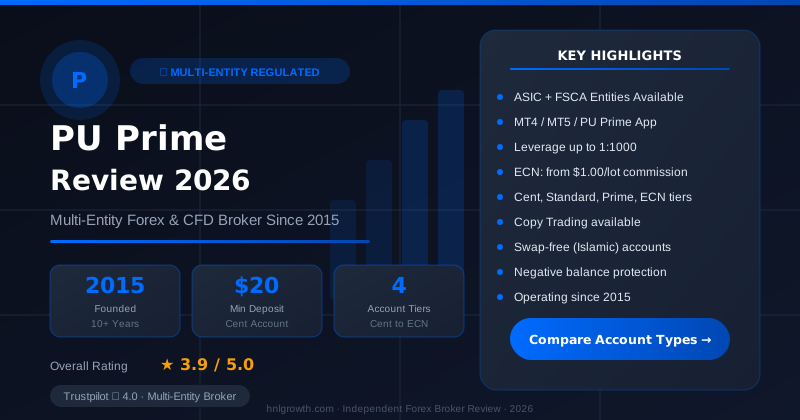
PU Prime — Multi-Entity Forex & CFD Broker
ASIC (AU) + FSCA (ZA) entities available · $20 min deposit (Cent) · MT4, MT5, PU Prime App · 4 account tiers
A demo account is a practice environment provided by a broker. You receive a balance of virtual funds—the default amount varies by broker and account type and should be confirmed directly with the broker—and you use that balance to place trades on a real platform connected to live market prices.
Here is a concrete example of how it works: you open a trade on EUR/USD using virtual money. The price moves 20 pips in your favour. Your account shows a profit of roughly $20—calculated exactly the way a live account would calculate it. No money changes hands. If the price had moved against you, your virtual balance would drop by the same amount, equally consequence-free.
A few important distinctions worth making upfront:
- Demo trading is not backtesting. Backtesting runs a strategy against historical price data to see how it would have performed. Demo trading plays out in real time, on current market prices, as they actually move.
- Demo trading is not paper trading in a spreadsheet. The platform, charting tools, order types, and execution buttons are the same as the broker's live account. That is precisely what makes it useful—you are learning the actual tool you will use when you go live.
- A demo does not carry FSCS, ASIC, or any other regulatory protection because no real funds are held. Regulatory protections apply to live client money, not virtual balances. This is worth understanding before you think about moving from demo to live.
The One Thing a Demo Cannot Teach You
This section is here because leaving it out would be dishonest, and most people who have been through the demo-to-live transition will tell you it is the most important thing to know before you start.
Demo trading removes financial consequence. That changes how you behave in ways you probably will not notice until real money is at stake.
In a demo environment, many beginners hold losing trades longer than they should, because there is no real discomfort attached to a virtual loss. They take larger position sizes than they would ever use with real capital, because oversizing does not sting. They abandon a strategy after a few bad trades and try something else, because nothing is at stake in starting over.
None of this makes demo trading useless. It means demo trading is excellent for learning platform mechanics, order types, and the logical structure of a strategy—and genuinely limited when it comes to building the emotional discipline that live trading requires.
The practical implication: treat your demo practice as if the money were real. Set position sizes proportional to the live capital you actually intend to deposit. Use stop-losses on every single trade. Log every trade in a journal. Not because the virtual result matters, but because you are building habits. Those habits are what will actually carry over.
The Four Criteria That Determine Whether a Demo Is Worth Your Time
Before looking at any specific broker, it helps to have a clear frame for what you are actually evaluating. There are four things that matter for a beginner:
1. Duration. A 30-day demo is rarely enough to build real habits. You spend the first week learning the platform, the second experimenting, and by the time you are starting to develop a consistent approach, the account has expired. Unlimited demo access—or a minimum of 90 days—gives you the room to go through a full cycle of trying something, reviewing it, adjusting it, and testing it again under different market conditions.
2. Platform fidelity. The demo should run on the same platform as the live account, using live market prices, with the same order types available. If the demo uses a simplified interface that does not match what you will use when trading with real money, the transfer of learning is reduced. Check whether spreads displayed in the demo are indicative of what you will see on a live account, and whether execution mechanics—order placement, stop-loss and take-profit settings—work identically.
3. Mobile completeness. "Has a mobile app" is not the same as "the full demo experience is available on mobile." For anyone who intends to trade primarily from a phone, every feature you practise in demo needs to be available in the same form on the app. If the mobile demo is stripped down relative to the desktop version, you are practising the wrong tool.
4. Transition friction. When you are ready to move from demo to live, how hard is it? How many steps does account verification take? What is the minimum deposit? Can you open a live account quickly, or does the process take days? Low friction matters because the moment you feel ready to trade with real money is not the moment you want to encounter unnecessary obstacles.
Broker Comparison: Demo Accounts Side by Side
The table below summarises key facts for each broker's demo offering. PU Prime figures are drawn from the broker's official published sources. Competitor figures are drawn from commonly available public information and must be verified on each broker's official account pages before you rely on them, as demo terms—particularly virtual fund amounts and duration—vary by region and change over time. Treat this table as a starting framework, not a definitive record.
| Broker | Demo Duration | Platforms | Regulator(s) | Min. Live Deposit | Mobile Demo | Notes |
|---|---|---|---|---|---|---|
| PU Prime | Unlimited (per official published source) | MT4, MT5, PU Web Trader, PU Prime App | ASIC (AU), FSA (Seychelles), FSC (Mauritius), FSCA (South Africa), UAE CMA | From $20 (Cent Account) / $50 (Standard Account) | Yes — available in PU Prime mobile app | Multi-jurisdiction; confirm which regulatory entity applies to your country |
| IG | Verify at ig.com | Proprietary web/mobile, MT4 | FCA (UK), ASIC (AU), others | Verify current | Yes | Verify current terms |
| Pepperstone | Verify at pepperstone.com | MT4, MT5, cTrader | FCA, ASIC, CySEC, others | Verify current | Yes | Verify current terms |
| XM | Verify at xm.com | MT4, MT5 | ASIC, CySEC, IFSC | Verify current | Yes | Verify current terms |
| AvaTrade | Verify at avatrade.com | MT4, MT5, AvaTradeGO | CySEC, ASIC, others | Verify current | Yes | Duration and terms vary by region—verify |
| Capital.com | Verify at capital.com | Proprietary app, TradingView integration | FCA, CySEC, ASIC | Verify current | Yes | Verify current terms |
Virtual fund default amounts have been removed from this table because the figure varies by account type, region, and broker configuration, and no independently confirmed current figures were available for any broker at the time of writing. Confirm the virtual balance directly on each broker's official demo registration page.
Start a free PU Prime demo account — no deposit required
PU Prime in Detail
PU Prime offers a free demo account across its account types—Standard, Prime, ECN, and Cent—on MT4, MT5, PU Web Trader (a browser-based platform requiring no download), and the proprietary PU Prime mobile app. Official published material describes the demo as unlimited in duration, with no expiry date imposed.
The account structure is worth understanding before you decide which demo to open, because the demo environment you practise in should reflect the live account type you intend to use. The figures below are drawn from PU Prime's official account-types and help-centre pages; spread values are published as averages and reference figures, and the platform carries the most current data.
| Account Type | EUR/USD Spread (avg.) | Commission | Min. Live Deposit | Best Suited To |
|---|---|---|---|---|
| Standard | From 1.3 pips | None | $50 | Beginners; all costs included in spread |
| Prime | From 0.0 pips | $3.50 per side / lot | $1,000 | Intermediate traders who want tighter spreads |
| ECN | From 0.0 pips | $1.00 per side / lot | $10,000 | High-volume, high-frequency traders |
| Cent | Same as Standard | None | $20 | Beginners practising with micro-level position sizes |
The Cent Account denominated balance in cents (1 USD = 100 cents) is useful for beginners who want to move to a live account at the smallest possible financial commitment. The Standard Account is the most straightforward starting point for most new traders—all costs are embedded in the spread, with no separate commission to calculate.
Spread and cost reference values are published on the PU Prime spreads and costs page. Always check the platform directly for the most current figures.
Leverage: Default leverage on Standard, Prime, Islamic, and Cent accounts is 1:500. Adjustable options run from 1:100 to 1:1000, though if you select 1:1000 and your account equity exceeds $20,000, leverage is automatically reduced to 1:500. Different instruments carry different fixed leverage caps—for example, some exotic forex pairs are fixed at 1:20, and indices vary between 1:30 and 1:500 depending on the instrument. PU Prime also applies dynamic leverage reductions during periods of high market volatility. Full details are in the leverage help-centre article.
Regulation: PU Prime holds licences from ASIC (Australia), FSA (Seychelles), FSC (Mauritius), FSCA (South Africa), and the UAE Capital Market Authority (CMA, Licence No. 20200000388, granted February 2026). The specific entity and protections that apply to you depend on your country of residence. PU Prime's homepage and account documentation indicate that different entities serve different jurisdictions; confirm which entity covers your country before opening a live account, because regulatory protections differ meaningfully between, for example, an ASIC-regulated and an FSA (Seychelles)-regulated relationship.
Client fund protection: PU Prime's homepage states that client funds are held in segregated accounts and that the broker holds insurance coverage through Lloyd's up to $1,000,000. The scope and conditions of that coverage should be confirmed directly with PU Prime for your jurisdiction.
What to confirm before opening a live account:
- Which regulatory entity covers your country of residence, and what protections that entity provides
- The current virtual fund default for the demo account type you intend to open
- The minimum deposit for your intended live account type in your region
- Whether the demo account type you opened matches the live account type you plan to use, so that the spread and execution conditions you practise with are representative of what you will encounter live
- The current policy if your virtual funds deplete (reset terms are not prominently documented; check the help centre or contact support)
Honest limitation: PU Prime's multi-jurisdiction structure is standard for globally operating brokers, but it means you cannot assume uniform protections across all countries. A client under the ASIC entity benefits from Australian regulatory oversight; a client under FSA (Seychelles) operates in a different regulatory environment with different recourse options. This distinction matters and should be verified, not assumed.
Platform Path: Which Demo Environment Matches Your Goals
Not every platform suits every beginner. The table below is designed to help you self-select based on your priorities.
| Your Primary Goal in Demo | Recommended Platform | Why |
|---|---|---|
| Learn forex and CFD basics on desktop | MT4 or MT5 | Industry standard; skills transfer to virtually any other broker |
| Practise exclusively on mobile | PU Prime App or MT5 mobile | Purpose-built for touch; confirm all order types are available in-app |
| Explore stocks, indices, and crypto alongside forex | MT5 | Supports more instrument classes than MT4 |
| Focus on technical analysis with advanced charting | MT5 | More built-in indicators, timeframes, and drawing tools than MT4 |
| Browser access with no software installation | PU Web Trader | Instant access from any device; useful if you share a computer |
PU Prime's help centre notes that MT4 has the longest established track record and the largest library of custom indicators and Expert Advisors (automated strategies), while MT5 offers a newer interface, more timeframes, and broader multi-asset capability. Both platforms are available on PU Prime's demo. If you are uncertain which to try first and your primary interest is forex, MT4 is the more widely used starting point; if you want to explore equities or indices alongside forex, MT5 gives you more flexibility from the outset.
How to Get the Most From a Demo Without Wasting It
A demo account is only as useful as the habits you build while using it. Three specific mistakes are common enough to be worth naming directly.
The Beginner Mistake Grid
| Common Demo Mistake | Why It Happens | How to Catch It | How to Prevent It in Live |
|---|---|---|---|
| Trading with much larger position sizes than you intend to use live | No real loss consequence; clicking a large lot feels no different from a small one | Check your lot size before every trade entry; compare it to what 1–2% of your intended live capital would actually allow | Write a maximum lot-size rule into your trading plan before going live |
| Skipping stop-losses on most or all trades | Virtual losses create no discomfort, so discipline to set stops feels optional | Review your trade history weekly and count trades where no stop-loss was set | Make stop-loss placement a non-negotiable pre-trade step, starting in demo, every trade |
| Abandoning a strategy after two or three losing trades | Demo allows infinite restarts at no cost; patience feels pointless | Keep a trade journal with entry reasoning and exit notes for every trade | Commit to evaluating any strategy over at least 20 trades before drawing conclusions about it |
A Minimum Viable Practice Routine
Consistent practice at a sustainable pace is more valuable than intense, sporadic sessions:
- Open the platform at a set time each day and check one or two instruments you have specifically chosen to follow.
- Before placing any trade, write down why you are placing it—what signal triggered it, where your stop-loss is set, and where your target is.
- After closing any trade, note what happened and whether you followed your plan.
- Once a week, review your trade log and identify one pattern—something you did consistently, or one mistake that appeared more than once.
That routine, maintained across 30 to 60 trading sessions, produces more transferable learning than random demo trading for hours at a time. The session count matters because it gives you enough trades to identify patterns in your own behaviour, not just in the market.
Demo-to-Live Readiness: How to Know When You Are Ready
Moving from demo to live trading is not a step you have to take on a schedule. It is a threshold you cross when you have observable evidence that you are prepared—not because you feel confident (confidence in early trading can be a warning sign rather than a reliable indicator), but because you can demonstrate specific consistent behaviours.
Demo-to-Live Readiness Checklist
- I have placed at least 30 trades using a single, consistent strategy
- I have used a stop-loss on every trade for at least two consecutive weeks without exception
- I have a written trading plan that I followed without deviation across five consecutive trading sessions
- My results have been consistent enough to evaluate—not necessarily profitable, but stable enough to identify patterns across at least two different market conditions (for example, a trending period and a ranging period)
- I have reviewed my trade journal at least three times and identified at least one repeatable pattern in my own decision-making
- I understand the full cost structure of my intended live account: spread, overnight swap or administration fee (if applicable), and commission where relevant
- I have read the broker's deposit and withdrawal process and know the current timelines and methods
If you cannot tick all seven, that is information, not failure. It tells you specifically what to work on before moving capital. Some traders need three months in demo; others need six. There is no competitive advantage to moving faster than your preparation supports.
Open a free PU Prime demo account — practise with no deposit required
Common Questions From Beginners
Is a demo account free? Yes, demo accounts are free to open and use. Brokers offer them because doing so encourages eventual live account conversion—that is a legitimate business model that costs you nothing during the demo phase. The only financial commitment involved in transitioning to live is the minimum deposit, which at PU Prime starts at $20 on the Cent Account or $50 on the Standard Account.
How long does a demo account last? This varies by broker and sometimes by region. PU Prime's demo is described as unlimited in official published material, meaning no expiry date is imposed. Some other brokers set 30-, 60-, or 90-day limits, or require a live account to extend demo access. Always confirm the current policy on the broker's official site before assuming it applies to your region—these terms can and do change.
Are the prices in a demo account real? Demo accounts at reputable brokers connect to real-time market prices. The EUR/USD price you see in demo reflects the same live market data that live accounts are using. The execution environment differs: slippage, partial fills, and requotes during high-volatility periods may behave differently in demo versus live, because a demo order does not interact with the actual liquidity pool the way a live order does. This is a structural feature of how demo environments work across the industry, not a flaw specific to any broker.
What happens if my virtual funds run out? Most brokers allow you to reset or top up your demo balance. Some require an active live account to access a fresh demo balance. PU Prime's current policy on demo resets should be confirmed via their help centre or directly through customer support, as this detail is not prominently documented in the materials reviewed for this article.
Can I use MT4 with a demo account? Yes. PU Prime supports MT4 demo accounts alongside MT5, PU Web Trader, and the PU Prime app. MT4 has a larger established library of custom indicators and automated strategies; MT5 offers more built-in tools, additional timeframes, and broader multi-asset support. Both are worth exploring in demo before you decide which to use for your live account.
Is demo execution identical to live? Not entirely. Demo uses real-time prices, but the execution environment differs from live trading. In fast-moving markets, live accounts may experience slippage—where your order fills at a slightly different price than you clicked—or partial fills, where your full order size is not available at the requested price. These events are uncommon in demo because the virtual order is not competing for actual market liquidity. This is how markets work, not deceptive behaviour by any broker; knowing it in advance means you will not be surprised when you go live.
How is this different for a mobile-only trader? PU Prime's mobile app includes demo account access alongside live account functionality, with charting, order management, and account features available in-app. If you intend to trade primarily on mobile, open and use your demo account through the app rather than on desktop, so the interface and workflow you practise with matches what you will use live. Confirm that all order types and features you rely on are available in the app version.
Does PU Prime's multi-jurisdiction structure affect me as a demo user? During the demo phase, the regulatory entity question is less immediately relevant because no real funds are held. It becomes critical when you move to a live account. Different PU Prime entities operate under different regulators and provide different levels of client protection. Identifying which entity would cover your live account—and what that means for dispute resolution, fund segregation, and compensation schemes—is one of the steps to complete before depositing any money.
What Could Not Be Verified for This Article
In the interest of editorial transparency, the following items require independent confirmation before you should rely on them:
- Default virtual fund amounts for PU Prime demo accounts: Official sources confirm that demo accounts exist and are unlimited in duration, but do not specify a default virtual balance figure per account type. Confirm the current amount on PU Prime's account-types page or through their support team.
- Competitor demo terms (duration, virtual funds, reset policy): The comparison table uses publicly available information for non-PU Prime brokers. These figures change and must be verified on each broker's current official pages before you make a decision based on them.
- Regional variation in demo and live account terms: Minimum deposits, demo duration, and other conditions may differ depending on which regulatory entity serves your country. Check the terms as they apply to your specific jurisdiction.
- Demo reset policy if virtual funds deplete: Not confirmed from available official sources for PU Prime. Contact their support or check the help centre for the current policy.
- Exact regulatory entity-to-jurisdiction mapping for PU Prime: Official sources confirm five regulatory licences, but the precise mapping of which entity covers which countries requires confirmation through PU Prime's official account documentation or support team for your specific country of residence.
Risk Warning
Risk warning: CFDs and leveraged forex products are complex instruments and carry a high risk of losing money rapidly due to leverage. Consider whether you understand how these products work and whether you can afford to take the high risk of losing your capital. Check the entity, terms and protections that apply in your jurisdiction before trading.
Regulatory data from the European Securities and Markets Authority (ESMA) and equivalent authorities in other jurisdictions indicates that the majority of retail CFD traders lose money. This figure applies across the industry and is not specific to any single broker. Demo performance does not predict live trading results; the absence of real financial consequence in demo changes behaviour in ways that are material when you trade with actual capital. PU Prime operates under multiple regulatory entities across different jurisdictions; which entity covers your account determines the specific regulatory protections available to you.
Ready to Compare PU Prime Account Types?
PU Prime is a multi-entity broker — ASIC (Australia) and FSCA (South Africa) regulated entities offer stronger oversight, while most international clients are onboarded to the FSA Seychelles or FSC Mauritius entities. Four account tiers (Cent, Standard, Prime, ECN) range from a $20 minimum deposit to full ECN pricing.
Risk disclaimer: PU Prime is a live, regulated multi-entity broker — trading forex and CFDs is done with real capital under normal market risk (this is not a simulated prop-firm evaluation). PU Prime operates under multiple separate licenses (ASIC, FSCA, FSA Seychelles, FSC Mauritius); which entity holds your account depends on your country of residence and determines your leverage cap and protections — confirm this before funding. CFDs and leveraged forex products are complex instruments and carry a high risk of losing money rapidly due to leverage; 62.2% of retail investor accounts lose money when trading CFDs with this provider. Consider whether you understand how CFDs/forex work and whether you can afford the high risk of losing your money. Affiliate disclosure: HNL Growth earns a commission when you open a PU Prime account through links on this page.