Contango vs Backwardation: What They Mean for Traders
Disclosure: This page may contain affiliate links. We may earn a commission if you open an account through our links, at no extra cost to you. This does not affect our editorial coverage.
Reviewed using our forex & CFD broker review methodology
Checked on: 2026-08-17 | Broker terms, regulation, and pricing can change. Always verify at the official PU Prime site before opening an account.
Affiliate Disclosure: HNL Growth may earn a commission if you open an account through our links, at no additional cost to you. Risk Warning: CFDs and leveraged forex products are complex instruments and carry a high risk of losing money rapidly due to leverage. 62.2% of retail investor accounts lose money when trading CFDs with this provider. Trading forex and CFDs may not be suitable for all investors. Consider your objectives, experience, and risk appetite before trading, and ensure you understand the risks involved. Broker Disclosure: PU Prime is a live, regulated multi-entity broker (not a simulated prop-firm evaluation) — trades are executed with real capital in live market conditions, subject to normal market risk. Which PU Prime entity holds your account depends on your country of residence and determines your leverage cap and protections.
Last verified: August 2026 | Editorial Team
Contango vs Backwardation: What They Mean for Traders
Disclosure: This page may contain affiliate links. We may earn a commission if you open an account through our links, at no extra cost to you. This does not affect our editorial coverage.
Contango is when a futures or forward price sits above the price you'd pay for the same asset today (the spot price). Backwardation is the opposite: the futures price sits below spot. Both describe the shape of a market's forward curve, and both show up constantly in commodities like oil, gold, and agricultural products.
For a beginner, the useful takeaway is this: contango usually reflects the cost of holding an asset over time (storage, insurance, financing), while backwardation often signals tight near-term supply or strong immediate demand. Neither condition is inherently bullish or bearish. This guide breaks down why the two occur, walks through a simple numeric example, and explains what they mean if you hold a position in a commodity market.
If you want to watch these dynamics play out on real prices before committing capital, a demo account is a practical starting point. PU Prime offers a demo option alongside its live account registration — you can explore commodity instruments and observe how pricing and financing charges behave at your own pace via the account opening page. Note that the demo is accessed as part of the same registration flow as a live account rather than through a separate standalone path. Account terms, available instruments, and minimum deposits vary by jurisdiction and entity, so check what applies to your region before assuming any specific condition.
What Contango and Backwardation Mean, in Plain Terms
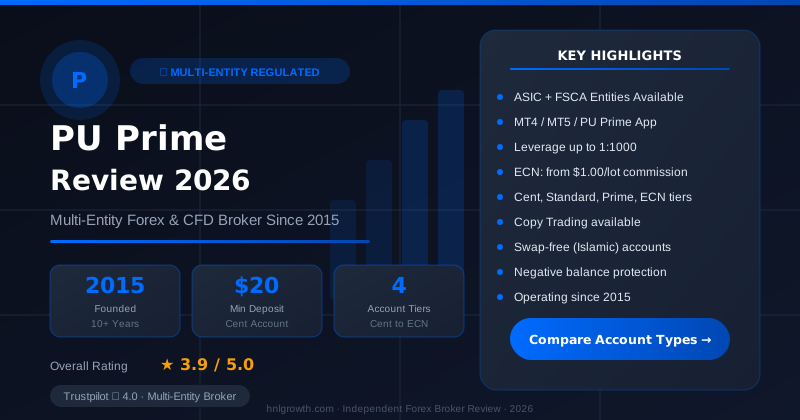
PU Prime — Multi-Entity Forex & CFD Broker
ASIC (AU) + FSCA (ZA) entities available · $20 min deposit (Cent) · MT4, MT5, PU Prime App · 4 account tiers
Every futures or forward contract has two prices to compare: the spot price (buy it now, take it now) and the futures price (agree today on a price for delivery or settlement later).
- Contango: futures price > spot price. The market is pricing in a premium for later delivery.
- Backwardation: futures price < spot price. The market is pricing later delivery at a discount.
You'll sometimes see this drawn as a "forward curve" — a line connecting spot price to futures prices at different future dates. An upward-sloping curve is contango. A downward-sloping curve is backwardation. Neither shape is fixed: a market can move between the two as conditions change.
It's worth separating this from a price forecast. Contango doesn't mean the market expects the spot price to rise by the time the contract expires; it mostly reflects the cost of carrying the asset forward, not a prediction. That distinction matters later when we look at common mistakes.
Why Futures Prices Drift From Spot: The Carrying-Cost Logic
For a physical commodity, holding it between today and a future delivery date isn't free. Three costs typically get built into the futures price:
- Storage: warehousing oil, grain, or metal costs money and space.
- Insurance: physical stock needs to be insured against loss or damage.
- Financing: money tied up in the commodity has an opportunity cost, roughly in line with prevailing interest rates.
Add these "cost of carry" components to today's spot price, and you get a rough explanation for why a futures contract might trade higher. This is contango's default state for many storable commodities in calm markets: nothing dramatic is happening, so the price simply reflects spot plus the cost of waiting.
Backwardation flips this logic. It tends to show up when near-term supply is tight or demand is unusually strong right now — tight enough that buyers are willing to pay more for immediate delivery than for delivery further out. A supply disruption, a seasonal shortage, or a sudden spike in demand can all push a market into backwardation, because the premium for having the physical good today outweighs the cost-of-carry logic that would normally push the curve upward. This premium for immediate availability is sometimes called convenience yield, and when it's high enough, it overrides carrying costs and flips the curve into backwardation.
Neither state is permanent. Curves shift as storage capacity, interest rates, and supply-demand conditions change.
A Simple Worked Example: Spot vs Forward Price
Numbers make this easier to follow than definitions alone. This example uses round figures for a hypothetical commodity — not a live market quote, and not representative of any specific instrument's actual pricing.
| Point in time | Price | Difference vs spot | Plain-language takeaway |
|---|---|---|---|
| Spot price (today) | $80.00 | — | What you'd pay for immediate delivery |
| 3-month futures price | $83.00 | +$3.00 (contango) | The market is pricing in roughly 3.75% for carrying the asset three months forward |
| 3-month futures price (alternative scenario) | $77.50 | −$2.50 (backwardation) | The market is pricing a discount for later delivery, often because near-term supply is tight |
In the contango row, the $3.00 gap is a rough stand-in for storage, insurance, and financing costs over that three-month window. In the backwardation row, the discount suggests buyers value having the commodity now more than they value it in three months.
If you held a long position through to expiry in the contango scenario, and the spot price stayed flat at $80, the futures price would need to fall back toward $80 as expiry approaches — this is called convergence. That erosion, from $83 down to $80, is a cost that has nothing to do with whether your market view was right. It's often referred to as roll cost when a position is repeatedly closed and reopened in a new contract to avoid taking delivery, and it can quietly erode returns on long-held positions even when the underlying price forecast was correct.
Note: convergence is the general tendency, not a guarantee. In practice, basis risk — the difference between the futures price and spot price — can persist or widen in certain conditions, particularly around cash-settled contracts or markets with unusual supply dynamics.
Contango vs Backwardation at a Glance
| Contango | Backwardation | |
|---|---|---|
| Futures price vs spot | Futures trade above spot | Futures trade below spot |
| Typical cause | Cost of carry (storage, insurance, financing) | Near-term scarcity, strong immediate demand, high convenience yield |
| Curve shape | Upward-sloping | Downward-sloping |
| Effect on a long position held over time | Futures price tends to drift down toward spot as expiry nears (potential erosion, "roll cost") | Futures price tends to drift up toward spot as expiry nears (potential benefit for long positions) |
| Common in | Calm, well-supplied storable commodity markets | Markets with supply disruptions or seasonal shortages |
The practical impact column is the one beginners tend to skip. If you're holding a long position in a contango market, all else equal, time itself can work against you as the futures price converges toward spot. In backwardation, the reverse tends to be true for a long position. This isn't a trading signal on its own — it's a structural feature of the position you're holding.
Where This Shows Up in Real Markets
Oil: Crude oil has moved between contango and backwardation many times, often tracking storage availability. When storage tanks and pipelines are nearly full, near-term contracts can trade at a steep discount because there's nowhere to put more physical oil right now — pushing the curve toward backwardation. When storage is ample and supply is comfortable, the market often reverts to a mild contango reflecting standard carrying costs.
Gold: Gold is easy to store and doesn't spoil, so its futures curve is usually in a fairly stable, mild contango driven mostly by financing costs (interest rates) rather than storage or insurance, since those costs are comparatively small for gold. When interest rates rise, the contango in gold futures tends to widen, all else equal, because the financing component of carrying cost has gone up.
These are general market-structure patterns drawn from widely documented commodity behaviour, not a forecast for any specific contract, and the depth of contango or backwardation can change with market conditions. The oil and gold examples are used here as educational illustrations of how the framework applies in practice — they are not a representation of how any specific PU Prime instrument is priced.
If you trade commodities as CFDs rather than as physical futures, you're not taking delivery either way, but the underlying futures curve your CFD price references still behaves the same way. PU Prime lists its commodity and metals CFD instruments, along with reference spread values, on its trading costs and instruments page. Spread and cost figures shown there are reference values only — verify current conditions directly on the platform before trading, as actual values may differ.
Why This Matters Even If You Trade CFDs, Not Futures
If you're trading a commodity CFD rather than a physical futures contract, you don't have to worry about storage or delivery. But most commodity CFD pricing is still linked to an underlying futures market, so the same contango and backwardation dynamics can influence the price you see.
Overnight financing charges (sometimes called swap rates) on commodity CFDs are set by the broker and may reflect — among other factors — the cost of carrying exposure linked to the underlying futures market. Whether a commodity CFD's financing charges differ for long versus short positions, and how those are structured, is instrument-specific and may also vary by account type and entity. The details for PU Prime instruments are listed on its spreads and costs page, but as noted there, all values are reference figures — check the live platform or contact support for current rates before relying on them for position sizing.
This is why a beginner holding a CFD position for weeks or months — rather than closing it out the same day — should understand that the instrument's price isn't only driven by the spot-market news headline. Part of the price movement, and part of any cost of holding, can come from where the underlying futures curve sits and how it's shifting.
The Main Risks, and Who This Concept Matters Less For
Contango and backwardation are structural features of a market, not risks in the sense of a broker-specific issue, but they do have practical implications:
- Erosion risk on long-held contango positions: holding a long position in a contango market can see value quietly erode toward expiry even if the spot price doesn't move.
- Curve shifts can happen quickly: a market can move from contango to backwardation (or back) around supply shocks, seasonal patterns, or major economic data, and a beginner reading a curve shape as a fixed signal can be caught out.
- It's easy to overweight the concept: for many short-term retail positions, price action, news, and technical levels matter far more day to day than the shape of the forward curve.
This concept matters less for very short-term or intraday traders, since roll and carry effects accumulate slowly and are unlikely to meaningfully affect a position held for hours. It matters more for anyone holding a position for weeks or months, particularly in commodities where storage and financing costs are a bigger share of the price.
It's also not a concept that applies meaningfully to instruments without a forward curve — such as most spot forex pairs or individual shares traded outright — so beginners focused purely on those markets can treat this as background knowledge rather than something to actively monitor.
Common Beginner Mistakes to Avoid
- Treating contango as a bearish signal, or backwardation as bullish. Both describe market structure and cost dynamics, not a forecast of where the price is headed next.
- Ignoring carry erosion on longer-dated holds. A position that looks flat on the underlying spot price can still lose value in a contango market purely from convergence as expiry approaches.
- Assuming the curve shape is fixed. Markets shift between contango and backwardation, sometimes quickly, around supply and demand news.
- Confusing contango with volatility. A steep contango doesn't necessarily mean a volatile market, and a flat curve doesn't guarantee calm price action.
- Applying the concept to markets where it doesn't apply. Not every instrument has a meaningful forward curve; forcing the framework onto spot forex or single shares adds confusion without adding insight.
How to Observe These Conditions Before Trading Live
Before applying any of this to a live position, it helps to simply observe. A demo account lets you watch how a commodity's price behaves over several weeks using virtual funds, while reflecting live market prices.
A practical checklist for this specific concept:
- Pick one commodity CFD (for example, an oil or gold instrument) and note its current price.
- In the platform's instrument details or the broker's costs page, look for any overnight financing or swap charges on that instrument. Note whether the charge differs for long versus short positions — that difference can be a clue about the direction of the underlying curve.
- Track the price and any financing charges over a few weeks — not to trade around them immediately, but to see how they relate to supply or demand news for that commodity.
- Compare what you observe against the plain-language definitions above.
- Before moving to a live account, confirm which regulated entity would service your account and what protections apply in your jurisdiction.
PU Prime's account registration — which includes access to a demo — requires a government-issued ID, proof of address dated within the last three months, and a minimum deposit for the live account (Cent account from $20, Standard account from $50, per the account opening page). The same page outlines the full registration steps. As with any regulated broker, specific terms — including which regulated entity services your account and what protections apply — depend on your jurisdiction. Review the regulation page to understand what oversight applies to your region before proceeding. PU Prime states it operates under the oversight of several financial authorities, though the specific entities and jurisdictions relevant to you will depend on where you are based.
FAQ
What is the difference between contango and backwardation? Contango is when the futures price is higher than the spot price; backwardation is when the futures price is lower than the spot price. The shape reflects cost of carry (contango) or near-term scarcity and demand (backwardation), not a price forecast.
What causes contango? Mainly the cost of carrying an asset forward in time: storage, insurance, and financing. When these costs dominate, futures trade at a premium to spot.
What causes backwardation? Usually tight near-term supply or unusually strong immediate demand — sometimes called high convenience yield — where buyers value having the commodity now more than carrying costs would otherwise justify.
Why do futures prices tend to converge to spot prices as expiry approaches? As a contract nears its delivery or settlement date, there's less time left for storage and financing costs to accrue (in contango) or for scarcity premiums to matter (in backwardation), so the futures price generally moves toward the spot price. This is known as convergence. Basis risk means the relationship is not always exact in practice.
Does contango affect CFD traders, or only futures traders? It can affect both. Commodity CFD prices are often linked to an underlying futures market, so the same forward-curve dynamics — and any related overnight financing charges — can influence a CFD position even though you're not taking physical delivery.
Which commodities typically trade in contango? Storable commodities with meaningful carrying costs — such as gold and, in calmer supply conditions, crude oil — often trade in contango. The same markets can shift into backwardation when supply tightens.
Can I open a demo account without committing to a live account? At PU Prime, the demo option is offered as part of the same registration flow as a live account rather than as a fully separate path. Check the account opening page for the current process and any steps that apply before a live account is funded.
Risk Warning
Risk warning: CFDs and leveraged forex products are complex instruments and carry a high risk of losing money rapidly due to leverage. Consider whether you understand how these products work and whether you can afford to take the high risk of losing your capital. Check the entity, terms and protections that apply in your jurisdiction before trading.
Ready to Compare PU Prime Account Types?
PU Prime is a multi-entity broker — ASIC (Australia) and FSCA (South Africa) regulated entities offer stronger oversight, while most international clients are onboarded to the FSA Seychelles or FSC Mauritius entities. Four account tiers (Cent, Standard, Prime, ECN) range from a $20 minimum deposit to full ECN pricing.
Risk disclaimer: PU Prime is a live, regulated multi-entity broker — trading forex and CFDs is done with real capital under normal market risk (this is not a simulated prop-firm evaluation). PU Prime operates under multiple separate licenses (ASIC, FSCA, FSA Seychelles, FSC Mauritius); which entity holds your account depends on your country of residence and determines your leverage cap and protections — confirm this before funding. CFDs and leveraged forex products are complex instruments and carry a high risk of losing money rapidly due to leverage; 62.2% of retail investor accounts lose money when trading CFDs with this provider. Consider whether you understand how CFDs/forex work and whether you can afford the high risk of losing your money. Affiliate disclosure: HNL Growth earns a commission when you open a PU Prime account through links on this page.