Copper Trading and COMEX Futures: A Practical Guide
COMEX copper futures (ticker HG1! on TradingView) are standardised exchange-traded contracts covering 25,000 pounds of Grade 1 electrolytic copper, priced in US dollars per pound and cleared through...
Reviewed using our forex & CFD broker review methodology
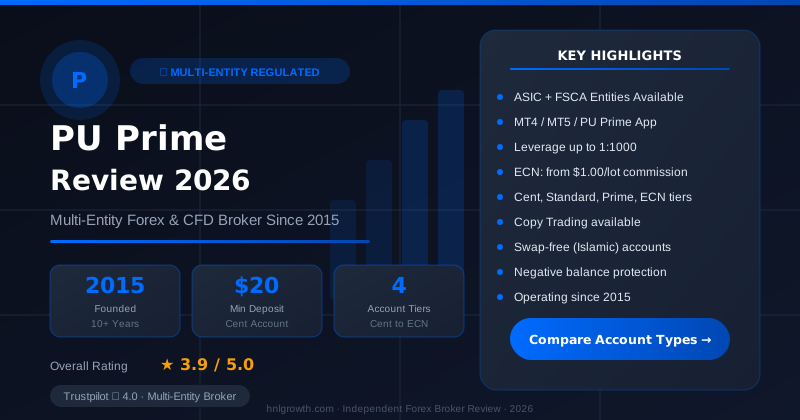
Checked on: 2026-08-17 | Broker terms, regulation, and pricing can change. Always verify at the official PU Prime site before opening an account.
Affiliate Disclosure: HNL Growth may earn a commission if you open an account through our links, at no additional cost to you. Risk Warning: CFDs and leveraged forex products are complex instruments and carry a high risk of losing money rapidly due to leverage. 62.2% of retail investor accounts lose money when trading CFDs with this provider. Trading forex and CFDs may not be suitable for all investors. Consider your objectives, experience, and risk appetite before trading, and ensure you understand the risks involved. Broker Disclosure: PU Prime is a live, regulated multi-entity broker (not a simulated prop-firm evaluation) — trades are executed with real capital in live market conditions, subject to normal market risk. Which PU Prime entity holds your account depends on your country of residence and determines your leverage cap and protections.
Last verified: August 2026 | Editorial Team
Copper Trading and COMEX Futures: A Practical Guide
COMEX copper futures (ticker HG1! on TradingView) are standardised exchange-traded contracts covering 25,000 pounds of Grade 1 electrolytic copper, priced in US dollars per pound and cleared through CME Group's COMEX division in New York. Each contract lets a buyer and seller lock in a copper price today for delivery or cash settlement at a future date. Retail traders can access copper exposure through COMEX futures, regulated CFDs, or exchange-traded products—each with different capital requirements, cost structures, and risk profiles. This guide explains how the contract works, what moves the price, which instrument suits which trader, and how to practise without committing live capital.
1. Copper and the Exchange Behind It
PU Prime — Multi-Entity Forex & CFD Broker
ASIC (AU) + FSCA (ZA) entities available · $20 min deposit (Cent) · MT4, MT5, PU Prime App · 4 account tiers
CME Group operates COMEX as its metals division. Where stock exchanges list company shares, COMEX lists standardised commodity contracts—each with a fixed size, defined quality grade, and transparent daily settlement price. Because contracts are standardised and centrally cleared, buyers and sellers never need to trust each other directly; the CME Clearinghouse stands between every trade.
Copper earned the informal title "Dr. Copper" among market participants because its price historically tracks global industrial activity. Copper is the primary conductor in motors, power cables, construction wiring, and increasingly in electric vehicles and renewable energy infrastructure. When factories expand output, more copper is consumed; when construction slows, copper demand contracts. Unlike financial assets, copper cannot easily be substituted in most applications, so its price tends to react quickly to changes in the real economy—often before official economic data is published. This makes the COMEX copper price a closely watched signal for macro conditions, not just a commodity benchmark.
2. How the COMEX Copper Contract Works
Contract Specification Reference
The table below summarises the standard COMEX HG copper contract. Margin figures change frequently based on market volatility; treat the indicative figure as a starting point only and verify current requirements at cmegroup.com before trading.
| Specification | Detail | Notes |
|---|---|---|
| Contract symbol | HG (continuous front-month: HG1! on TradingView) | Verify symbol convention has not changed |
| Underlying | Grade 1 electrolytic copper | Minimum 99.9% purity, COMEX-approved brands |
| Contract size | 25,000 lbs | Note: LME copper uses metric tonnes—different unit |
| Price quotation | USD per pound | e.g. $4.50/lb = $112,500 notional per contract |
| Minimum tick | $0.0005 per pound | Each tick = $12.50 per contract |
| Tick value | $12.50 | Five ticks = $62.50; 100 ticks = $1,250 |
| Trading hours (Globex) | Nearly 24 hours/day, Sunday–Friday, with a daily maintenance break (~45 min) | Check CME Globex calendar for exact session times |
| Last trading day | Third-to-last business day of the contract month | Check CME contract calendar for specific dates |
| Settlement method | Physical delivery to COMEX-licensed warehouses, or cash if position is closed before expiry | Most retail traders roll or close before delivery |
| Exchange | COMEX division, CME Group, New York | |
| Initial margin (indicative) | Typically several thousand USD per contract; varies by exchange rule changes | Always verify at cmegroup.com before trading—margin rates change frequently |
Expiry and Rolling
Most retail traders never intend to accept physical delivery of 25,000 lbs of copper wire bar. Before the contract's last trading day, they either close the position outright or roll it—closing the expiring contract and opening the next month's contract simultaneously. Rolling incurs a small cost because the two contract months rarely trade at exactly the same price. That price difference (the spread between front and back months) reflects storage, insurance, and financing costs; it can be positive or negative depending on market structure.
3. What Moves the Copper Price
Copper price drivers operate across different time horizons. What matters for an intraday scalp is largely irrelevant to a three-month macro position, and vice versa. Understanding which horizon you are trading helps you filter relevant news from background noise.
Copper Price Driver Matrix
| Time Horizon | Driver | Example Event | Mechanism |
|---|---|---|---|
| Intraday | USD index movement | US CPI print stronger than expected → USD rises | Copper is USD-denominated; a stronger dollar makes copper more expensive in other currencies, typically suppressing demand |
| Intraday | LME warehouse inventory report | Cancelled warrants spike (metal leaving storage) | Signals tightening physical supply; tends to support spot price |
| Intraday | Risk sentiment / equity markets | Broad equity sell-off on recession concern | Copper trades as a risk asset; sell-offs often correlate with short-term copper weakness |
| Cyclical (6–12 months) | China manufacturing PMI | PMI falls below 50 for consecutive months | China accounts for roughly half of global copper consumption; a sustained PMI contraction signals reduced industrial demand |
| Cyclical (6–12 months) | Auto production cycles | Global auto output ramp-up ahead of model-year changeover | Each vehicle uses significant copper for wiring and motors; production surges lift copper demand |
| Cyclical (6–12 months) | Chinese construction seasons | Property developer credit conditions tighten | Construction-related copper demand (plumbing, wiring) tracks building starts with a 3–6 month lag |
| Structural (multi-year) | EV adoption | Major markets mandate EV sales share targets | EVs use roughly 3–4× the copper of an internal combustion engine vehicle; rising EV share expands the demand curve |
| Structural (multi-year) | Renewable energy buildout | Solar and wind farm installation targets | Power cables and transformers for grid connection are copper-intensive; IEA projections flag copper as a critical mineral for energy transition |
| Structural (multi-year) | Mine supply depletion and grade decline | Declining ore grades at major Chilean mines | New mine development takes 10–15 years; structural undersupply risk builds as existing reserves thin |
Supply Geography and Concentration Risk
Chile accounts for approximately 25–27% of global copper mine output (cross-reference USGS Mineral Commodity Summaries and COCHILCO data at the time you read this—the figure shifts annually). The DRC and Peru are the next largest producers. This geographic concentration creates event-driven risk: labour disputes at major Andean mines, water-use restrictions in Chile's northern desert, or sovereign policy changes can tighten global supply quickly. Documented historical episodes—including the Escondida mine strikes in 2017 and 2018—show that significant supply disruptions can push COMEX prices materially higher within days, as traders price in reduced near-term availability. The effect on open interest tends to be immediate; the effect on physical inventories takes weeks to months to show through. Short-term traders need to distinguish the price signal from the underlying fundamentals adjusting at a much slower pace.
4. Ways to Trade Copper: Instrument Comparison
Three main instruments give retail traders copper price exposure. They differ substantially in capital requirement, regulatory oversight, cost structure, and whether physical copper ever changes hands.
| Criterion | COMEX Futures | Regulated CFD | Copper ETF / ETP |
|---|---|---|---|
| Minimum capital (indicative) | Several thousand USD per contract (exchange margin); verify at CME | Lower barrier; depends on broker account type and leverage offered | Price of one ETF unit (often $10–$100+); no leverage required |
| Leverage available | Exchange margin implies significant leverage; position-specific | Leverage available; varies by jurisdiction and broker | Typically no leverage (unlevered ETPs exist; leveraged ETPs carry compounding risk) |
| Cost type | Bid-ask spread + broker commission per contract | Spread (built into price); overnight swap charge if held past daily close | Annual management fee (TER) + bid-ask spread on exchange |
| Overnight holding cost | Roll cost at expiry rather than daily swap | Daily swap charge accrues on open positions | TER accrues continuously but is low (e.g. 0.65–1.0% p.a. for some copper ETPs) |
| Settlement | Physical delivery (if held to expiry) or cash on close | Cash settlement only; no delivery | Sell on exchange; no delivery |
| Regulatory oversight | CME-regulated; FCM broker must be registered with CFTC/NFA (US) | Regulated CFD broker: check FCA, CySEC, ASIC, or equivalent; unregulated offshore brokers offer no equivalent client protection | Listed on regulated exchange (LSE, NYSE Arca, etc.); issuer regulated by securities authority |
| Physical delivery option | Yes (if held to delivery period) | No | No |
| Best suited to | Experienced traders with sufficient margin capital; commercial hedgers | Retail traders seeking copper price exposure without delivery; active or swing traders | Passive investors seeking long-term copper exposure without leverage |
Regulated vs unregulated platforms: A CFD with a broker regulated under FCA, CySEC, ASIC, or equivalent carries client money protections, best-execution obligations, and complaint mechanisms. An offshore CFD provider outside recognised regulatory frameworks offers no equivalent safeguards. This distinction matters more in copper than in some other markets because volatility events—supply disruptions, macroeconomic data releases—can produce rapid margin pressure.
5. The Real Cost of a Copper Trade
The table below compares indicative total costs for a standardised $10,000 notional copper exposure held for five trading days. All figures are illustrative and for comparison purposes only. Actual costs depend on the broker, account type, current spreads, and prevailing interest rates.
Assumptions: $10,000 notional position; copper price $4.50/lb (indicative for illustration); position held 5 trading days; CFD overnight financing rate based on benchmark rate + broker markup (varies); ETF uses a representative copper ETP with ~0.65% TER.
| Cost Component | COMEX Futures | Regulated CFD | Copper ETF |
|---|---|---|---|
| Entry cost (spread or commission) | Broker commission ~$2.50–$5.00 per contract + exchange fee; bid-ask spread typically very tight in liquid sessions | Spread built into price; check current copper spread on the PU Prime spread and costs page | Bid-ask spread on exchange; typically 0.05–0.15% of trade value |
| Overnight/carry cost (per day × 5) | No daily swap; carry cost realised at roll/expiry | Daily swap charge; for a $10,000 position at indicative rates, typically $1–$3/day depending on benchmark rate and broker markup (~$5–$15 for 5 days) | TER accrues daily; ~0.65% p.a. ÷ 365 × 5 days ≈ $0.09 on $10,000 |
| Roll/expiry cost if approaching contract month end | Spread between front and second month; can be positive or negative; historically small in copper but variable | Not applicable (no delivery obligation; position rolls at broker's financing rate) | Underlying ETP rolls futures internally; roll cost embedded in tracking difference |
| Estimated 5-day total cost | Commission + tight spread (low entry cost); no daily swap but margin tie-up is substantial | Spread + ~$5–$15 in overnight financing (illustrative) | Very low carry; modest entry spread; most cost-efficient for passive holding |
The key takeaway: for short holding periods, futures can be cost-efficient once you have the margin capital. For multi-week or multi-month positions, daily swap charges in CFDs accumulate and reduce cost efficiency compared with futures or ETFs. For purely passive long-term exposure without leverage, a copper ETP has the lowest explicit carry cost—but also no leverage.
Copper spread and cost data for PU Prime: The PU Prime spread and costs page lists copper under Commodities for Standard, Prime, and ECN account types. All spread values on that page are reference figures; check MT4/MT5 or the PU Prime app for current live values before trading, as spreads are variable.
6. Risk, Leverage, and Margin Reality
Worked Numerical Example
Suppose copper is trading at $4.50/lb and a trader opens a CFD position representing $10,000 of notional copper exposure using 10:1 leverage. The trader deposits $1,000 in margin to control the $10,000 position.
Scenario A — 5% adverse move: Copper falls to $4.275/lb. The position loses $500 (5% of $10,000). That $500 loss equals 50% of the $1,000 margin deposited. The broker's maintenance margin threshold may trigger a margin call before the position reaches full loss.
Scenario B — 5% favourable move: Copper rises to $4.725/lb. The position gains $500—a 50% return on the $1,000 margin. However, the position could just as easily have gone the other way.
The same leverage that amplifies gains amplifies losses proportionally. A 10% adverse move would eliminate the entire initial margin. Most regulated brokers apply negative balance protection to retail accounts (required under ESMA-derived rules in the EU and FCA rules in the UK), but traders in other jurisdictions should verify what protections their specific regulatory entity provides.
Margin Calls and Stop-Losses
When a position moves against a trader and available equity falls below the broker's maintenance margin level, the broker issues a margin call requiring additional funds. If the trader cannot meet the margin call promptly, the broker may close the position at the prevailing market price. During fast-moving markets—a Chilean mine strike announcement, a surprise Chinese PMI print—prices can gap, meaning execution occurs at a price worse than the stop-loss level. This is called slippage and is a documented feature of all leveraged markets, not just copper.
Retail Loss-Rate Context
Regulatory authorities in multiple jurisdictions require CFD brokers to disclose the proportion of retail client accounts that lose money. A significant proportion of retail CFD accounts do lose money when trading leveraged products. Readers should check PU Prime's own risk disclosure materials for the figure applicable to their account jurisdiction before opening a live account.
7. Who Copper Trading Is—and Is Not—For
Trader Profile Decision Matrix
This matrix is a general orientation guide, not financial advice. Your personal circumstances, risk tolerance, and financial situation are the deciding factors.
| Trader Profile | Recommended Instrument | Indicative Capital Threshold | Key Risk to Manage |
|---|---|---|---|
| Beginner speculator (learning market structure, limited capital) | Regulated CFD on a demo account first; live account with tight position sizing | From $50 (PU Prime Standard account); start small | Over-leveraging; not understanding swap costs; trading without stop-losses |
| Active day trader (monitors positions in real time, short holding periods) | Regulated CFD (low entry friction, no delivery risk) | Sufficient margin to absorb intraday volatility; check broker requirements | Spread costs in fast markets; margin calls during volatile sessions |
| Long-term macro investor (structural copper thesis, months-to-years horizon) | Copper ETP/ETF or COMEX futures rolled at low frequency | Sufficient for ETF purchase or COMEX margin; ETF requires no margin maintenance | TER drag on ETF; roll cost on futures; thesis taking longer to materialise than expected |
| Commercial hedger (mining company, manufacturer with genuine physical exposure) | COMEX futures or OTC forwards | Exchange margin; typically institutional capital | Basis risk between COMEX price and physical purchase/sale price |
Who This Is Not For
Copper trading with leverage is not suitable if:
- You do not have sufficient capital to meet COMEX initial margin requirements and sustain a full futures contract through normal volatility without a forced close
- You cannot monitor open leveraged positions during active trading sessions, particularly around key data releases (Chinese PMI, LME inventory reports, FOMC announcements)
- You are using borrowed personal funds—credit card advances, personal loans, emergency savings—to fund your margin account
- You are expecting a specific structural copper demand narrative (e.g., EV adoption) to produce short-term price gains; structural theses play out over years, not weeks
- You have not yet practised placing entries, exits, and stop-losses on a demo account with realistic position sizes
New to commodity trading? Practising copper CFD trades on a demo account removes the financial risk from the learning process while you build familiarity with how the price moves and how margin mechanics work. PU Prime's demo account uses real-time market prices.
Disclosure: This page may contain affiliate links. We may earn a commission if you open an account through our links, at no extra cost to you.
8. Getting Started on a Regulated Platform
PU Prime's Regulatory Standing
PU Prime is a regulated CFD broker operating under several financial authorities. According to the official PU Prime regulation page, the company is authorised and regulated by:
- Financial Services Authority of Seychelles (FSA)
- Financial Services Commission of Mauritius (FSC)
- Financial Sector Conduct Authority of South Africa (FSCA)
- Capital Market Authority of the UAE (CMA)
Regulatory protections—including client fund segregation requirements, operational transparency standards, and audited compliance processes—apply through the relevant licensed entity. The protections and terms available to you depend on which PU Prime entity services your jurisdiction. Check the regulation page to confirm which entity applies in your region and what client protections are in scope.
Important: PU Prime's website notes that it is intended for individuals residing in jurisdictions where accessing it is permitted by law, and that PU Prime and its affiliated entities may not be established or operating in all home jurisdictions.
Copper on PU Prime
PU Prime lists copper CFDs under its Commodities category, available alongside crude oil, sugar, and other hard and soft commodities. Spread and cost data for copper across Standard, Prime, and ECN account types is published on the spread and costs page. Values listed there are reference figures; always check MT4/MT5 or the PU Prime app for current live spreads before placing a trade, as spreads are variable.
Account Types and Opening Process
According to the PU Prime account opening guide, four main account types are available:
| Account | Minimum Deposit | Commission | Spreads (EUR/USD reference) | Best For |
|---|---|---|---|---|
| Cent | $20 | None | Same as Standard | Beginners testing strategies with minimal capital |
| Standard | $50 | None | From 1.3 pips | Most beginners; simple spread-only pricing |
| Prime | $1,000 | $3.50/lot/side | From 0.0 pips | Active traders wanting tighter spreads |
| ECN | $10,000 | $1.50/lot/side | From 0.0 pips | High-volume professional traders |
The account opening process takes approximately 10–15 minutes of active work. You need a government-issued ID, proof of address (dated within the last three months), and your minimum deposit. Verification by the compliance team typically takes a few hours on business days; during that time, a demo account is available for practise.
Minimum deposit requirements and available account types can differ by regulatory entity and jurisdiction—confirm the terms for your specific region via the official page before proceeding.
What to Verify Before Trading Copper on Any Platform
Since no first-hand audit of execution, spreads, or withdrawal processing is available for this article, here is a practical checklist to verify yourself:
- Confirm the copper CFD symbol and current spread in the platform's market watch before placing a trade
- Check the overnight swap rate for your intended position direction (long vs short swaps differ)
- Verify the margin requirement per lot for your account type
- Confirm which regulatory entity services your jurisdiction and what client fund protections apply
- Test the stop-loss and take-profit order workflow on a demo account before going live
9. Common Mistakes and How to Avoid Them
Oversizing the position relative to account equity. A single COMEX copper futures contract controls 25,000 lbs of copper—at $4.50/lb, that is $112,500 of notional value. Even on CFDs with 10:1 leverage, a $10,000 account controlling $100,000 notional has almost no buffer against normal intraday moves. Standard risk management practice suggests risking no more than 1–2% of account equity on a single trade.
Ignoring roll cost and overnight financing. Traders who focus only on entry and exit prices often overlook the daily swap charges that accumulate on CFD positions held over days or weeks. For a position held several weeks, swap costs can meaningfully erode profits or compound losses. Always calculate total cost of carry before holding a position beyond a few days.
Conflating the structural demand thesis with a short-term trade. The copper EV and renewable energy demand story is a multi-year structural argument. Short-term copper prices respond to Chinese PMI data, USD movements, LME inventory fluctuations, and risk sentiment—none of which cares about 2030 EV targets. Entering a leveraged position because of a long-term narrative and then holding through months of adverse price action without a defined exit plan is a documented path to margin calls.
Trading without stop-losses during key data releases. Copper can move several cents per pound in minutes around events like Chinese manufacturing PMI, FOMC rate decisions, or unexpected mine supply news. An unprotected leveraged position in that environment can reach margin-call territory faster than a manual close allows. Pre-setting stop-losses before high-impact events is standard practice.
Confusing COMEX and LME pricing. COMEX copper is quoted in USD per pound for a 25,000 lb contract. London Metal Exchange copper is quoted in USD per metric tonne for a 25-metric-tonne contract. These are different units, different exchanges, and slightly different prices (though they generally track each other closely). Mixing them up when calculating notional values leads to significant position-sizing errors.
10. FAQ
What exactly is a COMEX copper futures contract? It is a legally binding agreement to buy or sell 25,000 lbs of Grade 1 electrolytic copper at a price agreed today, for delivery or settlement at a specified future date. The contract is standardised by CME Group and traded on the COMEX exchange. Most retail traders close or roll the contract before the delivery date rather than accepting physical copper.
What are the COMEX copper trading hours? COMEX copper trades on CME Globex nearly 24 hours a day, Sunday through Friday, with a short daily maintenance break. Exact session times are published on the CME Group product page—check there for current hours, as they can change around holidays and exchange rule updates.
How does a CFD on copper differ from a COMEX futures contract? A CFD is a derivative contract between a trader and a broker that tracks the copper price without involving the exchange directly. CFDs have no physical delivery obligation, typically require less capital than a full COMEX contract, and carry daily overnight financing charges when held beyond the daily close. COMEX futures are exchange-cleared contracts with physical delivery as an option, typically higher minimum capital requirements, and no daily swap charge (though roll costs apply at expiry). The two instruments also operate under different regulatory regimes.
Can retail traders access COMEX copper futures directly? Yes. Retail traders can access COMEX futures through a registered Futures Commission Merchant (FCM) or introducing broker in the United States, or through internationally licensed brokers with access to CME markets. However, the initial margin requirement per contract (several thousand dollars) and the size of a single position mean this route suits traders with meaningful capital and market experience. For traders with smaller accounts, copper CFDs provide retail-accessible exposure without the minimum contract-size constraint.
What drives copper prices in the short term versus the long term? Short-term (intraday to weeks): USD movements, LME inventory data, equity market risk sentiment, and macroeconomic data releases—particularly Chinese manufacturing PMI. Medium-term (months): Chinese construction and auto production cycles, global industrial output trends, and seasonal patterns. Long-term (years): structural demand from EV adoption and renewable energy buildout, mine supply growth (or depletion), and geopolitical concentration risk in major producing nations like Chile and Peru. See the driver matrix in Section 3 for more detail.
How is copper taxed? Tax treatment of copper futures profits, CFD gains, and ETF disposals varies by country, and in some jurisdictions by whether trading is treated as investment income, capital gains, or business income. This article cannot provide tax advice. Consult a qualified tax adviser in your jurisdiction before trading commodities with leverage.
What is the minimum capital needed to start trading copper? For a COMEX futures contract, the exchange-set initial margin is typically several thousand dollars per contract—check the current figure at cmegroup.com before trading. For copper CFDs on PU Prime, the Standard account starts from a $50 deposit, though the appropriate trading capital should be sized to your position and stop-loss level, not just the minimum deposit figure. The Cent account starts from $20 for traders who want to begin with very small position sizes.
How do I practise copper trading before risking real money? Open a demo account with a regulated CFD broker. PU Prime's demo account replicates live market conditions using real-time prices, allowing you to place practice trades, test stop-loss and take-profit orders, and observe how copper responds to market events—without committing capital. Use the demo to validate your position sizing and risk management approach before switching to a live account.
Ready to see how copper moves in real time? Open a PU Prime demo account to track live copper prices and place practice trades
Risk warning: CFDs and leveraged forex products are complex instruments and carry a high risk of losing money rapidly due to leverage. Consider whether you understand how these products work and whether you can afford to take the high risk of losing your capital. Check the entity, terms and protections that apply in your jurisdiction before trading.
Spread and cost figures referenced in this article are drawn from PU Prime's official spread and costs page and are reference values only; verify current figures in the platform before trading. COMEX margin requirements are indicative and change frequently; always confirm at cmegroup.com before trading. Regulatory protections available to you depend on which PU Prime entity services your jurisdiction; see puprime.com/regulation for current details. Supply and demand figures (Chile production share, EV copper demand projections) should be cross-referenced against the most recent USGS Mineral Commodity Summaries, COCHILCO reports, and IEA World Energy Outlook at time of reading; this article requires annual review.
Ready to Compare PU Prime Account Types?
PU Prime is a multi-entity broker — ASIC (Australia) and FSCA (South Africa) regulated entities offer stronger oversight, while most international clients are onboarded to the FSA Seychelles or FSC Mauritius entities. Four account tiers (Cent, Standard, Prime, ECN) range from a $20 minimum deposit to full ECN pricing.
Risk disclaimer: PU Prime is a live, regulated multi-entity broker — trading forex and CFDs is done with real capital under normal market risk (this is not a simulated prop-firm evaluation). PU Prime operates under multiple separate licenses (ASIC, FSCA, FSA Seychelles, FSC Mauritius); which entity holds your account depends on your country of residence and determines your leverage cap and protections — confirm this before funding. CFDs and leveraged forex products are complex instruments and carry a high risk of losing money rapidly due to leverage; 62.2% of retail investor accounts lose money when trading CFDs with this provider. Consider whether you understand how CFDs/forex work and whether you can afford the high risk of losing your money. Affiliate disclosure: HNL Growth earns a commission when you open a PU Prime account through links on this page.