Currency Converter and Live FX Rates
A currency converter shows the reference rate between two currencies at a given moment. For traders, the number that matters is not the mid-market rate you see on a search engine...
Checked on: 2026-08-09 | Broker terms, regulation, and pricing can change. Always verify at the official HFM site before opening an account.
Affiliate Disclosure: HNL Growth may earn a commission if you open an account through our links, at no additional cost to you. Risk Warning: CFDs and leveraged forex products are complex instruments and carry a high risk of losing money rapidly due to leverage. Between 65-95% of retail investor accounts lose money when trading CFDs, depending on the HFM entity and account type. Trading forex and CFDs may not be suitable for all investors. Consider your objectives, experience, and risk appetite before trading, and ensure you understand the risks involved. Broker Disclosure: HFM (HF Markets Group) is a live, regulated multi-entity broker (not a simulated prop-firm evaluation) — trades are executed with real capital in live market conditions, subject to normal market risk. Protections vary significantly by the specific legal entity that onboards your account.
Currency Converter — Live FX Rates for Traders
A currency converter shows the reference rate between two currencies at a given moment. For traders, the number that matters is not the mid-market rate you see on a search engine — it is the executable rate you receive after spread markup, commission, and any platform conversion fee. This page provides a live FX rate reference for the pairs most traded by retail FX and CFD participants, then breaks down the structural costs that separate the rate on screen from the rate in your account.
Use the converter below as a starting point. Treat every figure as indicative: executable prices depend on your broker's execution model, the liquidity available at the moment of conversion, and the account base currency you selected when you opened the trading account.
Live FX Rate Reference
HashHedge — Crypto Futures Prop Firm
Up to $200K funded accounts · 85% profit split · Instant USDT payouts · 160+ assets
| Pair | Bid | Ask | Spread (pips) | Daily Change |
|---|---|---|---|---|
| EUR/USD | — | — | — | — |
| GBP/USD | — | — | — | — |
| USD/JPY | — | — | — | — |
| AUD/USD | — | — | — | — |
| USD/CAD | — | — | — | — |
| USD/CHF | — | — | — | — |
| NZD/USD | — | — | — | — |
| EUR/GBP | — | — | — | — |
| EUR/JPY | — | — | — | — |
| GBP/JPY | — | — | — | — |
| AUD/JPY | — | — | — | — |
| EUR/AUD | — | — | — | — |
| EUR/CHF | — | — | — | — |
| GBP/CHF | — | — | — | — |
| USD/ZAR | — | — | — | — |
| USD/TRY | — | — | — | — |
| USD/MXN | — | — | — | — |
| EUR/TRY | — | — | — | — |
| GBP/AUD | — | — | — | — |
| CAD/JPY | — | — | — | — |
Rates populate via the on-page widget. Refresh interval and data source are displayed beside the live feed. All figures are reference-level mid-market quotes; executable bid and ask prices at any broker will differ.
Disclosure: This page may contain affiliate links. We may earn a commission if you open an account through our links, at no extra cost to you.
Open a demo account with HFM to see executable rates in real time
How Exchange Rates Actually Work for Retail Traders
Mid-Market, Interbank, and Spot Rates
The mid-market rate is the arithmetic midpoint between the best available bid and ask in the interbank market at a given instant. It is a reference benchmark, not a tradable price. No retail participant — and very few institutional ones — transacts at the exact midpoint.
The interbank rate is the price at which tier-one banks trade with each other in sizes typically above $5 million. Retail brokers aggregate quotes from multiple liquidity providers and add their own markup to cover operational costs, risk, and margin.
The spot rate is the price for settlement in two business days (T+2 for most pairs, T+1 for USD/CAD). When a broker quotes you a price on a CFD or rolling spot contract, it is derived from the spot rate but adjusted for the broker's pricing model.
The Bid-Ask Spread and Why It Exists
Every executable quote has two prices: the bid (what the market will buy at) and the ask (what the market will sell at). The difference is the spread. It exists because liquidity providers need compensation for inventory risk, adverse selection, and operational cost. For retail traders, the spread is the first and often largest component of conversion cost.
Typical retail spread ranges by pair tier, based on publicly available broker rate sheets across the industry:
| Pair Tier | Typical Spread Above Mid-Market |
|---|---|
| Majors (EUR/USD, GBP/USD, USD/JPY) | 0.1 – 1.0 pips |
| Minors (EUR/GBP, EUR/JPY, GBP/JPY) | 0.5 – 2.5 pips |
| Exotics (USD/ZAR, USD/TRY, USD/MXN) | 5 – 50+ pips |
Exotic pairs carry wider spreads because underlying liquidity is thinner and hedging cost is higher. These ranges are illustrative; individual brokers vary based on their execution model and the account type you hold.
How Different Broker Models Set Conversion Rates
| Broker Model | How Conversion Is Handled | Typical Markup Range | Transparency |
|---|---|---|---|
| Market Maker | Broker acts as counterparty; sets own bid/ask around interbank reference | Wider spreads, often no separate commission | Lower — markup embedded in spread |
| STP (Straight Through Processing) | Orders routed to liquidity providers; broker adds markup to LP quotes | Moderate spread markup, sometimes with commission | Medium — markup visible in spread |
| ECN (Electronic Communication Network) | Direct access to LP book; broker charges separate commission | Tight raw spreads plus fixed commission per lot | Higher — commission stated separately |
No model is universally cheaper. A market maker with tight spreads may cost less than an ECN with wide commissions on small trade sizes, and vice versa on large positions. The total cost — spread plus commission plus any conversion fee — is what matters.
The Real Cost of Currency Conversion on a Trade
Spread Markup, Commission, and Platform Fees
Currency conversion cost on a trade has three layers:
- Spread markup — the difference between the mid-market rate and the price you execute at. This is the primary cost for most retail traders.
- Commission — a fixed or variable charge per lot, applied on ECN and some STP accounts. On commission-based accounts, the spread is typically tighter.
- Conversion fee — an explicit charge applied when your account base currency differs from the quote or base currency of the instrument you are trading, or when you deposit or withdraw in a currency different from your account denomination.
Worked Example — Converting $10,000 for a EUR/USD Position
Assume you fund an account denominated in USD and open a 1-lot EUR/USD position (100,000 EUR notional).
| Cost Layer | Assumption | Cost |
|---|---|---|
| Spread markup | 1.0 pip on EUR/USD | $10.00 |
| Commission | $3.50 per side (round turn $7.00) | $7.00 |
| P&L conversion | Unrealized EUR profit/loss converted to USD at close | Variable — depends on rate at exit |
| Total fixed cost | $17.00 |
On a $10,000 account, that $17.00 represents 0.17% of equity consumed before the trade moves a single tick. Over 100 round-trip trades, the cumulative drag reaches $1,700 — or 17% of the original deposit — assuming costs remain constant.
How Your Account Base Currency Creates Ongoing Conversion Drag
When your account is denominated in USD and you trade GBP/JPY, every pip value must be converted from JPY to USD at the prevailing rate. This conversion happens on every tick of unrealized P&L and again at settlement. If you trade 10 different pairs from a single USD account, you are paying implicit conversion on each one.
Choosing an account base currency that matches your most-traded pair reduces this drag. A trader who primarily trades EUR-denominated crosses would face less ongoing conversion cost in a EUR-denominated account than in USD.
Overnight Swaps and Currency Conversion
Swap rates reflect the interest-rate differential between the two currencies in a pair. When you hold a position overnight, the swap is calculated in the quote currency and then converted to your account base currency. For accounts where the base currency differs from both legs of the pair, this introduces an additional conversion layer on every rollover. The effect is small per night but compounds on positions held for weeks or months.
Test conversion costs on a virtual HFM account before risking capital
When to Convert — Liquidity Windows and Timing
Peak Liquidity by Session Overlap
FX liquidity is not uniform across the 24-hour trading day. Conversion spreads tighten when major financial centres overlap and widen during handoff periods.
| Session Overlap | GMT (Winter / Summer) | Typical Conditions | Conversion Recommendation |
|---|---|---|---|
| Tokyo – London | 07:00–08:00 / 07:00–08:00 | Moderate liquidity; JPY and EUR pairs active | Suitable for JPY crosses |
| London – New York | 12:00–16:00 / 13:00–17:00 | Peak global liquidity; tightest spreads | Best window for most conversions |
| Sydney – Tokyo | 23:00–02:00 / 00:00–03:00 | Lower liquidity; wider spreads on non-Asian pairs | Avoid for majors; acceptable for AUD, NZD |
| New York close | 21:00–22:00 / 22:00–23:00 | Liquidity drops sharply; spreads widen | Avoid conversion during this window |
GMT offsets shift with daylight saving time in the US, UK, and other jurisdictions. Verify current session times seasonally.
Economic Events That Widen Conversion Spreads
Major data releases — US Non-Farm Payrolls, central bank rate decisions, CPI prints — cause volatility spikes that widen spreads across all pairs, sometimes by 5–10x normal levels for several minutes. Converting currency immediately before or after a tier-one release exposes you to significantly higher cost. The practical approach is to avoid conversion in the 15 minutes surrounding scheduled high-impact events.
Rate-Alert Strategies for Account Funding
If you are funding a trading account in a foreign currency, setting a rate alert at a favorable level can reduce conversion cost meaningfully on larger deposits. A 20-pip improvement on a $50,000 deposit saves approximately $100 on EUR/USD. Most specialist transfer services and some trading platforms allow configurable alerts tied to mid-market reference rates.
Conversion Methods Compared
Broker-Handled Conversion
When you deposit in a currency different from your account base currency, the broker typically converts at its own quoted rate. This is convenient — a single step — but the rate includes the broker's markup. The advantage is speed and integration; the disadvantage is limited transparency on the exact markup applied unless the broker discloses it explicitly.
Specialist Transfer Services
Services such as Wise, Revolut, and similar providers offer conversion at or near the mid-market rate with a stated fee. For account funding, this can be cheaper than broker-handled conversion on larger amounts, particularly when the specialist service's fee is a small percentage. The trade-off is an additional step in the funding process and potential delays of one to three business days depending on the transfer route.
Card Network Rates for Deposits
Visa and Mastercard publish their own exchange rates, which are generally close to wholesale levels. However, the issuing bank may add a foreign transaction fee of 1–3% on top. Before funding via card, check both the card network's rate and your bank's fee schedule. Card deposits are typically instant, which is their primary advantage.
Decision Matrix — Best Method by Scenario
| Scenario | Recommended Method | Why |
|---|---|---|
| Funding a new account for the first time | Specialist transfer for large amounts; card for speed on small amounts | Transfer services offer better rates on size; cards are instant |
| Withdrawing profits | Specialist transfer or bank wire in your account base currency | Minimizes double conversion |
| Frequent small trades in foreign pairs | Broker-handled conversion within a matched base-currency account | Reduces per-trade friction |
| Large one-time conversion | Specialist transfer with rate alert | Best rate on size; alert captures favorable level |
| Multi-currency portfolio | Account in base currency matching your most-traded pair | Minimizes ongoing conversion drag |
Currency Conversion on HFM
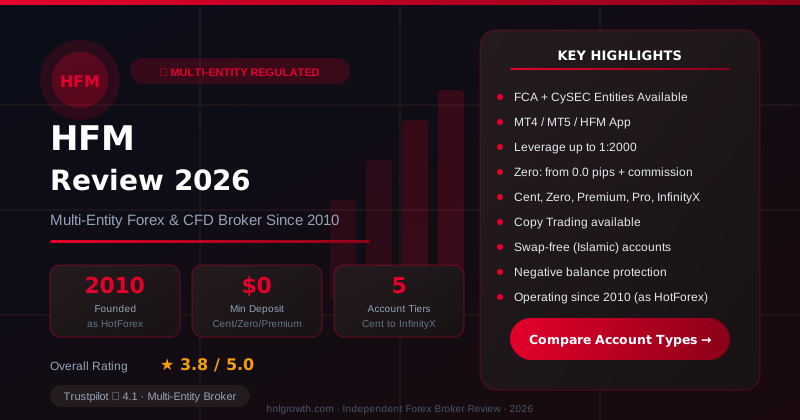
HFM offers trading accounts denominated in USD and EUR, based on the published account comparison on the HFM trading accounts page. The available base currencies may vary by account type and the specific HFM entity you register under.
HFM provides access to platforms including MetaTrader 5, the HFM WebTrader, and the HFM mobile application (hfm.com). Spreads are published from 0.0 pips on commission-based accounts and from 1 pip on spread-only accounts.
The specific conversion fee or markup that HFM applies to deposits, withdrawals, and internal currency conversion is governed by the client agreement and payment terms of the HFM entity you contract with. HFM operates through multiple regulated entities across different jurisdictions, and terms — including conversion handling — may differ between them. Before funding, review the payment terms document provided during account registration or contact HFM support directly to confirm the conversion rate methodology that applies to your account.
Open a HFM live account and review your applicable conversion terms
What to Verify Yourself
Since conversion terms vary by entity and account type, confirm the following before depositing:
- The exact account base currencies available to your jurisdiction and account tier
- Whether HFM applies a conversion fee on deposits made in a currency different from your account base
- The spread markup or fixed fee applied to internal currency conversion
- Whether withdrawal conversion uses the same rate as deposit conversion
- How unrealized P&L in a foreign currency is converted at position close
Frequently Asked Questions
What is the mid-market rate and will I receive it? The mid-market rate is the midpoint between the best bid and ask in the interbank market. Retail traders do not receive this rate. Executable rates include a spread markup that varies by broker model, pair, and market conditions.
Why do conversion rates differ between brokers and transfer services? Each provider applies its own markup above the interbank rate to cover liquidity costs, risk management, regulatory obligations, and operating margin. The total cost depends on the provider's execution model, not a single "fair" rate.
Should I convert currency before funding my broker account or let the broker convert? It depends on the relative cost. Compare the broker's stated conversion terms against the specialist transfer service's fee and rate. For large deposits, specialist services often provide better value. For speed and convenience on smaller amounts, broker-handled conversion may be preferable.
Does my account base currency affect my trading costs? Yes. When your account base currency differs from the currencies in the pair you are trading, every pip of profit or loss is converted at the prevailing rate. Over many trades, this creates cumulative conversion drag. Matching your base currency to your most-traded pair reduces this effect.
What is the best time of day to convert currency for trading? The London–New York session overlap (approximately 12:00–16:00 GMT in winter, 13:00–17:00 GMT in summer) offers peak liquidity and the tightest conversion spreads. Avoid conversion during the New York close and around major economic data releases.
Are free currency converters accurate enough for trading decisions? Free converters typically display mid-market reference rates. These are useful for directional awareness but do not represent executable prices. For trading decisions, check the live bid and ask on your broker's platform.
Risk warning: CFDs and leveraged forex products are complex instruments and carry a high risk of losing money rapidly due to leverage. Consider whether you understand how these products work and whether you can afford to take the high risk of losing your capital. Currency conversion introduces an additional variable — exchange rate movements between your account base currency and the instruments you trade can increase or decrease your realized returns independently of trade direction. Check the entity, terms, and protections that apply in your jurisdiction before trading.
Risk warning: CFDs and leveraged forex products are complex instruments and carry a high risk of losing money rapidly due to leverage. Retail investor accounts lose money when trading CFDs with most providers; the exact percentage varies by HFM entity and account type. You should consider whether you understand how CFDs work and whether you can afford to take the high risk of losing your money. Check the entity, terms and investor protections that apply in your jurisdiction before opening an account or trading.
Ready to Start Your Funded Trading Journey?
Join traders backed by $11M+ in verified payouts and a 4.7/5 Trustpilot rating. Compare HashHedge challenge plans, drawdown rules, and payout terms — apply code ha25 for the current discount.
Risk disclaimer: Challenge fees are non-refundable if you breach the rules. Prop trading involves significant financial risk. Past performance in a simulated environment does not guarantee results on a funded account. Only purchase if you understand the rules fully and can afford to lose the fee. Affiliate disclosure: HNL Growth earns a commission when you purchase a HashHedge challenge through links on this page.