Day Trading Forex: Realistic Expectations and Method
Day trading means opening and closing every position within a single session — no trade is left open overnight. In the forex market, that constraint defines the whole approach:...
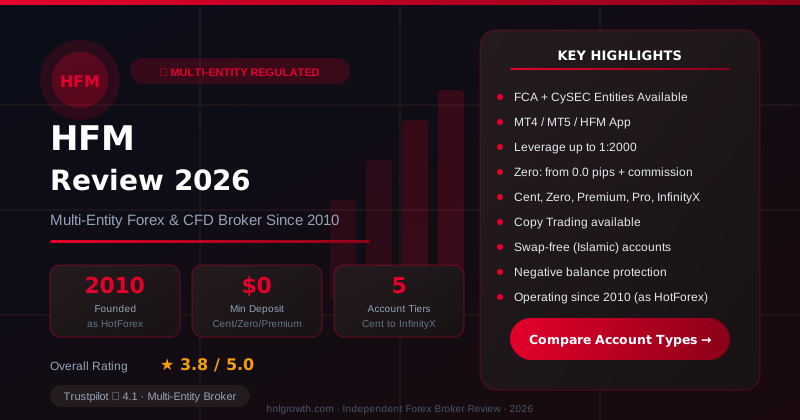
Checked on: 2026-08-06 | Broker terms, regulation, and pricing can change. Always verify at the official HFM site before opening an account.
Affiliate Disclosure: HNL Growth may earn a commission if you open an account through our links, at no additional cost to you. Risk Warning: CFDs and leveraged forex products are complex instruments and carry a high risk of losing money rapidly due to leverage. Between 65-95% of retail investor accounts lose money when trading CFDs, depending on the HFM entity and account type. Trading forex and CFDs may not be suitable for all investors. Consider your objectives, experience, and risk appetite before trading, and ensure you understand the risks involved. Broker Disclosure: HFM (HF Markets Group) is a live, regulated multi-entity broker (not a simulated prop-firm evaluation) — trades are executed with real capital in live market conditions, subject to normal market risk. Protections vary significantly by the specific legal entity that onboards your account.
Day Trading Forex: Realistic Expectations and Method
Day trading means opening and closing every position within a single session — no trade is left open overnight. In the forex market, that constraint defines the whole approach: you target intraday price moves, avoid overnight swap charges, and exploit the session-based liquidity cycle of a 24-hour market. The appeal is real: forex is the world's most liquid financial market, running continuously from Monday morning (Sydney time) through Friday evening (New York time). The caution is equally real. Independent academic research consistently finds that the majority of retail day traders do not sustain profitability over time. This guide explains how the strategy works, what it actually costs, and what structured preparation looks like before you risk capital.
Disclosure: This page may contain affiliate links. We may earn a commission if you open an account through our links, at no extra cost to you.
Intraday trading — the core mechanics
HashHedge — Crypto Futures Prop Firm
Up to $200K funded accounts · 85% profit split · Instant USDT payouts · 160+ assets
The defining rule is simple: all positions close before the session ends. No overnight exposure. That single constraint shapes everything else about the approach.
Because positions last hours — sometimes minutes — the strategy depends on tight costs, fast execution, and reading price behaviour on short timeframes (M1 to M15 are standard). Profit targets are smaller than those of swing or position traders, which means each trade needs to clear its cost drag efficiently.
Day trading is not scalping (seconds to a few minutes per trade) and not swing trading (days to weeks). It sits between the two: typically one to ten trades per session, with holding periods of minutes to a few hours.
Who day trading is not suited for:
- Traders who cannot monitor positions during active market hours
- Anyone using capital that may be needed for essential expenses
- Beginners who have not yet tested a defined strategy on a demo account over a meaningful sample of trades
Forex day trading in practice
The forex market has no single exchange — it operates as a global over-the-counter network, open from Monday to Friday. That gives it near-continuous liquidity, but liquidity is not evenly distributed across the 24-hour cycle. It concentrates in session overlaps.
When to trade: the session overlap window
The most active period is the London–New York overlap, when the two largest trading centres are simultaneously open. HFM's official forex guide confirms this overlap runs approximately 12:00–16:00 UTC in winter (GMT). Daylight Saving Time shifts in both the UK and US can move this window by one to two hours seasonally — always use UTC times rather than local hours to avoid confusion.
During this window:
- Bid-ask spreads on major pairs tighten as more market makers compete for order flow
- Intraday price ranges are typically wider, giving trades more room to reach target before reversing
- US and European economic data releases occur during this period, driving directional moves
The Asian session (roughly 23:00–08:00 UTC) offers the opposite conditions: lower volume, narrower intraday ranges, and wider spreads on many pairs. Tight-spread strategies are harder to execute profitably in this window.
Pair selection for beginners
For intraday forex trading, prioritise pairs with:
- Tight spreads — the lower the round-trip cost, the lower the hurdle each trade must clear to reach profit
- High liquidity — reduces slippage on entry and exit
- Predictable volatility patterns — major economic releases drive EUR/USD and GBP/USD moves at scheduled times
EUR/USD, USD/JPY, and GBP/USD are the three most commonly traded pairs by intraday forex traders for these reasons. According to HFM's published instrument specifications, EUR/USD spreads start from 0.5 pips, GBP/USD from 0.6 pips, and USD/JPY from 0.4 pips (indicative figures; conditions vary by account type and entity). Exotic pairs such as USD/ZAR carry spreads of 89 pips or more on the same source — that cost load makes consistent day trading structurally very difficult.
Other markets at a glance
Forex is not the only market accessible via CFDs for intraday strategies. The table below provides a comparison. Leverage figures reflect EU/UK retail regulatory caps (ESMA/FCA guidelines); other regulatory jurisdictions may differ significantly. Confirm which entity and conditions apply to you before trading.
| Market | Trading hours (UTC) | Indicative spread range | Max leverage (retail EU/UK) | Key volatility drivers |
|---|---|---|---|---|
| Forex majors (e.g. EUR/USD) | 24/5 (Mon 00:05 – Fri 23:58) | From ~0.5–1.5 pips (indicative) | 1:30 | Economic data, central bank decisions, geopolitical events |
| Stock CFDs | Exchange hours (e.g. US: ~14:30–21:00) | Varies widely by stock | 1:5 | Earnings reports, macro sentiment, corporate news |
| Index CFDs (e.g. US500, DE40) | Near 24/5 (futures-based) | From a few index points | 1:20 | Macro data, risk appetite, constituent stock moves |
| Commodity CFDs (e.g. oil, gold) | Varies by commodity | Variable | 1:10 (non-gold); 1:20 (gold) | Supply/demand data, USD strength, geopolitical risk |
| Crypto CFDs | Near 24/7 for major coins | Wide; crypto is highly volatile | 1:2 | Sentiment shifts, regulatory news, on-chain data |
Verify current instrument availability and leverage conditions for your entity at HFM's official trading accounts page.
The true cost of a day trade
Every trade opens with an immediate cost: the bid-ask spread. The price has to move in your direction by at least the spread before a trade reaches breakeven. At high trade frequency, that drag compounds quickly.
For EUR/USD at 0.1 lot (10,000 units), each pip of spread costs $1. The table below shows how spread size affects total monthly cost at three common trade frequencies — spread cost only; commission, swap, and guaranteed stop premiums are additional.
| Spread (pips) | Cost per trade (0.1 lot, EUR/USD) | 10 trades/month | 50 trades/month | 100 trades/month |
|---|---|---|---|---|
| 0.5 | $0.50 | $5 | $25 | $50 |
| 1.0 | $1.00 | $10 | $50 | $100 |
| 1.5 | $1.50 | $15 | $75 | $150 |
Formula: spread (pips) × lot size × $10 per pip per standard lot = cost per trade. Spreads are variable and widen during low-liquidity windows and around major data releases.
The difference between a 0.5-pip and a 1.5-pip spread across 100 trades at 0.1 lot is $100 per month. At 1.0 standard lot, that becomes $1,000 per month in additional costs for the same number of trades. This is why account type selection directly affects your P&L arithmetic — not just which broker you choose.
Additional cost components to model before trading:
- Commission: raw-spread and ECN-type accounts charge a per-lot commission in place of a wider spread; calculate total round-trip cost as spread + (commission × 2)
- Overnight swap: day traders who close all positions before the daily rollover (typically around 22:00–00:00 server time) avoid this charge; any position held through rollover incurs a swap debit or credit based on the interest rate differential between the paired currencies
- Guaranteed stop premium: a fixed charge applied when the order is placed; only relevant if you elect to use guaranteed stops (see risk controls section)
What the success-rate data actually shows
The most cited independent evidence on retail day trading comes from analyses of actual trading records across large populations:
- Barber, Lee, Liu, and Odean (2005) studied day trading activity in the Taiwan futures market and found that fewer than one in five traders were consistently profitable over a sustained period, even before accounting for the opportunity cost of the capital deployed.
- Chague, De-Losso, and Giovannetti (2020) analysed the Brazilian futures market — a larger, more recent dataset — and found that the proportion of traders who remained active for more than two years and earned more than the local minimum wage from trading was below 3%.
Both studies apply to futures markets in specific countries and time periods; they are not directly transferable to forex CFD trading globally or to every broker and strategy. What they do establish is a consistent directional finding: this is difficult, and the difficulty is structural, not merely a beginner problem.
What the minority who sustain profitability tend to do differently:
Research points to three consistent factors rather than any single insight or technique:
- Strict position sizing and loss limits — risking no more than 1–2% of account equity per trade, with a daily drawdown ceiling
- A defined, tested edge — a strategy with measurable positive expectancy, verified across a meaningful number of demo trades before any live deployment
- Cost awareness — choosing account types and trade frequencies where the spread-plus-commission stack does not eliminate a theoretical edge before it can materialise
The loss-rate data is not an argument against ever attempting day trading. It is an argument for taking preparation seriously. A trader who starts with a demo account, tests a specific method across 50–100+ simulated trades, and transitions to live trading only with a position size calibrated to actual equity is in a structurally different position from one who opens a funded account without that foundation.
Choosing a broker for intraday trading
Broker selection criteria for day trading differ from those for longer-term strategies. The priorities are:
Execution quality — market orders should fill at or near the quoted price. Slippage on short-duration trades can eliminate the expected edge of an entry. Look for brokers that publish an execution policy and disclose order-fill data where available.
Charting and order types — M1, M5, and M15 timeframe charts are the minimum requirement for intraday analysis. One-click order entry reduces the delay between decision and execution. OCO (one-cancels-other) orders let you set a take-profit and stop-loss simultaneously, which is important for managing trades you cannot watch continuously. HFM offers MetaTrader 4, MetaTrader 5, and its own HFM Platform, each supporting these features.
Regulation — client fund segregation and regulatory oversight define what protections apply if a broker encounters financial difficulty. HFM operates across multiple regulated entities; which protections apply to you depends on which entity services your jurisdiction. Confirm this via HFM's regulatory disclosures before opening an account.
Account type: the table below maps account categories to their typical cost structure and fit. Minimum deposits and availability vary by HFM entity — verify current conditions before applying.
| Account type | Typical cost structure | UK tax treatment | Minimum deposit | Best-fit profile |
|---|---|---|---|---|
| Standard | Variable spread; no separate commission; wider quoted spread | CGT/income tax applies to profits | Verify at HFM accounts page | Beginners and lower-frequency traders; simpler cost model to track |
| ECN / Raw spread | Raw spread from 0.0 pips + per-lot commission | CGT/income tax applies to profits | Typically higher than standard; verify per entity | Active traders where total round-trip cost (spread + commission) is lower than standard spread cost |
| Spread bet (where offered) | Spread only; no separate commission | Gains typically free from CGT and stamp duty in UK — consult a tax adviser | Verify availability and conditions per entity | UK traders seeking a simpler tax position; confirm availability with HFM for your entity |
Conditions, minimums, and product availability vary by regulatory entity (INT, EU, UK, SC, PH). Always confirm at HFM's trading accounts page before opening.
The Premium Pro account is an example of HFM's professional-client offerings. According to HFM's official account specifications, it requires a $5,000 minimum deposit for professional clients, offers leverage up to 1:400 for professional clients, spreads from 1 pip on variable-spread pricing, and access to MetaTrader 5, HFM WebTrader, mobile trading platforms and the HFM Platform. The account supports all available trading instruments with no commission on forex pairs and includes personal account manager support. The contract size is 1 lot = 100,000 units, minimum trade size is 0.01 lot, and maximum total trade size is 60 standard lots per position with a maximum of 300 simultaneous open orders. This account is designed for advanced traders and requires professional client categorisation; confirm eligibility and current terms directly with HFM for your entity.
Compare HFM account types and open a demo account
Risk controls that matter
Position sizing is the primary control. The 1–2% rule means risking no more than 1–2% of account equity on any single trade. On a $2,000 account, that is $20–$40 per trade. At 0.1 lot on EUR/USD (approximately $1 per pip of movement), a 20-pip stop-loss risks $20 — within that range. At 1.0 standard lot, the same 20-pip stop risks $200 — 10% of the account in one trade. Position size must be calculated before entry, not estimated after.
Daily loss ceiling — a predetermined threshold at which you stop trading for the day. This functions as a circuit breaker against emotional revenge trading after consecutive losses. A common approach is to stop for the day after losing 3–5% of equity in a single session.
Stop-loss variants:
| Type | Slippage risk | Additional cost | Best use case |
|---|---|---|---|
| Standard stop | Yes — execution may be worse than the set level in fast or gapping markets | None | Normal intraday conditions in liquid forex sessions; the standard choice for most day trades |
| Trailing stop | Yes — same slippage risk applies; the order follows price at a fixed distance | None | Locking in open profit as a trade moves in your favour, without committing to a fixed take-profit level |
| Guaranteed stop | None — broker guarantees the set level regardless of market conditions | Small premium charged when placed | Around high-impact news releases, or when slippage risk is specifically elevated |
For most intraday trades during the London–New York overlap, a standard stop in a liquid major pair is appropriate. Guaranteed stops have a cost that must be weighed against realistic slippage risk before making them routine.
Getting started — a practical path
Minimum capital: beyond the deposit minimum
A broker's minimum deposit is not the same as the capital you need to trade with sound risk management. If a broker accepts a $50 deposit but your position-sizing rule requires $20 per trade at 1% risk, you need $2,000 in equity — not $50. Trading at or near minimum deposits typically forces either oversized position exposure or position sizes so small they barely cover spread costs.
A practical starting range for the 1–2% rule using 0.1-lot positions is $1,000–$2,000. This is a risk management requirement, not a broker one. Current minimum deposit figures for HFM account types should be confirmed at the accounts page, as they vary by entity and account type.
US traders: the Pattern Day Trader rule
In the United States, any trader making four or more day trades in a five-business-day window in a US margin account for equities is classified as a Pattern Day Trader (PDT) and must maintain at least $25,000 equity. This rule applies to exchange-traded equities and options in US margin accounts; it does not typically apply to OTC forex trading — a distinction that is frequently overlooked by US-based beginners comparing forex to stock day trading.
Deposits, withdrawals, and funding practicality
Before committing capital, verify the following directly with HFM for your entity:
- Which deposit and withdrawal methods are available (bank transfer, card, e-wallets)
- Typical processing times for each method — relevant if you need to move capital in or out promptly
- Any fees or minimums that apply to deposits or withdrawals under your account type
These details vary by entity and method and are not standardised across jurisdictions.
The demo-to-live transition
- Open a demo account on the same platform and account type you plan to use live — practising on a different platform creates unhelpful habits
- Define a specific strategy before starting: entry criteria, stop placement, take-profit level, and maximum simultaneous positions
- Log every demo trade: entry price, exit price, spread at entry, and the reason for the trade
- Review results after 30–50 trades; if the strategy does not produce a positive result in simulation, do not go live
- When you transition to a live account, start at the minimum viable position size — even if your equity supports larger trades — and give yourself time to adjust to real capital at risk
Practise intraday forex strategies without risking capital — open a free HFM demo account
Frequently asked questions
What is the difference between day trading and swing trading? Day traders close all positions within a single session with zero overnight exposure. Swing traders hold positions for days or weeks, accepting overnight swap charges in exchange for targeting larger price moves. Day trading requires more active session monitoring; swing trading offers more schedule flexibility.
How much money do I need to start day trading forex? The legal minimum deposit varies by broker and account type. The capital you actually need is set by your risk management rules. Using a 1–2% risk-per-trade rule with 0.1-lot positions, a practical starting equity of $1,000–$2,000 provides enough buffer to absorb a losing run without margin issues. Confirm current HFM minimum deposits per account type at the accounts page.
What percentage of day traders make money? Independent academic research is consistently discouraging. Barber et al. (2005) found fewer than one in five Taiwan futures day traders were consistently profitable; Chague et al. (2020) found the proportion of Brazilian futures day traders sustaining activity beyond two years with meaningful returns was below 3%. These are futures markets in specific periods — not forex CFDs globally — but the direction of evidence is consistent. Treat it as a preparation benchmark, not a reason to dismiss the approach.
What are the best forex pairs for day trading? EUR/USD, GBP/USD, and USD/JPY are most commonly used by intraday traders because of their tight spreads, deep liquidity, and clear volatility patterns around economic data. According to HFM's published instrument data, EUR/USD starts from 0.5 pips, GBP/USD from 0.6 pips, and USD/JPY from 0.4 pips (indicative; varies by account type and entity).
Do I pay tax on day trading profits? Tax treatment depends on your jurisdiction, the instrument you trade (CFD vs spread bet), and your individual circumstances. In the UK, profits from CFD trading are generally subject to Capital Gains Tax; spread betting profits are typically exempt from CGT and stamp duty for most retail traders. Tax rules change and vary by individual situation — consult a qualified tax adviser before trading.
Is HFM regulated? HFM operates through multiple regulated entities globally. Which regulatory body and client protections apply to you depends on which entity services your country of residence. Review the regulatory disclosure on HFM's official site for your jurisdiction before opening an account.
Can I day trade forex on a mobile device? Yes. HFM's MetaTrader 4, MetaTrader 5, and proprietary HFM Platform are available on mobile. For intraday strategies requiring rapid order entry and short-timeframe charts, verify that your preferred platform's mobile version supports the order types and chart timeframes you intend to use before committing to it.
What is the London–New York overlap and why does it matter? The overlap is the window when both the London and New York trading sessions are simultaneously active — approximately 12:00–16:00 UTC in winter, shifting by an hour during Daylight Saving Time transitions in either region. It produces the highest combined volume of the 24-hour cycle, tighter spreads on major pairs, and wider intraday price ranges. For beginners focusing on tight-spread, liquid conditions, this window is generally the most practical time to trade.
What to verify yourself before trading
No article can substitute for checking current live conditions directly. Before opening a funded account, confirm the following at source:
- Spreads and commissions for your chosen account type and pairs — published figures are indicative and conditions vary by entity. Check HFM's forex instrument page.
- Account minimum deposit and leverage for the specific HFM entity that will service your account. Check HFM's trading accounts page.
- Which regulatory entity applies to your jurisdiction and what client fund protections follow from it.
- Deposit and withdrawal methods available to you, associated processing times, and any applicable fees — request these details from HFM support for your entity.
- Platform order types and charting — open a demo account and verify that the platform supports M1/M5/M15 charts, one-click entry, and OCO orders before going live.
Risk warning: CFDs and leveraged forex products are complex instruments and carry a high risk of losing money rapidly due to leverage. Consider whether you understand how these products work and whether you can afford to take the high risk of losing your capital. Check the entity, terms and protections that apply in your jurisdiction before trading.
Risk warning: CFDs and leveraged forex products are complex instruments and carry a high risk of losing money rapidly due to leverage. Retail investor accounts lose money when trading CFDs with most providers; the exact percentage varies by HFM entity and account type. You should consider whether you understand how CFDs work and whether you can afford to take the high risk of losing your money. Check the entity, terms and investor protections that apply in your jurisdiction before opening an account or trading.
Ready to Start Your Funded Trading Journey?
Join traders backed by $11M+ in verified payouts and a 4.7/5 Trustpilot rating. Compare HashHedge challenge plans, drawdown rules, and payout terms — apply code ha25 for the current discount.
Risk disclaimer: Challenge fees are non-refundable if you breach the rules. Prop trading involves significant financial risk. Past performance in a simulated environment does not guarantee results on a funded account. Only purchase if you understand the rules fully and can afford to lose the fee. Affiliate disclosure: HNL Growth earns a commission when you purchase a HashHedge challenge through links on this page.