Forex Economic Calendar: How to Trade the Releases That Matter
Scheduled macroeconomic data releases are the most predictable source of forex volatility. An economic calendar is a real-time schedule of these releases—interest rate decisions,...
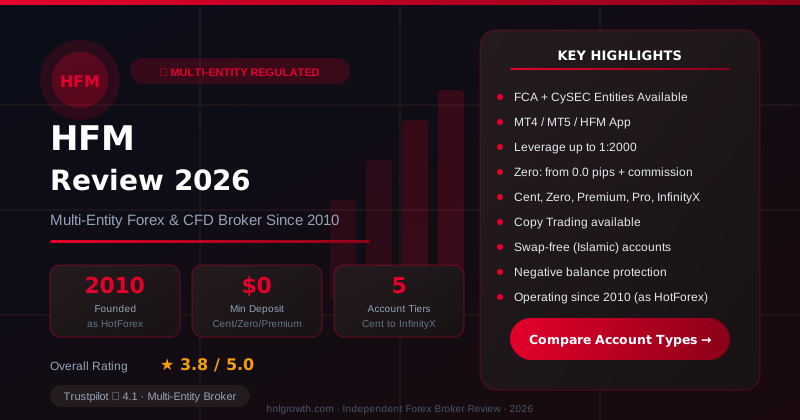
Checked on: 2026-08-08 | Broker terms, regulation, and pricing can change. Always verify at the official HFM site before opening an account.
Affiliate Disclosure: HNL Growth may earn a commission if you open an account through our links, at no additional cost to you. Risk Warning: CFDs and leveraged forex products are complex instruments and carry a high risk of losing money rapidly due to leverage. Between 65-95% of retail investor accounts lose money when trading CFDs, depending on the HFM entity and account type. Trading forex and CFDs may not be suitable for all investors. Consider your objectives, experience, and risk appetite before trading, and ensure you understand the risks involved. Broker Disclosure: HFM (HF Markets Group) is a live, regulated multi-entity broker (not a simulated prop-firm evaluation) — trades are executed with real capital in live market conditions, subject to normal market risk. Protections vary significantly by the specific legal entity that onboards your account.
Forex Economic Calendar: How to Trade the Releases That Matter
Scheduled macroeconomic data releases are the most predictable source of forex volatility. An economic calendar is a real-time schedule of these releases—interest rate decisions, inflation figures, employment reports, GDP—that lets traders anticipate when and where price movement is likely. This guide explains how to read calendar data, which indicators move major pairs the most, and how to integrate release awareness into your trade planning on HFM's platform.
The goal is not to predict the direction of a release but to prepare for the volatility it creates. Understanding the gap between a consensus forecast and the actual result—the "surprise"—is what separates traders who get caught in whipsaws from those who use scheduled events to frame their risk.
Using an Economic Calendar Alongside Your HFM Trading
HashHedge — Crypto Futures Prop Firm
Up to $200K funded accounts · 85% profit split · Instant USDT payouts · 160+ assets
HFM's trading ecosystem runs on MetaTrader 4, MetaTrader 5, the HFM WebTrader, and the HFM mobile app. These platforms focus on execution and charting rather than embedding a full-featured economic calendar. Most HFM traders supplement their workflow with a dedicated calendar tool—such as those offered by Investing.com, Trading Economics, or Myfxbook—and use the calendar as one input alongside their HFM chart analysis and order management.
This is a common setup. A standalone calendar provides filterable event tables, real-time actual-vs-consensus updates, and historical data depth. Your HFM account handles execution. The two tools work together: the calendar tells you when volatility is likely, and your platform lets you act on it.
Disclosure: This page may contain affiliate links. We may earn a commission if you open an account through our links, at no extra cost to you.
Open an HFM demo account to practice trading around scheduled releases
How to Read the Numbers That Move Markets
Every economic calendar entry shares the same core columns. Understanding them is the foundation of news-aware trading.
| Column | What It Shows | Why It Matters |
|---|---|---|
| Previous | The last published value for this indicator | Provides the trend baseline. Note: previous values are frequently revised, which can change the narrative. |
| Consensus | The median forecast from surveyed economists | The market has already priced this number in. It is the benchmark for measuring surprise. |
| Actual | The officially released figure | The number that triggers price movement when it deviates from consensus. |
| Deviation | Actual minus consensus | The volatility trigger. Larger deviations produce larger initial moves. |
Concrete example: US CPI consensus is 3.2%. The actual release comes in at 3.5%. This is a hawkish surprise for the US dollar—it suggests higher inflation than expected, which raises expectations for tighter monetary policy. EUR/USD typically drops, USD/JPY typically rises, all else being equal.
Revision Awareness
Most calendars display the "previous" column as a static number. In reality, statistical agencies routinely revise prior readings. A seemingly strong actual print can be undermined if the previous value is revised downward simultaneously. For example, if NFP actual beats consensus but the prior month is revised lower by 30,000 jobs, the net picture is less bullish than the headline suggests. Always check whether revisions accompany the release.
What Impact Ratings Actually Tell You About Volatility
Calendar tools assign impact levels—usually low, medium, and high—to each event. These labels are editorial classifications, not precise volatility forecasts. Here is what they mean in practical terms:
| Impact Level | Spread Behaviour | Typical Reaction | Action Required |
|---|---|---|---|
| High | Spreads widen noticeably around the release, sometimes 3–5× normal for 1–5 minutes | Sharp initial move on major pairs, often 20–80+ pips within the first 15 minutes | Review open positions before the release. Widen stops, reduce size, or step aside. |
| Medium | Moderate spread widening, usually 1.5–2× normal | Measured move, often 10–30 pips. Direction may reverse within the hour. | Be aware. Adjust stops if holding through the event. |
| Low | Minimal spread impact | Limited or no reaction on majors. May affect exotics or crosses. | No action needed for most traders. |
These ranges are editorial assessments based on widely observed market behaviour around scheduled releases. They are not guarantees—actual volatility depends on the deviation magnitude, prevailing sentiment, and liquidity conditions at the time of release.
Session Overlap Context
The impact of a release depends on when it lands. A high-impact US release during the London/New York overlap (roughly 13:00–17:00 GMT) hits the deepest liquidity pool in the forex market, producing cleaner price action and tighter spreads than the same release during thin Asian-session hours. Releases that land outside major session hours carry higher slippage risk and wider spreads, making execution less predictable.
The Indicators That Consistently Move Major Pairs
Not all data releases are equal. The following tier system ranks indicators by their historical market-moving impact on EUR/USD, GBP/USD, and USD/JPY. This is an editorial classification based on widely accepted market knowledge, not a precise quantitative model.
Tier 1 — Central Bank Decisions and Policy Statements
Central bank rate decisions are the single highest-impact recurring events in forex. The major banks and their typical schedules:
| Central Bank | Meeting Frequency | Key Pairs Affected |
|---|---|---|
| US Federal Reserve (Fed) | 8 scheduled meetings per year | All USD pairs |
| European Central Bank (ECB) | Every 6 weeks | EUR/USD, EUR crosses |
| Bank of England (BoE) | 8 meetings per year | GBP/USD, GBP crosses |
| Bank of Japan (BoJ) | 8 meetings per year | USD/JPY, JPY crosses |
| Reserve Bank of Australia (RBA) | Monthly (except January) | AUD/USD, AUD crosses |
| Bank of Canada (BoC) | 8 meetings per year | USD/CAD, CAD crosses |
The rate decision itself often matters less than the accompanying policy statement and press conference. Forward guidance—signals about future rate direction—can sustain a move long after the initial reaction. A hold decision with hawkish language can move a pair more than a widely expected cut.
Tier 2 — Employment, Inflation, and GDP
These are the most-traded data points between central bank meetings.
| Indicator | Releasing Body | Frequency | Why It Matters |
|---|---|---|---|
| US Nonfarm Payrolls (NFP) | Bureau of Labor Statistics | Monthly (first Friday) | Employment is the Fed's dual-mandate pillar. NFP surprises historically produce the largest single-release moves on USD pairs. |
| US Consumer Price Index (CPI) | Bureau of Labor Statistics | Monthly | Direct inflation gauge. Drives rate-expectation repricing. |
| US GDP (advance estimate) | Bureau of Economic Analysis | Quarterly | Broadest measure of economic output. The advance estimate moves most because it is the first read. |
| Eurozone CPI (flash estimate) | Eurostat | Monthly | ECB's primary inflation target metric. |
| UK GDP and Employment | Office for National Statistics | Monthly/quarterly | Key inputs for BoE policy. GBP-sensitive. |
Tier 3 — Sentiment Surveys and Secondary Indicators
Lower individual impact but useful for building directional bias over time.
- PMI surveys (manufacturing and services) — forward-looking business sentiment, released monthly.
- Consumer confidence indices — measure household optimism. Modest individual impact.
- Retail sales — consumer spending gauge. Can surprise when consumer behaviour shifts unexpectedly.
Most active traders only need to track 8–12 releases per week relevant to their traded pairs. The tier system helps you filter signal from noise.
Trading the Release — Practical Approaches
Calendar awareness is not a standalone strategy. It is a risk-management layer that informs how you approach your existing setups.
Before the Release — Preparing for Scheduled Volatility
When a high-impact release is due within the next few hours:
- Review open positions. Ask whether your current stop-loss distance is sufficient if the pair moves 50–80 pips against you in minutes.
- Decide whether to hold, reduce, or close. There is no universally correct answer. Holding through a release keeps you exposed to slippage. Closing removes opportunity. Reducing position size is a common middle ground.
- Avoid placing new orders immediately before the release. Market execution on HFM's account types means fills occur at prevailing prices, and spreads widen during high-volatility windows. Entering before a release increases the cost of a bad fill.
- Identify key technical levels. Support, resistance, and moving averages provide reference points for where price may react after the initial spike.
After the Release — Reading the Reaction
The initial price spike after a release is often not the sustained move. A common pattern is a sharp reaction in the first 5–15 minutes, followed by a retracement or continuation as the market digests the full context—including revisions, forward guidance, and positioning adjustments.
A framework for post-release interpretation:
- Check the deviation. Did the actual number deviate significantly from consensus? Small deviations often produce noise rather than tradeable moves.
- Check revisions. Was the previous value revised? A strong headline can be offset by a downward prior revision.
- Wait for the 15-minute candle to close. The direction of the first completed 15-minute candle after a release is a more reliable signal than the initial spike, which is often liquidity-driven rather than conviction-driven.
- Assess the context. Does the release change the central bank outlook? A single CPI print matters less than whether it shifts the market's expectation for the next rate decision.
What to Look for in an Economic Calendar — Evaluation Framework
Whether you use a standalone calendar or a broker-integrated tool, these criteria determine whether a calendar is useful for active trading.
| Criterion | Why It Matters |
|---|---|
| Update speed | Actual values must appear within seconds of official release. Delayed data is useless for real-time decision-making. |
| Filter granularity | Ability to filter by currency, country, impact level, and date range lets you focus on relevant events only. |
| Historical data depth | Access to past releases with actual, consensus, and previous values enables back-testing of how releases moved your pairs. |
| Deviation tracking | Automatic calculation of actual-minus-consensus saves time and reduces interpretation errors. |
| Timezone support | Release times should display in your local timezone. Critical for traders outside major financial centres. |
| Alert functionality | Push or email notifications for upcoming high-impact events on your watched currencies. |
| Platform integration | How easily can you move from reading the calendar to placing a trade? Fewer tab switches reduce reaction time. |
Standalone calendars like Investing.com and Trading Economics tend to lead on historical data depth and update speed. Broker-integrated calendars (where available) offer workflow convenience. For HFM traders, the practical approach is to keep a reliable standalone calendar open alongside your MT4/MT5 or HFM WebTrader and use it as a scheduled-volatility overlay.
Calendar Alerts and Workflow Integration
Setting alerts for specific events or currencies prevents surprises. Most calendar tools allow you to:
- Flag individual events for push or email notification before the release.
- Set recurring alerts for specific indicators (for example, NFP every first Friday).
- Filter the calendar to show only events relevant to the currencies you trade.
On HFM's platforms, you can use the built-in market watch and charting tools to prepare your workspace ahead of a known release. When your calendar alert fires, your charts are already open on the relevant pairs with technical levels marked.
For mobile traders, the HFM app provides on-the-go access to your positions and charts, allowing you to monitor or adjust exposure when a release is imminent, even away from your desktop.
HFM Account Types and Trading Around News Events
HFM offers five account types—InfinityX, Cent, Zero, Pro, and Premium—all supporting MetaTrader 4, MetaTrader 5, HFM WebTrader, and the HFM mobile platform. Each account uses market execution, meaning orders fill at the best available price at the time of execution. During high-impact releases, this execution model interacts with widened spreads and increased volatility in ways traders should understand.
The Zero account advertises spreads from 0 pips on forex pairs, though zero-spread quotes are delayed and commissions apply. The Pro account lists spreads from 0.6 pips, the InfinityX account from 0.3 pips, and the Cent and Premium accounts from 1.4 pips. These are stated minimums under normal market conditions. Around high-impact news events, spreads on all account types widen temporarily as liquidity providers adjust their quotes to reflect increased uncertainty and order flow.
Maximum leverage across most HFM accounts is 1:2000, with the InfinityX account offering unlimited leverage under specific conditions. Higher leverage amplifies both potential gains and losses. During news-driven volatility, rapid price moves combined with leverage can exhaust margin quickly if positions are not sized appropriately. The margin call level on most accounts is set at 50%, with stop-out at 20%; on the InfinityX account, margin call occurs at 20% and stop-out at 0%.
Minimum deposits vary: the InfinityX account requires $500, the Pro account $100, while the Cent, Zero, and Premium accounts have no stated minimum. All accounts allow a minimum trade size of 0.01 lots and support up to 500 simultaneous open orders (150 for the Cent account). Maximum position size is typically 60 standard lots per position, with the Cent account permitting up to 1,000 cent lots per position and 6,000 cent lots account-wide.
When trading around scheduled releases, traders commonly reduce position size, widen stop distances, or step aside entirely to avoid the combination of spread widening and rapid price movement. The choice depends on individual risk tolerance and the specific release. HFM's account structure does not restrict trading during news events, but the execution environment changes materially during the minutes surrounding high-impact data.
Frequently Asked Questions
What is an economic calendar?
An economic calendar is a schedule of upcoming macroeconomic data releases—such as interest rate decisions, employment reports, and inflation figures—organised by date, time, and country. Traders use it to anticipate when volatility is likely to increase.
How do I read actual, consensus, and previous values?
The "previous" column shows the last published reading. "Consensus" is the median economist forecast—the number the market has priced in. "Actual" is the official release. The difference between actual and consensus (the deviation) is what triggers price movement.
Which economic indicators move forex the most?
Central bank rate decisions and policy statements consistently produce the largest moves. Among data releases, US Nonfarm Payrolls, US CPI, and GDP advance estimates rank highest for impact on major pairs. See the tiered breakdown above for a full classification.
Does an economic calendar update in real time?
Most reputable calendars update actual values within seconds of the official release. Update speed varies by provider. Check your calendar's refresh mechanism—some require a manual page refresh while others auto-update.
Can a broker-provided calendar match a standalone tool?
It depends on the criteria that matter to you. Standalone calendars generally offer deeper historical data and faster updates. Broker-integrated calendars offer workflow convenience. Use the evaluation framework above to assess based on your priorities.
How many indicators should I track?
Most active traders focus on 8–12 releases per week relevant to their traded pairs. Use the tier system to prioritise Tier 1 and Tier 2 events for your currencies and treat Tier 3 as supplementary context.
Ready to trade with calendar awareness? Open an HFM demo account and practice managing positions around scheduled releases before committing real capital.
Risk warning: CFDs and leveraged forex products are complex instruments and carry a high risk of losing money rapidly due to leverage. Retail investor accounts lose money when trading CFDs with most providers; the exact percentage varies by HFM entity and account type. You should consider whether you understand how CFDs work and whether you can afford to take the high risk of losing your money. Check the entity, terms and investor protections that apply in your jurisdiction before opening an account or trading.
Ready to Start Your Funded Trading Journey?
Join traders backed by $11M+ in verified payouts and a 4.7/5 Trustpilot rating. Compare HashHedge challenge plans, drawdown rules, and payout terms — apply code ha25 for the current discount.
Risk disclaimer: Challenge fees are non-refundable if you breach the rules. Prop trading involves significant financial risk. Past performance in a simulated environment does not guarantee results on a funded account. Only purchase if you understand the rules fully and can afford to lose the fee. Affiliate disclosure: HNL Growth earns a commission when you purchase a HashHedge challenge through links on this page.