Forex Compounding Calculator: How Growth Actually Works
A forex compounding calculator projects how an account balance grows when you reinvest your trading profits instead of withdrawing them. Instead of adding the same flat amount every period, each new...
Reviewed using our forex & CFD broker review methodology
Checked on: 2026-08-17 | Broker terms, regulation, and pricing can change. Always verify at the official PU Prime site before opening an account.
Affiliate Disclosure: HNL Growth may earn a commission if you open an account through our links, at no additional cost to you. Risk Warning: CFDs and leveraged forex products are complex instruments and carry a high risk of losing money rapidly due to leverage. 62.2% of retail investor accounts lose money when trading CFDs with this provider. Trading forex and CFDs may not be suitable for all investors. Consider your objectives, experience, and risk appetite before trading, and ensure you understand the risks involved. Broker Disclosure: PU Prime is a live, regulated multi-entity broker (not a simulated prop-firm evaluation) — trades are executed with real capital in live market conditions, subject to normal market risk. Which PU Prime entity holds your account depends on your country of residence and determines your leverage cap and protections.
Last verified: August 2026 | Editorial Team
Forex Compounding Calculator: How Growth Actually Works
A forex compounding calculator projects how an account balance grows when you reinvest your trading profits instead of withdrawing them. Instead of adding the same flat amount every period, each new gain is calculated on top of the previous, larger balance, which produces exponential rather than straight-line growth. That's the entire mechanic.
What it does not do is predict your future results. The calculator answers "what happens mathematically if my return rate stays constant," not "what will happen to my account." Real trading has losing weeks, variable position sizes, and drawdowns that a simple formula doesn't account for. Understanding that distinction, before you assume steady reinvestment guarantees steady growth, is the actual point of this guide.
What a Forex Compounding Calculator Shows, in Plain Terms
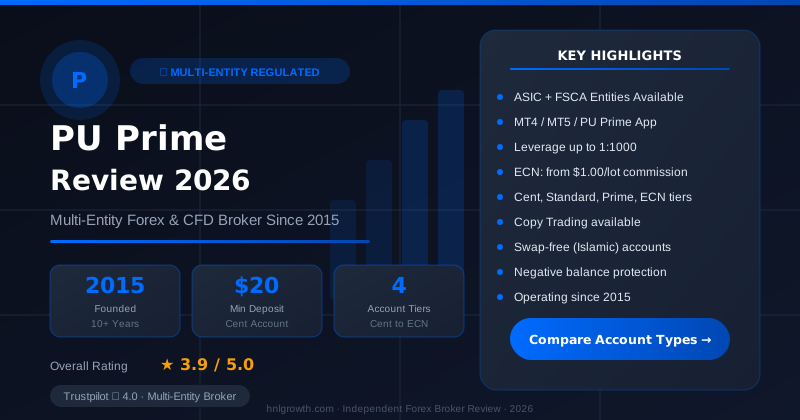
PU Prime — Multi-Entity Forex & CFD Broker
ASIC (AU) + FSCA (ZA) entities available · $20 min deposit (Cent) · MT4, MT5, PU Prime App · 4 account tiers
In forex trading, compounding means reinvesting your profits by increasing your position size on future trades, rather than withdrawing gains and trading the same fixed amount every time. This is different from the compound interest you'd earn on a savings account or bond, where a bank credits interest at a fixed, contractual rate. In trading, the "rate" is not guaranteed by anyone. It's whatever your strategy happens to produce that period, and it can be negative.
A compounding calculator takes three inputs: your starting balance, a gain percentage per period (weekly, monthly, whatever cycle you choose), and the number of periods you want to project. It then applies each gain to the new, larger balance rather than the original one, and shows you the resulting curve.
The single most important thing to understand about this output is that it's a scenario, not a projection. It shows you the arithmetic consequence of a specific assumption, constant, positive returns, repeated indefinitely. No live trading account behaves that way. Every worked number in this article, and in any compounding calculator you use, should be read as "here's what the math does under these assumptions," not "here's what your account will do."
How It Works: The Formula and a Worked Example
The compounding formula is straightforward:
End Balance = Start Balance × (1 + r)^n
Where:
- Start Balance is the capital you begin with
- r is the gain rate per period, expressed as a decimal (a 4% monthly gain is 0.04)
- n is the number of periods you're compounding over
The exponent is where the effect comes from. A single 4% gain is just 4%. But a 4% gain repeated six times, each one calculated on the previous balance, compounds to noticeably more than a flat 24%.
Here's a worked example using a $2,000 starting balance and a hypothetical, illustrative 4% monthly gain, reinvested in full each month:
| Month | Start Balance | Gain (4%) | End Balance |
|---|---|---|---|
| 1 | $2,000.00 | $80.00 | $2,080.00 |
| 2 | $2,080.00 | $83.20 | $2,163.20 |
| 3 | $2,163.20 | $86.53 | $2,249.73 |
| 4 | $2,249.73 | $89.99 | $2,339.72 |
| 5 | $2,339.72 | $93.59 | $2,433.31 |
| 6 | $2,433.31 | $97.33 | $2,530.64 |
After six months, the reinvested balance reaches $2,530.64. That's the compounding effect: each month's gain is a little larger than the last because it's calculated on a growing base.
Now compare that to withdrawing the profit every month instead of reinvesting it. If you took the $80 gain out each month and kept trading the original $2,000, your account balance would stay flat, but your total wealth (balance plus cash withdrawn) would still grow, just linearly:
| Month | Reinvested Balance | Withdrawn: Account Balance | Withdrawn: Cash Taken Out | Withdrawn: Total Value |
|---|---|---|---|---|
| 1 | $2,080.00 | $2,000.00 | $80.00 | $2,080.00 |
| 2 | $2,163.20 | $2,000.00 | $160.00 | $2,160.00 |
| 3 | $2,249.73 | $2,000.00 | $240.00 | $2,240.00 |
| 4 | $2,339.72 | $2,000.00 | $320.00 | $2,320.00 |
| 5 | $2,433.31 | $2,000.00 | $400.00 | $2,400.00 |
| 6 | $2,530.64 | $2,000.00 | $480.00 | $2,480.00 |
At month six, reinvesting produced $2,530.64 in total value versus $2,480.00 from withdrawing every month, a $50.64 difference under these specific, hypothetical assumptions. The gap looks small over six months because it compounds gradually; it becomes far more visible over a year or more, precisely because the exponent keeps growing. Neither column is a forecast of what a real strategy would return. Both assume the same fixed 4% gain, every single period, with no losing months, which no live trading strategy delivers consistently.
Disclosure: This page may contain affiliate links. We may earn a commission if you open an account through our links, at no extra cost to you.
If you want to see how these numbers move with your own inputs before you consider funding an account, it's worth running a few scenarios first. Open a PU Prime demo account to test position sizing and reinvestment concepts with virtual funds before any real capital is involved.
Where the Growth Curve Breaks Down: Risk and Who This Isn't For
The math above assumes every period is a winner. That assumption is the biggest gap between a compounding calculator and reality, and it works against you just as powerfully as it works for you.
A loss doesn't require an equal-sized gain to recover. It requires a larger one, because the percentage is calculated on a smaller remaining balance. This asymmetry is the main reason beginners underestimate how damaging a bad drawdown period actually is:
| Loss | Gain Required to Recover |
|---|---|
| 5% | 5.3% |
| 10% | 11.1% |
| 15% | 17.6% |
| 20% | 25.0% |
| 50% | 100.0% |
A 20% drawdown doesn't need a 20% recovery, it needs a 25% gain just to get back to even. A 50% drawdown needs your account to double. This is why a strategy that occasionally posts large gains but also takes large losses tends to compound worse over time than one that produces smaller, steadier returns with tight risk control.
This is also where compounding as a strategy stops being appropriate for certain accounts and approaches:
- Undercapitalized accounts. If your starting balance is small relative to your trading costs and typical position size, a single losing streak can wipe out the base you're trying to compound.
- High-drawdown or highly leveraged strategies. If your approach regularly produces double-digit percentage swings, reinvesting profits into larger positions amplifies both the gains and the losses. The recovery math above gets worse, not better, at higher leverage.
- Anyone targeting an unrealistic monthly rate. Professional fund managers commonly target in the range of 15–20% annually, not monthly, according to PU Prime's own forex compounding calculator guide. A target of 5% or more per month, compounded, implies an annual return that sits far above what experienced, regulated fund managers typically achieve. Treat any monthly figure in that range as an assumption to stress-test, not a plan to build around.
None of this means compounding is a flawed concept. It means the calculator's output is only as good as the return assumption you feed it, and beginners routinely feed it numbers that no consistent trading track record supports.
Common Mistakes Beginners Make When Modelling Compounding
A few patterns show up repeatedly when new traders first play with a compounding calculator:
- Assuming a fixed win rate with no losing periods. Every calculator output assumes constant gains. Real accounts have losing weeks and losing months, sometimes several in a row. Modeling only the winning scenario sets an expectation that reality won't meet.
- Ignoring drawdown entirely. It's easy to focus on the upward curve and skip the question of what happens if the account drops 15% or 20% before it starts compounding again. The recovery math table above is the check most beginners skip.
- Over-leveraging to hit a target compounding rate. If a realistic strategy only produces 2-3% a month, increasing position size to force a 10% month doesn't create a better strategy, it just increases the size of the eventual loss.
- Ignoring trading costs. The rate you enter into a calculator is a gross assumption. In practice, spreads and commissions reduce the return actually realized on each trade. Cost structures differ by account type, for example, PU Prime's Standard account trades on spread only with no commission, while its Prime and ECN accounts add a per-lot commission in exchange for tighter raw spreads (see PU Prime's trading costs page for the current figures by instrument and account type). A gain rate that looks achievable before costs may be considerably harder to sustain after them.
- Treating the output as a forecast. This is the mistake underlying most of the others. The number at the bottom of a compounding table is what the formula produces under a fixed assumption, not a projection of what your account will actually be worth.
Practising the Concept on a Demo Account
Because a compounding calculator is only useful once you have a realistic return rate to put into it, and the only reliable way to find that rate is to trade and track your actual results over time, a demo account is the practical next step for a beginner.
According to PU Prime's account opening guide, opening a live account involves registering, submitting identity and address verification documents, and funding the account, a process that typically takes 10 to 15 minutes of active work plus a verification period. While that verification is in progress, PU Prime notes that a demo account can usually be opened and used with virtual funds on real market prices, which is a useful window to start testing position sizing and reinvestment behavior without financial risk. Demo accounts run on the same MetaTrader 4 or MetaTrader 5 platforms used for live trading.
The practical way to use this: trade on a demo for a period, whether a few weeks or a few months, and record your actual average gain (or loss) per period. Feed that real number into a compounding calculator instead of a guessed or aspirational one. That gives you a scenario grounded in your own trading behavior rather than a number picked because it looked achievable.
Account type also matters once you move to live trading, since minimum deposits and cost structures differ. PU Prime lists a Cent account starting at a $20 minimum deposit and a Standard account starting at $50, with Prime and ECN accounts requiring larger minimum deposits in exchange for lower per-trade spreads, per its account opening guide. Whichever entity or account you open under, confirm the specific regulatory protections that apply to you. PU Prime operates under multiple licenses depending on the entity, including the Financial Services Authority of Seychelles, the Financial Services Commission of Mauritius, the Financial Sector Conduct Authority of South Africa, and the Capital Markets Authority of the UAE, and the entity and protections that apply depend on your jurisdiction (see PU Prime's regulation page for details relevant to your location).
What to verify yourself before funding a live account:
- Which PU Prime entity and license applies to your country of residence
- The current minimum deposit and spread/commission structure for the account type you're considering
- Whether your jurisdiction permits access to the broker at all
- The exact verification documents required for your account (government ID and proof of address are standard)
FAQ
What is a forex compounding calculator? It's a tool that projects how a trading account balance changes over time if you reinvest each period's profit rather than withdraw it. You enter a starting balance, a gain rate per period, and a number of periods, and it applies each gain to the growing balance instead of the original one.
What monthly return should I consider realistic? There's no universal figure that applies to every trader, and no broker can honestly promise one. As a general reference point, professional fund managers commonly target annual returns in the range of 15-20%, which works out to a low single-digit percentage per month when averaged, well below figures like 5% or 10% monthly that are sometimes used as calculator inputs. Treat any higher monthly figure as aggressive and stress-test it against the recovery math above before assuming it's sustainable.
How does withdrawing profits change the compounding effect? Withdrawing profit each period keeps your trading balance flat, so future gains are calculated on the same starting amount rather than a growing one. Your total wealth (balance plus cash withdrawn) still increases, but linearly rather than exponentially. The comparison table earlier in this article shows the gap under one set of hypothetical assumptions.
Is compounding a strategy or just a math concept? It's a reinvestment mechanic, not a trading strategy on its own. Compounding describes what happens to your balance if you keep putting profits back into the account; it says nothing about how those profits are generated. The quality of your underlying trading approach, and your risk management, determines whether there's anything consistent to compound.
Can I lose money even while compounding? Yes. Compounding works in both directions. A losing period reduces your balance just as a winning period increases it, and because percentage losses are calculated on a shrinking base, they're proportionally harder to recover from than they were to create, as shown in the recovery math table above.
Who shouldn't rely on a compounding calculator's projections? Anyone using an unrealistic input rate, anyone trading a strategy with large, frequent drawdowns, and anyone undercapitalized relative to their position sizing. In each case, the calculator's smooth curve is likely to diverge sharply from what actually happens to the account.
Risk Warning
Risk warning: CFDs and leveraged forex products are complex instruments and carry a high risk of losing money rapidly due to leverage. Consider whether you understand how these products work and whether you can afford to take the high risk of losing your capital. Check the entity, terms and protections that apply in your jurisdiction before trading.
Ready to Compare PU Prime Account Types?
PU Prime is a multi-entity broker — ASIC (Australia) and FSCA (South Africa) regulated entities offer stronger oversight, while most international clients are onboarded to the FSA Seychelles or FSC Mauritius entities. Four account tiers (Cent, Standard, Prime, ECN) range from a $20 minimum deposit to full ECN pricing.
Risk disclaimer: PU Prime is a live, regulated multi-entity broker — trading forex and CFDs is done with real capital under normal market risk (this is not a simulated prop-firm evaluation). PU Prime operates under multiple separate licenses (ASIC, FSCA, FSA Seychelles, FSC Mauritius); which entity holds your account depends on your country of residence and determines your leverage cap and protections — confirm this before funding. CFDs and leveraged forex products are complex instruments and carry a high risk of losing money rapidly due to leverage; 62.2% of retail investor accounts lose money when trading CFDs with this provider. Consider whether you understand how CFDs/forex work and whether you can afford the high risk of losing your money. Affiliate disclosure: HNL Growth earns a commission when you open a PU Prime account through links on this page.