Is Forex Investment Worth It? Returns, Risk and Reality
Forex investment — in practice, trading currency pairs as CFDs — can generate real returns, but the honest answer to 'is it worth it?' depends on three things: the cost of each trade, how leverage is...
Reviewed using our forex & CFD broker review methodology
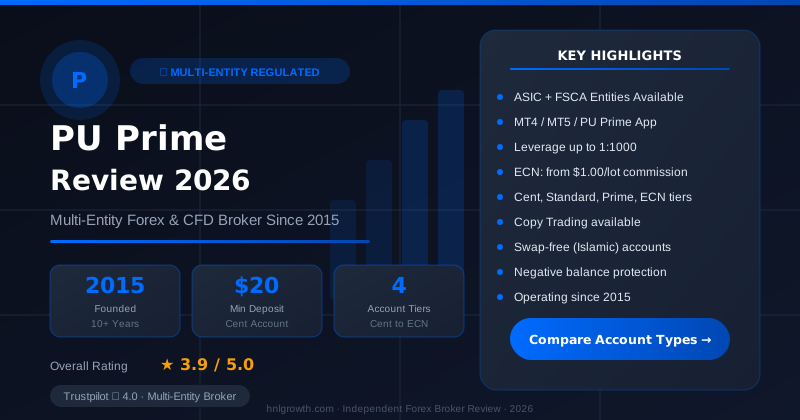
Checked on: 2026-08-17 | Broker terms, regulation, and pricing can change. Always verify at the official PU Prime site before opening an account.
Affiliate Disclosure: HNL Growth may earn a commission if you open an account through our links, at no additional cost to you. Risk Warning: CFDs and leveraged forex products are complex instruments and carry a high risk of losing money rapidly due to leverage. 62.2% of retail investor accounts lose money when trading CFDs with this provider. Trading forex and CFDs may not be suitable for all investors. Consider your objectives, experience, and risk appetite before trading, and ensure you understand the risks involved. Broker Disclosure: PU Prime is a live, regulated multi-entity broker (not a simulated prop-firm evaluation) — trades are executed with real capital in live market conditions, subject to normal market risk. Which PU Prime entity holds your account depends on your country of residence and determines your leverage cap and protections.
Last verified: August 2026 | Editorial Team
Is Forex Investment Worth It? Returns, Risk and Reality
Disclosure: This page may contain affiliate links. We may earn a commission if you open an account through our links, at no extra cost to you.
Forex investment — in practice, trading currency pairs as CFDs — can generate real returns, but the honest answer to "is it worth it?" depends on three things: the cost of each trade, how leverage is applied, and the regulatory standing of the broker you use. Retail forex CFDs are not a savings product or a low-risk investment vehicle. Studies consistently show the majority of retail CFD traders lose money. Whether it is worth trying depends on your capital position, risk tolerance, time commitment, and willingness to study market conditions before risking real money. This article covers each factor without promotional gloss.
Quick Verdict
PU Prime — Multi-Entity Forex & CFD Broker
ASIC (AU) + FSCA (ZA) entities available · $20 min deposit (Cent) · MT4, MT5, PU Prime App · 4 account tiers
Editorial assessment — not broker data. Ratings reflect general characteristics of retail forex CFD trading for beginners.
| Dimension | Rating | What it means in practice |
|---|---|---|
| Return potential | Medium | Outsized gains are possible but far from typical; consistent profitability requires skill, discipline, and time |
| Loss risk | High | Leverage amplifies losses; most retail CFD accounts lose money overall |
| Entry cost | Medium | Spreads and overnight swaps are real costs that must be overcome before profit appears |
| Regulatory protection | Varies | Depends entirely on which broker entity covers your jurisdiction; tier-1 licences offer stronger protections |
| Complexity for beginners | High | Margin mechanics, swap costs, and leverage management are not intuitive without study |
What Forex Investment Actually Involves
When people search "forex investment," they usually mean speculative trading on currency pairs — not holding foreign currency in a bank account or investing in a currency-hedged fund.
In practice, retail forex trading through a broker like PU Prime means trading contracts for difference (CFDs) on currency pairs such as EUR/USD, GBP/USD, or USD/JPY. You are not buying euros or selling dollars in any physical sense. You are entering a contract that pays you the price difference if the market moves in your favour, or debits your account if it moves against you.
Key mechanics to understand before depositing:
- Margin trading: You only need to post a fraction of the full trade value as collateral (margin). This is what enables leverage.
- No delivery: You never take possession of any currency.
- Both directions: CFDs allow you to profit from falling prices (short) as well as rising ones (long).
- Costs are continuous: You pay the spread each time you open or close a trade, and an overnight swap charge if you hold a position past the daily rollover time (usually 22:00 GMT).
This is meaningfully different from converting currency at a bureau de change, investing in a forex ETF, or placing money in a foreign currency savings account. The risk profile and cost structure are distinct.
Return Expectations and Loss Reality
The most widely cited fact about retail forex trading is that the majority of retail CFD accounts lose money. This is not broker scepticism — it is a regulatory disclosure requirement. Brokers regulated in the EU and UK under ESMA and FCA rules must publish the percentage of their retail client accounts that lose money on CFDs. Check the specific loss-rate figure published in PU Prime's own risk disclosure or website footer; this figure was not confirmed at time of writing and must be checked on the official site before relying on it.
What the data broadly shows across the industry:
- Loss rates for retail CFD traders typically range from roughly 70% to 80% of accounts, depending on broker, period, and product.
- Losses are concentrated among traders who use high leverage, hold positions without stop-losses, and trade without a clear strategy.
- Shorter time frames and higher leverage correlate with faster account depletion.
None of this means forex trading is uniformly unsuccessful. Some retail traders are consistently profitable. What distinguishes them from the majority is not market access — it is cost discipline (keeping the break-even move per trade small), leverage discipline (not overextending on any single position), and strategic consistency (not trading on impulse).
The realistic return ceiling for a disciplined retail trader is moderate by institutional standards. A 10–20% annual return on trading capital — net of all costs — would be considered good performance. Claims of 50–100% monthly returns are not realistic and should be treated as a red flag.
The honest frame: forex trading is a skill-based activity with real financial risk, not a passive investment product. Approach it like learning a craft with capital at stake, not like placing money in a diversified portfolio.
The Real Cost of a Forex Trade
Cost is the variable most beginners underestimate. Every trade has at least two cost components before any swap is considered: the spread (the difference between the buy and sell price, measured in pips) and, on some account types, a commission per lot.
PU Prime publishes its spread and cost information at puprime.com/spread-and-costs. The official page notes that "all values listed are for reference only" and directs traders to check MT4/MT5 or the PU Prime mobile app for the most accurate current values. Specific spread figures and commission rates are not reproduced here because the published page states they are for reference and subject to change; verify them directly on the platform before trading.
What the cost structure looks like conceptually:
| Cost component | Standard account | ECN account | Notes |
|---|---|---|---|
| Spread | Wider, no commission | Tighter raw spread | Check current indicative values on the spread-and-costs page or platform |
| Commission per lot | None | Charged per lot per side | Commission applies in addition to spread on ECN |
| Overnight swap | Variable | Variable | Direction and magnitude depend on interest rate differential; check live rates on MT4/MT5 or the PU Prime app |
| Break-even move required | Must exceed round-trip spread cost | Must exceed spread plus round-trip commission | You must overcome total cost before any profit registers |
Illustrative cost scaling by position size (spread-cost component only):
The spread cost on any position scales directly with lot size. As a structural illustration: on a hypothetical 1.0 pip all-in spread, the cost per round trip is approximately $10 per standard lot (100,000 units), $1 per mini lot (10,000 units), and $0.10 per micro lot (1,000 units). The actual spread applicable to your account and instrument must be confirmed on the PU Prime platform at the time of trading.
These numbers look small in isolation. The problem emerges with frequency: a trader making many round trips per week at meaningful lot sizes can consume a significant fraction of their account in spread and commission before a single profitable outcome. Against a small trading account, accumulated transaction costs represent a high bar to overcome.
Overnight swap adds a further variable. If you hold a EUR/USD long position overnight and the euro carries a lower interest rate than the dollar, you pay swap. The rate fluctuates with central bank policy. Check the live swap rate on MT4/MT5 or the PU Prime app before holding positions overnight.
Leverage: Opportunity and Risk in One Number
Leverage is the defining mechanic of retail forex CFDs. It is the reason small accounts can control large positions — and the reason small adverse moves can eliminate a large fraction of your capital.
Under FCA (UK) and ESMA (EU) rules, retail clients at tier-1 regulated entities are capped at 1:30 leverage on major currency pairs. Some offshore-regulated entities offer higher leverage. Higher leverage is not inherently better — it amplifies losses at the same rate as it amplifies gains. The leverage available on your account depends on which PU Prime entity covers your jurisdiction; confirm this on the regulation page.
Leverage risk table: 1% adverse move on a £500 deposit
Illustrative calculations only — not a forecast or guarantee. Actual outcomes depend on position size, pair, and margin call policy. The leverage ratios shown cover the range from the FCA/ESMA retail cap to levels available at some offshore entities; confirm what applies to your specific account and entity.
| Leverage ratio | Notional position size | Loss on 1% adverse move | Capital remaining |
|---|---|---|---|
| 1:30 (FCA/ESMA retail cap for majors) | £15,000 | £150 | £350 (30% of deposit lost) |
| 1:100 | £50,000 | £500 | £0 (account wiped) |
| 1:500 | £250,000 | £2,500 | Negative before this point — margin call would trigger earlier |
Three things the table demonstrates:
- At 1:30, a 1% move against you costs 30% of your deposit. EUR/USD moves 1% in a day with some regularity.
- At 1:100, the same move wipes a £500 account entirely.
- At 1:500, theoretical losses exceed the deposit — which is why negative balance protection matters. Confirm whether it applies to the entity covering your account before depositing.
Traders using higher-leverage offshore entities take on additional risk exposure compared with those covered by FCA/ESMA-equivalent retail caps. This is a statement of structural fact, not a recommendation for or against any entity.
PU Prime Account Options for Beginners
PU Prime offers four account types. Based on the account-opening page, the confirmed minimum deposits are $20 for the Cent account and $50 for the Standard account. The page also describes ECN as available; the minimum deposits for Prime and ECN accounts should be confirmed directly on the official site, as these details were not fully specified in the sourced documentation reviewed for this article.
Account overview (source: PU Prime account-opening page)
| Feature | Cent account | Standard account | Notes on Prime and ECN |
|---|---|---|---|
| Confirmed minimum deposit | $20 | $50 | Confirm minimums for Prime and ECN on the official site |
| Position sizing | Denominated in cents | Standard lot sizes | Cent is designed for minimal real-money exposure |
| Commission | None (spread-based) | None (spread-based) | ECN accounts carry per-lot commission; confirm rates on platform |
| Platforms available | MT4, MT5, PU Prime app | MT4, MT5, PU Prime app | All account types use the same platforms |
| Best for | Testing strategies with minimal capital at risk | Beginners; commission-free simplicity | Higher-volume traders may benefit from ECN raw spreads |
For most beginners, Standard is the rational starting point. The $50 minimum deposit is accessible, the commission-free structure is straightforward to model, and spread costs are predictable in direction even if variable in magnitude. ECN accounts make cost sense only at higher trading volumes where the raw spread advantage outweighs the per-lot commission.
The Cent account is a useful intermediate step between a demo account and full live trading. It uses real market prices and real money, but the cent-denomination means a $20 deposit behaves as if it were $0.20 in standard terms, limiting downside while preserving the psychological reality of live trading.
All account types are accessible via MetaTrader 4, MetaTrader 5, and the PU Prime mobile app. MT5 is the newer platform and offers more order types and analytical tools; MT4 remains widely used and well-documented for automated trading strategies.
A demo account is available and does not require a deposit. It uses live market prices and is the lowest-friction way to understand execution mechanics before committing capital.
Open a PU Prime demo or live account
Regulation and Client Protection
PU Prime operates through multiple regulated entities covering different jurisdictions. The regulation page states that PU Prime is "authorised and regulated by several financial authorities" and that licences "ensure PU Prime adheres to strict standards of transparency, client fund protection, and operational integrity." The page also states that client funds are protected and that compliance processes are audited. Full regulatory details, including the specific entities and licence numbers, are available on that page.
What the regulation page confirms at the level available in the sourced excerpt:
- PU Prime is regulated by multiple financial authorities
- Client fund protection and transparent operational standards are stated commitments
- Audited compliance processes are in place
- Full licence details are published on the regulation page itself
What to verify directly on the regulation page before depositing:
- The specific regulatory entities and their jurisdictions that cover your account
- The licence numbers and their current status
- Whether negative balance protection applies to the entity covering your country of residence
- Whether client funds are held in segregated accounts under the applicable entity's rules
- What investor compensation or recourse is available under the applicable jurisdiction
Important structural context:
The regulation page states that "PU Prime and its affiliated entities are neither established nor operating in your home jurisdiction" for certain visitors, and confirms that some access is provided on a reverse-solicitation basis. This underlines the importance of confirming which entity applies to your account — protections vary by entity and jurisdiction.
Unlike FCA (UK) or ASIC (Australia) tier-1 regulated brokers, the entities available through PU Prime do not provide access to the UK's Financial Services Compensation Scheme (FSCS), which protects retail clients up to £85,000 if a broker becomes insolvent. This is a factual structural difference, not a disqualifying assessment, but it is material to understanding what recourse exists in an insolvency scenario.
Verify the current and complete regulatory details at puprime.com/regulation before making any deposit decision.
Funding, Withdrawing, and Getting Started
Based on information from the PU Prime account-opening page:
Account opening takes approximately 10–15 minutes of active work. You will need a government-issued ID (passport, national identity card, or driving licence) and proof of address dated within three months (utility bill or bank statement). Verification typically completes within a few hours on business days, though times can vary.
Confirmed minimum deposits:
- Cent account: $20
- Standard account: $50
- Prime and ECN accounts: confirm on the official site
Funding methods confirmed on the account-opening page include credit cards, debit cards, bank wire transfer, Skrill, and Neteller, as well as local payment methods (availability varies by region). Card and e-wallet deposits typically arrive immediately. Bank transfers take 1–3 business days.
Withdrawals: The account-opening page confirms withdrawals are available but does not specify processing times or minimum amounts with precision. As a general practice, withdrawals are processed back to the original funding method. Verify current processing times, any minimum withdrawal amounts, and any fees directly via the PU Prime funding page or customer support before relying on specific timeframes.
What to check before your first deposit:
- Confirm the payment methods available in your country and whether currency conversion fees apply
- Confirm the withdrawal minimum and estimated processing time for your chosen method
- Confirm whether any promotional terms apply and what conditions must be met before accepting them
- Confirm which regulatory entity will hold your account and what protections apply
Is Forex Investment Right for You?
Forex CFD trading suits a specific type of person. It does not suit everyone, and framing it as universally accessible would be misleading.
Forex trading is more likely to be appropriate if:
- You have disposable capital you can afford to lose entirely — not savings, not borrowed money, not funds earmarked for expenses
- You can dedicate time to learning technical and/or fundamental analysis before trading live
- You can monitor open positions and act on stop-loss triggers without significant disruption to your life
- You are drawn to active, short-to-medium-term market participation, not passive long-term wealth accumulation
- You understand that losses are probable in the early phase of learning and you have budgeted for that
Forex trading is less likely to be appropriate if:
- You need your capital to be safe or available for other purposes
- You are looking for a steady income stream — forex returns are highly variable
- You cannot monitor the market during the sessions when your chosen pairs are most active
- You are considering using high leverage without substantial prior trading experience
- Your motivation is primarily the hope of large quick returns rather than interest in market mechanics
Self-qualification checklist:
| Question | If yes | If no |
|---|---|---|
| Can you afford to lose the full amount you plan to deposit? | Proceed with caution | Stop — do not deposit |
| Have you traded a demo account for at least a few weeks? | Reasonable to consider live trading | Open a demo first |
| Do you understand how overnight swap affects your position costs? | Continue | Study this before depositing |
| Can you set and leave stop-loss orders without overriding them on impulse? | Positive sign | Work on this in demo first |
| Do you understand which regulatory entity covers your account? | Proceed with confidence | Verify before depositing |
Forex vs Alternative Products
Structural comparison only — no return predictions or cherry-picked figures.
| Factor | Forex CFD | Shares CFD | Cash savings |
|---|---|---|---|
| Leverage available | Up to 1:30 (retail, major pairs, FCA/ESMA cap) or higher at offshore entities | Up to 1:5 (retail, FCA/ESMA cap) | None |
| Market hours | 24 hours, 5 days per week | Exchange hours only | N/A |
| Capital protection | None — losses can equal full deposit | None — losses can equal full deposit | FSCS up to £85,000 at UK-regulated banks |
| Minimum entry | From $20–$50 at accessible brokers | Varies by broker | Varies |
| Regulated product | Yes, if broker holds relevant licence | Yes, if broker holds relevant licence | Yes (bank deposits) |
| Loss floor | Full deposit (negative balance protection limits further loss at entities where it applies) | Full deposit | Zero (savings do not fall in value nominally) |
What We Could Not Verify
In the interest of editorial transparency, the following items could not be confirmed from official sources at time of writing and are therefore excluded or qualified in the body of this article:
- PU Prime's published retail CFD loss percentage: The risk warning figure must be taken from PU Prime's own disclosure or website footer — it is not estimated or borrowed from industry averages in this article. Check the current figure on the official site before relying on any number.
- Specific spread figures and commission rates: The spread-and-costs page states that published values are for reference only and directs traders to check the platform for current values. No specific spread or commission figures are quoted as current facts in this article for this reason.
- Exact overnight swap rates: Swap rates change with central bank policy and must be confirmed on MT4/MT5 or the PU Prime app at the time of trading.
- Negative balance protection by entity: The regulation page confirms client fund protection as a general commitment but per-entity confirmation of negative balance protection requires direct verification on the regulation page.
- Minimum deposits for Prime and ECN accounts: Only the Cent ($20) and Standard ($50) minimums are explicitly confirmed in the sourced account-opening documentation.
- Inactivity fees and account maintenance charges: Not confirmed from sourced official documentation; check the terms and conditions page.
- Exact withdrawal processing times and fees: Stated as available on official pages but specific figures were not confirmed in the sourced documentation; verify before depositing.
- Third-party review platform ratings: Any figures cited on external review platforms change continuously; verify on the live platform page at the time of reading before relying on any specific number or rating.
Frequently Asked Questions
How much money do I need to start forex trading with PU Prime? The Standard account requires a $50 minimum deposit, confirmed on the PU Prime account-opening page. The Cent account starts at $20 and is designed for those wanting minimal real-money exposure. You can also open a demo account with no deposit at all, which is the recommended starting point for complete beginners.
Is forex trading legal and regulated? Retail forex CFD trading is legal and regulated in most major markets. PU Prime holds licences from multiple financial regulators; the specific entities and jurisdictions are listed on the regulation page. Regulatory protections vary by entity — confirm which entity covers your country of residence and what protections apply to your account.
How do I avoid losing all my money in forex? No strategy guarantees against loss. The practices most associated with better outcomes are: sizing positions so that a single loss cannot wipe a large fraction of your account; always using stop-loss orders; trading with a defined plan rather than on impulse; and keeping leverage low, particularly while learning. Starting on a demo account before any live trading is strongly advisable.
What is the difference between a demo account and a live account? A demo account uses real market prices but virtual money. It is free, carries no financial risk, and is available immediately without verification. A live account uses your real deposited capital. The psychological experience differs significantly — losses feel different when they affect real money. Demo trading builds familiarity with the platform and cost mechanics; it does not replicate the emotional discipline required in live trading.
What are the tax implications of forex trading in the UK? In the UK, profits from CFD trading are generally subject to Capital Gains Tax (CGT). Spread betting (a separate product not offered by all brokers) is currently exempt from CGT and stamp duty for most UK retail traders. CFD trading profits may also be subject to income tax if trading is considered a business activity. Tax treatment depends on individual circumstances. Consult a qualified tax adviser for personal guidance. This article does not constitute tax advice.
How do I get started with PU Prime? Visit the account-opening page, register with your email and basic details, upload identity and address documents, wait for verification (typically a few hours on business days), then deposit and trade. The process takes approximately 10–15 minutes of active work.
Is forex trading suitable for someone with no financial background? There is no professional qualification requirement to open a retail forex account. However, brokers are required to assess your knowledge and experience of leveraged products as part of the account-opening process. A lack of financial background is not a barrier to entry, but it does increase the importance of spending time on education and demo trading before committing significant capital.
Risk Warning
Risk warning: CFDs and leveraged forex products are complex instruments and carry a high risk of losing money rapidly due to leverage. Consider whether you understand how these products work and whether you can afford to take the high risk of losing your capital. Check the entity, terms and protections that apply in your jurisdiction before trading.
The specific percentage of retail investor accounts that lose money when trading CFDs with PU Prime is published in their risk disclosure; check the current figure on the official PU Prime website before making any trading decision. Past performance is not indicative of future results. This article does not constitute financial advice.
Ready to Compare PU Prime Account Types?
PU Prime is a multi-entity broker — ASIC (Australia) and FSCA (South Africa) regulated entities offer stronger oversight, while most international clients are onboarded to the FSA Seychelles or FSC Mauritius entities. Four account tiers (Cent, Standard, Prime, ECN) range from a $20 minimum deposit to full ECN pricing.
Risk disclaimer: PU Prime is a live, regulated multi-entity broker — trading forex and CFDs is done with real capital under normal market risk (this is not a simulated prop-firm evaluation). PU Prime operates under multiple separate licenses (ASIC, FSCA, FSA Seychelles, FSC Mauritius); which entity holds your account depends on your country of residence and determines your leverage cap and protections — confirm this before funding. CFDs and leveraged forex products are complex instruments and carry a high risk of losing money rapidly due to leverage; 62.2% of retail investor accounts lose money when trading CFDs with this provider. Consider whether you understand how CFDs/forex work and whether you can afford the high risk of losing your money. Affiliate disclosure: HNL Growth earns a commission when you open a PU Prime account through links on this page.