Lot Sizes in Forex: Standard, Mini, Micro and Cent
A forex lot is a standardised batch size that determines how many units of a currency you buy or sell in a single trade. Four tiers exist — standard (100,000 units), mini...
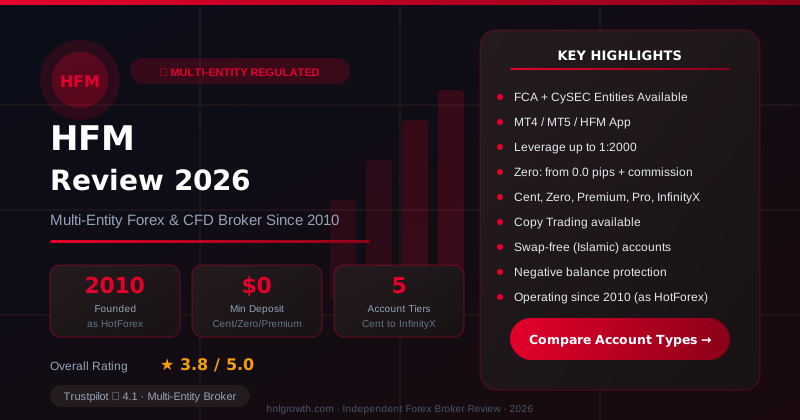
Checked on: 2026-08-07 | Broker terms, regulation, and pricing can change. Always verify at the official HFM site before opening an account.
Affiliate Disclosure: HNL Growth may earn a commission if you open an account through our links, at no additional cost to you. Risk Warning: CFDs and leveraged forex products are complex instruments and carry a high risk of losing money rapidly due to leverage. Between 65-95% of retail investor accounts lose money when trading CFDs, depending on the HFM entity and account type. Trading forex and CFDs may not be suitable for all investors. Consider your objectives, experience, and risk appetite before trading, and ensure you understand the risks involved. Broker Disclosure: HFM (HF Markets Group) is a live, regulated multi-entity broker (not a simulated prop-firm evaluation) — trades are executed with real capital in live market conditions, subject to normal market risk. Protections vary significantly by the specific legal entity that onboards your account.
Lot Sizes in Forex: Standard, Mini, Micro and Cent
A forex lot is a standardised batch size that determines how many units of a currency you buy or sell in a single trade. Four tiers exist — standard (100,000 units), mini (10,000), micro (1,000) and nano/cent (100) — and the lot size you choose directly controls how much money each pip movement is worth, making it the single most consequential decision a beginner makes before pressing "buy" or "sell." Understanding lot sizes is not about memorising numbers; it is about controlling risk before you ever place a trade.
Disclosure: This page may contain affiliate links. We may earn a commission if you open an account through our links, at no extra cost to you.
What "Lot Size" Means When You Trade Forex
HashHedge — Crypto Futures Prop Firm
Up to $200K funded accounts · 85% profit split · Instant USDT payouts · 160+ assets
Currencies are traded in standardised batches rather than one unit at a time. A "lot" is simply the unit of measure for that batch — like ordering flour by the kilo rather than by the grain. Without lots, every trade would require specifying an exact number of individual currency units, which would be impractical on a market that processes trillions of dollars daily.
When you open a trade on any platform, the "volume" or "size" field you see is asking for your lot size. Enter 1.00 and you are trading one standard lot. Enter 0.01 and you are trading one micro lot. That single input determines how much money you gain or lose for every pip the market moves.
The Four Lot Sizes — From Cent to Standard
There are four recognised lot-size tiers. Each one scales the trade by a factor of ten.
Standard Lot — 100,000 Units
Decimal notation: 1.00
One standard lot represents 100,000 units of the base currency. If you buy 1.00 lot of EUR/USD, you are buying 100,000 euros, priced in US dollars. For a pair like EUR/USD, each pip is worth roughly $10 per standard lot. A 10-pip move means $100 — up or down.
Standard lots suit traders with larger account balances who have already developed consistent risk management. For beginners, this size carries disproportionate risk.
Mini Lot — 10,000 Units
Decimal notation: 0.10
A mini lot is one-tenth of a standard lot — 10,000 units of the base currency. Each pip in EUR/USD is worth roughly $1 per mini lot. A 10-pip move means $10.
Mini lots are suitable for accounts in the low thousands of dollars. They allow meaningful position sizing without the dollar-per-pip exposure of a standard lot.
Micro Lot — 1,000 Units
Decimal notation: 0.01
A micro lot represents 1,000 units of the base currency. Each pip in EUR/USD is worth roughly $0.10 per micro lot. A 10-pip move means $1.
Micro lots are the recommended starting point for most beginners. They let you experience real market movement without large dollar exposure, which reduces the emotional pressure that leads to impulsive decisions.
Nano / Cent Lot — 100 Units
Decimal notation: 0.001
A nano lot represents 100 units of the base currency. Each pip in EUR/USD is worth roughly $0.01 per nano lot. A 10-pip move means $0.10.
Nano lots are an industry concept used on cent-account formats at some brokers. They are the smallest practical trade size and suit traders who want to test strategies with near-zero financial stakes. Note that not all brokers or account types support 0.001 lot increments — verify availability on your chosen platform before relying on nano lots for your plan.
Forex Lot Sizes at a Glance
| Lot Type | Decimal Notation | Units of Base Currency | Approx. Pip Value (EUR/USD) | Best Suited For |
|---|---|---|---|---|
| Standard | 1.00 | 100,000 | ~$10.00 | Experienced traders with large accounts |
| Mini | 0.10 | 10,000 | ~$1.00 | Intermediate traders, mid-size accounts |
| Micro | 0.01 | 1,000 | ~$0.10 | Beginners, small accounts, demo practice |
| Nano/Cent | 0.001 | 100 | ~$0.01 | Testing strategies, near-zero-risk learning |
Pip values are illustrative, calculated at an EUR/USD rate of approximately 1.0800. Actual pip value depends on the current exchange rate and the quote currency of the pair.
How Lot Size Changes What Each Pip Costs You
The reason lot size matters so much is that it directly sets the dollar value of each pip. A pip is the smallest standard price move in a forex pair — typically 0.0001 for most pairs, or 0.01 for JPY-quoted pairs.
Pip Value by Lot Size Across Three Pairs
| Lot Size | EUR/USD | USD/JPY | EUR/GBP |
|---|---|---|---|
| Standard (1.00) | ~$10.00 | ~$6.76 | ~$12.72 |
| Mini (0.10) | ~$1.00 | ~$0.68 | ~$1.27 |
| Micro (0.01) | ~$0.10 | ~$0.07 | ~$0.13 |
| Nano (0.001) | ~$0.01 | ~$0.01 | ~$0.01 |
Illustrative snapshot. EUR/USD ≈ 1.0800, USD/JPY ≈ 148.00, EUR/GBP ≈ 0.8550. JPY pip values reflect the 0.01 pip increment; all values are in USD equivalents and rounded.
This table shows a critical point that many beginners miss: pip value is not fixed. It depends on the pair's quote currency and the current exchange rate. The same 0.01 lot produces roughly $0.10 per pip on EUR/USD but roughly $0.07 per pip on USD/JPY.
Worked Example: EUR/USD
You buy 0.10 lots of EUR/USD (one mini lot) at 1.0800. The price rises to 1.0830 — a 30-pip move.
- Pip value per mini lot: ~$1.00
- 30 pips × $1.00 = $30 profit
If you had used 0.01 lots (one micro lot) instead:
- Pip value per micro lot: ~$0.10
- 30 pips × $0.10 = $3 profit
Same trade, same direction, same pip move. The only difference is the lot size — and the difference is tenfold.
Worked Example: USD/JPY
You buy 0.10 lots of USD/JPY at 148.00. The price rises to 148.20 — a 20-pip move (remember, JPY pairs use 0.01 as the pip).
- Pip value per mini lot on USD/JPY: ~$0.68
- 20 pips × $0.68 = ~$13.60 profit
Fractional Lot Notation Explained
Most platforms accept arbitrary decimal inputs. You are not limited to round numbers. Here is how fractional lots work:
- 0.05 lots = 5 micro lots (5 × 1,000 units = 5,000 units)
- 0.15 lots = 1 mini lot + 5 micro lots (10,000 + 5,000 = 15,000 units)
- 0.23 lots = 2 mini lots + 3 micro lots (20,000 + 3,000 = 23,000 units)
This flexibility means you can fine-tune your position size precisely — not just jump between 0.01, 0.10, and 1.00.
Work Out the Right Lot Size for Your Account
Choosing a lot size is not about picking the biggest trade you can afford. It is about risking a defined percentage of your account on each trade, based on your stop-loss distance.
The Risk-Based Lot Size Formula
Lot Size = (Account Balance × Risk %) ÷ (Stop-Loss in Pips × Pip Value per Pip)
This formula ensures your lot size is driven by your risk tolerance and trade structure — not by what sounds impressive.
Step-by-Step Calculation Walkthrough
Let's say you have a $500 account and want to risk 2% per trade. Your analysis says EUR/USD will rise, and your stop-loss is 25 pips.
- Calculate your risk in dollars: $500 × 0.02 = $10 (the most you are willing to lose)
- Find the pip value for a standard lot on EUR/USD: ~$10 per pip
- Apply the formula: $10 ÷ (25 pips × $10) = $10 ÷ $250 = 0.04 lots
So the correct lot size for this trade is 0.04 lots — four micro lots. At that size, each pip is worth ~$0.40. Twenty-five pips against you means a $10 loss, which is exactly 2% of your account.
What a Losing Trade Costs at Different Risk Levels ($500 Account)
| Risk per Trade | Lot Size Used | Stop-Loss (Pips) | Dollar Loss if Stopped Out | Remaining Balance |
|---|---|---|---|---|
| 1% | 0.02 | 25 | $5.00 | $495.00 |
| 2% | 0.04 | 25 | $10.00 | $490.00 |
| 5% | 0.10 | 25 | $25.00 | $475.00 |
This table makes the cost of overleveraging tangible. At 5% risk, a single stopped-out trade leaves you with $475 — and three consecutive losses would drop you to $425, a 15% drawback from a single string of trades.
Suggested Starting Lot Size by Account Balance
| Account Balance Range | Recommended Starting Lot | Why |
|---|---|---|
| Under $500 | 0.01 (micro) | Keeps dollar risk per trade at $0.50–$1.00, allowing many practice trades |
| $500–$10,000 | 0.01–0.05 (micro) | Allows flexible sizing while keeping risk at 1–2% per trade |
| Above $10,000 | 0.05–0.10 (micro to mini) | Room for mini lots once consistency is proven, still conservative |
These are starting points, not ceilings. The formula above should always be the final arbiter — not a round number you default to.
Practising lot-size calculations with real market prices before committing capital is the most reliable way to build confidence in position sizing. Open a HFM demo account to test the risk formula above against live price movement and verify that your calculated lot size produces the intended dollar risk when your stop-loss is hit.
Lot Size, Leverage and Margin — How They Connect
Leverage and lot size are related but separate concepts. Leverage determines how much margin your broker requires to open a position of a given lot size. It does not dictate how large your lot should be.
Margin is a deposit — money set aside from your account to keep a trade open. A higher leverage ratio means a smaller margin deposit is required for the same lot size. For example, at 1:100 leverage, one standard lot of EUR/USD might require roughly $1,080 in margin. At 1:500 leverage, the same lot requires roughly $216.
But here is the critical point: just because leverage lets you open a larger lot with less margin does not mean you should. Leverage reduces the barrier to entry — it does not reduce the risk per pip. A standard lot still costs $10 per pip regardless of whether the margin deposit was $216 or $1,080.
According to HFM's official account documentation, contract size is defined as 1 lot = 100,000 units, minimum trade size is 0.01 lot, and trade-size increments are 0.01 lot. Maximum leverage and other account-specific terms vary by HFM entity and the regulator under which you open your account — always confirm the terms for your specific jurisdiction before trading.
Lot Size and Overnight Swap Costs
Your lot size also affects overnight holding costs, known as swaps. Swap fees are calculated on the total notional value of your position, so a larger lot means a larger swap charge. If you hold 0.50 lots of EUR/USD overnight, the swap will be five times what it would be at 0.10 lots. For strategies that involve holding positions for days or weeks, swap costs can erode or exceed pip-based gains — always factor them into your sizing decision.
Five Lot-Size Mistakes That Cost Beginners Money
Confusing lot size with leverage. Leverage controls margin; lot size controls pip value. High leverage does not make a large lot "safe" — it makes the margin deposit smaller while the per-pip risk stays the same.
Ignoring stop-loss distance when sizing. A 10-pip stop-loss and a 50-pip stop-loss require very different lot sizes for the same dollar risk. Many beginners pick a lot size first, then place a stop-loss wherever it "looks right" — this inverts the correct order.
Always defaulting to 0.01 without checking pip value. 0.01 is a reasonable default on USD-quoted pairs, but on pairs where the quote currency is not USD, the pip value differs. Always confirm the actual pip value before placing the trade.
Scaling up lots after a winning streak. A few wins do not change your account risk model. Increasing lot size after wins is one of the most common paths to blowing an account. Your lot size should be recalculated from your current balance each trade, not from your emotions.
Not accounting for spread cost on small lots. The spread is your first cost when entering a trade. On very small lots, the spread may represent a meaningful percentage of your intended risk — especially on pairs with wider spreads. Factor the spread into your total risk before sizing.
A Step-by-Step Plan to Practise Lot Sizing on Demo
Before placing a live trade, work through these four stages on a demo account. There is no fixed timeline — move on only when you can execute the steps without hesitation.
Stage 1: Nano/micro lots on demo. Place 5–10 trades at 0.01 lot. Focus on correctly identifying the pip value, entering the lot size in the platform, and watching how P/L moves in real time. Do not worry about strategy — this is about the mechanics.
Stage 2: Formula-driven sizing on demo. Pick a $500 hypothetical balance. For each trade, calculate the correct lot size using the risk formula. Place 15–20 trades across EUR/USD, USD/JPY, and one cross pair. Track whether your actual loss when stopped out matches your intended risk dollar.
Stage 3: Micro lots on a small live account. Fund a small account — only what you can afford to lose entirely. Continue using 0.01 lots. The goal is to experience the emotional difference between demo and live execution, not to make money.
Stage 4: Mini lots only after consistent results. If you have 30+ live trades at micro-lot size with a risk-adjusted outcome you are satisfied with, consider scaling to 0.05 or 0.10 lots — and recalculate from your current balance each time.
Where to Find Lot-Size Controls in a Trading App
In most mobile trading platforms, including MetaTrader-based apps, lot size appears in the order-placement screen as a "Volume" field. You can usually tap a +/- stepper to adjust in 0.01 increments or type a value directly. Some platforms also offer a lot-type dropdown. Before placing your first trade, open the order screen, find the volume field, and confirm that the increments match what you expect — this prevents accidental over-sizing on a small screen.
FAQ: Lot-Size Questions Beginners Ask Most
What is a lot in forex?
A lot is a standardised batch of currency units. One standard lot equals 100,000 units; smaller tiers scale down by factors of ten. Lot size determines how much money each pip movement is worth.
What lot size should I use with a $100 account?
Use micro lots (0.01). At 2% risk ($2) with a 20-pip stop-loss, the correct lot size is approximately 0.01. Nano lots (0.001) would be ideal if your broker supports them, but micro lots are the practical minimum on most standard accounts.
How do I calculate lot size?
Use the formula: (Account Balance × Risk %) ÷ (Stop-Loss in Pips × Pip Value per Pip). This gives you the lot size that risks exactly your chosen percentage if your stop-loss is hit.
Is a micro lot profitable?
A micro lot can produce gains, but they are small by design — roughly $0.10 per pip on EUR/USD. Its purpose is not high returns but controlled risk during learning. Profitability depends on your strategy and win rate, not on the lot size itself.
Does leverage change my lot size?
No. Leverage changes how much margin you need to open a position. It does not change the pip value or the risk per pip. Higher leverage lets you open larger positions with less capital — which is exactly why it increases risk.
What is the difference between lot size and position size?
Lot size is the unit measure (standard, mini, micro). Position size is the total exposure of your trade — lot size multiplied by the number of lots. In practice, traders use the terms interchangeably, but "position size" also includes the broader context of your total portfolio exposure.
Risk Warning
Risk warning: CFDs and leveraged forex products are complex instruments and carry a high risk of losing money rapidly due to leverage. Consider whether you understand how these products work and whether you can afford to take the high risk of losing your capital. Check the entity, terms and protections that apply in your jurisdiction before trading.
According to HFM's official documentation, contract size is defined as 1 lot = 100,000 units, minimum trade size is 0.01 lot, and trade-size increments are 0.01 lot. Leverage, margin requirements, and other trading conditions vary by HFM entity and regulator. Always review the specific terms for your account type and jurisdiction before placing a trade.
Risk warning: CFDs and leveraged forex products are complex instruments and carry a high risk of losing money rapidly due to leverage. Retail investor accounts lose money when trading CFDs with most providers; the exact percentage varies by HFM entity and account type. You should consider whether you understand how CFDs work and whether you can afford to take the high risk of losing your money. Check the entity, terms and investor protections that apply in your jurisdiction before opening an account or trading.
Ready to Start Your Funded Trading Journey?
Join traders backed by $11M+ in verified payouts and a 4.7/5 Trustpilot rating. Compare HashHedge challenge plans, drawdown rules, and payout terms — apply code ha25 for the current discount.
Risk disclaimer: Challenge fees are non-refundable if you breach the rules. Prop trading involves significant financial risk. Past performance in a simulated environment does not guarantee results on a funded account. Only purchase if you understand the rules fully and can afford to lose the fee. Affiliate disclosure: HNL Growth earns a commission when you purchase a HashHedge challenge through links on this page.