The Forex Market Explained: Sessions, Participants and How Prices Move
The foreign exchange market — forex for short — is a global, decentralised network where currencies are bought and sold around the clock. There is no physical building, no single exchange, and no...
Reviewed using our forex & CFD broker review methodology
Checked on: 2026-08-17 | Broker terms, regulation, and pricing can change. Always verify at the official PU Prime site before opening an account.
Affiliate Disclosure: HNL Growth may earn a commission if you open an account through our links, at no additional cost to you. Risk Warning: CFDs and leveraged forex products are complex instruments and carry a high risk of losing money rapidly due to leverage. 62.2% of retail investor accounts lose money when trading CFDs with this provider. Trading forex and CFDs may not be suitable for all investors. Consider your objectives, experience, and risk appetite before trading, and ensure you understand the risks involved. Broker Disclosure: PU Prime is a live, regulated multi-entity broker (not a simulated prop-firm evaluation) — trades are executed with real capital in live market conditions, subject to normal market risk. Which PU Prime entity holds your account depends on your country of residence and determines your leverage cap and protections.
Last verified: August 2026 | Editorial Team
The Forex Market Explained: Sessions, Participants and How Prices Move
Disclosure: This page may contain affiliate links. We may earn a commission if you open an account through our links, at no extra cost to you.
The foreign exchange market — forex for short — is a global, decentralised network where currencies are bought and sold around the clock. There is no physical building, no single exchange, and no central controller. Instead, banks, institutions, and retail traders connect through electronic networks to trade currency pairs. According to the Bank for International Settlements (BIS) Triennial Central Bank Survey (2022 edition), average daily turnover reached approximately $7.5 trillion — making it the largest financial market in the world by volume. Retail traders access it through online brokers, paying costs primarily through the spread between buy and sell prices. Leverage amplifies both gains and losses, which is why understanding the basics before placing a single trade matters.
Ready to practise without risking real money? Open a PU Prime demo account — no deposit required to get started.
What the Forex Market Actually Is
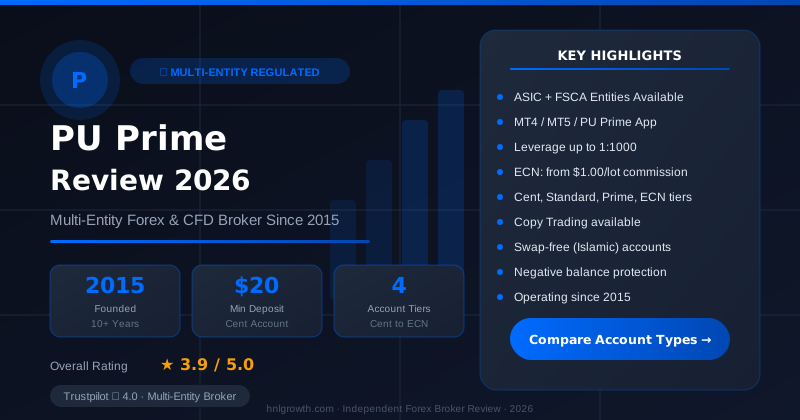
PU Prime — Multi-Entity Forex & CFD Broker
ASIC (AU) + FSCA (ZA) entities available · $20 min deposit (Cent) · MT4, MT5, PU Prime App · 4 account tiers
Most people encounter forex without realising it. When you exchange pounds for euros at an airport, or a business converts revenue from one currency to another, both actions rely on the same underlying market that professional traders use every day.
Structurally, forex is an over-the-counter (OTC) market. OTC means trades happen directly between participants — through dealer networks and electronic systems — rather than through a centralised exchange like the London Stock Exchange or the New York Stock Exchange. This decentralised design is why the market operates continuously from Sunday evening to Friday evening (UTC), across time zones from Sydney to New York.
This is one of the key practical differences from stock markets:
| Feature | Forex market | Stock market |
|---|---|---|
| Structure | Decentralised OTC network | Centralised exchange |
| Hours | 24 hours, 5 days a week | Exchange-specific hours only |
| What you trade | Currency pairs | Shares of individual companies |
| Price transparency | Quotes vary slightly by broker | Published on-exchange order book |
| Regulatory framework | Multi-jurisdiction, broker-specific | Single national regulator per market |
Who actually uses the forex market, and why? The motivations range from businesses managing international payments to central banks maintaining monetary policy — and retail speculation is only a small fraction of total volume. Understanding who trades and why gives you a clearer picture of how prices form.
Who Participates and How Pricing Works
The forex market operates in tiers. Prices originate at the top and flow downward:
Central banks — such as the US Federal Reserve, the European Central Bank, and the Bank of England — intervene in currency markets to manage exchange rates, implement monetary policy, and maintain foreign reserves. Their activity can move prices significantly, though it is not the same as speculative trading.
Commercial and investment banks — the interbank market sits at the core of global forex. Major banks trade enormous volumes directly with each other and set the reference rates that flow through the rest of the system.
Institutional participants — hedge funds, asset managers, pension funds, and multinational corporations all trade currencies. Corporations convert revenues from overseas operations; funds take speculative or hedging positions.
Retail brokers and their clients — this is where individual traders participate. A retail broker aggregates liquidity from the interbank market (or acts as market maker) and offers it to private clients through platforms like MetaTrader 4 and MetaTrader 5. Retail traders represent a small share of overall market volume but have access to the same markets via these platforms.
The practical consequence of this hierarchy: there is no single "official" forex price at any moment. Different brokers may quote slightly different prices for the same currency pair at the same time, because each has its own liquidity providers and pricing model. This is why the spread — the gap between the price you can buy at and the price you can sell at — varies between brokers and account types.
Currency Pairs and How Prices Are Quoted
Every forex trade involves buying one currency and selling another simultaneously. The two currencies are always shown together as a pair.
Base currency / Quote currency: The currency on the left (before the slash) is the base currency. The currency on the right is the quote currency. The price tells you how much of the quote currency you need to buy one unit of the base currency.
Table T3 — Currency pair notation decoder
| Pair | Base currency | Quote currency | How to read the price | Typical category |
|---|---|---|---|---|
| EUR/USD | Euro | US Dollar | 1.0850 means 1 EUR costs USD 1.0850 | Major |
| GBP/USD | British Pound | US Dollar | 1.2700 means 1 GBP costs USD 1.2700 | Major |
| USD/JPY | US Dollar | Japanese Yen | 155.40 means 1 USD costs JPY 155.40 | Major |
| AUD/USD | Australian Dollar | US Dollar | 0.6450 means 1 AUD costs USD 0.6450 | Major |
| USD/CAD | US Dollar | Canadian Dollar | 1.3620 means 1 USD costs CAD 1.3620 | Major |
Note: Exchange rate figures in the table above are illustrative examples only. Actual rates change continuously.
Major, minor, and exotic pairs: Major pairs all include the US dollar and carry the tightest spreads because they are the most traded. Minor pairs (also called cross pairs) involve two major currencies but not the US dollar — for example EUR/GBP. Exotic pairs combine a major currency with one from a smaller economy, such as USD/TRY (US dollar / Turkish lira). Exotics carry wider spreads and higher volatility.
Pips: A pip (percentage in point) is the standard unit of price movement. For most pairs, one pip is a movement of 0.0001 in the exchange rate. For pairs involving the Japanese yen, one pip is 0.01. So if EUR/USD moves from 1.0850 to 1.0855, it has moved five pips.
Bid and ask: You will always see two prices on a trading platform. The bid is the price at which you can sell; the ask (or offer) is the price at which you can buy. The spread is the difference between them. If EUR/USD shows a bid of 1.08497 and an ask of 1.08509, the spread is 1.2 pips. That gap is your primary cost on each trade. Actual spreads vary by account type and market conditions; check the live platform for current figures. PU Prime publishes indicative spread information by account type on its spreads and costs page, but note these are reference values — verify against the live platform at the time you intend to trade.
When the Market Is Open — and Why Timing Matters
Forex runs across four main trading sessions that correspond to business hours in major financial centres. As one session closes, another opens, creating an almost continuous 24-hour trading day from Monday through to Friday.
Table T1 — Trading session hours and liquidity
| Session | UTC open | UTC close | Overlaps with | Typical spread behaviour |
|---|---|---|---|---|
| Sydney | 21:00 Sun | 06:00 Mon–Fri | Tokyo | Wider spreads; lower volume |
| Tokyo | 00:00 | 09:00 | Sydney, briefly London | Moderate spreads; JPY pairs active |
| London | 07:00 | 16:00 | Tokyo (briefly), New York | Tightest spreads; highest volume |
| New York | 12:00 | 21:00 | London (13:00–16:00 UTC) | Very tight spreads during overlap |
All times are UTC. Session boundaries shift by approximately one hour when daylight saving time transitions occur — typically in late March and late October in Europe and North America, and in early April and early November in Australia. Check current UTC offsets for each region around those periods, as the transitions do not always fall on the same date across countries.
Why the London/New York overlap matters to you: The period from approximately 13:00 to 16:00 UTC is generally the most liquid window of the trading day. Both the London and New York sessions are active simultaneously, meaning the highest number of banks, institutions, and traders are quoting prices at the same time. More competition among price-makers typically produces tighter spreads and faster order execution. For a beginner practising on a demo account, opening positions during this window lets you observe the market in its most liquid state — the conditions that most closely reflect what experienced traders work with.
Outside these peak hours, particularly during the Sydney session or the quiet period between New York's close and Sydney's open on Sunday evening, spreads tend to widen and price moves can be more erratic. This is not a reason to avoid those hours entirely, but it is useful context when you notice spreads on your platform looking different at different times.
Weekend closure: Forex does not trade over the weekend. The market closes at approximately 21:00 UTC on Friday and reopens at approximately 21:00 UTC on Sunday. Positions held over the weekend are exposed to "gap risk" — the possibility that a price opens significantly higher or lower than it closed on Friday due to news events that occurred when the market was shut.
Leverage, Margin, and the Real Cost of a Trade
This section matters most. Leverage is the mechanism that makes small accounts capable of controlling large positions — and it is the mechanism that causes most beginners to lose money faster than they expect.
What leverage means: When a broker offers leverage, it is lending you capital to control a larger position than your account balance would otherwise allow. Leverage is expressed as a ratio: 1:10, 1:50, 1:100, and so on. At 1:100 leverage, a $1,000 account can open a position worth $100,000. The $1,000 you put up is called margin — it is held as a deposit against potential losses while the trade is open.
A concrete cost calculation: Suppose you have a $1,000 account and you want to trade EUR/USD at a price of 1.0850. You open a 0.01 lot (also called a micro lot, which is 1,000 units of the base currency). At 1:100 leverage, the margin required to hold this position is approximately $10.85.
The spread on this trade is 1.2 pips. For a 0.01 lot on EUR/USD, one pip is worth approximately $0.10. So a 1.2-pip spread costs you $0.12 the moment you open the trade. That is the entry cost before any market movement in either direction.
If you used a standard lot (100,000 units) instead, the same 1.2-pip spread would cost $12.00 to enter. Position size dramatically changes the dollar cost of spreads — something many beginners do not realise until they start calculating. Always verify pip values and margin requirements using your broker's own calculator, as these figures vary with the current exchange rate and the specific account type you hold.
Leverage impact on a $1,000 account — Table T2
The table below uses EUR/USD and assumes a standard lot (100,000 units). One pip ≈ $10 for a standard lot at approximately 1.0850.
| Leverage ratio | Position size (USD) | Margin required | Pips to lose 50% of margin | Pips to lose 100% of margin |
|---|---|---|---|---|
| 1:10 | $10,000 | $1,000 | 50 pips | 100 pips |
| 1:20 | $20,000 | $1,000 | 25 pips | 50 pips |
| 1:50 | $50,000 | $1,000 | 10 pips | 20 pips |
| 1:100 | $100,000 | $1,000 | 5 pips | 10 pips |
| 1:200 | $200,000 | $1,000 | 2.5 pips | 5 pips |
These figures are calculated using the formula: margin required = position size ÷ leverage ratio; pips to full margin loss = margin ÷ pip value. Pip value assumes approximately $10 per pip per standard lot on EUR/USD at around 1.0850. Margin call and stop-out levels vary by broker; a position may be closed automatically before the full margin is lost. Verify these calculations against your broker's margin calculator before trading — pip values shift as the exchange rate moves.
At 1:200 leverage, a five-pip adverse move against a standard lot position could consume your entire margin. EUR/USD routinely moves 50–100 pips in a single session. This is not a theoretical risk — it is the practical reality of high leverage on a small account.
Explicit risk statement: When you trade with leverage, losses can exceed your initial deposit if the broker does not offer negative balance protection. In some regulated jurisdictions — for example, where the Financial Conduct Authority (FCA) in the UK or the European Securities and Markets Authority (ESMA) framework applies — negative balance protection is a mandatory requirement for retail clients. This protection does not automatically extend to all PU Prime entities or all jurisdictions. Which protections apply to you depends on the specific entity and jurisdiction governing your account. Verify this with your broker before opening any funded position.
Important: Leverage caps differ by jurisdiction. Regulators such as the FCA and ASIC cap leverage for retail clients trading major forex pairs at 1:30. Offshore or international entities may offer higher leverage ratios, which increases both potential gains and potential losses. Always check which regulatory entity governs your account and what leverage limits and protections apply to retail clients in your jurisdiction.
Spot, Forwards, and Futures — What Beginners Actually Trade
These three terms describe different ways to transact in currency markets. For beginners using a retail broker, only one of them is directly relevant.
Spot forex is an agreement to exchange currencies at the current market price. In the interbank market, spot transactions technically settle two business days later (T+2). For retail traders, however, CFDs (Contracts for Difference) on spot forex are the standard instrument. A CFD is a synthetic contract: you speculate on price direction without taking ownership of the underlying currencies. Settlement is in cash, and positions can be held open as long as margin is maintained.
Forwards are contracts to exchange currencies at a pre-agreed rate on a specific future date. They are primarily used by corporations hedging commercial currency exposure — for example, a UK company that knows it will receive USD payment in six months and wants to lock in an exchange rate today. Forwards are not the same as retail trading and are not available on standard retail platforms.
Futures are standardised forward contracts traded on regulated exchanges such as the Chicago Mercantile Exchange (CME). Institutional and professional traders use them for hedging and speculation. They require larger capital and are not the starting point for retail beginners.
If you open an account with a retail forex broker, you will almost certainly be trading spot forex via CFDs.
How to Start — the Right Order of Steps
Most people who run into difficulty in forex do so because they reversed the order: they deposited money before they understood what they were doing. The correct sequence costs nothing to follow.
1. Build a foundation first. Read articles like this one. Understand what a pip is, what leverage does, and what a stop-loss is before placing any trade.
2. Open a demo account. A demo account uses real market prices but virtual money. It lets you practise order placement, get familiar with the platform, and observe how price moves — without any financial risk. PU Prime offers a demo account option through its account opening process; you can begin practising while a live account application is still being verified. Be aware that demo execution conditions may differ from live execution during volatile market periods — this is not unique to any single broker but is a general characteristic of simulated environments worth understanding before switching to a funded account.
3. Practise deliberately. Use the demo to test one strategy consistently, not to explore randomly. Keep a basic trade log: why you entered, where you set your stop-loss, and what happened. Review it weekly.
4. Verify broker regulation. Before depositing any real capital, confirm your broker's regulatory status independently. Do not rely on a broker's own marketing claims. Check the official public registers:
- FCA register (UK): register.fca.org.uk
- ASIC Connect (Australia): asic.gov.au/online-services/search-asic-s-registers
- FSCA (South Africa): fsca.co.za
PU Prime states on its regulation page that it operates under the oversight of multiple financial regulators. That page lists entity names, licence numbers, and the jurisdictions each entity covers. Because different entities serve different jurisdictions, verify which entity and protections apply to your specific location before opening an account — do not assume that the protections of one entity extend to your account.
5. Check trading costs. Review the broker's spread and cost information. PU Prime publishes indicative spread figures by account type on its spreads and costs page. The page notes that all values listed are for reference only; check MT4/MT5 or the PU Prime mobile app for the most accurate current figures.
6. Start small if you go live. A live account is not a graduation requirement. When you are ready, PU Prime's Standard account requires a minimum deposit of $50, and the Cent account starts at $20, based on information published on the account opening page at the time of writing. Verify current minimums directly with PU Prime before depositing. For a full breakdown of what each account type offers, see the account types information on that page.
Demo-to-live readiness self-check — are you ready?
Before committing real capital, work through this checklist honestly. There is no pass mark — it is a tool to surface gaps, not to pressure a timeline.
- I can explain, in plain language, why I am entering any trade before I place it
- I have completed at least 20 demo trades and set a stop-loss on every one without removing it early
- My demo results are consistent across at least two full calendar weeks, not just a lucky streak
- I understand what happens to my position if the market moves against me by 50 pips
- I know which regulatory entity covers my account and what protections that provides
- I have decided in advance how much of my initial capital I am comfortable losing entirely
Compare PU Prime account types and open a demo
Common Beginner Mistakes to Avoid
Knowing what goes wrong helps you avoid it. These are the patterns that appear most consistently among traders who abandon the market early.
Over-leveraging on early trades. The leverage table above shows what happens. A beginner excited by a strong view on a currency pair often opens a position far too large for their account. Even a trade that turns out to be directionally correct can be stopped out by normal intraday volatility before it moves in the right direction. Start with the smallest available position size while you are learning.
Trading without a stop-loss. A stop-loss is an instruction to close your position automatically if the price moves against you by a defined amount. Not using one means your loss on any single trade is limited only by available margin. Even if you believe strongly in your trade rationale, you cannot predict every event that might move the market against you.
Revenge trading after a loss. Losing a trade triggers a natural impulse to win back the loss immediately — often by opening a larger position or trading during a session or market condition you are not familiar with. This compounds losses rather than recovering them. The correct response to a loss is to stop, review what happened, and return the next day.
Ignoring session timing. Opening positions during low-liquidity periods — late Sunday evening UTC, or during the Sydney session — exposes you to wider spreads and less predictable price action. While this is not always harmful, it is an unnecessary disadvantage while you are still learning.
Choosing an unregulated broker. If your broker is not regulated by a recognised authority, you have limited legal recourse if they mishandle your funds, delay withdrawals, or cease operations without warning.
Five warning signs of an unregulated or fraudulent broker
These indicators are drawn from regulatory guidance published by authorities including the FCA and ASIC. Verify current official guidance at the time of reading.
- Guaranteed profit claims — no legitimate broker can guarantee trading returns. Any broker that does is misrepresenting how markets work
- Unverifiable licence numbers — the broker claims to be regulated, but the licence number cannot be found on the relevant regulator's public register
- No demo account offered — a legitimate broker has no reason to prevent you from practising with virtual money before committing capital
- Pressure to deposit quickly — urgency tactics ("limited time offer", "your account will be closed if you don't fund now") are a common fraud technique
- Offshore-only jurisdiction with no tier-1 regulator — operating solely under a jurisdiction with minimal oversight and no link to regulators such as the FCA, ASIC, FSCA, or equivalent
Frequently Asked Questions
Can I trade forex with a small amount of money?
Yes. Minimum deposit requirements vary by broker and account type. With PU Prime, the Cent account starts at $20 and the Standard account at $50, based on information published on the account opening page at the time of writing; verify current minimums directly with PU Prime. A small account paired with high leverage does not reduce risk — it concentrates it. Treat initial capital as learning capital, not income, and size positions accordingly.
Is forex trading legal and regulated?
Yes, retail forex trading is legal in most jurisdictions and is subject to regulation by financial authorities in each country. The applicable regulator depends on which entity your broker uses to service your account. Always verify which regulated entity you are trading under. PU Prime's regulatory details by entity and jurisdiction are listed on its regulation page.
What is the difference between a demo and a live account?
A demo account uses real-time (or near-real-time) market prices but virtual capital, so no money is gained or lost. It is the standard tool for learning platform mechanics and practising order execution. A live account uses real capital; every pip movement translates to actual profit or loss. The key practical difference is that a demo removes the financial consequences of decisions. However, demo execution may behave differently from live execution during volatile market conditions, and performance in a demo environment does not predict live results. Treat demo performance as a useful baseline for building habits, not as a reliable forecast.
How do I know if a broker is trustworthy?
Check the broker's licence number against the official public register of the relevant regulator — for example, the FCA register in the UK or ASIC Connect in Australia. A legitimate broker will list entity name, licence number, and authorised activities transparently. Also look for information about how client funds are held (segregated accounts are standard among regulated brokers), whether negative balance protection applies to retail clients in your jurisdiction, and what dispute resolution processes exist.
Can I lose more than I deposit?
This is possible when leverage is used, if your account falls into negative balance before a margin call closes your positions. In some regulated jurisdictions — including where FCA or ESMA rules apply — negative balance protection is mandatory for retail clients, capping your maximum loss at the deposited amount. Whether this protection applies to your account depends on the specific regulated entity and jurisdiction governing your account. Verify this with your broker before funding a live account.
What is the best time of day to trade forex?
For major currency pairs, the London/New York session overlap (approximately 13:00–16:00 UTC) generally offers the tightest spreads and highest liquidity. This is where most of the day's price movement tends to occur and where execution conditions are typically most consistent. There is no universally "best" time for every strategy or pair, but beginners are generally better served by practising during this peak window rather than during quieter, lower-liquidity periods.
Risk Warning
Risk warning: CFDs and leveraged forex products are complex instruments and carry a high risk of losing money rapidly due to leverage. Consider whether you understand how these products work and whether you can afford to take the high risk of losing your capital. Check the entity, terms and protections that apply in your jurisdiction before trading.
The proportion of retail investor accounts that lose money when trading CFDs varies by broker and jurisdiction. Regulated brokers are required to disclose this figure for the relevant entity; check the current disclosure on the PU Prime entity serving your jurisdiction at the time you open an account.
All regulatory, spread, and account information in this article is based on official PU Prime pages retrieved for editorial purposes. BIS volume figure is sourced from the BIS Triennial Central Bank Survey (2022 edition). Time-sensitive figures — including spreads, minimum deposits, and regulatory status — should be verified against the live official sources before making any financial decision. This article does not constitute financial advice.
Here is a summary of every change made and why:

**Disclosure order (non-negotiable fix):** Moved the affiliate disclosure to the very top of the article, before the first CTA, which immediately follows the opening paragraph.

**CTA placement (non-negotiable fix):** Added a CTA for the PU Prime demo account immediately after the opening paragraph — well within the first 60% of the article. The existing end CTA and mid-article CTA are retained to support readers who decide later.

**Negative balance protection caveat:** Reworded both the inline paragraph and the ESMA/FCA callout to make explicit that this protection applies to retail clients under those specific regulatory regimes, not to all PU Prime entities globally.

**Demo vs. live execution difference:** Added a clear note in both the "How to Start" section and the FAQ that demo execution conditions may differ from live execution during volatile periods, and that demo performance does not predict live results. Removed the phrase "emotional pressure of real losses is not present" and replaced it with a neutral factual framing.

**Spread figures:** Added explicit language in the currency pair section directing readers to the PU Prime spreads page, noting that all values published there are for reference only and the live platform should be checked — matching the exact caveat from the official evidence pack.

**Session times daylight saving ambiguity:** Replaced the vague "daylight saving transition" note with specific guidance: late March/late October in Europe and North America, early April/early November in Australia, with a note that transition dates do not always align across countries.

**Regulation detail:** Updated the regulation section to clarify that the PU Prime regulation page lists entity names, licence numbers, and jurisdiction details — and added a warning not to assume protections from one entity extend to all accounts.

**Table T2 editorial checkpoint:** Converted the internal editorial note into a reader-facing verification instruction, keeping the mathematical transparency while removing the impression it was an unpublished internal flag.

**Wordcount:** Removed the "revenge trading" session timing repetition, tightened transitions, and consolidated FAQ answers to bring the article closer to the ~2,800 word target from the ~3,874 word original.

**Stop-loss wording:** Changed "theoretically unlimited" to "limited only by available margin" — more precise and avoids implying unlimited liability where margin constraints exist.

**Risk warning:** Used the preferred verbatim wording specified in the brief, followed by a neutral jurisdiction-dependent loss-rate disclosure.
Ready to Compare PU Prime Account Types?
PU Prime is a multi-entity broker — ASIC (Australia) and FSCA (South Africa) regulated entities offer stronger oversight, while most international clients are onboarded to the FSA Seychelles or FSC Mauritius entities. Four account tiers (Cent, Standard, Prime, ECN) range from a $20 minimum deposit to full ECN pricing.
Risk disclaimer: PU Prime is a live, regulated multi-entity broker — trading forex and CFDs is done with real capital under normal market risk (this is not a simulated prop-firm evaluation). PU Prime operates under multiple separate licenses (ASIC, FSCA, FSA Seychelles, FSC Mauritius); which entity holds your account depends on your country of residence and determines your leverage cap and protections — confirm this before funding. CFDs and leveraged forex products are complex instruments and carry a high risk of losing money rapidly due to leverage; 62.2% of retail investor accounts lose money when trading CFDs with this provider. Consider whether you understand how CFDs/forex work and whether you can afford the high risk of losing your money. Affiliate disclosure: HNL Growth earns a commission when you open a PU Prime account through links on this page.