Forex Scalping 2026: Rules, Costs and Broker Requirements
Scalping in forex means targeting 2–10 pips per trade, holding for seconds to roughly five minutes, and executing 10–50+ positions per session. Whether that works financially...
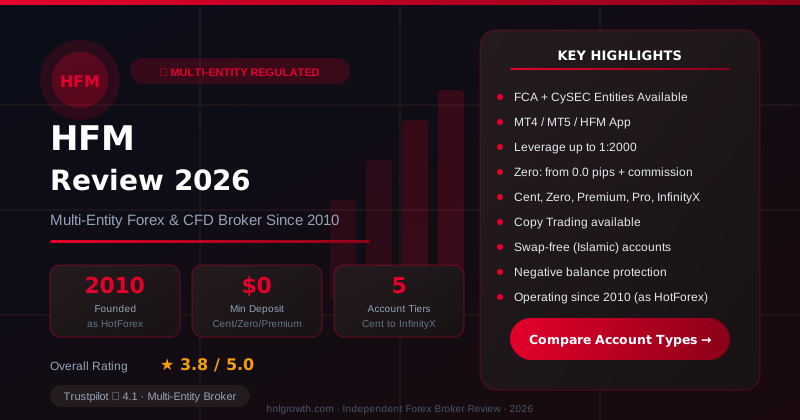
Checked on: 2026-08-06 | Broker terms, regulation, and pricing can change. Always verify at the official HFM site before opening an account.
Affiliate Disclosure: HNL Growth may earn a commission if you open an account through our links, at no additional cost to you. Risk Warning: CFDs and leveraged forex products are complex instruments and carry a high risk of losing money rapidly due to leverage. Between 65-95% of retail investor accounts lose money when trading CFDs, depending on the HFM entity and account type. Trading forex and CFDs may not be suitable for all investors. Consider your objectives, experience, and risk appetite before trading, and ensure you understand the risks involved. Broker Disclosure: HFM (HF Markets Group) is a live, regulated multi-entity broker (not a simulated prop-firm evaluation) — trades are executed with real capital in live market conditions, subject to normal market risk. Protections vary significantly by the specific legal entity that onboards your account.
Forex Scalping 2026: Rules, Costs and Broker Requirements
Scalping in forex means targeting 2–10 pips per trade, holding for seconds to roughly five minutes, and executing 10–50+ positions per session. Whether that works financially comes down to one number: the breakeven pip move — the minimum price displacement needed to recover total entry and exit cost before any profit is possible. That cost has three layers: spread, commission, and swap if a position crosses the daily rollover. This article gives you the formula to calculate breakeven cost per trade by account type, the execution requirements that keep that cost predictable, and the broker policy facts that determine whether your specific setup is viable at HFM.
Disclosure: This page may contain affiliate links. We may earn a commission if you open an account through our links, at no extra cost to you.
What scalping actually means in execution terms
HashHedge — Crypto Futures Prop Firm
Up to $200K funded accounts · 85% profit split · Instant USDT payouts · 160+ assets
Hold time, pip targets, and trade frequency defined
A scalp is defined operationally: hold time of seconds to approximately five minutes, pip target of 2–10 on liquid FX majors (or the dollar equivalent on metals), and trade frequency of 10–50+ per session. Systematic scalpers using Expert Advisors can exceed this substantially. The defining feature is a profit target that is small relative to normal intraday volatility — which means spread consumes a meaningful share of the available range before market risk even enters the equation.
A 5-pip target against a 1.5-pip spread plus a 0.6-pip round-trip commission equivalent leaves 2.9 pips of net target. That is 42% consumed by fixed costs. Increase trade frequency to 40 per day and that overhead compounds to 84 pips of cumulative breakeven cost across the session.
How cost structure changes the maths at high trade frequency
A single 0.5-pip commission overhead on a swing trade is trivial. On 40 scalp trades per day, it is 20 pips of additional breakeven cost across the session. The compounding effect of per-trade cost is the primary reason scalping demands lower spreads, tighter execution, and stricter session discipline than any longer-hold trading style.
The full cost of one scalping trade
Three cost layers: spread, commission, and swap
Spread is the most visible cost and the most variable. Every figure in a trading conditions table — including the ones below — reflects normal market conditions. Spreads widen to multiples of their floor during economic data releases, low-liquidity hours, and at session open. This variability is not disclosed in averages.
Commission on raw-spread accounts is charged per side per lot. To convert to a per-pip equivalent: divide by 10. A $3 commission per side per standard lot equals $0.30/pip per side, or $0.60/pip round-trip. This is a fixed, predictable cost unlike spread — it is the same regardless of market conditions.
Swap is charged when a position passes daily rollover (typically 22:00–00:00 UTC). Most scalpers close before rollover. Those who hold overnight positions — particularly in XAU/USD and GBP/USD where financing costs are material — must add the daily swap rate to their cost model. Current swap rates for each instrument are available on HFM's trading conditions page; rates change and must be verified with a date.
Worked example: breakeven pip move at 0.1, 0.5, and 1.0 lot
The formula is consistent regardless of lot size:
Breakeven pips = Spread + (Commission per side per standard lot × 2 ÷ Pip value per standard lot)
For EUR/USD, pip value is $10 per standard lot. Breakeven pips are identical across lot sizes because both revenue and cost scale linearly — lot size changes dollar exposure per pip, not the pip threshold to break even. What changes your breakeven is the cost inputs: spread and commission per lot.
Table T2 — Breakeven pip threshold, EUR/USD (illustrative — verify actual HFM Zero commission at trading conditions page)
| Account type | Spread floor | RT commission equiv. | Total breakeven |
|---|---|---|---|
| Zero | From 0.0 pip (variable) | Verify current rate | Verify at HFM conditions page |
| Pro | From 0.6 pip (variable) | None | ≥ 0.6 pips |
| Premium | From 1.4 pip (variable) | None | ≥ 1.4 pips |
Example at 0.2-pip Zero account spread + $3/side commission (illustrative): breakeven = 0.2 + 0.6 = 0.8 pips. At Premium with 1.4-pip spread and no commission: breakeven = 1.4 pips — nearly double, consuming 47% of a 3-pip target before market risk applies.
Why XAU/USD has a different cost structure than FX majors
One pip on XAU/USD is conventionally a $0.01 price move. At a standard lot (100 oz), that equals $1 of P&L. Spreads on XAU/USD are quoted in dollar terms (e.g., $0.35), which translates to 35 pips by the conventional pip definition — or $35 cost per standard lot round-trip on spread alone.
At 0.01 lot (1 oz), the same $0.35 spread costs $0.35 round-trip. That is viable for micro-sizing, but profit targets shrink proportionally. XAU/USD scalping is an instrument for raw-spread accounts and requires explicit lot sizing discipline. Verify the current XAU/USD minimum spread per account type on HFM's symbol specifications page.
Open a Zero account at HFM to access raw spreads for scalping
Execution quality and what it costs when it fails
ECN and NDD execution: requotes and conflict-of-interest risk explained
A dealing-desk (DD) broker internalises client trades — the broker takes the opposite side. When a scalper extracts 40 small profits, the broker records 40 offsetting losses. This creates a structural incentive to reject orders at the quoted price (requote), delay fills, or widen spreads during volatile moments.
ECN/NDD routing passes orders to external liquidity providers. The broker earns commission, not position profit, removing the adversarial structure. For scalpers with 2–5 pip targets, fill quality on every entry and exit determines outcome — market execution with no requotes is a functional requirement. Verify which execution model applies to each HFM account type on HFM's execution policy page.
Latency, VPS, and order routing to the matching engine
Round-trip latency — order submission to fill confirmation — is the infrastructure analogue of spread cost. Above 200ms, fill quality degrades for manual scalpers and systematically for EAs. Co-location benefit is highest when the VPS server is geographically close to the broker's matching engine.
HFM offers VPS hosting to eligible clients. Eligibility criteria (deposit or volume threshold), server locations, and latency specifications should be confirmed on HFM's VPS page before factoring VPS into your execution model.
Slippage patterns: normal markets versus news event windows
Slippage is structural under two conditions: insufficient liquidity depth at the quoted price, and order arrival during rapid price movement. Both occur around high-impact economic releases. The operational rule: close open positions and step away from the market for at least 15 minutes before and after any tier-1 data release (US NFP, CPI, central bank decisions). No scalping structure has positive expected value in the 60-second window around a major release — bid-ask spreads widen to 5–20× normal conditions during those seconds.
Instruments ranked by scalping cost-efficiency
FX major pairs: spread benchmarks by session
Table T3 — Session-pair spread guidance, directional only (verify current HFM ranges at trading conditions page)
| Instrument | London open 07:00–08:30 UTC | London–NY overlap 12:00–16:00 UTC | Asian session 00:00–06:00 UTC |
|---|---|---|---|
| EUR/USD | Low–moderate | Lowest (primary window) | Moderate–wide |
| GBP/USD | Moderate | Low–moderate | Wide |
| USD/JPY | Low–moderate | Low–moderate | Low (Tokyo active 00:00–03:00 UTC) |
| XAU/USD | Moderate | Moderate–low | Moderate |
All figures reflect typical normal-conditions direction only. Spreads widen substantially around scheduled events regardless of session.
EUR/USD remains the benchmark scalping pair: highest daily volume globally, tightest normal-conditions spread on raw accounts, and depth sufficient that standard-lot fills rarely move price. USD/JPY is the strongest alternative, particularly during the Tokyo window.
XAU/USD: spread in dollar terms and lot sizing for scalpers
At standard lot, XAU/USD spread cost in dollar terms makes sub-5-pip targets structurally marginal unless you hold a raw-spread account with the spread near its published minimum. At 0.01–0.10 lot, dollar cost scales down proportionally and the economics become viable. The critical verification: check the actual XAU/USD minimum spread on the Zero account before sizing any live position.
Instruments where cost structure makes scalping unviable
Exotic pairs (USD/TRY, USD/ZAR) carry spreads of 10–30+ pips under normal conditions — larger than any scalping target. GBP/NZD, EUR/NOK, and similar low-liquidity minors have spread floors that consume most of a 5-pip target. Low-volume cryptocurrency pairs beyond BTC/USD exhibit structurally wide bid-ask spreads. These instruments are cost-incompatible with scalping regardless of account type.
Session windows where cost and liquidity converge
London open and the London–New York overlap as the primary window
The London open (07:00 UTC) brings the entry of the largest forex centre and typically produces directional moves with tightening spreads as interbank flow rises. The 30–90 minutes after open suits momentum continuation setups.
The London–New York overlap (12:00–16:00 UTC) is the highest-liquidity window of the trading day. EUR/USD, GBP/USD, and USD/JPY reach their tightest spreads and highest volume. This is the primary scalping window for FX majors. Asian session is the exception only for USD/JPY during active Tokyo hours.
News release windows: spread widening and the avoidance rule
Brokers widen spreads pre-emptively 1–5 minutes before a tier-1 print. During the release: spreads reach 10–50× normal. Normalisation takes 5–15 minutes. Rule: no new positions 2 minutes before to 10 minutes after any tier-1 release. Pre-scheduled news is avoidable risk.
Three scalping trade structures and their mechanics
Momentum continuation: riding an established intraday move
Entry trigger: Price retraces to a prior micro-structure level or 20-period EMA on M5 during a clear trend. Enter on the first candle re-closing in the trend direction.
Stop: Beyond the retrace extreme, minimum 1.5× spread width to avoid premature exit on normal spread fluctuation.
Target: 4–8 pips, sized for at least 2:1 reward-to-total-cost ratio after deducting spread and commission.
Cost viability: Valid only during the London–NY overlap where spread is at or near its floor.
Range boundary fade: fading tested support or resistance
Entry trigger: Two to three clean tests of a horizontal level on M1–M5, followed by a rejection candle at the boundary.
Stop: Beyond the boundary level by at least 1× average spread to prevent spread-induced exit.
Target: Range midpoint, providing at least 2:1 after total round-trip cost.
Cost viability: Negative expected value if any tier-1 release is scheduled within the holding window — breakout risk outweighs the range pattern.
Moving average pullback: entry structure on M1–M5 retrace
Entry trigger: 20-period EMA trending on M5; price pulls back to touch the EMA and then closes back in the trend direction.
Stop: 3–5 pips beyond the pullback extreme, accounting for full spread width.
Target: 4–6 pips at 2:1 after full round-trip cost.
Cost viability: Filter strictly by session. The 1.4-pip spread floor on a no-commission account makes a 4-pip target marginal; this structure earns its place only during the tightest-spread windows on a raw-spread account.
Platform and account requirements
Execution tools: one-click trading, hotkeys, and order management
One-click execution — placing a trade without a confirmation dialog — is a functional requirement for manual scalpers. MT4 and MT5 both support it via the toolbar; enable it before any session, not during. MT5 Depth of Market (DoM) is useful for gauging fill risk on larger positions. M1 and M5 charts must load natively in your charting setup.
EA and automated scalping: what is supported and on which account types
HFM supports Expert Advisors on MT4 and MT5 across its account types. Whether automated scalping is permitted on your specific account under your regulatory entity must be confirmed in the applicable Client Agreement — permissions vary by jurisdiction and account type. Confirm with HFM support before deploying any EA in a live environment.
Account type comparison: standard versus raw/zero spread for scalping frequency
Table T4 — HFM account types for scalpers (Source: HFM account comparison page)
| Account | Spread floor (Forex) | Commission | Min. deposit | EA (MT4/MT5) | Best for |
|---|---|---|---|---|---|
| Zero | From 0.0 pip (variable) | Applies — verify rate | $0 / €0 | Yes | High-frequency scalpers, EA systems |
| Pro | From 0.6 pip (variable) | None | $100 / €100 | Yes | Mid-frequency active scalpers |
| Premium | From 1.4 pip (variable) | None | $0 / €0 | Yes | Lower-frequency active trading |
| InfinityX | From 0.3 pip (variable) | None | $500 | Yes | Active traders prioritising leverage |
Commission rate for the Zero account and entity-specific availability must be verified on HFM's trading conditions page. Raw spreads are available on specific symbols only.
For scalpers executing 20+ trades per session targeting 3–8 pips, the Zero account's raw spread floor changes the cost model relative to the Premium account's 1.4-pip floor. At 1.4 pips spread alone, a 3-pip target has 47% consumed before commission and market risk — structurally marginal at high trade frequency.
Broker policy checklist before you scalp
Scalping permission and minimum hold time: what the T&Cs say
Some brokers prohibit scalping outright or impose minimum hold time rules (positions must remain open 2–5 minutes minimum), which makes sub-minute trade structures non-viable. These restrictions often appear in annexes to the client agreement, not the headline terms.
Table T5 — Broker evaluation checklist
| Criterion | What to look for | HFM — where to verify |
|---|---|---|
| Scalping explicitly permitted | "Scalping" in Client Agreement or Trading Terms | HFM Client Agreement page |
| No minimum hold time restriction | "Minimum duration", "holding period" clauses | HFM Client Agreement page |
| ECN/NDD execution on your account type | Execution policy per account | HFM execution policy page |
| EA/automated trading permitted | T&Cs and platform documentation | MT4/MT5 supported; entity-specific terms apply |
| VPS hosting available and viable | Server location, latency, eligibility criteria | HFM VPS page |
Hedging and FIFO rules by regulatory jurisdiction
FIFO rules — imposed by US CFTC/NFA regulation — require positions in the same instrument to be closed in the order opened, preventing simultaneous intraday hedges. FIFO applies only to NFA-regulated accounts. Clients of HFM entities regulated under other authorities (which vary by client jurisdiction) are not subject to FIFO. Confirm which regulatory entity governs your account in HFM's regulatory disclosures.
Risk management scaled to high-frequency trading
Stop placement when spread consumes a large share of the pip target
Stops placed within 1–2 pips of entry on a 3-pip target are structurally unsound when spread alone is 0.8–1.2 pips. During low liquidity or at session open, spread widening can trigger a stop that was placed rationally under normal conditions.
Minimum stop distance = spread floor × 1.5 + structural invalidation level. If meeting that minimum stop requires risking more than 2:1 relative to the pip target, the setup does not have a viable reward-risk ratio under current spread conditions. Do not trade it.
Daily loss cap and trade-count discipline
High trade frequency accelerates drawdown velocity. Standard discipline for scalpers: a maximum daily loss of 2–3% of account equity, with a hard stop on trading for the day when that threshold is reached. Attempting to recover intraday losses by adding more scalp trades under widened spread conditions is the most common mechanism of accelerating loss.
Trade count is not a proxy for edge. Twenty well-selected trades during the London–NY overlap typically produce better outcomes than 50 trades across low-liquidity windows where the spread-to-target ratio is unfavourable.
Practise on a demo account before trading live
Before committing capital, use HFM's demo account to validate two specific things: observe the actual spread on your target instrument during different session windows (note the difference between the Asian session and the London–NY overlap on the same pair), and test your one-click execution and stop-placement workflow under realistic conditions. Demo conditions replicate live market spreads and full platform functionality on MT4, MT5, and the HFM platform.
If you are deploying an EA, run it on demo for at least two to three weeks of active trading sessions before going live — long enough to encounter at least one news event and a range of liquidity conditions.
Open an HFM demo account and validate your scalping setup before risking capital
Frequently asked questions
Is scalping allowed at HFM?
HFM markets itself as scalping-compatible. However, permissions are entity-specific — the regulatory entity governing your account determines the applicable terms. Read the Client Agreement for your specific entity on HFM's legal page before trading.
Which account type suits scalping at HFM?
The Zero account offers the lowest spread floor (from 0.0 pip on Forex, variable) with per-lot commissions. For scalpers executing 20+ trades per session, the lower spread floor typically reduces total per-trade cost compared to no-commission accounts with wider spread floors. Verify the commission rate and whether the Zero account is available for your entity on HFM's account conditions page.
What is the minimum move to break even on a EUR/USD scalp?
It equals total round-trip cost: spread + commission (both sides). On a Zero account with a 0.2-pip spread and $3/side commission per standard lot (illustrative figures), the breakeven is 0.8 pips. Verify actual Zero account spread and commission to calculate your real threshold on HFM's trading conditions page.
Does HFM support EAs for automated scalping?
MT4 and MT5 are available on HFM accounts and both support Expert Advisors. Whether automated scalping is permitted under your specific account type and regulatory entity should be confirmed directly in the applicable client agreement before deploying any EA.
What is the best time to scalp EUR/USD?
The London–New York overlap (12:00–16:00 UTC) offers the tightest typical spreads and highest liquidity for EUR/USD. The London open (07:00–08:30 UTC) produces directional momentum suitable for continuation setups. Avoid the 15-minute window around any scheduled tier-1 release.
Is XAU/USD suitable for scalping?
Yes, on a raw-spread account and with lot sizing that reflects the instrument's tick value. At standard lot, dollar-denominated spread cost makes small pip targets marginal. At 0.01–0.10 lot, the economics scale accordingly. Verify current XAU/USD minimum spread on the Zero account on HFM's trading conditions page.
Risk warning: CFDs and leveraged forex products are complex instruments and carry a high risk of losing money rapidly due to leverage. Consider whether you understand how these products work and whether you can afford to take the high risk of losing your capital. Check the entity, terms and protections that apply in your jurisdiction before trading.
Risk warning: CFDs and leveraged forex products are complex instruments and carry a high risk of losing money rapidly due to leverage. Retail investor accounts lose money when trading CFDs with most providers; the exact percentage varies by HFM entity and account type. You should consider whether you understand how CFDs work and whether you can afford to take the high risk of losing your money. Check the entity, terms and investor protections that apply in your jurisdiction before opening an account or trading.
Ready to Start Your Funded Trading Journey?
Join traders backed by $11M+ in verified payouts and a 4.7/5 Trustpilot rating. Compare HashHedge challenge plans, drawdown rules, and payout terms — apply code ha25 for the current discount.
Risk disclaimer: Challenge fees are non-refundable if you breach the rules. Prop trading involves significant financial risk. Past performance in a simulated environment does not guarantee results on a funded account. Only purchase if you understand the rules fully and can afford to lose the fee. Affiliate disclosure: HNL Growth earns a commission when you purchase a HashHedge challenge through links on this page.