Forex Trading for Beginners: The Complete 2026 Guide
Forex trading means speculating on whether one currency will rise or fall against another, in a decentralized, 24-hour global market with no single exchange. You don't buy a physical currency to use...
Reviewed using our forex & CFD broker review methodology
Checked on: 2026-08-17 | Broker terms, regulation, and pricing can change. Always verify at the official PU Prime site before opening an account.
Affiliate Disclosure: HNL Growth may earn a commission if you open an account through our links, at no additional cost to you. Risk Warning: CFDs and leveraged forex products are complex instruments and carry a high risk of losing money rapidly due to leverage. 62.2% of retail investor accounts lose money when trading CFDs with this provider. Trading forex and CFDs may not be suitable for all investors. Consider your objectives, experience, and risk appetite before trading, and ensure you understand the risks involved. Broker Disclosure: PU Prime is a live, regulated multi-entity broker (not a simulated prop-firm evaluation) — trades are executed with real capital in live market conditions, subject to normal market risk. Which PU Prime entity holds your account depends on your country of residence and determines your leverage cap and protections.
Last verified: August 2026 | Editorial Team
Forex Trading for Beginners: The Complete 2026 Guide
Disclosure: This page may contain affiliate links. We may earn a commission if you open an account through our links, at no extra cost to you. This does not affect our editorial standards or the information we provide.
Forex trading means speculating on whether one currency will rise or fall against another, in a decentralized, 24-hour global market with no single exchange. You don't buy a physical currency to use it; you take a position on price movement, using a broker's trading platform. Before risking any money, a beginner needs to understand how currency pairs are priced, how leverage magnifies both profits and losses, what trading actually costs, and how to manage risk on every single trade. The realistic path is: learn the mechanics, practice on a demo account, verify your broker's regulation, then start live with a small amount of capital and strict risk limits.
What Forex Trading Actually Means
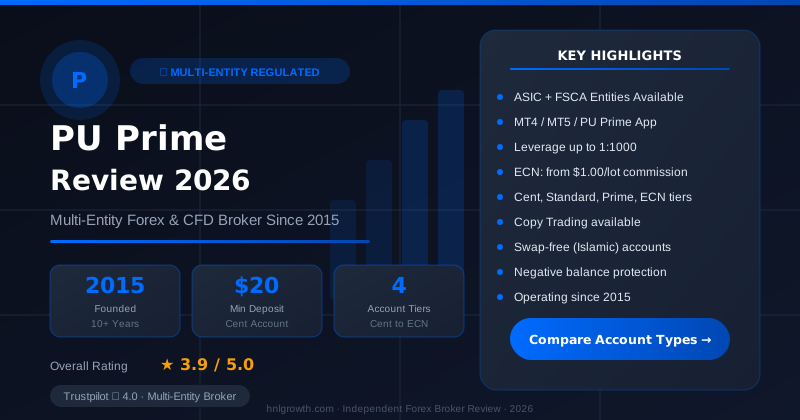
PU Prime — Multi-Entity Forex & CFD Broker
ASIC (AU) + FSCA (ZA) entities available · $20 min deposit (Cent) · MT4, MT5, PU Prime App · 4 account tiers
Forex, short for foreign exchange, is the market where currencies are exchanged. Unlike a stock exchange, there's no central building or single price feed. It's an over-the-counter (OTC) market: a global network of banks, financial institutions, and retail brokers all quoting prices to each other and to clients.
The scale is enormous. The Bank for International Settlements' most recent Triennial Central Bank Survey put average daily global forex turnover at roughly $7.5 trillion, dwarfing any stock market. That volume comes mainly from banks and institutional players hedging trade and investment flows; retail traders are a small slice of that total, accessing the market through brokers rather than trading directly with banks.
Because trading happens across financial centers in Asia, Europe, and North America, the market runs close to 24 hours a day on weekdays, opening in Sydney and Tokyo and closing after New York. That continuous cycle is convenient, but it also means price-moving news can hit outside your usual waking hours, which matters when you're deciding how closely to monitor open positions.
How Currency Pairs Work: The Mechanics
Every forex trade involves a pair, like EUR/USD. The first currency (EUR) is the base currency; the second (USD) is the quote currency. The price tells you how much of the quote currency it takes to buy one unit of the base currency. If EUR/USD is trading at 1.0850, one euro costs $1.0850.
When you "go long" (buy) EUR/USD, you're betting the euro will strengthen against the dollar. When you "go short" (sell), you're betting the opposite. This is different from typical stock investing logic of "buy low, sell high" — in forex, you can profit from a falling price just as easily as a rising one, because you're trading a relationship between two currencies, not owning an asset outright.
Brokers quote two prices: the bid (what you can sell at) and the ask (what you can buy at). The difference is the spread, and it's measured in pips — typically the fourth decimal place in most pairs (0.0001). A EUR/USD price moving from 1.0850 to 1.0860 is a 10-pip move. The spread is effectively a built-in transaction cost: you're slightly behind as soon as you open a trade, before any market movement happens at all.
Understanding Leverage: It Amplifies Losses Just as Fast as Gains
Leverage lets you control a larger position than your deposited capital would normally allow. A leverage ratio of 1:100 means $1,000 of your own money can control a $100,000 position. The amount you must set aside as collateral is called margin.
This is the part beginners consistently underestimate: leverage doesn't change how many dollars a given pip movement is worth on your position — it changes how large a position you can open with a small deposit, which directly determines how fast that account can be wiped out.
Here's a worked illustration using a $1,000 account trading EUR/USD, where a standard lot (100,000 units) is worth roughly $10 per pip. This table assumes the full account margin is deployed at each leverage level — a worst-case scenario chosen to show maximum exposure, not a recommended approach. In practice, responsible position sizing typically involves using only a fraction of available margin.
| Leverage | Position Size (full margin deployed) | Margin Required | P/L at +100 pips | P/L at -100 pips | Approx. Move That Wipes Out the Account |
|---|---|---|---|---|---|
| 1:10 | 0.1 lot ($10,000) | $1,000 | +$100 | −$100 | ~1,000 pips |
| 1:30 | 0.3 lot ($30,000) | $1,000 | +$300 | −$300 | ~330 pips |
| 1:100 | 1.0 lot ($100,000) | $1,000 | +$1,000 | −$1,000 | ~100 pips |
| 1:500 | 5.0 lot ($500,000) | $1,000 | +$5,000 | −$5,000 | ~20 pips |
The math is symmetrical: whatever leverage lets you gain, it lets you lose just as quickly. At 1:500, a routine 20-pip adverse move — something that can happen in minutes during normal volatility — can erase the entire account. This is exactly why regulators in some jurisdictions cap retail leverage on major pairs. Under product intervention measures introduced by the European Securities and Markets Authority (ESMA) in 2018, brokers regulated in the EU/EEA must limit retail leverage on major currency pairs to 1:30 and provide negative balance protection, so a client's losses can't exceed their deposited funds. The UK's Financial Conduct Authority applies similar retail limits. Many offshore-regulated entities are not bound by these specific caps and can offer materially higher leverage, which is a real risk factor beginners should weigh carefully, not simply a "feature" to chase.
The Real Costs of Forex Trading
Even before you consider whether a trade is right or wrong, trading has a cost floor: the spread, plus commissions on some account types, plus overnight financing (swap) charges if you hold a position past the daily rollover, plus potential slippage during fast-moving markets.
To illustrate with a hypothetical example: if a beginner were to trade EUR/USD three times a week (156 trades a year) at one standard lot each time, with a spread of 1.3 pips — a reference spread PU Prime publicly discloses on its Standard account for EUR/USD, which carries no separate commission on that account type — that would represent roughly $13 in spread cost per trade (1.3 pips × $10/pip), or approximately $2,028 a year in spread cost alone, before any swap charges on positions held overnight or any actual profit or loss from market direction. This projection is purely illustrative: actual costs depend on your individual trading frequency, position size, and market conditions at execution time. PU Prime notes that all published spread values are reference figures only, and traders should confirm current spread, commission, and swap values directly in MT4, MT5, or the mobile app, since these values shift with market conditions.
Overnight swap costs vary by instrument, direction, and current interest rate differentials and should always be checked on the live platform. The takeaway is straightforward: trading more frequently doesn't just increase your exposure to market risk, it compounds a cost drag over a year regardless of your trading skill.
Major, Minor, and Exotic Pairs: Which to Trade
Currency pairs fall into three broad categories. Majors pair the US dollar with other heavily traded currencies (EUR/USD, GBP/USD, USD/JPY, USD/CHF) and typically have the tightest spreads and deepest liquidity, because they're traded constantly by banks and institutions worldwide. Minors pair two non-USD major currencies (EUR/GBP, GBP/JPY) and usually carry somewhat wider spreads. Exotics pair a major currency with a currency from a smaller or less liquid economy (USD/TRY, EUR/ZAR) and tend to have noticeably wider spreads and sharper, less predictable price swings, often tied to local political or economic events.
| Category | Examples | Liquidity | Typical Volatility | Beginner Suitability |
|---|---|---|---|---|
| Major | EUR/USD, GBP/USD, USD/JPY | Highest | Moderate, generally more orderly | Suitable — start here |
| Minor | EUR/GBP, GBP/JPY, AUD/NZD | Moderate | Moderate to elevated | Approach with caution once comfortable with majors |
| Exotic | USD/TRY, EUR/ZAR, USD/MXN | Low | Often sharp and less predictable | Not recommended for beginners |
For the first six to twelve months, sticking to two or three major pairs keeps costs predictable and price behavior more consistent, which matters far more when you're still learning than access to a large instrument list.
How to Choose a Forex Broker You Can Trust
"Which broker is best?" isn't really the right question — the right question is which broker is suitable for where you are right now. That depends on a few concrete, checkable things rather than star ratings or marketing claims.
| Criterion | What to Check | Where to Verify | Red Flags |
|---|---|---|---|
| Regulation | Which specific entity holds your account and what license it operates under | The regulator's own public register | Broker won't confirm the licensing entity for your country |
| Fund protection | Segregated client accounts, negative balance protection where applicable | Regulator rules for that specific license, broker's regulation page | Vague or absent answers about fund segregation |
| Cost transparency | Published spreads, commissions, swap rates by account type | Broker's cost/spread page, live platform quotes | Costs only disclosed after you deposit |
| Demo availability | Free demo with real market pricing before funding | Account opening flow | No demo offered, or demo pricing clearly unrealistic |
| Education depth | Structured beginner content, not just promotional material | Broker's education or learning hub | Content is entirely product pitching, no risk context |
Regulatory protections differ meaningfully by jurisdiction, and this is worth being precise about. Regulators commonly referenced as tier-1 for retail forex — the UK's FCA, Australia's ASIC, and Cyprus's CySEC — operate under frameworks that, in the EU/EEA context, include the ESMA leverage caps and negative balance protection mentioned earlier. Other regulators apply different frameworks with different leverage limits and client protections.
PU Prime, for example, is authorised and regulated by the Financial Services Authority of Seychelles (FSA), the Financial Services Commission of Mauritius (FSC), the Financial Sector Conduct Authority of South Africa (FSCA), and the Capital Market Authority of the UAE (CMA). Which entity holds your account, and which regulatory framework applies, depends on the jurisdiction from which you open your account. Leverage caps, negative balance protection, and other client safeguards vary by regulator and are not uniform across PU Prime's licensing entities.
Before funding any account with any broker, follow these verification steps:
- Ask the broker explicitly which licensed entity will hold your funds given your country of residence.
- Note the license number provided.
- Visit that regulator's own public register — not the broker's website — and confirm the license is active and matches the entity name.
- Review what client protections (leverage limits, fund segregation, negative balance protection, compensation schemes) apply under that specific license.
This process takes around ten minutes and is the most important due diligence step a new trader can take.
Starting with a Demo Account: Practice Without Risking Capital
A demo account uses simulated funds on live market pricing, so you can practice opening trades, setting stop-losses, and reading price charts without any financial risk. Treat it as the mandatory first stage of learning to trade, not optional groundwork.
Opening one is quick: most brokers, including PU Prime, let you open a demo account alongside or even before your live account verification finishes, since a demo doesn't require identity documents. A reasonable self-assessment guideline before considering live capital is completing 50 or more trades over at least three months, so you experience different market conditions rather than a single lucky or unlucky stretch. These are suggested personal benchmarks, not industry-standard requirements — their purpose is to help you build genuine familiarity before real money is involved.
One limitation to keep in mind: a demo simulates price movement and execution reasonably well, but it cannot replicate the emotional pressure of watching real money fluctuate. Fear tends to cut winning trades short; the hope of avoiding a loss can make you hold losers too long. Live execution can also occasionally differ slightly from demo during fast-moving news events (slippage, requotes). Demo performance is a learning tool, not a prediction of how you'll perform once real capital is at stake.
Your First Trade: A Step-by-Step Walkthrough
Here's how a single, disciplined first trade might be structured, using EUR/USD as an illustrative example. The price levels are hypothetical, chosen to demonstrate the risk-reward calculation rather than to reflect any specific market condition or constitute a trading recommendation.
- Pick the pair. Stick to a major pair you've watched on demo, e.g., EUR/USD.
- Set your risk per trade. A common beginner rule is risking no more than 1–2% of account balance on any single trade. On a $1,000 account, that's $10–$20.
- Identify entry and stop. Suppose price is holding above a level it has bounced from twice before (a support level) at 1.0830. You enter long at 1.0850 and place a stop-loss at 1.0830 — 20 pips below entry, at the level that would tell you the idea was wrong.
- Set a target using a reward-to-risk ratio. With a 20-pip stop, a 1:2 ratio means a target 40 pips above entry, at 1.0890.
- Calculate position size from your risk, not the other way around. If you're risking $20 and your stop is 20 pips away, you need a position where 20 pips equals $20 — roughly 0.1 lot on EUR/USD (approximately $1 per pip). Size the trade to fit the risk, never size the risk to fit how large a position "feels" exciting.
- Execute, then leave it alone. Place the order with the stop and target attached, and resist adjusting the stop wider if the trade moves against you.
- Record it afterward. Note the pair, direction, entry/exit, position size, risk-reward ratio, your reasoning, and how you felt during the trade. A simple trade journal — even a spreadsheet with those seven fields — becomes more valuable over time than the outcome of any single trade.
Once you've run through this process repeatedly on a demo and it feels mechanical rather than stressful, that's the point to evaluate whether you're ready to fund a small live account. If you want to apply what you've just read without risking capital first, you can open a PU Prime demo account and practice this exact sequence under real market pricing.
Three Beginner-Friendly Trading Strategies
| Strategy | Timeframe | Typical Holding Period | Time Commitment | Risk Level | Beginner Suitability |
|---|---|---|---|---|---|
| Trend-following | Daily chart | Several days to weeks | 20–30 min/day | Moderate | Good starting point — fewer decisions, less screen time |
| Support/resistance | 4-hour to daily | Hours to a few days | 30–45 min/day | Moderate | Good once you can identify clear price levels |
| Breakout trading | 1-hour to daily | Hours to days | 45–60 min/day, plus alerts | Higher | Suitable only after some experience — false breakouts are common |
Trend-following means identifying a series of higher highs and higher lows (or the reverse in a downtrend) and looking to enter on pullbacks rather than chasing new highs. Support/resistance trading means buying near a price floor that has held multiple times and selling near a price ceiling that has repeatedly capped rallies. Breakout trading means waiting for price to move decisively out of a tight consolidation range, which can work well but also produces frequent false signals that catch beginners off guard. None of these require complex indicators — clean price charts and patience are the core tools.
Risk Management: The Only Way to Survive Long Enough to Improve
Strategy matters less than most beginners assume; risk control is what determines whether you're still trading in a year. A few non-negotiable rules: risk no more than 1–2% of account equity per trade, place stops at a technical level that invalidates your idea (not an arbitrary distance), aim for a reward-to-risk ratio of at least 1:2 so winners can outweigh losers even at a moderate win rate, limit yourself to two or three open positions at a time as a beginner, and set a hard daily loss limit — for example, stop trading for the day once you're down 5% of account equity, regardless of how confident the next setup looks.
Common Beginner Mistakes and How to Avoid Them
- Using maximum available leverage. Opening oversized positions relative to account size, as the leverage table above shows, can wipe out an account in a handful of adverse pip moves.
- Over-trading. Opening far more positions than a risk-managed plan calls for, often out of boredom or a need for constant action, multiplies cost drag and mistakes.
- Ignoring the stop-loss. Moving a stop further away or removing it entirely when a trade turns against you, hoping price will recover, turns a small planned loss into a much larger unplanned one.
- Revenge trading. Increasing position size right after a loss to "win it back" quickly, which compounds risk exactly when discipline matters most.
- Trading through major news releases without understanding volatility. Economic announcements can cause rapid price spikes and wider spreads that catch inexperienced traders off guard.
From Demo to Live: Closing the Psychological Gap
Live trading feels different from demo trading because real money changes your relationship to risk. Before scaling up, a reasonable self-assessment checklist looks like this:
| Criterion | Suggested Threshold | How to Measure |
|---|---|---|
| Trade sample size | 50+ completed trades | Demo trading log |
| Track record length | 3+ months | Demo account history |
| Maximum drawdown | Under 15% | Peak-to-trough equity drop |
| Largest single loss | Under 2% of account | Trade journal |
| Trade journal | Documented for every trade | Entry/exit reasoning recorded |
These thresholds are suggested personal guidelines for self-assessment, not verified industry benchmarks. If you meet them, a sensible next step is funding a live account with a small fraction of the capital you eventually intend to trade with — commonly cited as 10–20% — to test whether your discipline holds when real money is involved before scaling further.
Realistic Expectations: Profitability, Time, and Failure Rates
Regulatory risk disclosures across the industry consistently show that a majority of retail forex accounts lose money. While precise figures vary by broker and reporting period, regulatory authorities and brokers commonly cite figures in the 70–80% range for the proportion of retail accounts that lose money trading CFDs and leveraged forex. Many new traders stop trading within their first six months. Reaching a genuine breakeven point typically takes disciplined practice over roughly 12–24 months, and consistent profitability, where it happens at all, usually takes longer still. This isn't a reason to avoid learning forex, but it is a reason to treat it as a skill built over months and years, funded only with money you can afford to lose entirely, rather than a fast way to generate income.
FAQ
How much money do I need to start? Minimum deposits can be low — PU Prime's account opening page indicates its Cent account starts at $20 and its Standard account at $50 — but a small deposit forces smaller position sizes or higher relative leverage, which increases risk. Many educators suggest $1,000–$5,000 as a more realistic starting amount to absorb a normal learning curve without being forced into oversized positions.
Is forex a scam? The forex market itself is legitimate and used by banks, corporations, and governments daily. The risk comes from unregulated brokers, fake signal sellers, and schemes making performance claims they cannot support. Verifying a broker's license number directly on the relevant regulator's own public register — rather than relying on the broker's marketing page — and treating extraordinary performance claims with strong skepticism, are the two most effective filters.
Can I get rich quickly with forex? No credible source supports that expectation. Given typical failure rates and realistic breakeven timelines, forex is better approached as a slow skill-building process than a shortcut to wealth.
Should I use high leverage to grow my account faster? High leverage accelerates losses at the same rate it accelerates gains, and beginners typically lack the precision to avoid the frequent small losses that add up quickly at high leverage. Many experienced educators suggest capping leverage well below whatever maximum a broker offers, regardless of the account's regulatory limit.
Do I need to trade full-time to be profitable? No — a daily-chart, trend-following approach can realistically be managed in 20–30 minutes a day. What full-time commitment does require, especially in the first year, is time spent studying and journaling, separate from time spent actively watching charts.
Risk Warning
Risk warning: CFDs and leveraged forex products are complex instruments and carry a high risk of losing money rapidly due to leverage. Consider whether you understand how these products work and whether you can afford to take the high risk of losing your capital. Check the entity, terms and protections that apply in your jurisdiction before trading.
Ready to Compare PU Prime Account Types?
PU Prime is a multi-entity broker — ASIC (Australia) and FSCA (South Africa) regulated entities offer stronger oversight, while most international clients are onboarded to the FSA Seychelles or FSC Mauritius entities. Four account tiers (Cent, Standard, Prime, ECN) range from a $20 minimum deposit to full ECN pricing.
Risk disclaimer: PU Prime is a live, regulated multi-entity broker — trading forex and CFDs is done with real capital under normal market risk (this is not a simulated prop-firm evaluation). PU Prime operates under multiple separate licenses (ASIC, FSCA, FSA Seychelles, FSC Mauritius); which entity holds your account depends on your country of residence and determines your leverage cap and protections — confirm this before funding. CFDs and leveraged forex products are complex instruments and carry a high risk of losing money rapidly due to leverage; 62.2% of retail investor accounts lose money when trading CFDs with this provider. Consider whether you understand how CFDs/forex work and whether you can afford the high risk of losing your money. Affiliate disclosure: HNL Growth earns a commission when you open a PU Prime account through links on this page.