Forex Trading in Kenya 2026: CMA Rules, Tax and Getting Started
*Last updated: June 2026*
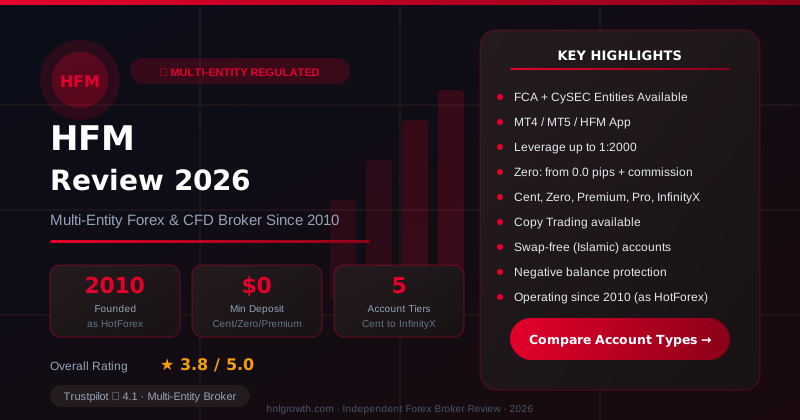
Checked on: 2026-08-08 | Broker terms, regulation, and pricing can change. Always verify at the official HFM site before opening an account.
Affiliate Disclosure: HNL Growth may earn a commission if you open an account through our links, at no additional cost to you. Risk Warning: CFDs and leveraged forex products are complex instruments and carry a high risk of losing money rapidly due to leverage. Between 65-95% of retail investor accounts lose money when trading CFDs, depending on the HFM entity and account type. Trading forex and CFDs may not be suitable for all investors. Consider your objectives, experience, and risk appetite before trading, and ensure you understand the risks involved. Broker Disclosure: HFM (HF Markets Group) is a live, regulated multi-entity broker (not a simulated prop-firm evaluation) — trades are executed with real capital in live market conditions, subject to normal market risk. Protections vary significantly by the specific legal entity that onboards your account.
Forex Trading in Kenya 2026: CMA Rules, Tax and Getting Started
Last updated: June 2026
Forex trading is legal in Kenya. The Capital Markets Authority (CMA) regulates the industry locally, licensing and supervising brokers that operate within Kenya's borders. However, many Kenyan traders also use international brokers that accept Kenyan clients under regulation from bodies such as CySEC, the FCA, or the DFSA — a legal arrangement, but one that changes the protections available to you.
This guide explains the regulatory landscape, provides a decision framework for comparing brokers, works through trading costs in Kenyan Shillings, and covers the account-opening process. It is structured to help you evaluate brokers — including HFM — against criteria that matter for your situation, not to rank one above the rest.
The Legal Landscape: CMA Regulation and What It Means for You
HashHedge — Crypto Futures Prop Firm
Up to $200K funded accounts · 85% profit split · Instant USDT payouts · 160+ assets
What CMA licensing covers
The Capital Markets Authority is Kenya's capital markets regulator. It licenses and supervises intermediaries operating within Kenya, imposing requirements that typically include minimum paid-up capital, segregation of client funds in approved banks, regular financial reporting, and conduct-of-business standards.
A CMA-licensed forex broker offers Kenyan clients several layers of protection:
- Local regulatory recourse. Complaints can be escalated to the CMA directly, within Kenya's legal framework.
- Fund segregation. Client money must be held in segregated accounts at approved banks, separate from the broker's operational funds.
- Investor Compensation Fund. The CMA maintains a compensation mechanism that may cover eligible clients if a licensed intermediary defaults.
The specific capital thresholds and operational requirements are set by CMA regulations and are updated periodically. Verify current figures on the official CMA website before relying on any quoted number.
How internationally regulated brokers serve Kenyan clients
Brokers regulated by authorities such as the FCA (UK), ASIC (Australia), CySEC (Cyprus), or the DFSA (Dubai) can legally accept Kenyan residents without holding a CMA licence. The CMA's licensing requirement applies to firms operating from within Kenya — it does not prohibit Kenyan residents from opening accounts with overseas brokers.
The practical differences matter:
- Your protections derive from the overseas regulator's framework, not Kenyan law.
- The relationship is cross-border. Dispute resolution follows the procedures of the broker's regulatory jurisdiction.
- Compensation schemes, where they exist, operate under the overseas regulator's rules and eligibility criteria.
- Many tier-1 regulators maintain robust client-money rules and compensation schemes that may exceed protections available in some emerging-market jurisdictions.
A critical check: some brokers onboard international clients through a separate legal entity that sits outside the regulated perimeter. Always confirm which entity your account is held with and whether that entity falls under regulatory oversight.
How to verify any broker's regulatory status
- CMA register: Visit the CMA website and locate the public register of licensed intermediaries. Search for the broker's legal entity name. If it does not appear, it is not CMA-licensed.
- International registers: Visit the relevant regulator's public register — the FCA register, the CySEC register, or the equivalent. Search by the broker's legal entity name or licence reference number. Confirm the licence is active and covers the activities the broker offers.
- Match the entity: The entity name on your account-opening agreement must match the regulated entity on the register. If the names differ, your account may sit with an unregulated subsidiary.
HF Markets Group operates under regulation across multiple jurisdictions. Kenyan clients should verify which specific HF Markets entity they would be contracting with and confirm that entity's regulatory status on the relevant regulator's public register. HFM states its security commitments include segregated accounts, negative balance protection, and an insurance programme covering liabilities to clients.
Choosing a Broker: A Decision Framework
Rather than ranking brokers, here is a framework for evaluating which type of regulatory arrangement fits your profile.
CMA-licensed vs. internationally regulated: which fits you?
| Factor | CMA-Licensed Broker | Internationally Regulated Broker | What to consider |
|---|---|---|---|
| Regulatory recourse | Local — file complaints with the CMA in Kenya | Cross-border — use the overseas regulator's dispute process | Are you comfortable resolving issues across jurisdictions? |
| Compensation scheme | CMA Investor Compensation Fund (subject to eligibility and limits) | Jurisdiction-dependent — e.g., FSCS (UK) covers up to £85,000 | Compare the coverage amounts and eligibility rules |
| Leverage limits | Set by CMA regulations | Varies by regulator — some cap at 1:30 for retail, others allow higher | Higher leverage amplifies both gains and losses |
| Instrument range | Typically focused on major forex pairs and selected CFDs | Often broader — forex, indices, commodities, crypto, shares | Match available instruments to your trading strategy |
| Fund segregation | Required under CMA rules in approved local banks | Required under the home regulator's framework | Check where and how client funds are held |
| Account currencies | May offer KES-denominated accounts | Typically USD, EUR, or other major currencies | A non-KES base currency means conversion costs on every deposit and withdrawal |
Neither option is universally better. A CMA-licensed broker gives you local protections and a Kenyan legal framework. An internationally regulated broker may offer a wider product range, different leverage options, and access to a compensation scheme in a major financial centre. The right choice depends on your priorities.
Key comparison criteria
Spreads and commissions. These are your direct trading costs. Compare like-for-like: a "0 pips" account typically charges a per-trade commission, while a spread-only account builds the cost into the quoted price.
Leverage. Determines position size relative to your margin. International brokers accessible to Kenyan clients may offer leverage up to 1:2000 on certain account types. Higher leverage magnifies both gains and losses — it is a tool, not an advantage.
Minimum deposit. Ranges from $0 on some HFM account types to hundreds of dollars elsewhere. A low minimum gets you started but should not be confused with recommended trading capital.
Payment methods. Kenyan traders benefit from local options. M-Pesa deposits process near-instantly, while bank transfers take longer. Check which methods your shortlisted brokers support and whether withdrawal processing times differ from deposit speeds.
Platforms. MT4 and MT5 are widely available across brokers. Some brokers additionally offer proprietary mobile apps or TradingView integration. Choose based on your workflow — desktop analysis, mobile execution, or both.
Account base currency. If your broker only offers USD or EUR accounts and you fund in KES, a conversion cost applies on every deposit and withdrawal. Check whether a KES base currency is available and compare the implied conversion rate against the prevailing market rate.
Swap-free eligibility. For traders who require Sharia-compliant accounts, check which instruments qualify, whether spreads are widened in lieu of swap, and any administrative fees that apply.
Disclosure: This page may contain affiliate links. We may earn a commission if you open an account through our links, at no extra cost to you.
What Trading Costs Actually Look Like in Kenyan Shillings
Spread comparisons in pips do not tell the whole story. Here is a worked example showing the cost components of a typical trade, converted to Kenyan Shillings.
Scenario: Buy 1 standard lot (100,000 units) of EUR/USD on an HFM Premium account, which carries spreads from 1.4 pips on this pair with no separate commission on forex. Exchange rate: 1 USD = 129.50 KES (illustrative — use the prevailing rate when you calculate your own).
| Cost Component | Amount in USD | Amount in KES |
|---|---|---|
| Spread cost (1.4 pips × $10/pip) | $14.00 | ~KES 1,813 |
| Commission (Premium account) | $0.00 | KES 0 |
| Overnight swap (if held past 5 pm ET) | Varies by rate environment | Varies |
| Withdrawal fee | Method-dependent | Method-dependent |
How to read this table:
- Spread cost. On a Premium account with spreads from 1.4 pips, the cost of opening and immediately closing a 1-lot EUR/USD position would be approximately $14 (1.4 × $10 per pip for a standard lot). On a Zero account, the spread may be near 0 pips but a per-trade commission applies instead — check HFM's current commission schedule on their trading accounts page for exact figures.
- Overnight swap. If you hold the position past 5 pm New York time, a swap debit or credit applies based on the interest rate differential between the two currencies and the broker's markup. Swap rates change with monetary policy and vary between long and short positions.
- Withdrawal costs. These depend on the method chosen and may include a fixed fee, a percentage, or a currency conversion charge.
Costs that are easy to overlook:
- Currency conversion on funding. If you deposit KES via M-Pesa or bank transfer into a USD-denominated account, a conversion rate applies. Compare the rate offered against the CBK reference rate published by the Central Bank of Kenya.
- Inactivity fees. Some brokers charge a monthly fee after a period of account dormancy. Check the terms before leaving an account unfunded.
- Margin requirements around events. Brokers may increase margin requirements during high-impact news releases or over weekends, effectively requiring more capital to maintain open positions.
The point is not that one cost structure is always cheaper — it is that the full picture includes more than the headline spread.
Account Types Available to Kenyan Residents
HFM offers five account types to Kenyan clients, each suited to a different trading approach:
| Feature | InfinityX | Cent | Zero | Pro | Premium |
|---|---|---|---|---|---|
| Min. deposit | $500 | $0 | $0 | $100 | $0 |
| Spreads from | 0.3 pip | 1.4 pips | 0 pips (Forex) | 0.6 pip | 1.4 pips |
| Max leverage | Unlimited* | 1:2000 | 1:2000 | 1:2000 | 1:2000 |
| Commission (forex) | Check T&Cs | None | Applies | None | Included in spread |
| Instruments | Forex, Metals, Indices, Crypto, Energies | Forex, Gold | All available | All available | All available |
| Platforms | MT4, MT5, WebTrader, HFM App | MT4, MT5, WebTrader, HFM App | MT4, MT5, WebTrader, HFM App | MT4, MT5, WebTrader, HFM App | MT4, MT5, WebTrader, HFM App |
| Swap-free | Eligible** | Eligible** | Eligible** | Eligible** | Eligible** |
*Leverage may be adjusted based on market conditions and account equity. Refer to HFM's terms for conditions. Unlimited leverage carries significant risk and is not suitable for all traders.
**Swap-free eligibility applies to specific trading instruments. Terms and conditions apply — check whether spreads are widened or admin fees charged in lieu of swap.
Who each account suits:
- Premium ($0 minimum, spreads from 1.4 pips): Straightforward entry point for beginners. No separate commission to calculate.
- Pro ($100 minimum, spreads from 0.6 pip): For traders who want tighter spreads and can meet a slightly higher deposit.
- Zero ($0 minimum, spreads from 0 pips with commission): For traders who prefer raw spreads and transparent per-trade commission — common among scalpers and active day traders.
- Cent ($0 minimum, USC denomination): Position sizes are measured in cent lots (1 lot = 1,000 units). Useful for testing strategies with real money at reduced risk.
- InfinityX ($500 minimum, spreads from 0.3 pip, unlimited leverage): For experienced traders who understand leverage risk and want maximum position-sizing flexibility.
HFM serves Kenyan residents with five account types from $0 minimum deposit, MT4/MT5/HFM App platform access, spreads from 0 pips, and leverage up to 1:2000 on standard accounts. Fund segregation, negative balance protection, and an insurance programme provide additional security layers. Verify the specific entity and terms that apply to you before opening an account.
Compare HFM account types to find the option that fits your trading approach and budget.
Funding Your Account: Payment Options for Kenyan Traders
| Method | Deposit Speed | Withdrawal Speed | Notes |
|---|---|---|---|
| M-Pesa | Near-instant | Varies — typically within 24 hours | Most convenient for Kenyan traders. Check current limits on HFM's deposit methods page. |
| Bank transfer | 1–3 business days | 2–5 business days | Suitable for larger amounts. Your bank may charge a transfer fee. |
| Visa/Mastercard | Near-instant | 1–3 business days | Card issuer may apply a cash-advance or international transaction fee. |
| E-wallets (Skrill, Neteller) | Near-instant | Within 24 hours | Availability may vary. E-wallet providers charge their own fees. |
Processing times are indicative and may vary based on verification status, payment provider processing, and the specific method used. Confirm current conditions with HFM support or your account manager.
KES vs. USD base currency
HFM accounts available to Kenyan residents are denominated in USD or EUR (with the Cent account using USC — US cents). KES is not listed as a base currency option on the Kenya account comparison.
This has a practical consequence: when you fund a USD account using KES — via M-Pesa, bank transfer, or card — a currency conversion takes place. The conversion rate applied may include a margin above the interbank rate. Over multiple deposits and withdrawals, this margin accumulates. Before funding, check the conversion rate HFM applies and compare it with the CBK reference rate on the day of your deposit.
Platforms and Tools Available to Kenyan Traders
HFM offers the following trading platforms to Kenyan clients:
- MetaTrader 4 (MT4). The long-standing industry standard for retail forex. Supports Expert Advisors (EAs) for automated strategies, extensive charting, and custom indicators.
- MetaTrader 5 (MT5). Multi-asset platform with additional timeframes, an economic calendar, and a built-in market depth feature.
- HFM App. A proprietary mobile application designed for on-the-go trading, account management, and market monitoring. Capital Finance recognised the HFM App as Best Forex Trading App.
- HFM WebTrader. Browser-based access requiring no software installation — useful for traders who switch devices or prefer not to download desktop clients.
A note on mobile trading
Kenya is a mobile-first market. Most retail traders access the internet primarily via smartphone. The HFM App and MT4/MT5 mobile apps support full trading functionality, but active charting sessions consume meaningful data. If you are on a metered mobile data plan, consider downloading chart data and performing analysis on Wi-Fi, then executing trades on mobile.
Getting Started: From Registration to Your First Trade
Step-by-step account opening
- Register at HFM's website with your email address and basic personal information.
- Complete your profile with your full name, date of birth, residential address, and contact details.
- Submit KYC documents. You will typically need:
- A valid Kenyan national ID or passport (government-issued photo identification).
- Proof of residential address (a recent utility bill or bank statement dated within the last three months).
- Complete the suitability questionnaire. HFM asks about your trading experience, financial situation, and investment objectives. This is a regulatory requirement, not an approval test.
- Await verification. Processing typically takes up to one or two business days, depending on document quality and submission volume.
- Fund your account. Once approved, choose from the available deposit methods and fund your account in USD or EUR.
- Start trading. Download your preferred platform, log in with your account credentials, and begin.
Why starting on a demo account makes sense
Before depositing real money, consider practising on a demo account. HFM offers demo accounts with virtual funds that replicate live market conditions. This lets you learn the platform, practise order entry and exit, and test a strategy without financial risk.
A demo account addresses the most common beginner mistakes: unfamiliarity with order types, platform navigation errors, and unrealistic position sizing. By simulating the full trading workflow — from login to order execution to P&L tracking — you can identify gaps in your understanding before they cost real money. Demo conditions mirror live pricing, so spread costs, swap charges, and margin requirements behave as they would in a funded account. The main difference is psychological: demo profits feel different from live gains, and demo losses rarely trigger the same emotional response as seeing your capital decline. Use the demo to master mechanics, not to build confidence in untested strategies.
Tax Obligations for Kenyan Forex Traders
The Kenya Revenue Authority (KRA) requires residents to declare income from all sources. Forex trading profits may be treated as taxable income, but the specific classification — business income, investment income, or capital gains — depends on factors including your trading frequency, holding periods, and overall financial profile.
Kenyan tax law does not always address retail forex trading explicitly, and treatment can vary by individual circumstances. Tax obligations may also arise from swap income, rebates, or bonus credits received from your broker.
This article does not constitute tax advice. Consult a qualified Kenyan tax professional for guidance specific to your situation, and keep thorough records of every trade, deposit, withdrawal, and statement for accurate reporting.
FAQ: Common Questions from Kenyan Traders
Is forex trading legal in Kenya?
Yes. Forex trading is legal and overseen by the Capital Markets Authority (CMA) for locally licensed brokers. Kenyan residents may also trade with internationally regulated brokers.
How much money do I need to start?
HFM's Premium and Cent accounts have a $0 minimum deposit. In practice, starting with enough capital to manage risk meaningfully — even if that is a modest amount — is more useful than opening an account with funds too small to place a properly sized trade.
How do I know if a broker is safe?
Verify its regulatory status on the relevant public register (see the verification checklist above). Check which legal entity holds your account, whether client funds are segregated, and what compensation scheme applies. HFM states its fund security measures include segregated accounts, negative balance protection, and a €5 million insurance programme.
Which currency pairs are most practical for Kenyan traders?
Major pairs — EUR/USD, GBP/USD, USD/JPY — offer the deepest liquidity and tightest spreads. The European session (from around 10:00 AM EAT) and the US session overlap (from around 3:00 PM EAT) are typically the most active periods for Kenyan traders.
Does HFM offer swap-free (Islamic) accounts?
Yes. HFM offers swap-free trading on eligible instruments. Check which pairs and asset classes qualify and whether any cost tradeoffs — such as wider spreads or administration fees — apply to swap-free accounts.
Can I trade from my phone?
Yes. HFM offers the HFM App, MT4 mobile, and MT5 mobile for Kenyan traders. All support full trading functionality, though extended charting sessions consume mobile data.
What happens if the market moves against me?
HFM offers negative balance protection, meaning your account balance will not fall below zero even if a position is closed at a loss exceeding your deposited funds. Stop-out and margin-call levels act as additional safeguards: if your margin level reaches 50%, you receive a margin call warning; at 20%, positions are closed automatically to prevent further losses. These measures reduce but do not eliminate risk — position sizing and stop-loss discipline remain your primary risk controls.
Risk warning: CFDs and leveraged forex products are complex instruments and carry a high risk of losing money rapidly due to leverage. Consider whether you understand how these products work and whether you can afford to take the high risk of losing your capital. Check the entity, terms and protections that apply in your jurisdiction before trading.
Risk warning: CFDs and leveraged forex products are complex instruments and carry a high risk of losing money rapidly due to leverage. Retail investor accounts lose money when trading CFDs with most providers; the exact percentage varies by HFM entity and account type. You should consider whether you understand how CFDs work and whether you can afford to take the high risk of losing your money. Check the entity, terms and investor protections that apply in your jurisdiction before opening an account or trading.
Ready to Start Your Funded Trading Journey?
Join traders backed by $11M+ in verified payouts and a 4.7/5 Trustpilot rating. Compare HashHedge challenge plans, drawdown rules, and payout terms — apply code ha25 for the current discount.
Risk disclaimer: Challenge fees are non-refundable if you breach the rules. Prop trading involves significant financial risk. Past performance in a simulated environment does not guarantee results on a funded account. Only purchase if you understand the rules fully and can afford to lose the fee. Affiliate disclosure: HNL Growth earns a commission when you purchase a HashHedge challenge through links on this page.