Forex Trading in South Africa 2026: Legality, Brokers and Tax
Forex trading is legal for South African residents. The governing condition is straightforward: any broker providing financial services to South African clients must hold an active Financial Service...
Reviewed using our forex & CFD broker review methodology
Checked on: 2026-08-17 | Broker terms, regulation, and pricing can change. Always verify at the official PU Prime site before opening an account.
Affiliate Disclosure: HNL Growth may earn a commission if you open an account through our links, at no additional cost to you. Risk Warning: CFDs and leveraged forex products are complex instruments and carry a high risk of losing money rapidly due to leverage. 62.2% of retail investor accounts lose money when trading CFDs with this provider. Trading forex and CFDs may not be suitable for all investors. Consider your objectives, experience, and risk appetite before trading, and ensure you understand the risks involved. Broker Disclosure: PU Prime is a live, regulated multi-entity broker (not a simulated prop-firm evaluation) — trades are executed with real capital in live market conditions, subject to normal market risk. Which PU Prime entity holds your account depends on your country of residence and determines your leverage cap and protections.
Last verified: August 2026 | Editorial Team
Forex Trading in South Africa 2026: Legality, Brokers and Tax
Forex trading is legal for South African residents. The governing condition is straightforward: any broker providing financial services to South African clients must hold an active Financial Service Provider (FSP) licence issued by the Financial Sector Conduct Authority (FSCA). This single requirement — the FSP licence — is the compliance gate that separates legal, overseen trading from unregulated risk. Beyond legality, two further obligations apply: profits from forex trading are taxable under SARS rules, and South African residents face exchange control rules administered by the South African Reserve Bank (SARB) when transferring funds offshore. This article works through all three gates — regulation, tax, and practicality — before presenting any product recommendation or account opening step.
Is Forex Trading Legal in South Africa?
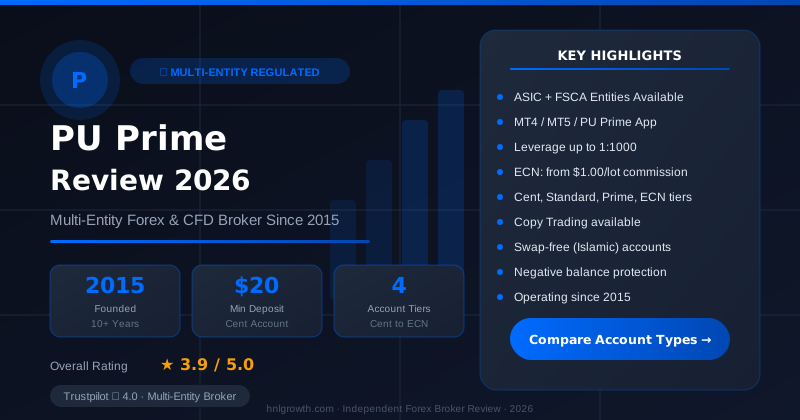
PU Prime — Multi-Entity Forex & CFD Broker
ASIC (AU) + FSCA (ZA) entities available · $20 min deposit (Cent) · MT4, MT5, PU Prime App · 4 account tiers
Yes. Forex and CFD trading are legal activities for South African residents. The legal framework rests on the Financial Advisory and Intermediary Services Act (FAIS Act), which defines the scope of regulated financial services and gives the FSCA its mandate to licence and supervise financial service providers.
Under FAIS, any person or entity that provides advice or intermediary services in relation to financial products — including OTC derivatives such as forex CFDs — must hold an active FSP licence. Trading through an unlicensed provider is a legal risk for the client: regulatory recourse and client fund protections do not apply where no licence exists.
Three distinct legal concepts apply and should not be conflated:
- Legality for the trader: Residents may legally trade forex.
- Licensing obligation for the broker: The broker must hold a current FSP number to legally serve SA clients from within South Africa.
- Tax obligation: Profits are taxable regardless of which broker you use or where it is regulated.
A broker can be regulated offshore and still accept South African clients on a cross-border basis — but doing so removes FSCA jurisdiction from the relationship. This trade-off is covered in full below.
How to Verify Whether a Broker Is FSCA-Authorised
The FSCA maintains a public register of all licensed Financial Service Providers at fsca.co.za. Checking the register before depositing is the single most important due-diligence step an SA trader can take.
Step-by-step FSP register verification:
- Go to fsca.co.za and navigate to the FSP register search tool.
- Search by the broker's legal entity name — not its trading name, as these sometimes differ. If you are unsure of the legal name, check the broker's own regulation or legal disclosure page.
- Confirm the FSP number shown on the register matches the number the broker displays on its website.
- Check the status field: the entry must show "Authorised" — not "Suspended", "Withdrawn", or "Pending".
- Check the category of authorisation: relevant categories for OTC derivatives and forex products include Category I (advice) and Category II (discretionary FSP), among others. Confirm the broker's authorised category covers the specific products you intend to trade. Definitions of FSCA authorisation categories are published at fsca.co.za.
- Separately, search the FSCA's public warning list at fsca.co.za/Warnings. If a broker appears on this list, the FSCA has issued a formal caution or determined the entity is operating without authorisation.
PU Prime and FSCA registration: PU Prime's official regulation page at puprime.com/regulation/ lists the FSCA among its regulatory authorities and states it operates under oversight of several financial authorities. The page also confirms it is a regulated broker adhering to standards of transparency, client fund protection, and operational integrity. However, the specific FSP number was not confirmed from the evidence available at time of writing. You must verify PU Prime's current FSP number and authorisation status directly against the live FSCA register using the steps above before opening an account. FSP status is a live record — always check the register, not only the broker's website.
FSCA-Authorised vs. Offshore Brokers: Protections and Trade-Offs
Many internationally recognised brokers accept South African clients without holding an FSCA FSP licence. This is not necessarily illegal for the client, but it materially changes the protection framework.
| Factor | FSCA-Authorised Broker | Offshore Broker Accepting SA Clients |
|---|---|---|
| Client money segregation | Required under FSCA rules; subject to local audit | Depends on the overseas regulator's requirements |
| Complaint escalation | FSCA complaints process and FAIS Ombud available | Falls under the foreign regulator's jurisdiction; recourse may be slower or harder to access from SA |
| Leverage cap enforcement | Subject to FSCA-set retail limits | Subject to limits set by the foreign regulator, which may differ |
| FSCA warning list accountability | Subject to local enforcement action | FSCA may issue a caution but cannot enforce against the foreign entity directly |
| Product range | May be more constrained by local FSCA rules | May offer broader products or higher leverage than FSCA caps permit |
| ZAR account availability | More likely for locally-operating entities | Variable; many process only USD, EUR, or GBP |
This matrix reflects editorial analysis of published FSCA guidance and broker disclosure structures. Verify the specific terms and entity that apply to your account before depositing.
Neither route is categorically superior. The right choice depends on what you prioritise: if local regulatory recourse and FSCA oversight matter most to you, an FSCA-authorised entity is the clearer fit. If you prioritise product range or are comfortable with offshore dispute resolution, that trade-off exists — but you should understand it clearly before committing capital.
Tax Obligations for South African Forex Traders
Forex trading profits are taxable in South Africa. SARS treats income from trading activities as taxable. Depending on your trading frequency, intent, and the nature of your activity, SARS may classify your gains as either revenue income (taxed as ordinary income) or capital gains (subject to the capital gains tax framework at a lower inclusion rate). The distinction is not mechanical — SARS looks at intent and pattern.
Illustrative scenario (not tax advice): A trader who realises R20,000 in net forex gains during a tax year would need to declare this in their annual SARS return. Whether it is classified as revenue income or a capital gain depends on factors including how actively the trader traded, whether trading was their primary occupation, and whether positions were held for speculation or longer-term purposes. A trader who opens and closes multiple positions weekly is more likely to be assessed as earning revenue income than one who holds positions for months.
This illustration shows the type of question SARS asks, not the answer for your specific situation. Always consult a qualified South African tax adviser and refer to current SARS guidance at sars.gov.za before filing. This article does not constitute tax advice.
Practical record-keeping implication: Regardless of classification, you need accurate records of all trades: entry and exit dates, amounts, profits, and losses. MetaTrader 4 and MetaTrader 5 both produce exportable trade history reports. Download and retain these for each tax year.
Funding Your Account from South Africa
Exchange Control Context
South African residents may transfer funds abroad within the SARB's allowance framework. The annual discretionary allowance and foreign investment allowance govern how much you can move offshore. Allowance limits and administrative requirements are set by SARB and can change; verify the current thresholds directly at resbank.co.za or through your bank before making any transfer to an offshore broker.
Transfers to FSCA-licensed entities operating locally may not require the same offshore transfer treatment. Confirm with your broker which entity your account is held under and how funds are routed.
Payment Methods: What to Verify for SA Residents
The table below summarises payment method considerations for South African traders. The PU Prime account opening page confirms that credit and debit card, bank wire, Skrill, Neteller, and local payment methods are accepted. Specific ZAR acceptance and local EFT availability should be confirmed directly with PU Prime at the time of account opening, as terms can change and SA-specific options may differ from globally-described account terms.
| Method | Typical SA Availability | ZAR Deposits | Typical Deposit Speed | Notes |
|---|---|---|---|---|
| EFT / Local Bank Transfer | Confirm on broker's funding page | Confirm availability | 1–3 business days typically | Subject to SARB exchange control for offshore entities |
| International Bank Wire | Generally available | Usually USD or EUR | 1–5 business days | Currency conversion fees may apply at your bank |
| Visa / Mastercard | Generally available | Confirm availability | Instant to same-day typically | Card processor routing may affect ZAR acceptance |
| Skrill | Available where Skrill operates in SA | Confirm availability | Instant typically | Skrill maintains its own verification requirements |
| Neteller | Available where Neteller operates in SA | Confirm availability | Instant typically | Check current Neteller SA acceptance |
Source: PU Prime account opening page (puprime.com/how-to-open-a-trading-account/). Verify current SA-specific acceptance before depositing.
Currency Conversion Cost Modelling
If you deposit in ZAR and your account is denominated in USD, you absorb a conversion cost on every deposit and withdrawal. As an illustration only — using a hypothetical mid-market rate to show the mechanics rather than a current market rate — R5,000 converting to USD at a mid-market rate would then lose a further 1–2% to a bank or payment processor's conversion spread. On a small starting balance, this overhead is proportionally significant. Check the live SARB reference rate at resbank.co.za before depositing to calculate your actual conversion cost. If ZAR account availability matters to you, confirm it directly with PU Prime before opening an account.
Entry Costs and Account Tiers
PU Prime offers four main account types. Minimum deposit figures below are sourced from the official PU Prime account opening page. ZAR equivalent figures in this table are for structural illustration only — the USD/ZAR rate fluctuates materially and the ZAR cost of entry shifts daily. Check the live SARB reference rate before depositing.
| Account Type | Minimum Deposit (USD) | EUR/USD Spread | Commission | Platform |
|---|---|---|---|---|
| Cent | $20 | From 1.3 pips | None | MT4 / MT5 |
| Standard | $50 | From 1.3 pips | None | MT4 / MT5 |
| Prime | $1,000 | From 0.0 pips | $3.50/lot/side | MT4 / MT5 |
| ECN | $10,000 | From 0.0 pips | $1.50/lot/side | MT4 / MT5 |
Source: puprime.com/how-to-open-a-trading-account/ and puprime.com/spread-and-costs/. Spread figures are indicative reference values; the spread-and-costs page notes all values are for reference only and actual values should be checked on MT4/MT5 or the PU Prime app.
Worked trading cost illustration: On a Standard account, a full standard lot EUR/USD trade (100,000 units) at a 1.3-pip spread costs approximately $13 in spread cost. At micro-lot size (0.01 lot), that scales proportionally to approximately $0.13. This illustration assumes the indicative mid-spread figure and does not account for execution slippage or market impact; actual costs at the moment of execution may differ. Understanding the relationship between lot size and spread cost is essential before selecting an account tier.
Who the Cent account suits: Traders who want exposure to live market conditions at minimal capital outlay. Account balances are displayed in cents (so $20 = 2,000 USC), which reduces position sizes and per-trade exposure significantly.
Who the Prime and ECN accounts do not suit: Beginners and traders with modest starting capital. The commission structure on raw-spread accounts is cost-efficient only for traders executing consistently high volumes.
Demo account note: A demo account uses real market prices for price feeds but does not replicate live execution conditions, including factors such as slippage, liquidity depth, or the psychological pressure of trading real capital. It is a useful starting tool but has limitations relative to live trading.
Disclosure: This page may contain affiliate links. We may earn a commission if you open an account through our links, at no extra cost to you.
If you have read the regulatory, tax, and cost sections above and are ready to review account options, you can compare PU Prime account types on their official page.
Platforms and Tools Available to SA Traders
PU Prime offers MetaTrader 4 (MT4) and MetaTrader 5 (MT5) across all account types, plus the PU Prime mobile app. MT5 is the newer platform, with additional order types and a broader instrument range. MT4 remains the established standard for third-party Expert Advisors (EAs).
| Platform | Available | EA / Automated Trading | Mobile | Key Use Case |
|---|---|---|---|---|
| MetaTrader 4 | Yes | Yes | Yes | EA-based automation, widely supported third-party tools |
| MetaTrader 5 | Yes | Yes | Yes | Wider instruments, advanced order types |
| PU Prime App | Yes | Limited | Native | On-the-go monitoring, copy trading access |
For SA traders who cannot actively monitor screens during London or New York sessions due to work schedules, automated order management on MT4 and MT5 is practically relevant. Pending orders, pre-configured take-profit levels, and stop-loss orders can execute without manual intervention during sessions you cannot monitor live.
Trading Hours and the SAST Reality
South Africa operates at UTC+2 year-round (no daylight saving adjustment). This creates a specific scheduling reality for SA-based traders.
| Session | UTC Open | UTC Close | SAST Open | SAST Close | Key Pairs | Liquidity Context |
|---|---|---|---|---|---|---|
| Tokyo | 00:00 | 09:00 | 02:00 | 11:00 | USD/JPY, AUD/USD, USD/ZAR | Moderate; ZAR pairs most active early |
| London | 08:00 | 17:00 | 10:00 | 19:00 | EUR/USD, GBP/USD, EUR/GBP | Highest liquidity; falls within SA business hours |
| New York | 13:00 | 22:00 | 15:00 | 00:00 | EUR/USD, USD/CAD, USD/ZAR | High liquidity; overlaps with London session |
| London–NY Overlap | 13:00 | 17:00 | 15:00 | 19:00 | EUR/USD, GBP/USD | Peak daily liquidity; accessible during SA business hours |
SAST times shown are based on standard UTC+2 (no DST). London and New York both observe daylight saving time. During seasonal clock transitions in those cities — typically late March and late October/early November — UTC offsets shift by one hour, which moves the SAST equivalent times of those sessions by one hour. Check a current DST calendar when planning around session open and close times.
Practical scheduling note: The London–New York overlap (15:00–19:00 SAST under standard UTC offsets) coincides with late SA business hours and early evening, making it accessible to traders who work full-time. The Tokyo session opens at 02:00 SAST, which is impractical for manual trading for most people. Traders who can only trade in evenings are better positioned for the tail end of the London session and the New York session than for Asian market hours.
Leverage Limits, Risk Controls, and What They Mean for Beginners
Leverage caps for retail accounts in South Africa are set by the FSCA. The figures below are drawn from widely cited regulatory commentary on FSCA-supervised retail accounts. Verify the current caps against the FSCA's published Board Notices at fsca.co.za before trading, as leverage rules can be updated.
| Product Type | Cited FSCA Maximum Leverage (Retail) | Practical Risk Note |
|---|---|---|
| Forex major pairs | Up to 1:500 | A 0.2% adverse move wipes the margin on a max-leveraged position; small moves have large ZAR impact |
| Forex minor/exotic pairs | Lower caps apply | USD/ZAR is volatile; high leverage amplifies ZAR-denominated losses rapidly |
| CFDs on indices | Up to 1:200 | Index CFDs can gap overnight; stop-losses do not guarantee against slippage |
| CFDs on individual stocks | Up to 1:20 | Lower leverage reflects higher individual stock volatility |
| Commodities | Varies by product | Check instrument-specific margin on the broker's platform before trading |
Leverage figures are drawn from regulatory commentary only and are not confirmed against a specific FSCA Board Notice. Verify current limits at fsca.co.za before trading.
Leverage is not a target — it is a ceiling. The FSCA maximums represent the upper bound a regulated broker may offer, not a recommended level. Most experienced traders use effective leverage well below the regulatory maximum.
A margin call occurs when your account equity falls below the required margin level; your broker will alert you and may require additional funds. A stop-out occurs when equity falls further to the broker's stop-out level, and open positions are automatically closed to prevent your balance going negative. Stop-loss orders reduce but do not eliminate the risk of losses exceeding your margin, particularly where markets gap. Understand both mechanics before placing a live trade.
Opening an Account: What SA Residents Need
Confirm you have verified the broker's FSP status, understood your tax obligations, and assessed entry costs before starting this process.
Step-by-step account opening with PU Prime:
- Register: Visit the PU Prime account opening page. Enter your name, email, phone number, and choose your account currency and trading platform (MT4 or MT5).
- Complete risk assessment questions: The broker is required under regulated conditions to assess whether you understand the risks of leveraged trading.
- Upload KYC documents: You will need:
- A valid government-issued photo ID (passport, national identity card, or driving licence — not expired, showing full name and date of birth).
- Proof of residential address dated within the last three months (utility bill, bank statement, or government-issued letter showing your name and home address).
- Clear photos: all four document corners visible, no glare, sharp text. Poor image quality is a common cause of verification delays.
- Wait for verification: PU Prime states verification typically takes a few hours on business days. Some accounts take up to 24–48 hours depending on document quality and compliance queue volume.
- Fund your account: Deposit using your chosen payment method. Card and e-wallet deposits typically process faster than bank transfers (bank wire typically 1–3 business days).
- Demo account option: You can open a PU Prime demo account while waiting for live account verification. The demo uses real market price feeds and is a useful first step for familiarising yourself with the platform — with the limitations noted in the account tiers section above.
Start with a PU Prime demo or live account once you have confirmed the broker's FSCA status, prepared your KYC documents, and confirmed your chosen funding method is available for SA residents.
SA Trader Compliance Checklist
Work through this checklist before depositing real capital:
- ☐ FSP register check: Searched fsca.co.za FSP register for the broker's legal entity name; status shows "Authorised"; FSP number matches the number on the broker's own regulation page.
- ☐ Authorisation category confirmed: Verified the FSP category covers OTC derivatives and forex CFDs, not only advisory services. Category definitions published at fsca.co.za.
- ☐ FSCA warning list checked: Searched fsca.co.za/Warnings; broker does not appear on the list.
- ☐ Servicing entity confirmed: Identified which PU Prime legal entity your account will be held under and which regulatory protections apply to that entity specifically.
- ☐ Tax awareness confirmed: Read current SARS guidance at sars.gov.za; consulted (or scheduled a consultation with) a qualified SA tax adviser.
- ☐ SARB exchange control confirmed: Verified current annual allowance thresholds at resbank.co.za if depositing with an offshore-regulated entity.
- ☐ Live ZAR rate checked: Checked the current SARB reference rate at resbank.co.za and calculated the ZAR equivalent of your intended deposit.
- ☐ Funding method confirmed: Verified your chosen payment method is currently accepted for SA residents on the broker's funding page.
- ☐ KYC documents ready: Valid ID and address proof (dated within three months) photographed clearly.
- ☐ Demo account trialled: Spent time on the demo platform before depositing live capital; noted its limitations relative to live execution.
- ☐ Capital amount reviewed: Confirmed the deposit amount represents funds you can afford to put at risk — not borrowed money, emergency savings, or funds needed for near-term expenses.
Dispute Resolution: What Happens if Something Goes Wrong
For brokers holding an active FSCA FSP licence, South African clients have a formal escalation path:
- Raise the complaint with the broker first. Most FSCA-authorised brokers operate a formal internal complaints procedure; use it and retain written records.
- If unresolved, escalate to the FSCA. The FSCA accepts complaints against licensed FSPs at fsca.co.za. The regulator can investigate and, where a breach of FAIS obligations is found, take enforcement action.
- Ombud for Financial Services Providers (FAIS Ombud): For complaints relating to FAIS-regulated advice and intermediary services, the FAIS Ombud (faisombud.co.za) provides an independent dispute resolution route. Verify the current scope and complaint process directly at faisombud.co.za before filing, as operational details can change.
For offshore brokers operating outside FSCA jurisdiction, escalation falls to the foreign regulator. Whether that regulator accepts complaints from non-residents, operates in English, and can enforce any outcome affecting you depends entirely on which jurisdiction the broker is licensed in. This asymmetry is one of the meaningful practical trade-offs between FSCA-licensed and offshore-regulated brokers, and it should factor into your decision before depositing.
Frequently Asked Questions
Is forex trading legal in South Africa? Yes. South African residents may legally trade forex and CFDs. The legal condition is that brokers providing financial services to SA clients must hold an active FSP licence from the FSCA. Trading through an unlicensed provider carries both legal and financial risk.
How do I verify a broker's FSCA authorisation? Use the FSP register at fsca.co.za. Search by the broker's legal entity name, confirm status shows "Authorised", and match the FSP number to what the broker discloses on its own website. Also check the FSCA warning list.
What are my tax obligations as a South African forex trader? Forex profits are taxable. Whether gains are assessed as revenue income or capital gains depends on your trading frequency, intent, and pattern. Refer to sars.gov.za and consult a qualified SA tax adviser before filing. This article does not constitute tax advice.
Can I open a ZAR-denominated account? This depends on the broker and the specific legal entity serving your account. Confirm ZAR account availability directly with PU Prime or on their current funding page, as SA-specific options may differ from globally-described account terms.
What leverage is available to SA residents? The FSCA sets maximum retail leverage caps. Commonly cited figures include up to 1:500 for forex major pairs, up to 1:200 for index CFDs, and up to 1:20 for stock CFDs; these figures come from regulatory commentary and should be verified against current FSCA Board Notices at fsca.co.za before trading.
What do I do if I have a dispute with an FSCA-authorised broker? First raise the complaint formally with the broker. If unresolved, escalate to the FSCA at fsca.co.za or the FAIS Ombud at faisombud.co.za. Retain all written records throughout the process.
Risk warning: CFDs and leveraged forex products are complex instruments and carry a high risk of losing money rapidly due to leverage. Consider whether you understand how these products work and whether you can afford to take the high risk of losing your capital. Check the entity, terms and protections that apply in your jurisdiction before trading.
Ready to Compare PU Prime Account Types?
PU Prime is a multi-entity broker — ASIC (Australia) and FSCA (South Africa) regulated entities offer stronger oversight, while most international clients are onboarded to the FSA Seychelles or FSC Mauritius entities. Four account tiers (Cent, Standard, Prime, ECN) range from a $20 minimum deposit to full ECN pricing.
Risk disclaimer: PU Prime is a live, regulated multi-entity broker — trading forex and CFDs is done with real capital under normal market risk (this is not a simulated prop-firm evaluation). PU Prime operates under multiple separate licenses (ASIC, FSCA, FSA Seychelles, FSC Mauritius); which entity holds your account depends on your country of residence and determines your leverage cap and protections — confirm this before funding. CFDs and leveraged forex products are complex instruments and carry a high risk of losing money rapidly due to leverage; 62.2% of retail investor accounts lose money when trading CFDs with this provider. Consider whether you understand how CFDs/forex work and whether you can afford the high risk of losing your money. Affiliate disclosure: HNL Growth earns a commission when you open a PU Prime account through links on this page.