Gold vs Forex: Which Suits Your Strategy and Risk
Choosing whether to trade gold vs forex comes down to four variables: how much volatility you can absorb, when you can trade, how you analyse markets, and what your capital...
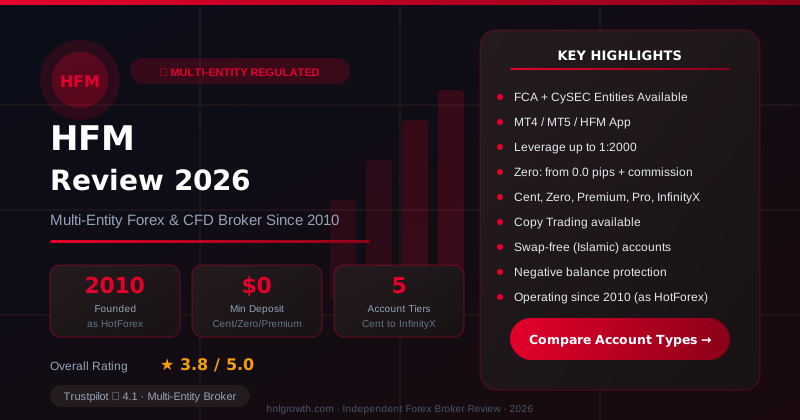
Checked on: 2026-08-07 | Broker terms, regulation, and pricing can change. Always verify at the official HFM site before opening an account.
Affiliate Disclosure: HNL Growth may earn a commission if you open an account through our links, at no additional cost to you. Risk Warning: CFDs and leveraged forex products are complex instruments and carry a high risk of losing money rapidly due to leverage. Between 65-95% of retail investor accounts lose money when trading CFDs, depending on the HFM entity and account type. Trading forex and CFDs may not be suitable for all investors. Consider your objectives, experience, and risk appetite before trading, and ensure you understand the risks involved. Broker Disclosure: HFM (HF Markets Group) is a live, regulated multi-entity broker (not a simulated prop-firm evaluation) — trades are executed with real capital in live market conditions, subject to normal market risk. Protections vary significantly by the specific legal entity that onboards your account.
Gold vs Forex: Which Suits Your Strategy and Risk
Choosing whether to trade gold vs forex comes down to four variables: how much volatility you can absorb, when you can trade, how you analyse markets, and what your capital allows. XAUUSD and major forex pairs such as EUR/USD are both accessible through the same CFD account and platform, yet they differ meaningfully in cost structure, daily range, price drivers, and session behaviour. Gold tends to produce larger, trend-driven swings tied to real yields, inflation expectations, and geopolitical risk. Forex majors deliver tighter spreads, more frequent mean-reverting setups shaped by interest-rate differentials and economic data. Neither is universally easier or more profitable — the right choice depends on matching the market to your schedule, risk budget, and analytical style.
Gold vs Forex at a Glance
HashHedge — Crypto Futures Prop Firm
Up to $200K funded accounts · 85% profit split · Instant USDT payouts · 160+ assets
The table below summarises how XAUUSD compares with two heavily traded forex pairs. Figures are indicative; always confirm live conditions on the broker's platform before trading.
| Factor | XAUUSD | EUR/USD | GBP/USD |
|---|---|---|---|
| Typical daily range (USD per std lot) | $2,500 – $4,500 | $700 – $1,200 | $900 – $1,500 |
| Typical spread (Premium account) | Wider; check HFM live conditions | From 1 pip | From 1.5 pips |
| Swap direction (long position) | Generally negative | Generally negative | Generally negative |
| Contract size | 1 lot = 100 troy oz | 1 lot = 100,000 units | 1 lot = 100,000 units |
| Peak liquidity session | London–New York overlap | London–New York overlap | London session |
| Primary price drivers | Real yields, USD, inflation, geopolitics | Rate differentials, ECB vs Fed data | Rate differentials, BoE data, risk sentiment |
| Best-fit strategy style | Trend-following, swing | Scalping, intraday, news | Intraday, swing |
Daily-range figures are illustrative, based on 20-day average true range observations during recent market conditions. Actual values shift with volatility regimes.
What Moves the Price
The comparison table gives you numbers; understanding what drives those numbers matters more for timing entries and managing risk.
Forces behind gold prices
Gold responds to a concentrated set of macro inputs. Real yields — nominal bond yields adjusted for inflation — are the single most influential driver: when real yields fall, gold's appeal as a non-yielding store of value rises. USD strength exerts an inverse effect because gold is dollar-denominated. Inflation expectations, geopolitical risk, and central-bank reserve buying provide additional directional pressure. These drivers tend to align during macro shocks, producing sustained trends that can persist for weeks.
Forces behind currency pairs
Forex pairs react to a broader, more frequently changing set of inputs. Interest-rate differentials between two central banks set the baseline trend. Economic data surprises — employment reports, CPI releases, GDP revisions — create intraday volatility. Risk sentiment shifts and cross-border capital flows add shorter-term noise. The result is more frequent but often less persistent movement than gold.
The shared factor — USD strength
Both markets share a common denominator: the US dollar. XAUUSD is inversely correlated with USD strength, and USD-denominated pairs like EUR/USD move in the opposite direction of dollar appreciation. This means a long XAUUSD position and a long EUR/USD position often express a similar bearish-USD view. Traders holding both simultaneously may have correlated exposure rather than genuine diversification.
During acute risk-off events, gold can rally as a safe haven even as the USD strengthens — a divergence from the usual inverse correlation. For hedging purposes, treat the two as correlated in normal conditions and potentially divergent during crises.
What It Costs to Trade
Cost differences between gold and forex operate on three levels: spread at entry, overnight swap charges, and margin requirements. Each affects profitability differently depending on holding period and position size.
Cost per standard lot: a worked example
The table below illustrates the entry cost for a one-standard-lot position. Spread figures are indicative and vary by account type, session, and market conditions. Verify current HFM spreads on the live platform before relying on these numbers.
| Cost element | XAUUSD (1 lot = 100 oz) | EUR/USD (1 lot = 100,000 units) |
|---|---|---|
| Indicative spread | Approx. 30 points ($3.00/oz) | Approx. 1.0 pip |
| Spread cost at entry | ~$300 per lot | ~$100 per lot |
| Spread as % of notional (at $3,000/oz and 1.1000) | ~0.10% | ~0.09% |
Gold's wider spread means higher upfront friction per lot, though the percentage impact is similar. For smaller accounts trading micro-lots, the absolute cost scales proportionally — a 0.01-lot gold position carries roughly $3 in spread cost versus $1 for EUR/USD.
Holding overnight — swap charges
Swap charges reflect the interest-rate differential and financing cost of holding a leveraged position. For gold, the swap on a long position is typically negative because you are financing the full notional value of 100 troy ounces. Published HFM swap tables show per-lot, per-night charges; these change periodically and should be verified on the broker's current swap schedule before committing to a multi-day position.
For EUR/USD, the swap charge is usually smaller in absolute terms per standard lot because the notional value is lower and the interest-rate differential between EUR and USD partially offsets the financing cost.
The practical implication: a gold position held for five nights accumulates noticeably higher swap costs than the same-duration EUR/USD position. Swing traders targeting multi-day gold moves must factor this into their profit target.
Volatility, Stop Distance, and Position Sizing
This is where the gold or forex decision becomes concrete. Volatility determines how far your stop-loss must sit and how large your position can be for a given risk target.
Daily range and stop placement
Using approximate 20-day average true range (ATR) benchmarks:
- XAUUSD: $25 – $40 daily range in price terms (250 – 400 points). At 1 lot, that translates to $2,500 – $4,000 of dollar movement per standard lot per day.
- EUR/USD: 70 – 100 pips daily range. At 1 lot, that is $700 – $1,000 of dollar movement.
A stop-loss placed within the normal daily range will be triggered by routine noise. Most traders set stops at or beyond 1× ATR to avoid premature exits. This means gold stops need to be wider in absolute terms, which directly constrains position size.
Sizing to the same dollar risk
Assume a fixed risk of $50 per trade and a stop placed at 1× ATR:
| Parameter | XAUUSD | EUR/USD |
|---|---|---|
| Target dollar risk | $50 | $50 |
| ATR (20-day, illustrative) | $35 (350 points) | 80 pips |
| Stop distance | $35 per oz | 80 pips |
| Dollar risk per 1.00 lot at that stop | $3,500 | $800 |
| Lot size for $50 risk | ~0.014 lots | ~0.06 lots |
The same $50 risk budget allows roughly four times the lot size on EUR/USD compared to XAUUSD when using equivalent ATR-based stops. Applying the same lot size across both markets without adjusting for volatility is one of the most common sizing errors — it either overexposes the account on gold or underutilises capital on forex.
When Each Market Moves
Both gold and forex majors trade nearly 24 hours a day, five days a week, but liquidity and volatility are not evenly distributed.
XAUUSD sees its highest volume and tightest spreads during the London–New York overlap, approximately 13:00 – 17:00 GMT. The London open (08:00 GMT) also triggers a liquidity surge. Outside these windows — particularly during the Asian session — gold spreads widen and movement tends to be limited. According to HFM's published gold trading guide, the London session (08:00 – 18:00 GMT) is identified as the most active period for gold trading.
Forex majors share the London–New York overlap as their peak window, but their spreads remain relatively competitive during the Asian session compared to gold. EUR/USD and GBP/USD react sharply to European and US economic data releases, typically at 07:00 – 09:00 GMT and 12:30 – 14:00 GMT respectively.
Practical takeaway: if your available trading window falls outside London and New York hours, forex majors offer more usable liquidity than gold. If you can trade the overlap, both markets are fully accessible, though gold's cost-efficiency improves markedly during that window.
Which Market Fits Your Approach
Labelling one market "better" misses the point. The question is which market's characteristics align with your temperament, schedule, and analytical preferences.
Intraday and scalping-oriented traders
Forex majors — particularly EUR/USD — tend to suit high-frequency intraday trading. Tighter spreads reduce the distance price must travel before a position turns profitable, which matters when targeting 5 – 15 pip moves. The consistent tick flow during London and New York sessions provides frequent setup opportunities. Gold can be scalped during the London–New York overlap, but the wider spread demands a larger per-trade move to achieve the same risk-reward ratio.
Swing traders and trend-followers
Gold tends to suit patient trend-followers. Its macro-driven price action — sustained by inflation cycles, central-bank policy shifts, and geopolitical developments — produces directional trends that can persist for weeks. Wider daily ranges allow for larger per-trade profit targets when stops are properly sized. Forex majors can also trend, particularly during divergent central-bank cycles, but mean-reverting tendencies driven by competing economic data make multi-week trends less persistent.
Macro and event-driven traders
Both markets respond to macro data, but the transmission mechanism differs. Gold reacts sharply to inflation prints, real-yield moves, and geopolitical escalation — often with a single-directional bias during risk-off events. Forex pairs respond to a wider menu of releases (NFP, CPI, GDP, PMI) with two-way volatility because each data point affects two currencies differently. Traders who prefer reading broad macro narratives and holding through multi-day developments often find gold more intuitive. Those who thrive on rapid data interpretation and short-term positioning may prefer forex.
Trader psychology and focus commitment
| Trader profile | Market that tends to suit | Key reason |
|---|---|---|
| Scalper / high-frequency intraday | Forex majors (EUR/USD) | Tighter spreads, more frequent setups |
| Swing trader / trend-follower | XAUUSD | Clearer macro trends, larger per-trade range |
| Macro / news-event trader | Either — depends on catalyst preference | Gold favours inflation/geopolitics; forex favours rate/data surprises |
| Part-time / limited session availability | Forex majors | Tighter spreads outside peak hours |
| Prefers fewer, higher-conviction setups | XAUUSD | Slower setup cadence, larger targets per trade |
Beyond style labels, consider your psychological profile. Gold's larger swings within a single session require tolerance for watching positions move significantly against you before resolving. Forex scalping demands discipline to accept frequent small losses as a cost of the strategy. The market that matches your natural patience level and stress response is usually the one where you will execute more consistently.
Disclosure: This page may contain affiliate links. We may earn a commission if you open an account through our links, at no extra cost to you.
Both XAUUSD and major forex pairs are available through a single HFM account on MetaTrader 4, MetaTrader 5, and the HFM platform — there is no need for separate accounts or platforms to access both markets. HFM has been operating since 2010 and offers spreads starting from 0.0 pips on certain account types. According to HFM's official trading accounts page, spreads on the Premium Pro account start from 1 pip for forex pairs, and all available instruments — including gold and forex — are accessible under the same account structure. Contract sizes are 1 lot = 100 troy ounces for gold and 1 lot = 100,000 units for forex, with a minimum trade size of 0.01 lots across instruments. Swap-free options are also available for traders who require them.
The unified platform access means you can diversify between gold and forex within a single account, adjusting position sizes according to the volatility framework outlined above rather than splitting capital across multiple brokers. Compare HFM account types and open a live account to start trading both markets under the same structure.
Trading Gold and Forex on HFM
HFM supports trading on multiple platforms designed to suit traders at every level. The HFM mobile app has been recognised by Capital Finance as the Best Forex Trading App, offering modern and intuitive mobile trading alongside desktop access through MetaTrader 5, the HFM WebTrader, and the HFM Platform. All account types allow access to the full range of available instruments, including XAUUSD and all major forex pairs.
For traders seeking the tightest possible spreads, HFM offers account structures with spreads starting from 0.0 pips on select instruments, though zero-spread quotes may experience delays and commissions apply. The Premium Pro account, designed for professional clients, requires a $5,000 minimum deposit and offers spreads from 1 pip with variable pricing. Maximum leverage on the Premium Pro account is 1:400 for professional clients, with margin call at 50% and stop-out at 20%. The account supports up to 300 simultaneous open orders and a maximum of 60 standard lots per position.
Account registration can be completed through an online form, followed by KYC verification to activate the account. Funding is available through multiple fast and secure methods. HFM provides support via email, live chat, and telephone at +357-244 001 65 for questions regarding account types or trading conditions. Note that there is a limit to the number of trading accounts a client can open on the HFM MT5 platform.
Not sure which market fits your rhythm? A demo account lets you trade both gold and forex under identical live-market conditions without risking capital. The HFM demo account page allows you to test the cost, volatility, and session dynamics described above before committing real funds.
Frequently Asked Questions
Is gold or forex better for beginners? Forex majors like EUR/USD offer tighter spreads, making each trade less costly to enter — a practical advantage when learning. Gold's larger swings require more careful position sizing but can suit beginners who prefer fewer, trend-oriented trades. Start with micro-lots on either market to learn the rhythm.
Which is more volatile — gold or forex? In dollar terms per standard lot, XAUUSD typically shows a larger daily range than EUR/USD or GBP/USD. As a percentage of price, gold's daily moves are also generally larger, often 1.5 – 2.5% versus 0.4 – 0.8% for major pairs during comparable conditions.
Can I trade both gold and forex on the same account? Yes. On HFM, both XAUUSD and forex pairs are available under a single account on MT4, MT5, and the HFM platform. Be aware of the USD correlation between gold and dollar-denominated pairs when holding positions in both simultaneously.
Is gold trading safer than forex? Gold's safe-haven reputation applies to physical ownership, not leveraged CFD positions. A gold CFD carries the same leverage risk, margin-call mechanics, and counterparty exposure as a forex CFD. The underlying asset's status does not reduce the risk of a leveraged trade.
Why does gold trend more than forex pairs? Gold responds to slower-moving macro cycles — inflation regimes, real-yield shifts, central-bank reserve allocation — that create sustained directional pressure over weeks or months. Forex pairs are influenced by two competing economies and frequent data releases, producing more mean-reverting behaviour within those same periods.
How do overnight costs compare? Gold swap charges per lot are generally higher than those for forex majors because the financing applies to the full notional value of 100 troy ounces. For multi-day swing positions, this adds meaningfully to the cost of holding. Check HFM's published swap table for current rates before planning extended holds.
Risk warning: CFDs and leveraged forex products are complex instruments and carry a high risk of losing money rapidly due to leverage. Retail investor accounts lose money when trading CFDs with most providers; the exact percentage varies by HFM entity and account type. You should consider whether you understand how CFDs work and whether you can afford to take the high risk of losing your money. Check the entity, terms and investor protections that apply in your jurisdiction before opening an account or trading.
Ready to Start Your Funded Trading Journey?
Join traders backed by $11M+ in verified payouts and a 4.7/5 Trustpilot rating. Compare HashHedge challenge plans, drawdown rules, and payout terms — apply code ha25 for the current discount.
Risk disclaimer: Challenge fees are non-refundable if you breach the rules. Prop trading involves significant financial risk. Past performance in a simulated environment does not guarantee results on a funded account. Only purchase if you understand the rules fully and can afford to lose the fee. Affiliate disclosure: HNL Growth earns a commission when you purchase a HashHedge challenge through links on this page.