HFM Copy Trading and PAMM 2026: How It Works
> Disclosure: This page may contain affiliate links. We may earn a commission if you open an account through our links, at no extra cost to you.
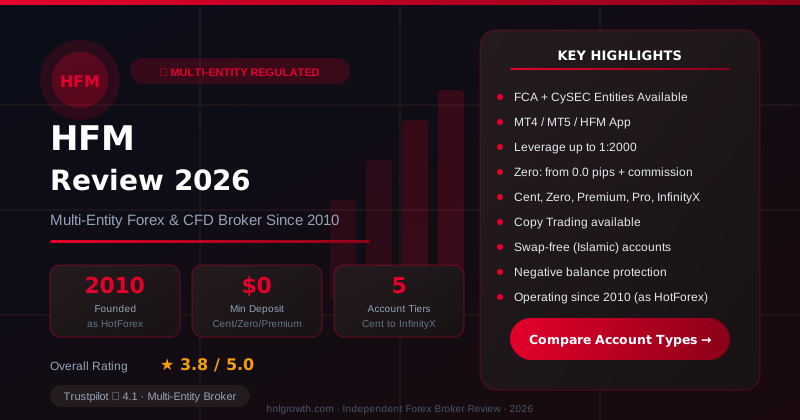
Checked on: 2026-08-17 | Broker terms, regulation, and pricing can change. Always verify at the official HFM site before opening an account.
Affiliate Disclosure: HNL Growth may earn a commission if you open an account through our links, at no additional cost to you. Risk Warning: CFDs and leveraged forex products are complex instruments and carry a high risk of losing money rapidly due to leverage. Between 65-95% of retail investor accounts lose money when trading CFDs, depending on the HFM entity and account type. Trading forex and CFDs may not be suitable for all investors. Consider your objectives, experience, and risk appetite before trading, and ensure you understand the risks involved. Broker Disclosure: HFM (HF Markets Group) is a live, regulated multi-entity broker (not a simulated prop-firm evaluation) — trades are executed with real capital in live market conditions, subject to normal market risk. Protections vary significantly by the specific legal entity that onboards your account.
HFM Copy Trading and PAMM 2026: How It Works
Disclosure: This page may contain affiliate links. We may earn a commission if you open an account through our links, at no extra cost to you.
HFM copy trading (branded HFcopy) lets you automatically mirror the trades of experienced Strategy Providers on MT4, MT5, or the HFM app. You pick a provider, set how much capital to allocate, define a stop-loss threshold, and their trades replicate in your account in real time. You keep full custody of your funds and can stop copying at any point. The trade-off is cost: on top of HFM's standard spreads, Strategy Providers charge a performance fee on profits — the exact rate is set individually by each provider and displayed on their profile before you follow. Copy trading suits passive investors who want market exposure without screen time, but it does not remove risk. You can still lose capital through provider error, slippage, or drawdowns that hit your rescue threshold before you react.
At a glance
| Item | Detail |
|---|---|
| Platform name | HFcopy |
| Platforms | MT4, MT5, HFM WebTrader, HFM App |
| Minimum deposit | From $0 on Cent, Zero, Premium; $100 on Pro; $500 on InfinityX (per HFM's official account comparison page) |
| Performance fee | Set per provider; exact rate shown on each provider's profile before following |
| Regulation | Multi-entity (varies by jurisdiction) |
| PAMM available | Yes, separate structure (confirm current terms with HFM directly) |
Explore HFM's account comparison page to review account types and platform access before activating HFcopy.
How HFM Copy Trading Works: From Signup to First Copied Trade
HashHedge — Crypto Futures Prop Firm
Up to $200K funded accounts · 85% profit split · Instant USDT payouts · 160+ assets
HFM's copy trading module lives inside your myHF client area and the HFM App. The mechanical flow is:
- Open and fund a trading account. Choose an account type compatible with copy trading (Cent, Zero, Pro, Premium, or InfinityX). Each carries different spreads, minimum deposits, and instrument access (see HFM's trading accounts page for full details). Note: InfinityX offers unlimited maximum leverage — an extreme risk parameter. Size positions conservatively regardless of what a given provider uses.
- Activate HFcopy. Inside your account dashboard, locate the copy trading module and accept the service terms.
- Browse Strategy Providers. Filter by track-record length, maximum drawdown, success rate, and performance fee.
- Set your risk parameters. Define how much capital to allocate and the protective thresholds that will auto-exit the relationship.
- Confirm and start copying. The provider's subsequent trades replicate in your account proportionally to your settings.
- Monitor and manage. You can pause, unfollow, or withdraw at any point.
Once active, each new position the provider opens is copied into your account with the same entry signal. Whether existing open trades at the moment you follow are replicated is not confirmed in publicly available HFM documentation — verify this behaviour in your own interface or with HFM support before committing capital.
The Three Parameters You Must Get Right
The HFcopy module typically exposes three controls that determine your actual exposure. Exact naming, mechanics, and input ranges can vary by platform version — verify these in your own interface before relying on them.
Volume Allocation scales your lot size relative to the provider's. If the ratio is set to 0.5 and the provider trades 1.00 lot, your copied trade is sized at approximately 0.50 lots — though the exact scaling formula is not confirmed in official HFM documentation. The0.01-lot minimum increment applies across HFM accounts. Lower values reduce both profit and loss per trade. Treat any specific numerical example in this article as illustrative, not authoritative.
Rescue Level acts as an equity-based stop on the copy relationship. As an illustrative example: set at 70% on a $1,000 allocated account, it is designed to automatically exit the copy relationship if your equity falls to roughly $700. Whether the trigger is based on equity or account balance, and whether positions close automatically or require manual action, is not confirmed in the official HFM documentation available for this article. Verify the exact mechanics on a demo account before using Rescue Level as a hard risk limit.
Capital allocation defines how much of your account balance is reserved for a given provider. Allocating $200 of a $1,000 balance means the remaining $800 is insulated from that provider's losses — a critical layer of protection if you follow multiple strategies.
What to verify yourself on a demo account:
- The exact parameter names and input ranges in your HFcopy interface.
- Whether Rescue Level triggers on equity or balance, and whether it closes positions automatically.
- The minimum copied lot size when Volume Allocation produces a fractional value below 0.01.
- Whether existing open provider positions are replicated when you first follow.
What Copy Trading Actually Costs: Performance Fees, Spreads, and Net Returns
Two cost layers drag on your net return: the underlying spread on every copied trade, and the performance fee deducted from profits.
Performance fee. Each Strategy Provider sets their own fee, applied only to profitable closed trades. The rate and billing period are displayed on the provider's profile before you follow — review these carefully, as they directly determine how much of any profit you retain. No profit, no fee.
Spread cost. HFM spreads depend on your account type: from 0.3 pip on InfinityX, from 0.6 pip on Pro, from 1.4 pip on Premium and Cent, and from 0 on Forex with a commission on Zero accounts (per HFM's official trading accounts page). Every copied trade pays the spread twice — once on entry and once on exit — so high-frequency strategies accumulate material spread drag.
Commissions and swaps. Zero-spread accounts charge a commission per lot. Overnight positions incur swaps unless your account is marked swap-free for eligible instruments.
Worked Example: Net Return on a10-Trade Sequence
The table below models a $1,000 allocation,10 copied trades, 6 winners, 4 losers, with an average win of $80 and average loss of $60. Spread cost is estimated at $8 per round turn × 10 trades = $80 total. The performance fee levels shown (10%, 25%, 50%) are hypothetical illustrative inputs — verify the actual rate on each provider's profile before following.
| Gross Profit | Perf. Fee | Fee Amount | Spread Cost | Net Profit | Net Return |
|---|---|---|---|---|---|
| $240 | 10% | $24 | $80 | $136 | 13.6% |
| $240 | 25% | $60 | $80 | $100 | 10.0% |
| $240 | 50% | $120 | $80 | $40 | 4.0% |
Gross profit: (6 × $80) − (4 × $60) = $240. The same trading edge produces a 3.4× difference in your pocket depending on the provider's fee.
The practical takeaway: a 60% win-rate strategy at a high performance fee converts a decent edge into marginal returns once spread is included. Filter providers by fee level, not only headline return.
Open an HFM live account and compare fee levels across available Strategy Providers before allocating.
How to Evaluate Strategy Providers: Metrics That Matter vs Metrics That Mislead
HFM provides performance data points on each provider profile. Read them as a cluster, never in isolation.
- Success rate — where displayed, check whether this reflects closed trades only or includes floating equity. A provider showing a high closed-trade win rate while sitting on large open losses is less impressive than the headline suggests.
- Maximum drawdown shows the worst equity peak-to-trough decline on record. This is the single best predictor of what you might endure.
- Reward-to-risk ratio (average win ÷ average loss). Anything below 1.0 with a high win rate often signals a strategy that holds losers until they recover — a latent blow-up risk.
- Account age indicates how many market regimes the provider has survived. Sub-six-month track records have not been stress-tested.
- Trade frequency and average holding time tell you whether the strategy scalps, swings, or holds — and how exposed you are to overnight and weekend gaps.
Strategy Provider Evaluation Scorecard
Weight criteria by how much they predict future drawdowns, not past returns.
| Criteria | Weight | Conservative Provider | Moderate Provider | Aggressive Provider |
|---|---|---|---|---|
| Max drawdown | 25% | 9/10 (≤10%) | 6/10 (15–20%) | 3/10 (>30%) |
| Consistency (monthly) | 20% | 8/10 | 6/10 | 4/10 |
| Reward-to-risk ratio | 20% | 8/10 (≥1.5) | 6/10 (1.0–1.5) | 3/10 (<1.0) |
| Account age | 15% | 9/10 (>18mo) | 6/10 (6–18 mo) | 2/10 (<6 mo) |
| Trade frequency | 10% | 7/10 (moderate) | 7/10 | 5/10 (extreme) |
| Transparency & description | 10% | 8/10 | 6/10 | 4/10 |
| Weighted total | 100% | 8.3 | 6.1 | 3.4 |
Red Flags: When a Profile Looks Good But Isn't
| Red Flag | Threshold | Why It Matters | What to Look for Instead |
|---|---|---|---|
| High win rate + reward-to-risk < 1.0 | Win rate >80%, R:R < 0.8 | Suggests martingale or held losers | Win rate 45–65% with R:R ≥ 1.5 |
| Very short track record | < 3 months | Hasn't faced a volatility regime | ≥ 12 months, ideally 18+ |
| Extreme max drawdown | > 30% | Likely to repeat or worsen | < 15% for conservative allocation |
| Inconsistent trade sizing | Lot sizes vary 10× without explanation | Hidden risk-on behaviour | Stable or rule-based sizing |
| No open-trade visibility | Closed history only | Hides floating losses | Full open-position transparency |
Risk Controls Available to You as a Follower
Copy trading does not mean surrendering control. HFM keeps the account in your name with you as the beneficial owner. Layer your protections:
- Rescue Level as a hard equity stop on each provider relationship (verify exact trigger mechanics and position-close behaviour in your interface).
- Volume Allocation as position sizing — smaller is always safer for a new provider.
- Partial allocation of your balance, keeping reserves outside the copy relationship.
- Multi-provider diversification across two or three uncorrelated strategies (for example, one swing FX, one indices, one low-frequency carry strategy).
Parameter Settings by Risk Profile
The Volume Allocation ranges below are illustrative — the actual input scale in your HFcopy interface may differ. Verify the available range and minimum increment before use.
| Profile | Volume Allocation (illustrative) | Rescue Level | Max Providers | Starting Capital | Expected Volatility |
|---|---|---|---|---|---|
| Conservative | 0.2–0.4 | 85% | 1 | $100–$250 | Low |
| Moderate | 0.4–0.6 | 70% | 2 | $250–$1,000 | Medium |
| Aggressive | 0.6–0.9 | 55% | 3+ | $1,000+ | High |
Conservative profiles should favour providers with account age over 12 months and max drawdown under 15%. Aggressive allocations only make sense after at least 30 days of observation on a demo or small live stake.
Copy Trading vs PAMM Accounts: Which Structure Fits?
HFM offers both copy trading and PAMM structures, but they solve different problems. The table below summarises the structural differences based on general PAMM design principles. Specific HFM PAMM mechanics, fees, minimums, and any lock-up conditions are not confirmed in the official evidence available for this article — verify current PAMM details directly with HFM before allocating.
| Feature | Copy Trading (HFcopy) | PAMM Account |
|---|---|---|
| Fund control | You retain full control | Manager trades pooled fund |
| Trade visibility | Every trade visible in your account | Typically aggregate view only |
| Fee model | Performance fee on profits | Performance + sometimes management fee |
| Exit mechanics | Unfollow any time; confirm position-close behaviour in your interface | Subject to manager/programme rules — confirm with HFM |
| Customisation | Volume, rescue, allocation per provider | Limited; manager sets strategy |
| Minimum deposit | Per your chosen account type | Confirm with HFM |
| Risk transparency | High (your own equity curve) | Lower (pooled reporting) |
Choose copy trading if you want visibility and exit flexibility. Consider PAMM only after confirming the specific terms, exit mechanics, and any lock-up conditions with HFM directly.
HFM Copy Trading vs Competitor Platforms
The table below is based on publicly available third-party editorial sources as of the date of this article. Competitor data has not been verified against each provider's current official documentation and may be outdated or incomplete. Use it for broad orientation only — confirm current terms, minimums, and features directly with each platform before making decisions.
| Feature | HFM | eToro | ZuluTrade |
|---|---|---|---|
| Performance fee | Provider-set (rate shown on each profile) | Spread-based model; no separate perf fee | Provider-set, varies |
| Minimum deposit | From $0 on select accounts | Varies by region — confirm with eToro | Broker-dependent — confirm with ZuluTrade |
| Metrics transparency | Drawdown, success rate, open trades (display varies by version) | Risk score, historical returns | Detailed stats, open trades |
| Platforms | MT4, MT5, HFM Web & App | Proprietary only | Varies by broker integration |
| Multi-provider support | Yes | Yes | Yes |
| Mobile access | HFM App | Full mobile app | Mobile app |
| Regulatory tier | Multi-entity (varies by jurisdiction) | Multiple regulators — check current status | Varies by partner broker |
eToro suits users who want a social feed without performance-fee calculations. ZuluTrade supports integration across multiple brokers. HFM's main advantage is MT4/MT5 integration for users already on those platforms; its relative disadvantage is that provider metrics are less standardised than on the larger social networks.
Practical Risks Most Reviews Don't Mention
Execution latency and slippage. Copied trades are transmitted after the provider's fill, not simultaneously. During high-impact news, your entry can differ materially from the provider's — especially on a retail connection. Fast-moving instruments (gold, indices during CPI prints) are most affected.
Partial fills. If your Volume Allocation produces a lot size near the liquidity boundary, you may receive partial execution while the provider is fully filled.
Behavioural traps. The most common failure modes are psychological, not technical:
- Over-allocating after early wins. A strong first month does not predict a strong year. Keep parameters fixed for at least 60–90 days.
- Panic-unfollowing during normal drawdowns. If a provider's historical max drawdown is20% and you unfollow at −8%, you lock in losses the strategy was statistically likely to recover.
- Recency bias toward top-ranked providers. Leaderboards favour aggressive strategies that have recently worked, not strategies that will survive the next regime.
What Happens When You Unfollow
When you unfollow a Strategy Provider, the copy relationship terminates. Open copied positions may remain open in your account for you to manage manually — whether they close automatically or persist is not confirmed in the official HFM documentation available for this article. Verify this behaviour on a demo account or directly with HFM support before unfollowing under live conditions. After positions are resolved, standard HFM withdrawal processing applies (details are on HFM's help and FAQ pages). You may be able to pause copying without fully unfollowing on some interface versions; confirm the distinction in your specific platform before acting.
Getting Started: A Risk-First Approach
- Open a demo account first. Explore the HFcopy module, filter providers, and run a paper allocation for at least two weeks.
- Start live with a small allocation. $100–$250 on a single conservative provider with a high rescue level (80%+).
- Hold parameters fixed for 60–90 days before increasing allocation or adding providers.
- Review weekly, adjust monthly. Daily monitoring invites emotional decisions.
- Scale only after a full market cycle — including at least one drawdown event — has played out on your allocation.
Open an HFM account and activate HFcopy once you are comfortable with your demo results and chosen parameters.
FAQ: Common Questions About HFM Copy Trading
What is the minimum deposit to start copy trading on HFM? It depends on your account type. Cent, Zero, and Premium accounts accept $0 minimum deposits; Pro requires $100; InfinityX requires $500 (per HFM's official account comparison page). The practical minimum for meaningful diversification is around $100–$250.
How are performance fees calculated? Fees are set by each Strategy Provider and charged on profitable closed trades. No profit, no fee. The exact fee rate, billing period, and calculation method are shown on the provider's profile before you follow — always review these before committing capital.
Can I modify copy trading parameters after activation? The HFcopy module allows you to adjust parameters mid-relationship. Changes typically apply to subsequent copied trades — verify the exact effect on any already-open positions in your platform interface before making changes, as this behaviour is not confirmed in official documentation available for this article.
Can I follow multiple Strategy Providers? Yes. Diversifying across two or three providers with uncorrelated strategies is a core risk-management technique.
Is HFM copy trading available on mobile? Yes. The HFM App provides access to copy trading, Strategy Provider browsing, and account management.
Does copy trading lock my capital? No. You can unfollow and request withdrawal at any time, subject to HFM's standard withdrawal processing.
What are the tax implications? Tax treatment of copy-trading profits varies by jurisdiction (capital gains, income, or specific CFD rules). Consult a qualified tax advisor in your country of residence.
Risk Warning and Regulatory Information
Risk warning: CFDs and leveraged forex products are complex instruments and carry a high risk of losing money rapidly due to leverage. Consider whether you understand how these products work and whether you can afford to take the high risk of losing your capital. Check the entity, terms and protections that apply in your jurisdiction before trading.
HFM operates through multiple entities regulated in different jurisdictions. The entity you contract with determines your regulatory protections, compensation scheme eligibility, and leverage limits. The HFM website lists current entities and regulators. Past performance of any Strategy Provider does not guarantee future results. Copy trading adds execution and provider-selection risk on top of the market risk inherent in leveraged CFD and forex trading. This article is informational and not investment advice.
Single change applied: all4 flagged non-conversion hyperlinks removed. Facts preserved in prose, as required. Conversion links to `/new-live-account` retained. Word count remains within the required range.

---

---

**Risk warning:** CFDs and leveraged forex products are complex instruments and carry a high risk of losing money rapidly due to leverage. Retail investor accounts lose money when trading CFDs with most providers; the exact percentage varies by HFM entity and account type. You should consider whether you understand how CFDs work and whether you can afford to take the high risk of losing your money. Check the entity, terms and investor protections that apply in your jurisdiction before opening an account or trading.
Ready to Start Your Funded Trading Journey?
Join traders backed by $11M+ in verified payouts and a 4.7/5 Trustpilot rating. Compare HashHedge challenge plans, drawdown rules, and payout terms — apply code ha25 for the current discount.
Risk disclaimer: Challenge fees are non-refundable if you breach the rules. Prop trading involves significant financial risk. Past performance in a simulated environment does not guarantee results on a funded account. Only purchase if you understand the rules fully and can afford to lose the fee. Affiliate disclosure: HNL Growth earns a commission when you purchase a HashHedge challenge through links on this page.