HFM India 2026: Legality, Funding and What to Verify
Last updated: June 2026
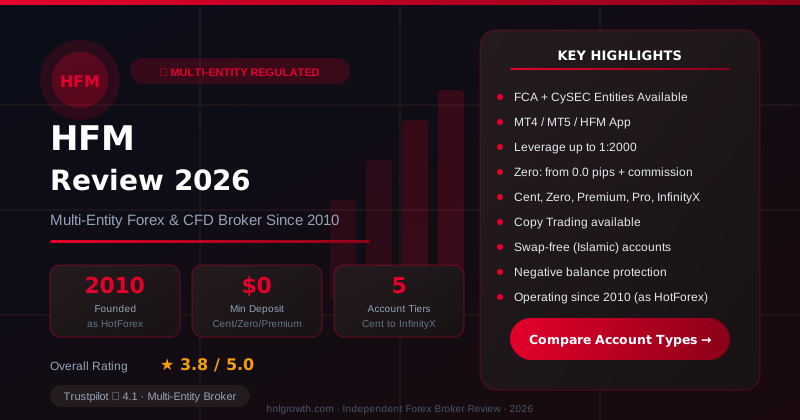
Checked on: 2026-08-15 | Broker terms, regulation, and pricing can change. Always verify at the official HFM site before opening an account.
Affiliate Disclosure: HNL Growth may earn a commission if you open an account through our links, at no additional cost to you. Risk Warning: CFDs and leveraged forex products are complex instruments and carry a high risk of losing money rapidly due to leverage. Between 65-95% of retail investor accounts lose money when trading CFDs, depending on the HFM entity and account type. Trading forex and CFDs may not be suitable for all investors. Consider your objectives, experience, and risk appetite before trading, and ensure you understand the risks involved. Broker Disclosure: HFM (HF Markets Group) is a live, regulated multi-entity broker (not a simulated prop-firm evaluation) — trades are executed with real capital in live market conditions, subject to normal market risk. Protections vary significantly by the specific legal entity that onboards your account.
HFM India 2026: Legality, Funding and What to Verify
Last updated: June 2026
HFM (formerly HotForex) does not hold recognition from SEBI or any Indian financial regulator. Indian residents who register on hfm.com are typically assigned to an offshore entity — most commonly HF Markets (SV) Ltd, incorporated in St. Vincent and the Grenadines — rather than HFM's Tier-1 regulated arms under the FCA (UK) or CySEC (EU).
HFM's restricted-jurisdiction list names the USA, Canada, Iran, and others — but does not explicitly exclude India (source). This suggests sign-ups from India may be accepted. However, accepting sign-ups is a commercial fact, not a regulatory endorsement. Trading forex or CFDs through an unregistered offshore broker occupies a legally ambiguous zone under SEBI advisories and FEMA outward-remittance rules. Verify with SEBI and RBI before proceeding.
HFM for Indian Residents — Current Status at a Glance
HashHedge — Crypto Futures Prop Firm
Up to $200K funded accounts · 85% profit split · Instant USDT payouts · 160+ assets
| Field | Status |
|---|---|
| Accepts sign-ups from India | Likely yes — India not listed among restricted jurisdictions |
| Servicing entity (expected) | HF Markets (SV) Ltd — St. Vincent and the Grenadines |
| Entity regulator | SVG FSA (International Business Company registration; limited prudential oversight) |
| SEBI authorisation | No — HFM holds no SEBI-recognised licence |
| RBI authorised dealer status | No — HFM does not appear on RBI's authorised dealer list |
| INR-denominated accounts | Not available based on published account currencies |
| Practical risk level | Elevated — offshore entity, no local regulatory recourse |
| Last reviewed | June 2026 |
How to verify yourself: Select India as your country of residence during HFM's registration flow. The entity name and applicable terms will be displayed before you complete sign-up. Cross-check the entity name against the regulator's public register.
Can Indian Residents Open an HFM Account?
What HFM's Sign-Up Flow Shows for India
HFM's international portal (hfm.com/int/en) allows visitors to select their country of residence during registration. India does not appear on the publicly listed restricted jurisdictions, which include the USA, Canada, Sudan, Syria, Iran, North Korea, UAE, and Türkiye (source). This indicates that the registration flow does not block Indian applicants at the country-selection stage.
However, the absence of a geo-block does not confirm regulatory compliance with Indian law. It simply means HFM's system will process an application from an Indian address.
The Entity Behind Your Account: Name, Jurisdiction, and Regulator
When India is selected, the onboarding flow typically assigns the client to HF Markets (SV) Ltd — an International Business Company registered in St. Vincent and the Grenadines under registration number 22747 IBC 2015 (source). This is not the same entity that serves UK clients under the FCA or EU clients under CySEC.
The SVG entity operates under the International Business Companies (Amendment and Consolidation) Act, Chapter 149 of the Revised Laws of Saint Vincent and the Grenadines, 2009. Its registered objects cover trading, brokerage, and managed account services in currencies, commodities, indexes, CFDs, and leveraged financial instruments (source).
What This Entity Assignment Means in Practice
Being onboarded under the SVG entity means:
- No Tier-1 regulatory protections. FCA compensation schemes (up to £85,000 via FSCS) and CySEC investor compensation (up to €20,000 via ICF) do not extend to SVG-entity clients.
- Limited prudential oversight. The SVG FSA registers International Business Companies but does not impose the same capital adequacy, conduct, or client-money rules as Tier-1 regulators.
- Dispute resolution is offshore. Any complaint would be handled through SVG jurisdiction mechanisms, which offer materially different recourse than UK or EU ombudsman services.
This distinction — between "HFM is regulated somewhere" and "HFM is regulated for you" — is the most important factor in your decision.
India's Rules on Offshore Forex and CFD Trading
SEBI's Position on Unregistered Offshore Trading Platforms
SEBI has issued multiple investor alerts warning the public against trading on unauthorised electronic trading platforms (ETPs) that are not recognised or registered under Indian securities law. SEBI maintains an alert list of such platforms and has cautioned that trading on these platforms has no legal recourse under Indian law.
What this means for HFM: HFM does not hold any SEBI registration or recognition. Whether or not HFM specifically appears on SEBI's alert list, the general SEBI position applies: trading on platforms not authorised by SEBI means you operate outside the protections of Indian securities regulation.
Action step: Check SEBI's current alert list at sebi.gov.in for any platform-specific warnings. SEBI's position may evolve; verify before opening an account.
FEMA and Outward Remittance: What Indian Law Says
The Foreign Exchange Management Act (FEMA) governs all cross-border financial transactions for Indian residents. Under FEMA, outward remittance for purposes not explicitly permitted under the Liberalised Remittance Scheme (LRS) may be restricted.
Key considerations:
- LRS limit: Indian residents may remit up to USD 250,000 per financial year under the LRS for permitted current and capital account transactions.
- Speculative trading ambiguity: The RBI's Master Direction on LRS does not explicitly list margin trading or CFD trading as a permitted purpose. Remittance for "investment" is allowed, but whether leveraged CFD trading qualifies as a permitted investment category is legally ambiguous.
- Bank compliance: Indian banks processing outward remittances are required to verify the purpose of remittance against FEMA guidelines. Some banks may decline transfer requests to offshore forex brokers.
RBI's Authorised Dealer Framework
All foreign exchange transactions in India must be routed through RBI-authorised dealers (ADs). HFM is not an RBI-authorised dealer, and deposits to HFM would need to be processed through your bank as an outward remittance — subject to the bank's own compliance checks and FEMA purpose codes.
The Practical Enforcement Reality
In practice, enforcement against individual retail traders using offshore CFD platforms has been limited. The legal framework creates risk — not certainty of prosecution. However:
- Banks may block or question transfers to known offshore brokers.
- Tax authorities may scrutinise foreign-sourced trading income.
- Regulatory enforcement could change at any time without notice.
This is not legal advice. Consult a qualified legal professional or chartered accountant familiar with FEMA and foreign trading income before proceeding.
HFM's Regulatory Licences: Which One Covers You?
HFM's Full Licence Map
HF Markets Group operates through multiple entities across several jurisdictions. The table below maps each entity to its regulator and indicates whether Indian residents are likely to be assigned to it.
| Entity | Regulator | Jurisdiction | Max Leverage | Compensation Scheme | Serves Indian Residents |
|---|---|---|---|---|---|
| HF Markets (UK) Ltd | FCA | United Kingdom | 1:30 (retail) | FSCS up to £85,000 | No |
| HF Markets (Europe) Ltd | CySEC | Cyprus (EU) | 1:30 (retail) | ICF up to €20,000 | No (professional clients only) |
| HF Markets (SV) Ltd | SVG FSA | St. Vincent & the Grenadines | Up to 1:2000 | None | Likely yes |
| HF Markets (Seychelles) Ltd | FSA Seychelles | Seychelles | Varies | Limited | Possible |
| HF Markets (South Africa) Pty Ltd | FSCA | South Africa | Varies | Per FSCA rules | No |
| HF Markets (Kenya) Ltd | CMA Kenya | Kenya | Varies | Per CMA rules | No |
| HF Markets (Dubai) Ltd | DFSA | UAE (DIFC) | Varies | Per DFSA rules | No |
Sources: HFM login/legal page, HFM international site. Leverage and compensation figures vary by entity and may change. Verify with the named regulator's public register.
Tier-1 vs. Offshore Regulation: What Changes
The protections available to you depend entirely on which entity holds your account. Here is what changes when you are under the SVG entity rather than FCA or CySEC:
| Protection | FCA / CySEC Entity | SVG Entity |
|---|---|---|
| Client fund segregation | Mandatory, audited | Stated by HFM (source) but not independently audited to Tier-1 standards |
| Negative balance protection | Regulatory requirement | Stated by HFM (source) but contractual, not regulatory |
| Compensation scheme | FSCS / ICF coverage | None |
| Dispute resolution | Financial Ombudsman / CySEC Ombudsman | SVG courts — limited practical recourse for overseas clients |
| Capital adequacy requirements | Strict minimum capital | Minimal under IBC registration |
Fund Protection, Dispute Resolution, and Compensation
HFM states that client funds are held in segregated accounts separate from company funds, and that negative balance protection ensures you cannot owe more than your deposit (source). These are positive measures. However, for SVG-entity clients, these protections are contractual commitments — not regulatory mandates backed by an independent supervisor with enforcement powers.
If the SVG entity were to become insolvent or a dispute could not be resolved internally, your recourse would be through the courts of St. Vincent and the Grenadines — a process that is costly, slow, and impractical for most retail traders.
Disclosure: This page may contain affiliate links. We may earn a commission if you open an account through our links, at no extra cost to you.
If you have reviewed the regulatory context above, understand which entity would service your account, and wish to proceed:
Opening Your Account: Documents, Verification, and Timelines
KYC Checklist for Indian Applicants
HFM requires standard identity and address verification. Here is how Indian documents map to those requirements:
| HFM Requirement | Indian Document Equivalent | Likely Accepted | Notes |
|---|---|---|---|
| Government-issued photo ID | Passport | Yes | Most widely accepted internationally |
| Government-issued photo ID | PAN card | Uncertain | May be accepted; passport is safer |
| Government-issued photo ID | Aadhaar card | Uncertain | Some offshore brokers do not accept Aadhaar |
| Proof of address (recent) | Bank statement (last 3–6 months) | Yes | Must show your name and residential address |
| Proof of address (recent) | Utility bill | Yes | Electricity, gas, or water bill within 3 months |
| Proof of address (recent) | Aadhaar (address side) | Uncertain | Check with HFM support before submitting |
Recommendation: Use your passport as primary ID and a recent bank statement as proof of address. These have the highest acceptance rate with international brokers.
Account Types Available When India Is Your Country of Residence
Based on HFM's published account comparison (source), the following account types are generally available through the offshore entity:
| Account Type | Min. Deposit | Spreads From | Max Leverage | Platforms |
|---|---|---|---|---|
| Cent | $0 | 1.4 pips | 1:2000 | MT4, MT5, HFM App |
| Premium | $0 | 1.4 pips | 1:2000 | MT4, MT5, HFM App |
| Zero | $0 | 0 pips (+ commission) | 1:2000 | MT4, MT5, HFM App |
| Pro | $100 | 0.6 pips | 1:2000 | MT4, MT5, HFM App |
| InfinityX | $500 | 0.3 pips | Unlimited* | MT4, MT5, HFM App |
*Leverage may be adjusted per HFM's terms and conditions (source). "Unlimited" leverage carries extreme risk of rapid loss.
Important caveat: These figures are from HFM's international pages and may differ from what is displayed once India is selected as your country. Verify the exact terms shown during your registration.
Verification Timelines and Common Rejection Reasons
Typical KYC verification with international brokers ranges from a few hours to several business days. Common rejection reasons for Indian applicants include:
- Blurred or cropped document scans
- Expired identity documents
- Name mismatch between ID and proof of address
- Documents not in English (translation may be required)
Moving Money In and Out from India
Deposit Methods Available to Indian Clients
HFM's international funding page lists multiple deposit methods. However, availability depends on the entity and country of residence. Methods that may be accessible to Indian clients include:
| Method | Direction | Currency | Processing Time | India-Specific Notes |
|---|---|---|---|---|
| Bank wire transfer (SWIFT) | Deposit & Withdrawal | USD, EUR | 3–5 business days | Most reliable method; subject to FEMA/LRS compliance |
| Visa / Mastercard | Deposit | USD | Usually instant | Some Indian banks block card payments to offshore brokers |
| E-wallets (Skrill, Neteller) | Deposit & Withdrawal | USD, EUR | Usually instant | Requires pre-funded e-wallet; may involve conversion fees |
| Local bank transfer | Deposit | Varies | Varies | Availability for India unconfirmed — check with HFM support |
What to verify yourself: Log in to your HFM account area after registration and check the "Deposit" and "Withdrawal" tabs for methods available with India selected as your country.
INR Conversion Costs: What Your Bank Actually Charges
HFM does not offer INR-denominated accounts based on published account currencies (USD, EUR, and select local currencies — INR is not listed) (source). This means every deposit and withdrawal involves a currency conversion.
Indian banks typically charge:
- Forex conversion markup: 1–3% above the interbank rate, varying by bank and account type.
- SWIFT wire transfer fees: Approximately ₹500–₹1,500 per outward remittance.
- GST on forex conversion: 18% GST applies to the forex conversion service component.
On a $1,000 deposit, expect total banking costs of roughly ₹1,500–₹3,500 depending on your bank's forex markup and wire fees.
Withdrawal Processing: Timelines and Forex Conversion on the Way Back
HFM states it offers 24/7 withdrawal processing (source). However, the actual time for funds to reach your Indian bank account depends on:
- HFM processing time: Stated as instant to 1 business day for internal processing.
- Bank wire transit: 3–5 business days for SWIFT transfers to Indian banks.
- Forex conversion on credit: When USD arrives at your Indian bank, it is converted to INR at the bank's prevailing buying rate — which includes a markup of 1–3% below the interbank rate.
Round-trip conversion costs (deposit + withdrawal) can erode 2–6% of your capital before any trading takes place.
LRS Limits and Reporting Obligations
Under the RBI's Liberalised Remittance Scheme:
- Indian residents may remit up to USD 250,000 per financial year for permitted purposes.
- Your bank will require you to declare the purpose of remittance. Whether "trading" or "investment in derivatives" qualifies as a permitted LRS purpose is legally ambiguous.
- TCS (Tax Collected at Source) of 20% applies to LRS remittances exceeding ₹7 lakh per financial year (as per current tax rules; consult a CA for the applicable rate).
What You Can Actually Trade on HFM from India
Platforms and Instruments Accessible to Indian Clients
HFM offers MetaTrader 4, MetaTrader 5, a proprietary web trader, and a mobile app across all account types (source). The platform provides access to 500+ trading instruments (source), including:
- Forex: Major, minor, and exotic currency pairs
- Metals: Gold, silver, and other precious metals
- Energies: Crude oil, natural gas
- Indices: Global stock indices
- Stocks and ETFs: International equities
- Cryptocurrencies: Bitcoin and other digital assets (CFD)
- Bonds and commodities
Leverage Caps: What the Offshore Entity Offers vs. Tier-1 Entities
The SVG entity offers leverage up to 1:2000 on standard accounts and "unlimited" leverage on InfinityX accounts (source). This is materially higher than the 1:30 cap imposed by FCA and CySEC for retail forex clients.
High leverage amplifies both gains and losses. Tier-1 regulators imposed the 1:30 cap specifically because higher leverage statistically increases the probability of rapid, substantial losses. Leverage of 1:2000 means a 0.05% adverse price movement can wipe out your entire margin. Approach high leverage as a risk factor, not a benefit.
Spreads and Fees on the Account Type You Would Receive
Published spreads for HFM's offshore-entity accounts (source):
- Premium/Cent: From 1.4 pips, no commission
- Pro: From 0.6 pips, no commission
- Zero: From 0 pips, commission applies
- InfinityX: From 0.3 pips, conditions apply
These are indicative figures from HFM's international pages. Actual spreads may vary by entity, account type, and market conditions. Zero spread quotes are delayed (source).
Copy Trading, Islamic Accounts, and Other Features
HFM offers copy trading and swap-free (Islamic) accounts on select instruments (source). However, availability may vary by entity and jurisdiction. Swap-free status applies only to specific trading instruments and is subject to terms and conditions (source).
Verify with HFM support whether copy trading and swap-free accounts are available to India-registered clients before relying on these features.
Compare HFM account types and open an account
How HFM Compares to Alternatives for Indian Traders
Side-by-Side: HFM vs. Brokers with Clearer India Access
| Criterion | HFM | Exness | XM |
|---|---|---|---|
| India sign-up status | Likely accepted (unconfirmed entity) | Accepts Indian clients | Accepts Indian clients |
| Servicing entity for India | SVG entity (expected) | Offshore entity | Offshore entity |
| SEBI authorisation | No | No | No |
| INR-denominated accounts | No | Yes (reported) | No |
| Local payment methods (UPI/IMPS) | Unconfirmed | Reported available | Unconfirmed |
| Max leverage | Up to 1:2000 | Up to 1:Unlimited | Up to 1:1000 |
| Minimum deposit | From $0 | From $1 | From $5 |
| Platforms | MT4, MT5, HFM App | MT4, MT5, proprietary | MT4, MT5, proprietary |
Comparison based on publicly available information as of June 2026. Verify current status directly with each broker.
When a Different Broker Might Be the Smarter Choice
Consider alternatives if:
- You need INR-denominated accounts to avoid double forex conversion costs.
- You want local payment rails (UPI, IMPS) for faster, cheaper funding.
- You require SEBI-regulated exposure — no major international CFD broker currently holds SEBI authorisation, but some Indian brokers offer currency derivatives on recognised exchanges (NSE, BSE).
- Regulatory certainty is your priority — trading through an Indian SEBI-registered broker on NSE/BSE currency derivatives is the only fully compliant route for forex-related trading in India.
FAQ: Questions Indian Traders Ask About HFM
Is HFM legal in India? HFM is not registered or authorised by SEBI. Whether Indian residents can legally trade CFDs through an offshore broker depends on your interpretation of FEMA and SEBI guidelines. This is a legal question — consult a qualified professional.
Is HFM the same as HotForex? Yes. HFM is the current brand name of the group previously known as HotForex. The rebrand does not change the entity structure or regulatory licences.
Can I deposit in INR? Based on HFM's published account currencies, INR is not offered as a base currency (source). Deposits would need to be made in USD or EUR, with forex conversion handled by your bank.
Does HFM accept Indian residents? India is not listed among HFM's restricted jurisdictions (source), suggesting sign-ups from India are accepted. However, acceptance does not imply regulatory approval under Indian law.
What happens if I have a dispute with HFM? As an SVG-entity client, your dispute resolution would be through HFM's internal process and, ultimately, the courts of St. Vincent and the Grenadines. You would not have access to the UK Financial Ombudsman Service, CySEC Ombudsman, or any Indian regulatory dispute mechanism.
Are my trading profits taxable in India? Indian residents are generally required to report worldwide income. How CFD trading profits are classified — as capital gains, business income, or income from other sources — depends on your specific circumstances. Consult a chartered accountant for guidance on your tax obligations, including any TDS and foreign income reporting requirements.
Has SEBI specifically warned about HFM? SEBI maintains a general position against unauthorised offshore trading platforms and publishes an alert list. Whether HFM (or HotForex, or HF Markets) specifically appears on this list changes over time. Check sebi.gov.in for the current list.
Risk Disclosure and Verification Disclaimer
Risk warning: CFDs and leveraged forex products are complex instruments and carry a high risk of losing money rapidly due to leverage. Retail investor accounts lose money when trading CFDs with most providers; the exact percentage varies by HFM entity and account type. You should consider whether you understand how CFDs work and whether you can afford to take the high risk of losing your money. Check the entity, terms and investor protections that apply in your jurisdiction before opening an account or trading.
Ready to Start Your Funded Trading Journey?
Join traders backed by $11M+ in verified payouts and a 4.7/5 Trustpilot rating. Compare HashHedge challenge plans, drawdown rules, and payout terms — apply code ha25 for the current discount.
Risk disclaimer: Challenge fees are non-refundable if you breach the rules. Prop trading involves significant financial risk. Past performance in a simulated environment does not guarantee results on a funded account. Only purchase if you understand the rules fully and can afford to lose the fee. Affiliate disclosure: HNL Growth earns a commission when you purchase a HashHedge challenge through links on this page.