HFM Review 2026: Fees, Platforms, Regulation & Verdict
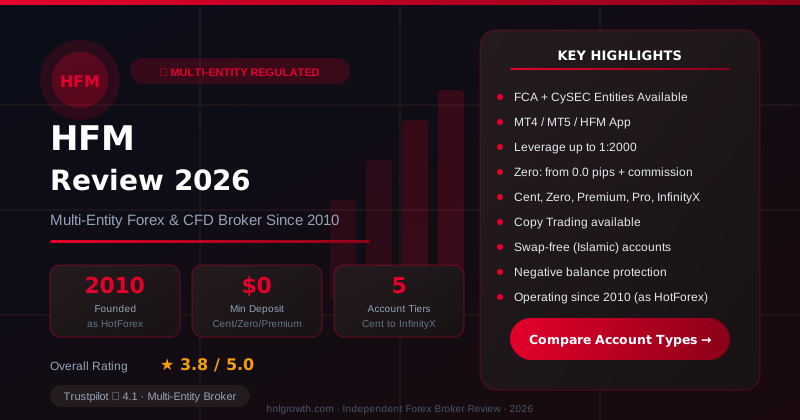
HFM (formerly HotForex) is a multi-entity forex and CFD broker operating since 2010 under the HF Markets Group. Whether it is safe for you depends entirely on which legal entity...
Checked on: 2026-08-20 | Broker terms, regulation, and pricing can change. Always verify at the official HFM site before opening an account.
Affiliate Disclosure: HNL Growth may earn a commission if you open an account through our links, at no additional cost to you. Risk Warning: CFDs and leveraged forex products are complex instruments and carry a high risk of losing money rapidly due to leverage. Between 65-95% of retail investor accounts lose money when trading CFDs, depending on the HFM entity and account type. Trading forex and CFDs may not be suitable for all investors. Consider your objectives, experience, and risk appetite before trading, and ensure you understand the risks involved. Broker Disclosure: HFM (HF Markets Group) is a live, regulated multi-entity broker (not a simulated prop-firm evaluation) — trades are executed with real capital in live market conditions, subject to normal market risk. Protections vary significantly by the specific legal entity that onboards your account.
HFM Review 2026: Fees, Platforms, Regulation & Verdict
HFM (formerly HotForex) is a multi-entity forex and CFD broker operating since 2010 under the HF Markets Group. Whether it is safe for you depends entirely on which legal entity onboards your account. Tier-1 regulated entities exist within the group, but the CySEC-licensed EU entity currently accepts only professional and eligible counterpart clients. Most international retail traders are served through the St. Vincent-registered entity or other offshore subsidiaries, which offer leverage up to 1:2000 or higher but minimal regulatory recourse. HFM may suit cost-conscious forex traders in emerging markets who understand entity-level risk. It is not available in the USA, Canada, UAE, or Türkiye. Before depositing, confirm in writing which entity will govern your account and what protections apply.
HFM at a Glance: The Verdict Before the Details
HashHedge — Crypto Futures Prop Firm
Up to $200K funded accounts · 85% profit split · Instant USDT payouts · 160+ assets
Is HFM Legitimate? The Short Answer
Yes. HF Markets Group has operated since 2010 and holds multiple regulatory licenses across jurisdictions, including FCA (UK), CySEC (EU), DFSA (Dubai), FSCA (South Africa), FSA (Seychelles), CMA (Kenya), and FSC (Mauritius). The group reports over 2.5 million client accounts, though this figure is self-reported and not independently audited. The brand rebranded from HotForex to HFM, maintaining operational continuity under the same parent group.
Legitimacy, however, is not the same as uniform safety. The HF Markets Group operates through distinct legal entities, each governed by different regulators with vastly different client protection standards.
The Critical Distinction: Which HFM Entity Will You Actually Use?
This is the most important question in this review. The HF Markets Group structure includes:
- HF Markets (Europe) Ltd — CySEC license 183/12. Currently accepts only Eligible Counterparties and Professional per se clients. Retail EU clients cannot open standard accounts here.
- HF Markets (UK) Ltd — FCA license 801701. Serves UK clients under FCA rules.
- HF Markets (SV) Ltd — St. Vincent & the Grenadines registration 22747 IBC 2015. This is a company incorporation only, not a securities or investment firm license. The SVG FSA does not regulate retail forex trading. This entity operates the main international website.
- HF Markets (Seychelles) Ltd — FSA Seychelles license SD015.
- HF Markets SA (PTY) Ltd — FSCA FSP 46632 (South Africa).
- HF Markets Middle East Ltd — DFSA regulated (Dubai).
- HFM Investments Ltd — CMA Kenya license 155.
- HF Markets (Mauritius) Ltd — FSC Mauritius Category 1 Global Business License C110008214.
Your protection level, leverage cap, compensation scheme access, and dispute resolution pathway are all determined by which entity onboards you — not by the HFM brand name.
Who Should Consider HFM (and Who Should Not)
HFM may suit you if:
- You trade forex and CFDs from an emerging-market jurisdiction (Africa, Southeast Asia, Latin America)
- You understand the entity you are contracting with and accept its regulatory framework
- You want access to high leverage and multiple account type options
- You primarily trade forex, metals, and energies
Consider alternatives if:
- You require all your funds protected under a single Tier-1 regulator (FCA, ASIC, CySEC retail)
- You are a US, Canadian, UAE, or Turkish resident (HFM does not serve these jurisdictions)
- You are uncomfortable navigating a complex multi-entity corporate structure
- You need deep stock or ETF CFD coverage from a specialist multi-asset broker
Your Protection Level: Entity-by-Entity Regulatory Breakdown
Tier-1 Regulated Entities: FCA and CySEC Coverage
The FCA (UK) and CySEC (EU) are widely regarded as top-tier regulators. They mandate client fund segregation, negative balance protection for retail clients, and access to compensation schemes (FSCS up to £85,000 under FCA; ICF up to €20,000 under CySEC).
Critical limitation: The CySEC entity, HF Markets (Europe) Ltd, currently restricts account opening to professional clients only. Retail traders in the EU cannot access this entity's standard services. The FCA entity serves UK clients and operates through hfmarkets.co.uk.
Tier-2 Entities: FSCA, DFSA, CMA Kenya
The FSCA (South Africa) and DFSA (Dubai) impose meaningful oversight including fund segregation requirements and dispute resolution frameworks, though investor compensation schemes are less generous or absent compared to Tier-1 jurisdictions. The CMA (Kenya) provides regulatory oversight for East African clients.
These entities offer a middle ground: legitimate regulatory supervision without the full compensation safety nets of FCA or CySEC.
Offshore Registration: St. Vincent and What "Company Registration Only" Means
HF Markets (SV) Ltd is incorporated in St. Vincent & the Grenadines as an International Business Company with registration number 22747 IBC 2015. This is important to understand: the SVG Financial Services Authority does not issue licenses for retail forex or securities trading. The registration confirms the company exists as a legal entity; it does not provide the supervisory framework, capital adequacy requirements, or client protection rules that a securities regulator would enforce.
Clients onboarded under this entity have no access to investor compensation schemes and limited formal dispute resolution beyond the company's internal complaints process.
How to Determine Which Entity Will Onboard You
Your onboarding entity typically depends on your country of residence. HFM's website routes visitors to different entity pages based on location. However, this routing is not always transparent.
What to verify yourself before depositing:
- Check your account opening documentation for the specific legal entity name
- Confirm the regulator listed on your client agreement matches your expectations
- Cross-reference the license number on the relevant regulator's public register
- Ask HFM support directly: "Which legal entity will my account be opened under?"
- Verify whether negative balance protection and fund segregation apply under that entity
| Country/Region | Governing Entity | Regulator | Regulator Tier | Max Leverage (Retail) | Compensation Scheme | Segregated Accounts |
|---|---|---|---|---|---|---|
| United Kingdom | HF Markets (UK) Ltd | FCA (801701) | Tier 1 | 1:30 | FSCS (£85,000) | Yes (mandated) |
| EU/EEA | HF Markets (Europe) Ltd | CySEC (183/12) | Tier 1 | N/A — professional clients only | ICF (€20,000) | Yes (mandated) |
| South Africa | HF Markets SA (PTY) Ltd | FSCA (46632) | Tier 2 | Up to 1:2000 | No formal scheme | Required by FSCA |
| Dubai/Middle East | HF Markets Middle East Ltd | DFSA | Tier 2 | Per DFSA rules | No formal scheme | Required by DFSA |
| Kenya | HFM Investments Ltd | CMA (155) | Tier 2/3 | Per CMA rules | No formal scheme | Required by CMA |
| Seychelles | HF Markets (Seychelles) Ltd | FSA (SD015) | Tier 3 | Up to 1:2000 | No formal scheme | Per FSA rules |
| Mauritius | HF Markets (Mauritius) Ltd | FSC (C110008214) | Tier 3 | Per FSC rules | No formal scheme | Per FSC rules |
| International (most other countries) | HF Markets (SV) Ltd | SVG registration only (22747 IBC 2015) | Not regulated for forex | Up to 1:2000 / Unlimited (InfinityX) | None | Per company policy |
Entity-to-country mapping is based on HFM's published disclosures and regulatory filings. Confirm your specific entity during account opening. "Tier" classifications reflect widely accepted industry assessments of regulatory rigor, not official rankings.
Disclosure: This page may contain affiliate links. We may earn a commission if you open an account through our links, at no extra cost to you.
If HFM's regulatory structure fits your jurisdiction and risk tolerance, the next step is choosing the right account type.
Trading Costs: What You Will Actually Pay Across Account Types
Spread-Only vs Commission-Based Accounts: Total Cost Comparison
HFM offers five main account types, each with different pricing structures. The official account comparison shows:
- Cent — Spreads from 1.4 pips. Spread-only pricing (no separate commission stated). Minimum deposit $0.
- Premium — Spreads from 1.4 pips. Spread-only pricing. Minimum deposit $0.
- Pro — Spreads from 0.6 pips. Spread-only pricing. Minimum deposit $100/€100.
- InfinityX — Spreads from 0.3 pips. Minimum deposit $500. Unlimited leverage available.
- Zero — Spreads from 0 pips on forex. Commission applies. HFM notes that "zero spread quotes are delayed."
The Zero account replaces wider spreads with a per-trade commission, which typically benefits higher-volume traders. The Cent account uses smaller contract sizes (1 lot = 1,000 units vs. 100,000 units on standard accounts), making it functionally cheaper per position despite wider spreads.
Important: "From X pips" figures represent best-case starting spreads during peak liquidity. Actual spreads widen during off-peak hours, news events, and low-liquidity conditions.
| Account | Min Deposit | Pricing Model | Spreads From | Best Suited For | Key Limitation |
|---|---|---|---|---|---|
| Cent | $0 | Spread-only | 1.4 pips | Beginners testing strategies with micro exposure | Limited to Forex and Gold only |
| Premium | $0 | Spread-only | 1.4 pips | Casual traders wanting full instrument access at zero entry cost | Wider spreads than Pro |
| Pro | $100 | Spread-only | 0.6 pips | Active traders wanting tighter spreads on all instruments | $100 minimum may deter new traders |
| Zero | $0 | Commission + raw spread | 0 pips (forex) | High-volume and algo traders minimizing spread cost | Quotes are delayed; commission adds cost on small positions |
| InfinityX | $500 | Spread-only | 0.3 pips | Traders seeking maximum leverage and tightest spreads | Limited instruments (Forex, Metals, Indices, Crypto, Energies); $500 minimum |
All spread figures are HFM's published starting points. Actual spreads vary by instrument, market conditions, and time of day.
Cost Scenarios by Trading Style and Volume
Total trading cost depends on your account type, instruments traded, position size, and holding period. Below is a framework for three common trader profiles. Because actual spreads fluctuate, costs are modeled using HFM's published "from" figures as optimistic baselines.
| Trader Profile | Trades/Month | Avg Position | Recommended Account | Spread Cost Basis | Commission | Key Cost Factor |
|---|---|---|---|---|---|---|
| Casual monthly | 5–10 | 0.1 lot | Premium or Cent | From 1.4 pips | None | Spread dominates; holding costs minimal |
| Active daily | 50–100 | 0.5–1.0 lot | Pro or Zero | From 0.6 pips (Pro) / 0 pips + commission (Zero) | Applies on Zero | Commission vs. spread tradeoff matters most |
| Swing/algo | 10–20 | 1.0+ lot, multi-day holds | Pro or InfinityX | From 0.3–0.6 pips | None | Swap/overnight financing becomes material |
What to verify yourself:
- Open a demo account and record actual spreads on your preferred instruments during the hours you typically trade
- Compare round-turn cost (spread + any commission) across Pro and Zero accounts for your typical position size
- Use HFM's swap calculator to estimate overnight financing costs for your typical holding period
Overnight Financing Costs Most Reviews Ignore
Swap fees apply when you hold positions overnight. These costs are material for swing and position traders but rarely addressed in broker reviews.
HFM provides a swap calculator with daily-updated rates. As an illustrative example from HFM's own documentation: a 1-lot short EUR/USD position with a swap rate of 1.5 points, held for 2 nights, costs 3.00 USD (calculated as 100,000 × 1.5 × 2 × 0.00001).
Swap rates vary by instrument, position direction (long vs. short), and account type. Some accounts offer swap-free options for specific instruments, subject to terms and conditions.
Before committing capital, check swap rates for the specific instruments you plan to hold overnight. For positions held weeks or months, cumulative swap costs can exceed spread costs.
Inactivity Fees and Account Maintenance
HFM's official documentation may include dormant or inactivity account charges. These fees vary by entity and are not always prominently displayed. Check your client agreement and the terms applicable to your specific entity before opening an account, particularly if you plan to trade infrequently.
Compare HFM account types on a demo account
Choosing Your Account Type: A Decision Framework
Beginner and Low-Capital Accounts
The Cent account offers the lowest barrier to entry: zero minimum deposit, micro contract sizes (1 lot = 1,000 units), and leverage up to 1:2000. This lets new traders test strategies with minimal capital at risk. The tradeoff is limited instruments (forex and gold only) and wider spreads from 1.4 pips.
The Premium account also requires no minimum deposit but provides full instrument access. If you want to trade beyond forex and gold from the start, Premium is the more versatile entry point, though spreads are similarly wide.
Accounts for Active and Cost-Sensitive Traders
The Pro account (minimum $100 deposit, spreads from 0.6 pips) offers the best balance of tight spreads and full instrument coverage for active traders. If you trade multiple times daily, the spread savings over Premium accumulate quickly.
The Zero account suits algorithmic traders and scalpers who prefer raw spreads with separate commission. Note that HFM states zero-spread quotes are delayed, which may affect execution-sensitive strategies.
High-Leverage Offshore Accounts: When They Make Sense (and When They Do Not)
The InfinityX account offers unlimited leverage and spreads from 0.3 pips. This account is only available through entities operating outside Tier-1 regulatory frameworks, meaning no compensation scheme access and limited dispute resolution options.
High leverage amplifies both gains and losses. The InfinityX account has a 0% stop-out level, meaning positions may remain open until your margin is entirely consumed. This structure suits experienced traders who understand margin mechanics and accept offshore entity risk. It is not appropriate for traders who need regulatory protection as a safety net.
Platforms and Execution: What You Trade On
MT4 vs MT5: Functional Differences That Matter at HFM
All HFM account types support MetaTrader 4, MetaTrader 5, HFM WebTrader, the HFM mobile app, and the HFM Platform.
MT4 remains the industry standard for forex trading with extensive EA (Expert Advisor) support, a familiar interface, and wide third-party tool compatibility. HFM also offers MT4 MultiTerminal for managing multiple accounts from one interface, and an MT4 WebTerminal for browser-based access without software installation.
MT5 adds 21 timeframes (vs. MT4's 9), an economic calendar, 80+ technical indicators, and the ability to view up to 100 charts simultaneously. MT5 also supports hedging at HFM.
Choose MT4 if you rely on existing EAs or third-party tools built for MT4. Choose MT5 if you want more analytical depth and multi-asset capability.
Mobile App and Web Platform Capabilities
The HFM App supports all account types and includes copy trading, PAMM access, fund management, and partner account management. You can open live or demo accounts directly within the app and manage deposits and transfers through the HF Wallet.
The HFM App is available on Google Play and the App Store. It provides charting tools, trade history analysis, and the ability to trade in lots, units, or amount.
Copy Trading Feature
Copy trading is fully available on the HFM App, allowing you to mirror the trades of selected strategy providers. Before allocating funds, review each provider's historical performance, drawdown, risk score, and trading duration. Past performance does not predict future results.
Premium Tools and Their Deposit Thresholds
HFM offers additional tools that may include Autochartist (automated technical pattern recognition) and FX Blue Premium Trader plugins. Access to some premium tools requires minimum deposit thresholds that vary by entity and promotion. Confirm current requirements with HFM support for your specific account.
What You Can Trade: Instrument Coverage and Limitations
Forex, Metals, and Energy: Core Strengths
HFM's core offering centers on forex pairs (majors, minors, and exotics), precious metals (gold, silver), and energy commodities (crude oil, natural gas). These markets have the deepest liquidity and tightest spreads on the platform.
Indices, Stocks, ETFs, and Crypto CFDs: Breadth Assessment
HFM states it offers 500+ trading instruments across asset classes including indices, individual stock CFDs, bonds, ETFs, and cryptocurrency CFDs. The Zero, Pro, and Premium accounts provide access to the full instrument list.
The Cent account is limited to forex and gold. The InfinityX account covers forex, metals, indices, cryptocurrencies, and energies — but not stocks, bonds, or ETFs.
Where HFM's Range Falls Short
Compared to multi-asset specialists, HFM's stock CFD and ETF coverage may be narrower in terms of individual listings and exchange coverage. If you need extensive single-stock coverage across multiple global exchanges, or direct market access (DMA) for equities, specialist multi-asset brokers may offer deeper inventories. HFM's strength lies in forex and commodity CFDs.
Deposits and Withdrawals: Process, Timelines, and Reliability
Funding Methods and Official Processing Times
HFM supports multiple funding methods including bank wire transfers, credit/debit cards, e-wallets, and cryptocurrency deposits, though availability varies by entity and jurisdiction. The specific methods offered depend on which entity holds your account and your country of residence.
HFM's security of funds page states that the company offers "24/7 withdrawal feature" with "instant withdrawal processing." This is a stated operational target, not a guarantee. Actual processing times depend on the payment method, KYC verification status, and entity-specific procedures.
Withdrawal Experience: Official Policy vs. Documented User Patterns
HFM's official position emphasizes seamless withdrawals and fund security. The company states that client funds are held in segregated accounts, separate from company operating funds, and maintains an insurance program with EUR 5 million coverage against fraud, errors, and other risks.
User experiences reported on third-party review platforms are mixed. Some users describe smooth and timely withdrawals, while others report delays. These reports are unverified and cannot be independently confirmed. Common friction points cited in user reviews across the industry include:
- KYC verification delays — Accounts with incomplete identity verification may experience withdrawal holds. This is a regulatory requirement, not a broker-specific issue.
- Method-specific processing differences — E-wallet withdrawals typically process faster than bank wires.
- Crypto transaction complications — Blockchain confirmation times and network selection errors can cause delays.
Method-Specific Timelines and Potential Friction Points
| Method Category | Typical Industry Processing | Potential Friction | What to Verify |
|---|---|---|---|
| E-wallets (Skrill, Neteller) | 0–24 hours after approval | Account verification must be complete | Confirm supported e-wallets for your entity |
| Bank wire | 2–5 business days | Intermediary bank fees, correspondent delays | Ask HFM for correspondent bank details |
| Credit/debit card | 1–5 business days | Refund to original card only; amount limits | Confirm card withdrawal limits |
| Cryptocurrency | Blockchain-dependent | Network congestion, wrong network selection | Verify supported coins and networks |
Processing times are indicative industry benchmarks. Confirm HFM's current processing times for your specific entity and method before depositing.
What to verify yourself:
- Complete KYC verification before your first withdrawal request
- Confirm which withdrawal methods are available under your entity
- Test with a small withdrawal before committing larger capital
- Document all transaction references and correspondence
Reputation Analysis: Separating Verified Patterns from Noise
Recurring Complaint Themes: Frequency and Severity Assessment
Analysis of publicly available user reviews on third-party platforms surfaces several recurring themes. All of the following are unverified user reports and should be weighed accordingly:
- Entity confusion — Multiple users report difficulty determining which HFM legal entity governs their account. This is a structural issue inherent to multi-entity broker groups and is addressable by confirming your entity at account opening.
- Withdrawal processing concerns — Some users allege delays in receiving funds. These complaints span the industry and may relate to KYC requirements, method-specific processing times, or bonus terms.
- Support responsiveness — Live chat wait times of 5–10 minutes are cited in some reviews. This is a friction point rather than a trust issue and varies across the industry.
What Satisfied Users Consistently Report
Positive reviews commonly highlight:
- Beginner-friendly account options (particularly the Cent account)
- Wide range of deposit and withdrawal methods
- Platform stability and MT4/MT5 availability
- Copy trading functionality
How to Weigh Anecdotal Evidence in Your Decision
User reviews provide signal but not proof. A single negative review may reflect an individual circumstance; a cluster of similar complaints across multiple platforms may indicate a pattern. When evaluating reviews:
- Check whether complaints are specific and detailed (more credible) or vague and emotional (less informative)
- Note whether the broker responded to complaints and how
- Consider that both positive and negative reviews may be incentivized or fabricated
- Rely on verifiable facts (regulatory status, official terms) as your primary decision basis
HFM's claim of "100% mediation in complaints" reported on WikiFX is self-reported and not independently verified.
Final Decision: Is HFM Right for Your Situation?
HFM Is a Strong Fit If You Are...
- A forex-focused trader in an emerging market (Africa, Southeast Asia, Latin America) who understands the entity governing your account
- A beginner looking for low-barrier entry through the Cent or Premium accounts with demo testing
- An active trader seeking competitive spreads on the Pro or Zero accounts with full MT4/MT5 support
- Comfortable with the regulatory framework of the specific entity that will onboard you
Consider Alternatives If You Need...
- Guaranteed Tier-1 regulatory coverage (FCA or CySEC retail) for all your capital
- Extensive single-stock or ETF CFD coverage across multiple exchanges
- A broker with a single, transparent legal entity rather than a multi-entity group
- Services in the USA, Canada, UAE, or Türkiye
Next Steps: How to Open an Account Safely
- Confirm your entity. Before depositing, verify which HFM legal entity will govern your account. Check the client agreement for the entity name and cross-reference the license number on the regulator's public register.
- Start with a demo account. Test spreads, platform functionality, and execution on your preferred instruments before committing real capital.
- Complete KYC early. Submit identity and address verification documents before your first deposit to avoid withdrawal delays later.
- Begin with a small deposit. Test the full cycle — deposit, trade, withdraw — with a small amount before scaling up.
- Understand the protections (or lack thereof). If your entity is St. Vincent or another offshore registration, acknowledge that your recourse in a dispute is limited.
Frequently Asked Questions
Is HFM the same as HotForex?
Yes. HFM is the rebranded name of what was previously known as HotForex. The HF Markets Group has operated since 2010 and the rebrand represents a name change, not a change in ownership or operations. Note that the EU entity uses the "HF Markets" brand name rather than "HFM," as stated on the European website.
Is HFM safe for beginners?
HFM offers beginner-friendly features including the Cent account (micro contract sizes, zero minimum deposit) and demo accounts. Safety depends on which entity onboards you. Accounts under Tier-1 or Tier-2 regulated entities carry stronger protections than those under the St. Vincent registration. Beginners should start with a demo account, complete KYC verification early, and understand the risks of leveraged trading before depositing real capital.
Can I trust HFM with large deposits?
Trust is entity-specific. If your account falls under the FCA or another Tier-1 regulator with a compensation scheme, your funds have stronger institutional protection. If your account is under the St. Vincent entity, your protection relies on the company's internal policies and segregated account arrangements, without a government-backed compensation safety net. For large deposits, confirm your entity and applicable protections before transferring funds. HFM states it maintains an insurance program covering EUR 5 million, though the specific terms and applicability per entity should be confirmed directly.
What happens if HFM goes bankrupt?
The answer depends on your governing entity. Under FCA regulation, the Financial Services Compensation Scheme (FSCS) covers eligible clients up to £85,000. Under CySEC, the Investor Compensation Fund (ICF) covers up to €20,000 for eligible clients. Offshore entities do not offer equivalent compensation schemes. Segregated accounts are designed to keep client funds separate from company assets, but enforcement of segregation varies by regulator.
Is HFM available in the United States?
No. HFM explicitly does not offer services to US citizens or residents. HFM also does not serve residents of Canada, Sudan, Syria, Iran, North Korea, UAE, Türkiye, and certain other jurisdictions.
How long do withdrawals take?
HFM states it offers 24/7 withdrawal processing. Actual timelines depend on the payment method (e-wallets are typically fastest, bank wires slowest), your KYC verification status, and your specific entity's procedures. Complete verification before requesting withdrawals to avoid delays.
Does HFM offer negative balance protection?
HFM's security of funds page states that negative balance protection is available: "If your balance goes negative, we'll automatically reset it to zero." However, the applicability of this protection may vary by entity and account type. Tier-1 regulators mandate negative balance protection for retail clients. Confirm that this protection applies to your specific account in your client agreement.
Still deciding? Start with an HFM demo account to test spreads and platform functionality on your preferred instruments before committing capital.
Risk warning: CFDs and leveraged forex products are complex instruments and carry a high risk of losing money rapidly due to leverage. Retail investor accounts lose money when trading CFDs with most providers; the exact percentage varies by HFM entity and account type. You should consider whether you understand how CFDs work and whether you can afford to take the high risk of losing your money. Check the entity, terms and investor protections that apply in your jurisdiction before opening an account or trading.
Ready to Start Your Funded Trading Journey?
Join traders backed by $11M+ in verified payouts and a 4.7/5 Trustpilot rating. Compare HashHedge challenge plans, drawdown rules, and payout terms — apply code ha25 for the current discount.
Risk disclaimer: Challenge fees are non-refundable if you breach the rules. Prop trading involves significant financial risk. Past performance in a simulated environment does not guarantee results on a funded account. Only purchase if you understand the rules fully and can afford to lose the fee. Affiliate disclosure: HNL Growth earns a commission when you purchase a HashHedge challenge through links on this page.