HFM vs Tickmill 2026: Fees, Regulation and Platforms Compared
Choosing between HFM and Tickmill comes down to what you prioritise as a trader. HFM offers broader account diversity — from Cent to Zero-spread to an unlimited-leverage InfinityX...
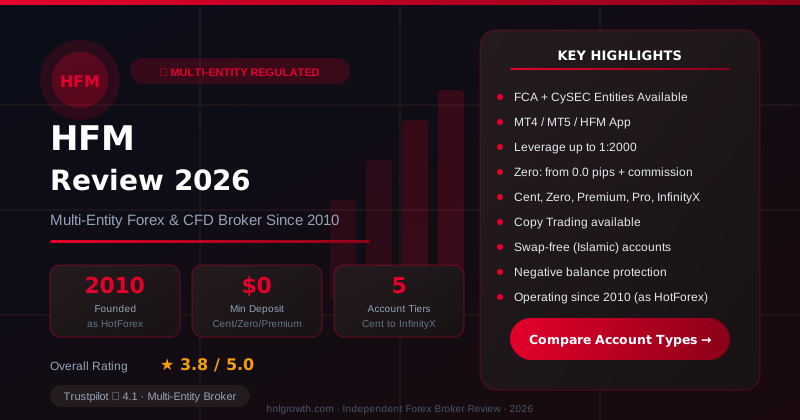
Checked on: 2026-08-14 | Broker terms, regulation, and pricing can change. Always verify at the official HFM site before opening an account.
Affiliate Disclosure: HNL Growth may earn a commission if you open an account through our links, at no additional cost to you. Risk Warning: CFDs and leveraged forex products are complex instruments and carry a high risk of losing money rapidly due to leverage. Between 65-95% of retail investor accounts lose money when trading CFDs, depending on the HFM entity and account type. Trading forex and CFDs may not be suitable for all investors. Consider your objectives, experience, and risk appetite before trading, and ensure you understand the risks involved. Broker Disclosure: HFM (HF Markets Group) is a live, regulated multi-entity broker (not a simulated prop-firm evaluation) — trades are executed with real capital in live market conditions, subject to normal market risk. Protections vary significantly by the specific legal entity that onboards your account.
HFM vs Tickmill 2026: Fees, Regulation and Platforms Compared
Choosing between HFM and Tickmill comes down to what you prioritise as a trader. HFM offers broader account diversity — from Cent to Zero-spread to an unlimited-leverage InfinityX tier — alongside a proprietary mobile app and integrated copy trading. Tickmill takes a leaner approach, focusing on raw-spread pricing with competitive per-lot commissions that appeal to cost-sensitive active traders, anchored by FCA regulation in the UK. Neither broker is universally superior. The right option depends on your strategy, the regulatory jurisdiction you fall under, and the total cost you will pay on the instruments you trade most.
The Short Answer — Who Should Trade With HFM and Who Should Trade With Tickmill
HashHedge — Crypto Futures Prop Firm
Up to $200K funded accounts · 85% profit split · Instant USDT payouts · 160+ assets
| Trader Type | Recommended Broker | Key Reason |
|---|---|---|
| Beginner or small-budget trader | HFM | Cent account from $0 deposit, 1:2000 leverage, and micro-lot sizing lower the entry barrier |
| Cost-sensitive active trader / scalper | Either — compare commissions on live platforms | Both offer raw-spread pricing; exact commission structures should be verified on current instrument specifications |
| Multi-asset diversifier | HFM | Broader instrument coverage including stock CFDs, bonds, and ETFs across multiple asset classes |
| Copy-trading user | HFM | Integrated copy-trading and PAMM services accessible via the proprietary HFM App |
Disclosure: This page may contain affiliate links. We may earn a commission if you open an account through our links, at no extra cost to you.
If HFM sounds like the better fit for your strategy, you can open an HFM trading account and explore their full range of account types.
What We Compared and How
This comparison evaluates HFM (HF Markets Group, formerly HotForex) and Tickmill across regulation, account structure, total trading cost, platforms, asset coverage, leverage, and funding practicality. Data is drawn from each broker's official website, legal disclosures, and regulator registers, accessed in Q2 2025. Account tiers are paired one-to-one by closest equivalent. All spread figures are indicative and sourced from official broker publications — actual spreads vary with market conditions, session timing, and volatility. Where data could not be confirmed from official sources, it is flagged transparently in the What We Could Not Verify section.
Regulation and Client Protections Side by Side
License Comparison
| Broker | Regulator | Jurisdiction | Tier | Compensation Fund | Segregated Accounts | Negative Balance Protection |
|---|---|---|---|---|---|---|
| HFM | CySEC | Cyprus (EU) | Tier-2 | ICF (up to €20,000) | Yes | Required (ESMA) |
| HFM | FSCA | South Africa | Tier-2 | None (segregated only) | Yes | Policy-based |
| HFM | FSA | Seychelles | Offshore | None | Yes | Policy-based |
| Tickmill | FCA | United Kingdom | Tier-1 | FSCS (up to £85,000) | Yes | Required (FCA) |
| Tickmill | CySEC | Cyprus (EU) | Tier-2 | ICF (up to €20,000) | Yes | Required (ESMA) |
| Tickmill | FSA | Seychelles | Offshore | None | Yes | Policy-based |
| Tickmill | FSCA | South Africa | Tier-2 | None (segregated only) | Yes | Policy-based |
Tickmill holds an FCA licence, which provides access to the Financial Services Compensation Scheme (FSCS) — one of the strongest client protection frameworks globally. HFM's regulatory portfolio does not include an FCA-licensed entity. Both brokers maintain CySEC and FSCA licences, and both operate offshore entities in Seychelles for international clients.
Which Entity Will You Actually Trade Under?
Most international retail clients — those outside the UK, EU, and a handful of other jurisdictions — are onboarded to each broker's offshore entity:
- HFM international clients are typically contracted with HF Markets (SV) Ltd, incorporated in St. Vincent & the Grenadines (registration 22747 IBC 2015), as stated in HFM's legal documentation. This entity is not covered by a compensation fund.
- Tickmill international clients are typically onboarded to an offshore entity without compensation scheme coverage.
The practical implication: if you are a retail trader in Africa, Asia, Latin America, or the Middle East, you will likely trade under an offshore entity at either broker. The regulatory safety gap between the two narrows considerably in this scenario. UK residents would benefit from Tickmill's FCA licence and FSCS protection; HFM does not offer a UK-regulated option.
Account Types — Matched Head to Head
Account Pairing Table
| HFM Account | Tickmill Account | Spread From | Commission | Min Deposit | Execution | Max Leverage |
|---|---|---|---|---|---|---|
| Cent | No equivalent | 1.4 pips | None | $0 | Market | 1:2000 |
| Premium | Classic | 1.4 pips | None | $0 (HFM) / Check Tickmill | Market | 1:2000 (HFM) / Check Tickmill |
| Zero | Pro | 0.0 pips | Check instrument specs | $0 (HFM) / Check Tickmill | Market | 1:2000 (HFM) / Check Tickmill |
| Pro | VIP | 0.6 pips | None | $100 (HFM) / Check Tickmill | Market | 1:2000 (HFM) / Check Tickmill |
| InfinityX | No equivalent | 0.3 pips | None | $500 | Market | Unlimited |
Source: HFM trading accounts page (official). Spread figures are indicative. Commission rates on HFM Zero accounts vary by instrument and are published on the broker's instrument specification pages. Tickmill account features should be verified on Tickmill's official account pages.
Key Differences in Account Structure
HFM offers five distinct account tiers — Cent, Zero, Pro, Premium, and InfinityX — giving traders granular choices. The Cent account is notable for beginners: each lot represents 1,000 units rather than the standard 100,000, letting new traders test strategies with minimal capital exposure. The InfinityX tier, with unlimited leverage, is a high-risk option available only through HFM's offshore entity.
Tickmill runs a simpler three-tier lineup: Classic (spread-only), Pro (raw spread + commission), and VIP (tighter spreads, higher minimum deposit). This reduces decision fatigue but means no Cent-equivalent for micro-budget traders and no ultra-high-leverage option comparable to InfinityX.
What a Trade Actually Costs — Spread Plus Commission
Total trading cost equals the spread cost plus any commission, charged both ways (open and close). Raw-spread accounts at both brokers quote spreads from 0.0 pips on major forex pairs during optimal liquidity conditions. The total cost difference comes down to the commission structure, which varies by instrument and should be verified on each broker's current pricing pages before trading.
Understanding Cost on Zero-Spread Accounts
On HFM's Zero account, spreads start from 0.0 pips on forex pairs, with a per-lot commission that varies by instrument. The exact commission rate is published on HFM's instrument specification pages. Tickmill's Pro account similarly offers raw interbank spreads with a per-lot commission structure.
For spread-only accounts (HFM Premium vs Tickmill Classic), the spread itself is the cost. Both brokers quote variable spreads from approximately 1.4 pips on major forex pairs on these tiers. On 1 lot EUR/USD, a 1.4-pip spread equals approximately $14.00 round-turn with no commission at either broker.
Gold and Index CFD Costs
Gold and index spreads are more volatile than forex spreads and widen significantly during news events and off-hours. The commission component on non-forex instruments may differ from the forex rate at both brokers. Always check the current instrument specification page on HFM and Tickmill before calculating your expected cost. Raw-spread accounts at both brokers apply per-lot commissions to commodities and index CFDs, with the exact rate varying by instrument class.
Non-Trading Fees You Might Overlook
| Fee Type | HFM | Tickmill |
|---|---|---|
| Inactivity fee | Verify current terms in legal documentation | Verify current terms in legal documentation |
| Withdrawal fee (bank wire) | May apply depending on method and entity | May apply depending on method and entity |
| Withdrawal fee (e-wallet) | Depends on method and entity | Depends on method and entity |
| Currency conversion | Applies if account currency differs from deposit/withdrawal currency | Applies if account currency differs from deposit/withdrawal currency |
| Deposit fee | Depends on method and entity | Depends on method and entity |
Non-trading fees are entity-dependent and subject to change. Check the current fee schedule on each broker's official legal documentation page before funding your account.
Platforms, Tools, and Execution
MetaTrader 4 and MetaTrader 5
Both brokers offer the full MetaTrader suite. HFM provides MT4 and MT5 desktop terminals, with MT4 supporting 9 timeframes and 50+ built-in indicators, and MT5 offering 21 timeframes, 80+ technical indicators, and an integrated economic calendar. HFM also offers an MT4 WebTerminal for browser-based trading and an MT4 MultiTerminal for managing multiple accounts simultaneously. Tickmill offers MT4 and MT5 across desktop, web, and mobile platforms.
Both brokers support Expert Advisors (EAs) and automated trading strategies.
Proprietary App and Copy Trading
HFM's proprietary HFM App consolidates trading, fund management, copy trading, and PAMM allocation in a single interface. The app is available on iOS and Android and was awarded Best Forex Trading App by Capital Finance. It allows traders to manage all portfolios, place trades in amount/lots/units, draw and analyze on charts, and access full PAMM and copy trading functionality.
Tickmill relies entirely on MetaTrader platforms and third-party tools, which is sufficient for traders already embedded in the MT ecosystem but limits options for those preferring a unified mobile experience.
| Feature | HFM | Tickmill |
|---|---|---|
| MT4 | Yes | Yes |
| MT5 | Yes | Yes |
| Proprietary mobile app | Yes — HFM App (iOS/Android) | No dedicated app (MT4/MT5 mobile only) |
| Web trader | Yes — HFM WebTrader + MT4 WebTerminal | Yes (WebTrader) |
| Copy trading | Yes — integrated in HFM App and platform | Check Tickmill's current offering |
| PAMM | Yes — available on HFM App | Check Tickmill's current offering |
| Multi-terminal | Yes — MT4 MultiTerminal | Check Tickmill's current offering |
What Can You Trade — Asset Coverage
| Asset Category | HFM | Tickmill | Notable Difference |
|---|---|---|---|
| Forex pairs | Available | Available | Comparable coverage |
| Stock CFDs | Available | Check Tickmill's current offering | HFM advertises broad stock CFD coverage |
| Indices | Available | Available | Comparable |
| Commodities / Energies | Available | Available | Comparable |
| Crypto CFDs | Available | Available | Both offer CFDs, not spot crypto |
| Bonds | Available | Check Tickmill's current offering | HFM lists bonds as available asset class |
| ETFs | Available | Check Tickmill's current offering | HFM lists ETFs as available asset class |
HFM advertises derivatives across forex, stocks, commodities, bonds, ETFs, and indices on its official platform pages. The HFM App description states: "Trade derivatives across forex, stocks, commodities, bonds, ETFs and indices." Tickmill's instrument list should be verified on their current platform pages. If you plan to diversify beyond forex into individual stock CFDs or bonds, confirm availability on the platform you choose.
Note: instrument availability varies by entity and account type. HFM's Cent account, for example, is limited to Forex and Gold only according to the official trading accounts page.
Leverage — What the Numbers Mean for Your Margin
Leverage Caps by Entity and Jurisdiction
| Broker | Entity | Max Forex Leverage | Regulatory Basis |
|---|---|---|---|
| HFM | Offshore (SVG) | Up to 1:2000 (or unlimited via InfinityX) | No regulatory cap |
| HFM | CySEC (EU) | 1:30 (retail ESMA cap) | ESMA regulation |
| Tickmill | Offshore (Seychelles) | Check current terms | No regulatory cap |
| Tickmill | FCA (UK) | 1:30 | FCA rules |
| Tickmill | CySEC (EU) | 1:30 (retail ESMA cap) | ESMA regulation |
HFM offers substantially higher maximum leverage through its offshore entity — up to 1:2000 on standard accounts and unlimited on the InfinityX tier. Higher leverage reduces the margin required to open a position but amplifies both gains and losses proportionally. Onshore entities at both brokers are constrained to 1:30 for major forex pairs under ESMA/FCA rules.
Margin Impact on Real Position Sizes
| Broker / Entity | Max Leverage | Margin for 0.1 Lot EUR/USD (~$10,000 notional) | Margin for 1 Lot EUR/USD (~$100,000 notional) |
|---|---|---|---|
| HFM offshore | 1:2000 | ~$5.00 | ~$50.00 |
| HFM offshore (InfinityX) | Unlimited | Nominally $0+ (subject to terms) | Nominally $0+ (subject to terms) |
| HFM CySEC (EU) | 1:30 | ~$333.33 | ~$3,333.33 |
| Tickmill onshore (FCA/CySEC) | 1:30 | ~$333.33 | ~$3,333.33 |
On a $1,000 account, HFM's 1:2000 leverage lets you open a 1-lot EUR/USD position with $50 margin — leaving $950 free margin. At 1:30 (onshore), you cannot open a full lot at all on a $1,000 account. Higher leverage enables larger positions on smaller accounts but increases the risk of rapid loss.
Deposits, Withdrawals, and Getting Started
Funding Methods and Speed
Both brokers accept bank wire transfers, credit/debit cards (Visa, Mastercard), and e-wallets (Skrill, Neteller). HFM additionally supports a range of local bank transfer options and regional payment methods depending on the client's jurisdiction, accessible via the HFM App and client portal.
Minimum deposits differ significantly:
- HFM: $0 on Cent, Zero, Premium accounts; $100 on Pro; $500 on InfinityX (source: HFM official trading accounts page)
- Tickmill: Verify current minimum deposit requirements on Tickmill's official account pages
Withdrawal Processing and Costs
Withdrawal processing times depend on the payment method and the broker's internal processing schedule. Typical timelines are:
- E-wallets: often processed within 1 business day after broker approval
- Bank wires: 2–5 business days after broker approval
- Cards: 2–5 business days after broker approval
Withdrawal fees may apply depending on the method, currency, and entity. Some methods are covered by the broker up to a threshold; beyond that, the payment processor's charges apply. Check the current withdrawal terms on each broker's payment processing page before requesting a payout.
So Which Broker Fits Your Situation?
If You Are New to Trading
HFM is the more accessible option. The Cent account requires $0 minimum deposit, lets you trade with contract sizes of 1,000 units (vs the standard 100,000), and provides leverage up to 1:2000 — meaning you can learn with very small capital at risk. The HFM App simplifies account management, and integrated copy trading lets you mirror experienced traders while building your own knowledge.
Tickmill's account structure should be evaluated for minimum deposit requirements and whether a micro-lot option is available.
Open an HFM Cent account to start with minimal capital.
If You Trade Actively and Watch Every Pip of Cost
Both brokers offer raw-spread pricing with per-lot commissions — the exact commission structure should be compared on each broker's current instrument specification pages. HFM's Zero account offers spreads from 0.0 pips with a per-lot commission that varies by instrument. Tickmill's Pro account similarly offers raw interbank spreads with a commission structure.
HFM's Zero account also offers MT4 MultiTerminal and supports algorithmic and multi-strategy traders. For scalpers running EAs, both brokers permit automated strategies — the total cost difference will depend on the specific instruments you trade and the commission rates applied.
If You Want to Trade Across Multiple Asset Classes
HFM offers broader coverage. The official HFM App description states: "Trade derivatives across forex, stocks, commodities, bonds, ETFs and indices." The HFM Pro and Premium accounts provide access to all available instrument classes. Tickmill's asset coverage should be verified on their current platform pages, but HFM's inclusion of bonds and ETFs as distinct asset classes is a documented differentiator.
Explore HFM's full instrument range when you open a Pro or Premium account.
Still deciding? Both brokers offer free demo accounts — the most practical way to compare spreads, platform feel, and execution on your preferred instruments before committing capital.
| HFM | Tickmill | |
|---|---|---|
| Best for | Beginners, multi-asset traders, copy-trading users | Compare on live platform for your specific instruments |
| Open an HFM account | Visit Tickmill |
What We Could Not Independently Verify
The following items could not be confirmed from official sources available at the time of writing:
- HFM Zero account commission per lot: The exact per-lot commission rate for the Zero account varies by instrument and was not specified in the source data accessed. Verify on HFM's instrument specification pages.
- Tickmill account features and pricing: Minimum deposits, commission structures, leverage caps, VIP account requirements, and specific account features for Tickmill were not supported by official Tickmill evidence in the source pack. All Tickmill-specific claims should be verified on Tickmill's official website.
- Execution speed and slippage statistics: Neither broker's official execution reports (if any) were available for independent comparison. Actual fill quality depends on liquidity conditions, order size, and session timing.
- Real-world withdrawal speed: Stated processing times reflect typical broker-side handling only. Bank and payment processor transit times are additional and vary by institution.
- Exact current asset counts: Instrument lists are updated periodically. The counts in this article are approximate and should be verified on each broker's live platform.
- Copy/social trading depth: While HFM offers copy trading and PAMM via the HFM App, the number of active strategy providers, historical performance data, and user experience quality could not be compared without live platform access. Tickmill's copy trading offering should be verified on their current platform.
- Inactivity fee specifics: Exact amounts, trigger periods, and conditions for inactivity fees at both brokers were not available in the official evidence and should be verified in each broker's current legal documentation.
- HFM CySEC client categorization: The claim that HF Markets (Europe) Ltd currently accepts only Eligible Counterparties and Professional per se clients was not supported by documentation in the official evidence pack and should be verified with HFM directly.
Frequently Asked Questions
Is HFM the same as HotForex? Yes. HFM rebranded from HotForex. The parent company (HF Markets Group), regulatory licences, and operational infrastructure remain the same. The brand previously known as HotForex now operates exclusively as HFM.
Which broker has lower spreads — HFM or Tickmill? On raw/zero-spread accounts, both brokers quote spreads from 0.0 pips on major forex pairs during optimal liquidity. The total cost difference comes down to the commission structure, which varies by instrument and should be verified on each broker's current pricing pages before trading.
Is HFM or Tickmill safer? Tickmill holds an FCA licence with FSCS compensation up to £85,000 — the strongest single protection in this comparison. HFM does not have an FCA entity. Both brokers hold CySEC and FSCA licences. However, most international retail clients at either broker are onboarded to offshore entities where no compensation scheme applies. Your actual safety level depends on which entity you are contracted with.
Can I use copy trading with HFM? Yes. HFM offers integrated copy trading and PAMM services accessible via the proprietary HFM App. The app allows you to find strategies, allocate funds, and monitor performance from a single interface. Tickmill's copy trading offering should be verified on their current platform.
Which broker is better for scalping? Both brokers offer raw-spread pricing suitable for scalping. HFM's Zero account offers 0.0-pip spreads with commission, and the MT4 MultiTerminal is useful for managing multiple scalping strategies simultaneously. Tickmill's Pro account similarly offers raw-spread pricing with a commission structure. The better choice depends on the exact commission rates applied to your preferred instruments, which should be compared on each broker's current pricing pages.
Do HFM and Tickmill offer Islamic (swap-free) accounts? HFM offers swap-free accounts on specific trading instruments, with terms and conditions applying. This is documented in the official swap calculator page legal text. Tickmill's Islamic account availability should be verified on their current account pages. Check current conditions — including any administration fees or time limits — directly with each broker before opening an account.
What is the minimum deposit for HFM vs Tickmill? HFM's minimum deposit starts at $0 for Cent, Zero, and Premium accounts, $100 for Pro, and $500 for InfinityX (source: HFM official trading accounts page). Tickmill's minimum deposit requirements should be verified on Tickmill's official account pages.
Does HFM offer higher leverage than Tickmill? Yes. HFM's offshore entity offers up to 1:2000 leverage on standard accounts and unlimited leverage on the InfinityX tier (source: HFM official trading accounts page). Higher leverage reduces margin requirements but increases loss potential proportionally. Onshore entities at both brokers are limited to 1:30 under ESMA/FCA rules.
Risk warning: CFDs and leveraged forex products are complex instruments and carry a high risk of losing money rapidly due to leverage. Retail investor accounts lose money when trading CFDs with most providers; the exact percentage varies by HFM entity and account type. You should consider whether you understand how CFDs work and whether you can afford to take the high risk of losing your money. Check the entity, terms and investor protections that apply in your jurisdiction before opening an account or trading.
Ready to Start Your Funded Trading Journey?
Join traders backed by $11M+ in verified payouts and a 4.7/5 Trustpilot rating. Compare HashHedge challenge plans, drawdown rules, and payout terms — apply code ha25 for the current discount.
Risk disclaimer: Challenge fees are non-refundable if you breach the rules. Prop trading involves significant financial risk. Past performance in a simulated environment does not guarantee results on a funded account. Only purchase if you understand the rules fully and can afford to lose the fee. Affiliate disclosure: HNL Growth earns a commission when you purchase a HashHedge challenge through links on this page.