High-Leverage Forex Brokers 2026: Rules by Jurisdiction
If you're comparing high-leverage forex brokers, the honest starting point is that 'leverage' isn't a single number a brand offers. It's a ceiling set by whichever regulated or offshore entity you're...
Reviewed using our forex & CFD broker review methodology
Checked on: 2026-08-17 | Broker terms, regulation, and pricing can change. Always verify at the official PU Prime site before opening an account.
Affiliate Disclosure: HNL Growth may earn a commission if you open an account through our links, at no additional cost to you. Risk Warning: CFDs and leveraged forex products are complex instruments and carry a high risk of losing money rapidly due to leverage. 62.2% of retail investor accounts lose money when trading CFDs with this provider. Trading forex and CFDs may not be suitable for all investors. Consider your objectives, experience, and risk appetite before trading, and ensure you understand the risks involved. Broker Disclosure: PU Prime is a live, regulated multi-entity broker (not a simulated prop-firm evaluation) — trades are executed with real capital in live market conditions, subject to normal market risk. Which PU Prime entity holds your account depends on your country of residence and determines your leverage cap and protections.
Last verified: August 2026 | Editorial Team
High-Leverage Forex Brokers 2026: Rules by Jurisdiction
If you're comparing high-leverage forex brokers, the honest starting point is that "leverage" isn't a single number a brand offers. It's a ceiling set by whichever regulated or offshore entity you're onboarded under and how that entity classifies you as a client. Two traders signing up with the same broker in different countries can end up with different maximum ratios, different protections, and different account terms. This guide gives you a framework for checking that before you fund an account, plus a sourced look at PU Prime's account tiers, costs, platforms, and account-opening flow so you can weigh leverage access against what it actually costs to trade and what protections you keep.
Verdict in one table
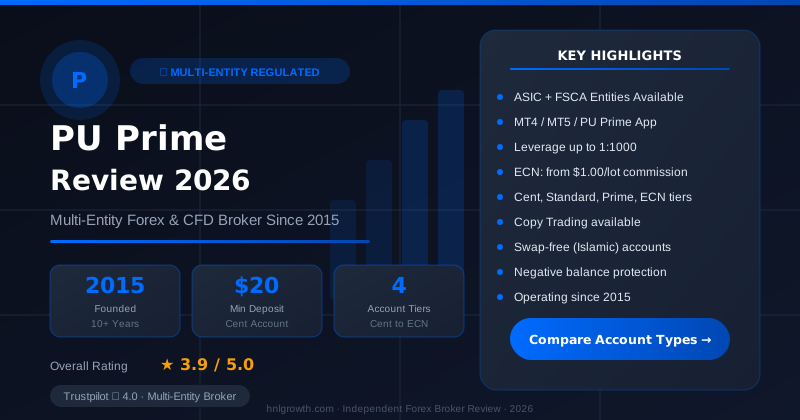
PU Prime — Multi-Entity Forex & CFD Broker
ASIC (AU) + FSCA (ZA) entities available · $20 min deposit (Cent) · MT4, MT5, PU Prime App · 4 account tiers
Before any leverage number means anything, you need to know which entity you'd actually be onboarded to and what that entity classifies you as. PU Prime operates under multiple regulatory entities rather than one blanket license, according to its regulation page. Here's the framework, using what's confirmed in that source and flagging what isn't.
| Entity / regulator | What it generally covers | Client classification | Max leverage | Platforms |
|---|---|---|---|---|
| Financial Services Authority of Seychelles (FSA) | International/offshore oversight | Retail (typical) | Not stated in the reviewed source — confirm current cap at signup | MT4, MT5 |
| Financial Services Commission of Mauritius (FSC) | International/offshore oversight | Retail (typical) | Not stated in the reviewed source — confirm current cap at signup | MT4, MT5 |
| Financial Sector Conduct Authority of South Africa (FSCA) | Domestic market conduct oversight | Retail (typical) | Not stated in the reviewed source — confirm current cap at signup | MT4, MT5 |
| Capital Market Authority of the UAE (CMA) | Domestic market conduct oversight | Retail (typical) | Not stated in the reviewed source — confirm current cap at signup | MT4, MT5 |
Two things to take from this table. First, PU Prime's regulation page confirms the entity structure and the four regulators but the specific maximum leverage ratio per entity and classification isn't published in the material reviewed for this article, so we're not going to invent a figure. Leverage caps also get revised by regulators periodically, which is exactly why a page that quotes a fixed ratio can go stale. Second, the site's own onboarding notice states PU Prime and its affiliated entities are not established or operating in every home jurisdiction, and access is on a reverse-solicitation basis where relevant, so eligibility itself is entity- and location-dependent before leverage even enters the conversation.
Disclosure: This page may contain affiliate links. We may earn a commission if you open an account through our links, at no extra cost to you.
If you want the exact leverage ceiling that applies to your classification, the fastest way to get an accurate answer is at the source: Open a PU Prime account and check the leverage setting shown during registration and inside your MT4/MT5 or app dashboard, where the current entity-specific cap is displayed.
How leverage ceilings actually work here
Leverage isn't a brand-wide setting. It's a function of three things: which legal entity holds your account, how that entity's regulator classifies retail versus professional clients, and sometimes your account equity or trading history. A regulator with a strict retail leverage cap (common in several onshore jurisdictions) will typically allow higher ratios only for clients who qualify as "professional" or "elective professional" under documented criteria — trading experience, portfolio size, or transaction volume thresholds set by that regulator, not by the broker's marketing team. Offshore-registered entities generally operate under different, often less prescriptive, leverage rules than onshore ones, which is the core tradeoff active traders are weighing: more leverage headroom against a different protection regime.
This is also why a single "PU Prime offers 1:XXX leverage" headline is the wrong question. The right question is: which entity would you be onboarded to based on your residency and how does that entity classify you. That answer determines your real ceiling, and it's set at the account level, not advertised as one universal number. If exact figures matter to your strategy, confirm them directly on the regulation page and inside your account dashboard before sizing positions around an assumed ratio.
Regulation and client protections side by side
Each of PU Prime's four listed regulators serves a different scope, and none of them should be assumed to extend the others' protections across the whole brand:
- FSA (Seychelles) and FSC (Mauritius) are commonly used as international/offshore licensing venues by CFD brokers serving clients outside their home markets. They typically involve lighter-touch conduct requirements than domestic retail-market regulators.
- FSCA (South Africa) is a domestic conduct authority overseeing financial services activity within South Africa.
- CMA (UAE) is the capital markets regulator for activity conducted in or from the UAE.
What none of the reviewed source material confirms is a per-entity breakdown of compensation scheme membership, negative balance protection status, or segregated-funds mechanics. PU Prime's page states general commitments around "protection of client funds," "transparent operational standards," and "audited compliance processes," but doesn't itemize which specific protection applies under which entity. Treat those as brand-level statements to verify against your specific entity's terms, not as a guarantee that applies identically everywhere. If a specific protection (like negative balance protection) is a deciding factor for your account choice, ask support which entity you'd be assigned to and request that entity's client agreement before funding.
This is also the right lens for comparing PU Prime against other brokers you might be researching, such as IC Markets, Pepperstone, or Plus500. Each of those brokers similarly operates under its own entity structure with its own regulator-by-jurisdiction breakdown. Rather than taking a marketing claim or forum comment about another broker's leverage or regulatory status at face value, check that broker's own current regulatory disclosure page the same way you'd check PU Prime's, since caps and licensing details change and vary by entity there too.
All-in cost check: same trade, three account tiers
Leverage headroom only matters if the cost of holding a leveraged position doesn't erase your edge. PU Prime publishes cost structure by account tier on its spreads and costs page, and the account-opening guide confirms the specific baseline figures below:
| Account | EUR/USD spread | Commission | Minimum deposit | Notes |
|---|---|---|---|---|
| Cent | Same spreads/execution as Standard | None | $20 | Balance shown in cents; smaller position sizes |
| Standard | From 1.3 pips | None | $50 | Spread is the only trading cost |
| Prime | From 0.0 pips (raw) | $3.50 per lot per side | $1,000 | Round-turn commission ≈ $7 per standard lot |
| ECN | From 0.0 pips (raw) | $1.50 per lot per side | $10,000 | Round-turn commission ≈ $3 per standard lot |
These are the figures confirmed in PU Prime's account-opening guide. What's missing from the source material for a full all-in comparison: an itemized XAU/USD spread figure and swap/overnight fee values by symbol. PU Prime's own spreads and costs page explicitly directs traders to check MT4, MT5, or the mobile app for the most accurate current values rather than relying on a static published table, which tells you spreads move and shouldn't be treated as fixed even once you do find a number. If XAUUSD cost and swap are central to your strategy, pull them live from the platform before sizing a position, not from any published table (ours included).
A simple illustration of how commission scales with volume: on Prime, ten round-turn standard lots costs roughly $70 in commission alone before spread; on ECN, the same ten lots costs roughly $30 in commission before spread, against a $10,000 minimum deposit versus $1,000. That's the real tradeoff between the two raw-spread tiers, independent of leverage.
Illustrative margin math
To show how leverage changes margin requirement — using hypothetical ratios for illustration only, not confirmed PU Prime figures — on a $10,000 EUR/USD position:
- At 1:100 leverage, margin required ≈ $100
- At 1:500 leverage, margin required ≈ $20
Higher leverage frees up capital for other positions but shrinks the price move needed to hit a margin call, since your equity buffer relative to position size is smaller. Confirm your account's actual leverage setting in MT4/MT5 or the app before using this math against a real position; it's a mechanic illustration, not a live figure.
Platforms and execution
PU Prime's account-opening flow lets you choose MetaTrader 4 or MetaTrader 5 at registration, per the how-to-open-a-trading-account guide, with MT5 positioned as the newer option with more built-in features. Both platforms support automated trading via Expert Advisors as a general MetaTrader capability, but PU Prime's specific policy on EA use, scalping, minimum hold times, or position-count limits isn't detailed in the sources reviewed for this article. If your strategy depends on high-frequency execution, hedging, or EA deployment, don't assume permission — confirm the current terms and conditions directly with PU Prime before committing capital to that strategy.
Similarly, the "Prime" and "ECN" account names signal a raw-spread-plus-commission pricing model, but the specific order execution model (market maker, STP, or ECN routing in the technical sense) isn't itemized in the reviewed material beyond the account tier naming and pricing structure. Treat the account names as a pricing tier label rather than a confirmed claim about order-routing technology until you've checked the execution disclosure in your account agreement.
Funding and withdrawal
Account opening, per PU Prime's own guide, runs through four practical steps: register with name, email, phone, and platform choice (about two minutes); upload a valid government ID plus a proof-of-address document dated within the last three months; wait for compliance review, which the guide states "usually takes a few hours during business days" for PU Prime specifically; then fund and trade.
Deposit methods listed include credit/debit card, bank wire, and e-wallets such as Skrill and Neteller, along with other local payment methods. Card and e-wallet deposits are described as usually arriving instantly, while bank transfers can take one to three business days. Minimum deposit scales by account: $20 for Cent, $50 for Standard, $1,000 for Prime, $10,000 for ECN.
What the reviewed source does not detail is withdrawal-specific processing time, withdrawal method restrictions, or any fees tied to withdrawals rather than deposits. If withdrawal speed is a deciding factor for switching brokers, verify it directly with PU Prime support or your account dashboard rather than assuming it mirrors deposit timing. Compare PU Prime account types to see current minimums and platform options before choosing a tier.
Who should pick which
- Scalpers and high-frequency traders: The Prime or ECN tiers' raw-spread-plus-commission structure is generally the cheaper model at volume, but scalping suitability isn't only a cost question — it also depends on execution rules and EA permissions that aren't confirmed in the sources reviewed here. Verify those specifics before building a scalping strategy around this broker.
- EA users: Both MT4 and MT5 are available, which is the platform prerequisite for most EAs. Whether a specific EA's trading frequency or hedging behavior is permitted under PU Prime's terms needs direct confirmation, not an assumption based on platform availability alone.
- Swing traders and lower-frequency traders: The Standard account's no-commission, spread-only pricing is simpler to model over longer hold periods, and the $50 minimum keeps the entry cost low.
- New or small-capital traders: The Cent account's $20 minimum and smaller position sizing is a lower-stakes way to get comfortable with a live account before committing Standard, Prime, or ECN capital.
This setup is not a fit if you need a written, guaranteed maximum leverage figure confirmed before you choose an entity — that number is set at onboarding, not advertised as one fixed brand-wide ratio. It's also not a fit if you're located in a jurisdiction where PU Prime states it isn't established or operating, since the site's own onboarding notice flags that reverse-solicitation basis applies. And it's not a fit if confirmed negative balance protection or a specific compensation scheme membership is a non-negotiable requirement before you'll fund an account, since those specifics aren't itemized per entity in the material reviewed here.
What we could not verify
In the interest of not asserting numbers we can't source, here's what wasn't confirmed in the official pages reviewed for this article and should be checked directly before you rely on it:
- Maximum leverage ratio per entity and per client classification (retail vs. professional)
- Margin call threshold and stop-out level (as percentages)
- Negative balance protection status by entity
- Compensation scheme membership by entity
- EA, scalping, and hedging policy, including any position-count or frequency limits
- Live XAU/USD spread figures and swap/overnight fee values by symbol
- Withdrawal processing times and any withdrawal-specific fees
- Latency or VPS specifications
None of these should be assumed favorably or unfavorably. They're gaps in the source material, not claims either way.
FAQ
How much leverage can I actually get with PU Prime? It depends on which regulated entity you're onboarded to and how that entity classifies you, and the exact current ratio isn't published in the sources reviewed for this article. Check the setting shown at registration and in your MT4/MT5 or app dashboard.
Which PU Prime account is best for scalping? Prime and ECN have the lowest headline spread-plus-commission cost structure for high-frequency trading, but confirm PU Prime's current EA and scalping rules directly, since that policy detail wasn't available in the sources checked for this article.
What's the minimum deposit to start? $20 for the Cent account, $50 for Standard, $1,000 for Prime, and $10,000 for ECN, per PU Prime's account-opening guide.
Does PU Prime support MetaTrader 4 and MetaTrader 5? Yes, both are offered and selectable at registration.
Is PU Prime regulated? PU Prime states it operates under the Financial Services Authority of Seychelles, the Financial Services Commission of Mauritius, the Financial Sector Conduct Authority of South Africa, and the Capital Market Authority of the UAE, each covering different entities and jurisdictions rather than one blanket license. See the regulation page for details.
How does PU Prime's leverage compare to IC Markets, Pepperstone, or Plus500? We can't state specific figures for those brokers here since they weren't part of the sources verified for this article. Use the same entity-and-classification framework above and check each broker's own current regulatory disclosure page directly before comparing numbers.
How long does withdrawal take? Not detailed in the sources reviewed. Deposit timing is documented (instant for card/e-wallet, one to three business days for bank transfer), but withdrawal-specific timing should be confirmed with support or your account dashboard.
Risk warning
Risk warning: CFDs and leveraged forex products are complex instruments and carry a high risk of losing money rapidly due to leverage. Consider whether you understand how these products work and whether you can afford to take the high risk of losing your capital. Check the entity, terms and protections that apply in your jurisdiction before trading.
Ready to Compare PU Prime Account Types?
PU Prime is a multi-entity broker — ASIC (Australia) and FSCA (South Africa) regulated entities offer stronger oversight, while most international clients are onboarded to the FSA Seychelles or FSC Mauritius entities. Four account tiers (Cent, Standard, Prime, ECN) range from a $20 minimum deposit to full ECN pricing.
Risk disclaimer: PU Prime is a live, regulated multi-entity broker — trading forex and CFDs is done with real capital under normal market risk (this is not a simulated prop-firm evaluation). PU Prime operates under multiple separate licenses (ASIC, FSCA, FSA Seychelles, FSC Mauritius); which entity holds your account depends on your country of residence and determines your leverage cap and protections — confirm this before funding. CFDs and leveraged forex products are complex instruments and carry a high risk of losing money rapidly due to leverage; 62.2% of retail investor accounts lose money when trading CFDs with this provider. Consider whether you understand how CFDs/forex work and whether you can afford the high risk of losing your money. Affiliate disclosure: HNL Growth earns a commission when you open a PU Prime account through links on this page.