How to Evaluate a Forex Broker: A 12-Point Checklist
If you're comparing forex brokers because you're switching, upgrading, or just double-checking a broker you already use, the fastest way to get a reliable answer is a structured checklist, not a star...
Reviewed using our forex & CFD broker review methodology
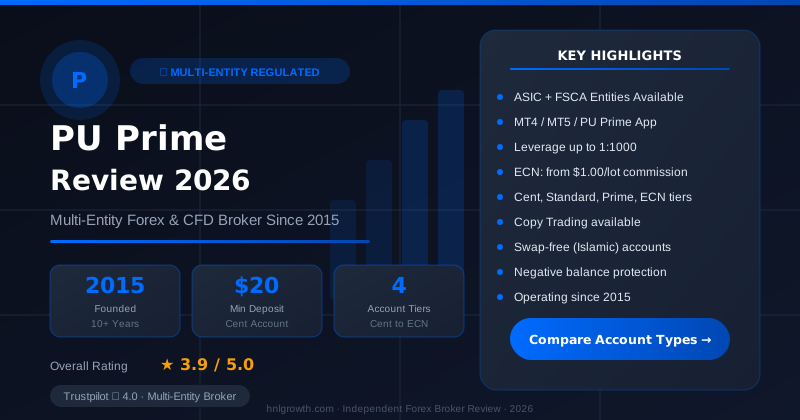
Checked on: 2026-08-17 | Broker terms, regulation, and pricing can change. Always verify at the official PU Prime site before opening an account.
Affiliate Disclosure: HNL Growth may earn a commission if you open an account through our links, at no additional cost to you. Risk Warning: CFDs and leveraged forex products are complex instruments and carry a high risk of losing money rapidly due to leverage. 62.2% of retail investor accounts lose money when trading CFDs with this provider. Trading forex and CFDs may not be suitable for all investors. Consider your objectives, experience, and risk appetite before trading, and ensure you understand the risks involved. Broker Disclosure: PU Prime is a live, regulated multi-entity broker (not a simulated prop-firm evaluation) — trades are executed with real capital in live market conditions, subject to normal market risk. Which PU Prime entity holds your account depends on your country of residence and determines your leverage cap and protections.
Last verified: August 2026 | Editorial Team
How to Evaluate a Forex Broker: A 12-Point Checklist
If you're comparing forex brokers because you're switching, upgrading, or just double-checking a broker you already use, the fastest way to get a reliable answer is a structured checklist, not a star rating. A proper forex broker review looks at regulation and entity structure, all-in trading costs, platform and execution quality, and funding reliability, then matches those facts to how you actually trade. This guide gives you a 12-point framework you can run against any broker, plus worked examples using PU Prime's own published terms so you can see how the checks apply in practice.
We'll flag upfront: some things (execution quality under live volatility, real-world support response times, withdrawal experience) can't be verified from a desk review. We'll tell you exactly what those are and how to check them yourself before funding an account.
The Verdict, in One Table
PU Prime — Multi-Entity Forex & CFD Broker
ASIC (AU) + FSCA (ZA) entities available · $20 min deposit (Cent) · MT4, MT5, PU Prime App · 4 account tiers
Before the detail, here's the full checklist. Use it as a scorecard for any broker comparison, not just this one.
| # | Checkpoint | What you're really checking | Where to find the answer |
|---|---|---|---|
| 1 | Regulatory license scope | Does the regulator cover your country, and what does the license actually permit? | Broker's regulation/legal page |
| 2 | Client fund segregation | Are your funds legally separated from the broker's operating capital? | Regulation page, terms of business |
| 3 | Contracting entity | Which legal entity signs your client agreement, and which regulator applies to that entity? | Terms & conditions, account opening docs |
| 4 | Spreads and commissions | What does a real trade actually cost across account types? | Broker's live pricing/cost page |
| 5 | Overnight financing (swap) | What does holding a position cost beyond the spread? | Cost page or platform contract specs |
| 6 | Non-trading fees | Deposit, withdrawal, inactivity, or conversion fees | FAQ or account terms |
| 7 | Trading platforms | MT4/MT5, proprietary app, or third-party integrations | Platform page |
| 8 | Execution model | Market execution, dealing desk, or hybrid, and how it affects fills | Execution policy, terms |
| 9 | Account types and minimums | Entry cost and what you get at each tier | Account types page |
| 10 | Funding and withdrawal methods | Speed, fees, and method matching between deposit and withdrawal | FAQ, payments page |
| 11 | Support availability | Channels, hours, and language coverage | Contact/support page |
| 12 | Independent reputation signals | How to read third-party reviews without over-trusting them | Treat as directional only |
Run through these twelve points for any broker you're seriously considering, and you'll catch most of the issues that turn into complaints later.
Regulation and Client Protections, Side by Side
This is where most broker comparisons fall apart, because "regulated" is not a single fact. It's a claim that only means something once you know which entity, which regulator, and which country.
1. Regulatory license scope. Start by identifying every regulator the broker discloses, then check what each license actually covers. A license from a regulator in one jurisdiction does not automatically extend protections to clients in a different jurisdiction, even if the broker's marketing feels global.
PU Prime publishes that it is authorised and regulated by multiple financial authorities, including the Financial Services Authority of Seychelles (FSA), the Financial Services Commission of Mauritius (FSC), the Financial Sector Conduct Authority of South Africa (FSCA), and the Capital Market Authority of the UAE (CMA), according to its regulation page. That page is the source of truth for specific entity names, registered addresses, and license numbers, not any third-party summary, because these details can change. Verify each license directly against the relevant regulator's public register before relying on them.
It is also worth noting that PU Prime's own website warns that the site is intended for individuals in jurisdictions where access is permitted by law, and that PU Prime and its affiliated entities may not be established or operating in your home jurisdiction. This disclaimer underscores the importance of checkpoint 3 below.
2. Client fund segregation. A regulated broker should state clearly that client funds are held separately from company operating funds. PU Prime's regulation page references "protection of client funds," "transparent operational standards," and "audited compliance processes." Treat these stated commitments as a starting point for your own verification rather than a final answer. Confirm segregation arrangements in the terms of business for the specific entity you'd be contracting with, since practices can vary across entities within the same brand. If a broker's site does not clearly state how client money is held, that's a gap worth raising directly with the broker before you fund an account.
3. The contracting entity. This is the step most traders skip, and it's the one that matters most if something goes wrong. When you open an account, you sign a client agreement with a specific legal entity, not with "the brand" as a whole. That entity determines which regulator has authority over your account and which complaint or dispute mechanism, if any, applies to you.
Multi-jurisdiction brokers commonly operate several entities, each regulated differently, so a South Africa-based client and a UAE-based client may be contracting with different entities under materially different rules even though the trading platform looks identical. Before opening an account with any broker, confirm which entity you'll be signed up with based on your country of residence, and read that entity's specific terms. Do not assume that protections described for one jurisdiction apply to yours.
Note on US traders: PU Prime's published materials do not address eligibility for US-based clients. Traders in the United States should verify directly with the broker whether any entity accepts US residents and whether any applicable CFTC or NFA requirements are met before attempting to open an account.
None of this tells you whether a broker is "safe" in absolute terms. Regulation reduces certain risks, such as commingled funds or unlicensed operation, but it does not eliminate market risk, guarantee outcomes, or remove the possibility of loss.
A note on retail loss rates. Regulated brokers in many jurisdictions are required to disclose the percentage of retail investor accounts that lose money when trading CFDs or leveraged products. Where such disclosure is published, review it carefully. If the broker you are evaluating does not publish a retail loss disclosure applicable to your jurisdiction, treat that as a question to raise directly with the broker.
All-In Cost on the Same Trade
Spread comparisons that ignore commissions, swaps, and non-trading fees are close to meaningless. A broker advertising ultra-tight spreads can still be more expensive overall once you add per-lot commissions and financing costs, and the reverse is also true.
4. Spreads and commissions. Check the actual figures for the instruments and account type you'd use, not the headline number from the account with the highest minimum deposit. Brokers often run several account tiers with different pricing models.
PU Prime publishes distinct pricing across its Standard, Prime, and ECN tiers on its spreads and costs page. According to that page, the Standard account carries no commission with spreads from 1.3 pips on EUR/USD; the Prime account offers spreads from 0.0 pips with a $3.50 per lot per side commission; and the ECN account offers 0.0 pip spreads with a $1.50 per lot per side commission. PU Prime notes explicitly that all values are for reference only and that you should check MT4/MT5 or the PU Prime mobile app for the most current figures, since spread values move with the market. Do not treat any static table, including those in third-party reviews, as current pricing.
Compare the tier you'd realistically trade on rather than the best-case headline number. A lower per-trade cost at the ECN tier only represents a saving over the Standard tier if your trading volume justifies the higher minimum deposit.
5. Overnight financing (swap). If you hold positions overnight, swap costs compound over time in a way spread comparisons don't capture. These rates vary by instrument and direction (long vs. short) and change with central bank rates. Check current contract specifications inside the platform or on the broker's live cost page rather than relying on a static screenshot from any review source.
6. Non-trading fees. Look for deposit fees, withdrawal fees, currency conversion charges, and inactivity fees. These rarely appear in headline marketing but can meaningfully affect returns for lower-frequency traders. Confirm them in the broker's official FAQ or account terms before you fund an account.
Disclosure: This page may contain affiliate links. We may earn a commission if you open an account through our links, at no extra cost to you.
Once you've mapped the full cost structure for the account tier you'd actually use, you have a real cost comparison. Check current PU Prime spreads and account costs directly on the source page for the most up-to-date figures.
Platforms and Execution
7. Trading platforms. Confirm which platforms are available and whether your preferred choice is available at account opening or locked in later. PU Prime's account opening guide states that you can choose between MT4 and MT5 during registration, alongside a mobile app. The same guide recommends MT5 as the newer option with more features for traders who are unsure which to choose.
If a platform choice matters to your strategy, such as support for automated trading, custom indicators, or specific order types, verify those capabilities before committing capital. Third-party integrations such as TradingView or algorithmic trading APIs should also be confirmed on the broker's platform page rather than assumed from the platform name alone.
8. Execution model. How a broker fills your orders affects realistic trading costs and slippage exposure more than any single spread figure. Ask specifically whether the broker uses market execution or a dealing desk model, and look for a dedicated execution policy document rather than relying on account type names as a proxy. PU Prime's execution model details are best confirmed via its own execution policy or terms rather than paraphrased here, since execution arrangements can vary by account tier and instrument.
Execution quality under real market conditions, such as fills during high-impact news events or periods of thin liquidity, is something a written policy describes but cannot prove. That limitation is addressed in the verification section below.
Funding and Withdrawal
9. Account types and minimum deposit. Minimums tell you what's accessible, but the more useful question is whether the entry-level tier's trading conditions match what you actually want to trade. PU Prime's account opening guide describes four account tiers: a Cent account starting at $20 (balances displayed in cents, suited to testing strategies with limited capital exposure); a Standard account starting at $50 with no per-trade commission; a Prime account with a $1,000 minimum deposit offering raw spreads plus commission; and an ECN account with a $10,000 minimum deposit at the lowest per-lot commission structure. Confirm current terms directly on PU Prime's account types page before opening an account, as conditions and minimums can change.
Match the tier to your actual trading volume and risk tolerance. Starting at the tier with the best-looking headline pricing only makes economic sense if your volume justifies the minimum deposit.
10. Deposit and withdrawal methods and timelines. A broker that makes deposits fast but withdrawals slow or restrictive is a well-documented complaint pattern across the industry. Check both sides of the transaction before funding. PU Prime's account opening guide states that deposits via card or e-wallet typically arrive instantly, while bank transfers can take one to three business days. The same guide notes that verification typically takes a few hours during business days, with some cases taking up to 24 to 48 hours.
These are the broker's own published expectations, not a guarantee for every withdrawal, every payment method, or every region. Confirm current terms directly before relying on them, and consider testing a withdrawal with a modest deposit before committing larger sums.
If a broker does not publish deposit and withdrawal methods, fees, and approximate timelines clearly, treat that absence as a gap to investigate rather than a neutral omission.
Review PU Prime's live registration flow and current account terms to check document requirements and current minimums for yourself before committing funds.
11. Support availability. Check what contact channels the broker offers (live chat, email, phone), the published hours, and whether support is available in your language. Published support hours tell you when help is theoretically accessible; they don't tell you how quickly a specific query gets resolved. Contact support with a real question before funding a live account if response quality matters to your trading approach.
Who Should Pick Which Account Tier
The twelve checkpoints matter differently depending on how you trade. Weight them accordingly rather than treating every item as equally important.
Cost-sensitive, high-frequency traders should give the most scrutiny to checkpoints 4 and 5 (spreads, commissions, and swap costs). A raw-spread, commission-based tier like PU Prime's Prime or ECN accounts is usually only worth the higher minimum deposit if trading volume is high enough that the lower per-trade cost outweighs the entry barrier.
Beginners or those testing a new broker relationship should prioritise checkpoints 1 through 3 (regulation, fund segregation, contracting entity) and checkpoint 9 (account minimums). A lower-minimum entry tier lets you evaluate platform behavior and the funding process with limited capital before scaling up.
Traders switching from another broker should pay particular attention to checkpoint 10 (funding and withdrawal) and checkpoint 3 (contracting entity). Switching brokers means re-establishing a funding relationship and reading a new set of terms from the beginning. Don't assume the new broker's process mirrors your previous experience.
Traders considering copy trading should note that some brokers, including PU Prime according to its published materials, offer copy trading as an alternative approach to managing positions. This does not remove the need to complete checkpoints 1 through 3 first; you're still opening an account with a regulated entity. Copy trading is a different risk profile from managing positions yourself, not a lower-risk alternative, since your capital remains exposed to the signal provider's outcomes, including losses.
This checklist is not the right fit if you're looking for a recommendation based on promised returns, a live execution speed ranking, or any guarantee about withdrawal outcomes. No credible review can deliver those, and any source that claims to do so warrants skepticism.
Negative balance protection is a feature offered by some regulated brokers that prevents your account balance from falling below zero due to adverse market movements. Whether this protection applies to your account depends on the entity you contract with and the regulator overseeing it. Confirm whether negative balance protection applies to your specific account before trading with leverage, as it is not universal across all jurisdictions or entities.
What We Could Not Verify
This article is built from each broker's own published regulatory, pricing, and account-opening pages. No live account testing, support contact tests, or withdrawal simulations were conducted. The following are outside the scope of what can be confirmed from a desk review and are worth checking yourself before relying on them:
- Real-world execution quality during volatile markets. Published execution policies describe intended behavior; they don't reflect how fills perform during high-impact news events or periods of low liquidity. Test on a demo account first, or start with minimal capital, before scaling up.
- Actual support response times. Published hours and channels don't tell you how quickly a real query gets resolved. Contact support with a specific question before funding a live account if this matters to you.
- Withdrawal experience at the individual account level. Published timelines are the broker's stated expectations, not a guarantee for every withdrawal, payment method, or region. Test a withdrawal with a modest initial deposit before committing larger sums.
- Complaint history and regulatory enforcement records. This article does not assess complaint patterns, Financial Ombudsman records, or regulator enforcement actions against any broker discussed. For any broker you are seriously evaluating, check the relevant regulator's public register for enforcement notices and review publicly available complaint data independently.
- Third-party review reliability. Independent review platforms can surface useful recurring themes, but they are also vulnerable to incentivized submissions and coordinated negative campaigns. Use them to generate questions to put to the broker directly, not as standalone proof of a factual claim.
None of this is a reason to avoid due diligence. It's a reason to do it in the right order: confirm regulatory and cost facts from official sources first, then verify operational reliability yourself with limited capital before committing more.
FAQ
How do I know if a forex broker is actually regulated in my country? Identify the specific entity named in the client agreement you'd be signing, not just the brand name on the homepage, then verify that entity against the relevant regulator's own public register. A broker operating multiple entities across jurisdictions may only hold certain licenses for certain regions, and the protections available to you depend entirely on which entity you're contracting with.
Does a tighter spread always mean lower total cost? No. Account tiers with the tightest spreads often carry per-lot commissions and higher minimum deposits. The total cost depends on your position size and trading frequency. Calculate the full cost — spread plus commission plus swap — for your actual trade size before comparing headline spread figures across brokers or account tiers.
What's the difference between a broker's parent brand and the entity I'm contracting with? The parent brand is the overall business; the contracting entity is the specific regulated company whose terms and regulator apply to your account. These can differ by region even under the same brand. Always confirm which entity applies to your country of residence before signing a client agreement.
How long should withdrawals realistically take? This varies by payment method, broker, and region. E-wallet and card withdrawals are often processed faster than bank wires, but published timelines are the broker's stated targets, not a guarantee. Confirm the broker's current terms in their official FAQ, and consider testing with a smaller amount before withdrawing a larger sum.
Are online broker reviews reliable for judging trustworthiness? Treat them as a starting point for questions, not as verified fact. Review platforms can be affected by incentivized submissions or coordinated negative campaigns. Look for recurring themes across multiple platforms and use them to formulate specific questions to ask the broker directly, rather than treating any individual review as definitive.
Can US-based traders open an account with any international CFD broker? Not automatically. US residents are subject to CFTC and NFA regulations that restrict CFD and rolling spot forex trading to brokers registered with those bodies. Many international CFD brokers do not hold the required US registrations and may not accept US residents. Verify directly with any broker whether they are authorised to accept clients from your jurisdiction before applying.
Is copy trading a lower-risk alternative to trading myself? It removes some day-to-day decision-making, but it does not remove market risk. Your capital remains exposed to the signal provider's trading outcomes, including losses. Copy trading represents a different approach to risk, not a reduction in it.
What is negative balance protection, and do I have it? Negative balance protection means your account cannot go below zero as a result of market moves against your position. Whether this applies to your account depends on the specific entity you contract with and the jurisdiction's regulatory requirements. Confirm with your broker whether it applies to your account type and jurisdiction before trading with leverage.
Risk warning: CFDs and leveraged forex products are complex instruments and carry a high risk of losing money rapidly due to leverage. Consider whether you understand how these products work and whether you can afford to take the high risk of losing your capital. Check the entity, terms and protections that apply in your jurisdiction before trading.
Ready to Compare PU Prime Account Types?
PU Prime is a multi-entity broker — ASIC (Australia) and FSCA (South Africa) regulated entities offer stronger oversight, while most international clients are onboarded to the FSA Seychelles or FSC Mauritius entities. Four account tiers (Cent, Standard, Prime, ECN) range from a $20 minimum deposit to full ECN pricing.
Risk disclaimer: PU Prime is a live, regulated multi-entity broker — trading forex and CFDs is done with real capital under normal market risk (this is not a simulated prop-firm evaluation). PU Prime operates under multiple separate licenses (ASIC, FSCA, FSA Seychelles, FSC Mauritius); which entity holds your account depends on your country of residence and determines your leverage cap and protections — confirm this before funding. CFDs and leveraged forex products are complex instruments and carry a high risk of losing money rapidly due to leverage; 62.2% of retail investor accounts lose money when trading CFDs with this provider. Consider whether you understand how CFDs/forex work and whether you can afford the high risk of losing your money. Affiliate disclosure: HNL Growth earns a commission when you open a PU Prime account through links on this page.