How to Short a Stock: Mechanics, Costs and Risk
Short selling means borrowing shares you don't own, selling them at the current market price, and buying them back later to return to the lender. If the price falls before you buy back ('cover'), you...
Reviewed using our forex & CFD broker review methodology
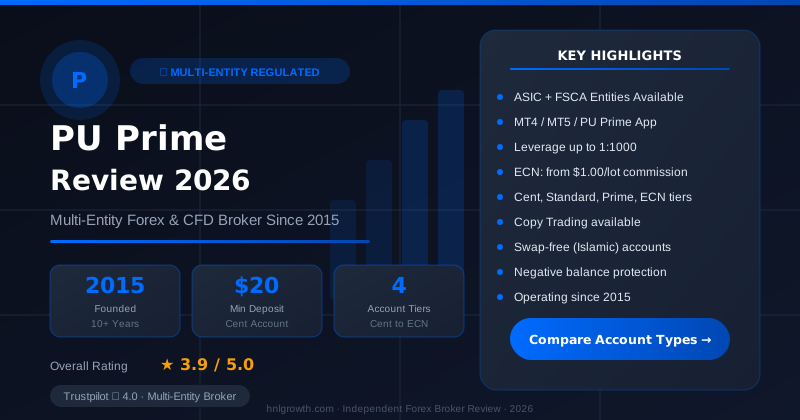
Checked on: 2026-08-17 | Broker terms, regulation, and pricing can change. Always verify at the official PU Prime site before opening an account.
Affiliate Disclosure: HNL Growth may earn a commission if you open an account through our links, at no additional cost to you. Risk Warning: CFDs and leveraged forex products are complex instruments and carry a high risk of losing money rapidly due to leverage. 62.2% of retail investor accounts lose money when trading CFDs with this provider. Trading forex and CFDs may not be suitable for all investors. Consider your objectives, experience, and risk appetite before trading, and ensure you understand the risks involved. Broker Disclosure: PU Prime is a live, regulated multi-entity broker (not a simulated prop-firm evaluation) — trades are executed with real capital in live market conditions, subject to normal market risk. Which PU Prime entity holds your account depends on your country of residence and determines your leverage cap and protections.
Last verified: August 2026 | Editorial Team
How to Short a Stock: Mechanics, Costs and Risk
Short selling means borrowing shares you don't own, selling them at the current market price, and buying them back later to return to the lender. If the price falls before you buy back ("cover"), you profit from the difference minus fees. If the price rises, your loss is theoretically unlimited, because a stock price has no ceiling. That asymmetry — capped downside on a long position, uncapped downside on a short — is the single most important fact to understand before doing this with real capital.
Short selling requires a margin account, sufficient equity to meet maintenance requirements, and the discipline to manage a position that can move against you faster than a long position typically does. It is not a beginner strategy. This guide walks through the mechanics, the full cost structure, the risk scenarios, and how to evaluate whether a broker's short-selling or CFD short conditions actually fit what you're trying to do.
Disclosure: This page may contain affiliate links. We may earn a commission if you open an account through our links, at no extra cost to you.
Prerequisites: what you need before you can short anything
PU Prime — Multi-Entity Forex & CFD Broker
ASIC (AU) + FSCA (ZA) entities available · $20 min deposit (Cent) · MT4, MT5, PU Prime App · 4 account tiers
You cannot short a stock from a standard cash account. You need a margin account, which lets you borrow value from your broker against your own equity, and which comes with a maintenance margin requirement — the minimum percentage of the position's value you must keep in equity at all times.
In the US, regulators set baseline margin account minimums, but individual brokers commonly require higher minimum balances and set their own maintenance margin percentages above the regulatory floor. The exact maintenance margin figure is broker- and instrument-specific — always confirm the current number directly with your broker or platform rather than assuming any fixed percentage applies to your account.
If you're trading short exposure through CFDs rather than borrowing physical shares, the account structure is different again: you're not borrowing an asset from a lender, you're opening a leveraged contract that mirrors the price movement. This distinction matters enough that it gets its own section below.
How share borrowing actually works
When you short a traditional stock, your broker has to locate shares to borrow, either from its own inventory, another client's margin account, or the wider securities lending market. In the US, this is shaped by FINRA's Regulation SHO, which requires a broker to have reasonable grounds to believe a share can be borrowed before accepting a short sale order — a "locate" requirement designed to curb naked short selling, where a trader sells shares without any real ability to deliver them.
Shares fall into two rough categories that materially affect cost and availability:
- Easy-to-borrow (ETB): large, liquid stocks with abundant available shares. Borrow costs are typically low, often under 1% annualized.
- Hard-to-borrow (HTB): stocks with limited float, high existing short interest, or heavy demand to short. Borrow rates can climb into double digits, and in extreme cases exceed 20–50% annualized. These are illustrative ranges from how stock loan markets generally price risk and liquidity, not broker-specific quotes — rates move daily. Availability can also disappear entirely, meaning some brokers simply won't let you open new short positions in a given name.
Because the lender retains the right to recall shares, you can also face a forced buy-in: if the party lending the shares wants them back and no replacement shares are available, your broker may close your position. This is a contractual right embedded in securities lending agreements, not something a broker does arbitrarily, but it means a short position can be closed at a time and price you didn't choose. Brokers vary in how and whether they notify clients ahead of such a close; confirm your specific broker's notification practices rather than assuming a standard process applies.
The full cost structure of a short position
Shorting isn't just "the spread." Costs accumulate from several sources simultaneously, and they compound the longer you hold the position open.
| Cost component | What it is | Typical range (illustrative only — not broker-specific quotes) |
|---|---|---|
| Borrow fee / stock loan rate | Annualized fee for borrowing the shares, charged on the value borrowed | Under 1% for easy-to-borrow; 10%+ up to 20–50%+ for hard-to-borrow names |
| Overnight financing | Daily charge for holding a leveraged position past the close, common on CFD short positions | Broker- and instrument-specific; changes daily |
| Spread | Difference between bid and ask at entry and exit | Wider on lower-liquidity or more volatile shares |
| Margin interest | Interest on the borrowed capital backing your leveraged position, where applicable | Varies by broker and account type |
These figures are illustrative ranges drawn from how stock loan markets generally price risk and liquidity. Actual numbers move daily and differ by account type and instrument — treat them as a mental model for comparison shopping, not numbers to plug into a live calculation without checking current rates with your broker first.
Cost accumulation over time: a worked example
The compounding effect is the part beginners most commonly underestimate. To make it concrete, consider how a borrow fee drags on an otherwise directionally correct trade at different holding periods and rates:
| Borrow rate (annualized) | 1 week | 1 month | 3 months |
|---|---|---|---|
| 1% | ~0.02% of position value | ~0.08% | ~0.25% |
| 5% | ~0.10% | ~0.42% | ~1.25% |
| 15% | ~0.29% | ~1.25% | ~3.75% |
These figures isolate the borrow cost alone on a position held for the stated period. They do not include spread on entry and exit, overnight financing (for CFDs), or margin interest — all of which add to the total drag. On a hard-to-borrow name at 15% annualized, three months of holding costs roughly 3.75% of the position value in borrow fees before you factor in anything else. If your price target implies a 4–5% move in your favour, the trade's actual risk/reward is considerably worse than the directional view alone suggests.
Before opening any short, work out the daily cost at the quoted rate (annual rate ÷ 365 × position value) and multiply it by your expected holding period. If that figure is close to your expected profit target, re-examine the trade.
For CFD shares specifically, PU Prime's trading costs page lists spreads and swap charges by account type (Standard, Prime, ECN) for share CFDs and other instruments. The page itself notes that all values are for reference only — check the live figures on the platform before trading, since spreads and swaps are variable and instrument-specific.
Step-by-step: how a short position gets opened and closed
- Identify a candidate. Based on your own analysis — fundamental deterioration, technical breakdown, or a hedging need against an existing long position. (Signal frameworks are covered below.)
- Check availability and borrow cost. For traditional stock shorting, confirm shares are locatable and note the current borrow rate. For CFDs, check the current spread and overnight financing rate on the platform before entering.
- Size the position. Decide what percentage of your account this position represents. Given that losses on a short are uncapped, consider whether you could sustain the loss if the position moved sharply against you, and size accordingly. A common risk management principle is to limit any single position to a small fraction of total account equity, though the appropriate percentage depends on your overall strategy, risk tolerance, and how closely you can monitor the position. There is no universal "right" number — the relevant discipline is to define your maximum acceptable loss before entering, not after.
- Place the sell order to open the short, then set a stop-loss order immediately — not "later." Because losses are theoretically unlimited, an unprotected short is a materially different risk than an unprotected long.
- Monitor margin and financing costs. Track your equity against the maintenance margin requirement and keep an eye on accumulating overnight charges if the position stays open for more than a few sessions.
- Close the position (buy to cover). You buy back the same number of shares or contracts to close the exposure, ending the borrow and the associated fees.
Every one of these steps depends on the broker's tools: how clearly it displays available shares or CFD margin requirements, how it notifies you of a margin call, and what order types it supports for automated risk control. That's the practical reason cost and platform comparison matters more here than on a simple long-only trade.
Calculating your margin call price
Understanding approximately where a margin call triggers helps you set a stop-loss level that prevents the broker from making that decision for you. The underlying logic:
Margin call triggers when: Account equity ÷ Current position value falls below the broker's maintenance margin requirement.
Working through the same simplified scenario used in the risk table below — 100 shares shorted at $100, $5,000 account equity, maintenance margin of 30% (illustrative; confirm your broker's actual figure):
- At entry: equity = $5,000 on a $10,000 position = 50% margin level — comfortably above the threshold
- At +20% ($120/share): position value = $12,000, P&L = −$2,000, equity ≈ $3,000 = 25% margin level — approaching or below a 30% threshold
- The precise trigger price depends on the broker's actual maintenance percentage, any additional fees accrued, and whether the broker applies margin at the position level or account level
This illustrates why the threshold matters: with 30% maintenance margin, a move far smaller than +50% can trigger a margin call. Set your stop-loss to close the position before that threshold is reached, not at it. The exact formula for your account is:
Approximate margin call price (short) = Entry price × (1 + (Initial equity − (Maintenance margin % × Initial position value)) ÷ (Shares × Entry price))
Replace the variables with your broker's actual figures. This is a structural approximation — brokers apply margin rules differently across account types and instruments.
The risk landscape, in numbers
Here's a simplified scenario to illustrate the mechanics — not a real trade, just a model. Suppose you short 100 shares at $100 (a $10,000 position) with $5,000 of account equity supporting it. A maintenance margin of 30% is used as an illustration only — confirm your broker's actual requirement.
| Price movement | New price | Position value | P&L on the short | Approx. equity remaining | Risk indicator |
|---|---|---|---|---|---|
| −20% | $80 | $8,000 | +$2,000 | $7,000 | Profitable |
| 0% | $100 | $10,000 | $0 | $5,000 | Flat, minus accumulated costs |
| +20% | $120 | $12,000 | −$2,000 | $3,000 | ⚠ Margin call likely at or before this point at 30% maintenance |
| +50% | $150 | $15,000 | −$5,000 | $0 | Equity wiped out — forced liquidation would occur well before this |
| +100% | $200 | $20,000 | −$10,000 | Deeply negative | Illustrates unlimited loss exposure |
The equity figures are simplified and exclude accumulated financing costs, which would erode equity faster. The ⚠ marker shows approximately where a 30% maintenance margin threshold would be breached on this example — in practice, the broker's actual percentage determines the real trigger. The point of the table is the shape of the curve: losses on a short accelerate as the price keeps rising, and the broker has a contractual right to liquidate the position once equity breaches the maintenance level, generally without waiting for you to act.
Short squeezes: when the feedback loop turns against you
A short squeeze happens when a rising price forces short sellers to buy back shares to limit losses or meet margin calls, and that buying itself pushes the price higher, forcing more shorts to cover, in a self-reinforcing loop. The GameStop episode in January 2021 is the widely reported example: heavily shorted shares (short interest was widely reported to exceed the available float at certain points) saw the price spike sharply within weeks, driven substantially by coordinated retail buying and short covering, with an intraday peak near $483 reported on 28 January 2021. Traders holding uncovered short positions during that move faced losses far beyond their original stake. It's an extreme case, but it illustrates a real mechanism, not a one-off anomaly: the more crowded a short trade is, the more violent the unwind can be if sentiment flips.
Common mistakes
- No stop-loss. Given uncapped downside, entering a short without a predefined exit is a materially bigger risk than doing the same on a long position.
- Position sizing too large. Because losses can exceed the initial position value, sizing that would be conservative on a long position can be reckless on a short.
- Shorting into strong momentum. Being fundamentally right about overvaluation doesn't protect you if the price keeps rising before the market agrees — timing risk is often larger than directional risk.
- Ignoring borrow or financing costs on longer holds. A trade that looks profitable at entry can become a loser once weeks of accumulated fees are subtracted. (See the cost accumulation table above.)
- Treating a hard-to-borrow stock like an easy one. Elevated borrow costs can consume the entire expected profit even if the price direction call is correct.
CFDs vs traditional stock borrowing
| Feature | Traditional stock short | CFD short |
|---|---|---|
| Underlying mechanism | Borrow real shares, sell them, buy back later | Enter a leveraged contract tracking the price; no share ownership at any point |
| Locate requirement | Yes — broker must identify borrowable shares before accepting the order | No share locate; access depends on the CFD provider's market availability |
| Typical cost drivers | Borrow fee, spread, margin interest | Spread, overnight financing charge, margin |
| Regulatory treatment | Governed by securities lending rules (e.g., FINRA Reg SHO in the US) | Governed by CFD/derivatives rules, which vary sharply by jurisdiction — EU retail CFD leverage is capped under ESMA's product intervention measures (with caps varying by instrument class, e.g., lower caps on equities than on major forex pairs); CFDs are restricted or unavailable to retail clients in some countries, including a complete prohibition on retail CFD trading in the US |
| Availability | Depends on share lending market liquidity | Depends on the broker's own CFD offering and margin rules |
Neither structure is inherently "better" — they carry different cost profiles and regulatory protections. Which one is relevant to you depends on where you're resident and what the broker actually offers under the entity that would service your account. PU Prime's trading costs page outlines share CFD instruments available for leveraged trading; it does not provide traditional stock borrowing.
Jurisdiction and regulatory context
Short selling availability isn't uniform globally. Some markets impose temporary bans during acute volatility — several European regulators restricted short selling during the 2020 market stress, for instance — while others maintain longer-standing structural limits on who can short and how.
The EU's framework under Regulation (EU) No 236/2012 establishes a disclosure regime for significant net short positions, gives national competent authorities power to temporarily restrict or ban short selling in defined circumstances, and sets conditions for intervention at the EU level. Rules differ by country, by instrument type (individual equities vs. CFDs vs. other derivatives), and by whether a position exceeds notification thresholds.
A broker operating through multiple regulated entities may apply different terms depending on which entity books your account — the protections and restrictions relevant to a client under one regulatory jurisdiction are not automatically the same as those under another. Always check the specific terms, entity, and jurisdiction that apply to your account, not general statements about the company as a whole.
Timing signals: patterns, not predictions
Traders commonly reference certain technical and fundamental signals when identifying short candidates. None of these predict outcomes reliably; they describe historical correlations that can fail at any time.
| Signal | What it describes | Caveat |
|---|---|---|
| Support level breakdown | Price falls through a previously defended price zone | Frequently reverses; not a standalone trigger |
| Moving average "death cross" | Shorter-term average crosses below a longer-term one | Lagging indicator; often confirms a move already underway |
| Volume divergence | Price rises on falling volume, suggesting weakening conviction | Correlational, not causal |
| Deteriorating earnings/guidance | Company fundamentals worsening | Market may have already priced this in |
| Sector rotation | Capital moving out of a sector broadly | Affects most names in a sector; not stock-specific |
None of this should be read as a signal that reliably predicts direction or timing. Being fundamentally correct that a stock is overvalued and being correctly timed on when the market agrees are two different skills, and the gap between them is where most losses on short positions actually happen.
Who this is not for
Short selling is not suited to everyone. Consider whether the following apply before proceeding:
- Limited capital reserves: Losses on a short can exceed the initial position value, and margin calls may require you to deposit additional funds promptly or accept a forced close. If you don't have capital in reserve beyond what's in the trading account, a short position can create a financial obligation beyond what you started with.
- No prior experience managing margin positions: The mechanics of margin calls, forced buy-ins, and overnight cost accumulation are meaningfully different from managing a standard long position. Trading a short before understanding these mechanics introduces risk beyond the directional bet itself.
- Low tolerance for equity volatility: A short position's margin level can swing sharply on intraday moves. If you need stable account equity — for example, because you're using the same account for other positions — a single adverse short can affect your entire account.
- Limited availability to monitor positions: Margin calls and forced buy-ins can occur at any point the market is open, and notification practices vary by broker. A position left unattended can generate losses or close unexpectedly.
- Long-term investing as the primary goal: Short selling individual stocks is a form of active, closely monitored risk management. Some investors use short exposure narrowly to hedge against an existing long portfolio — a different objective from speculative directional shorting, and one that requires its own assessment.
If several of these apply, the risk/reward of shorting individual stocks — as opposed to other instruments or strategies — is worth examining carefully before committing capital.
How to practise and evaluate the mechanics
Understanding the mechanics before trading with real capital reduces the chance of an operational error (wrong order type, misread margin level, overlooked financing cost) adding to the directional risk you're already taking. A demo account allows you to work through the order entry workflow, observe how margin levels move as prices change, and become familiar with where financing charges appear — all without capital at risk.
Keep in mind what a demo account does not replicate: the psychological pressure of watching a real loss grow, real-time share availability (especially for hard-to-borrow names, where actual availability shifts constantly), and live borrow costs, which may differ from any indicative rates shown. Use it to build fluency with the workflow, not as a rehearsal that predicts how you'd perform with real money.
If you want to work through the CFD short workflow specifically, PU Prime offers a demo account with access to their platform before committing to a live account.
Broker feature checklist for evaluating short-selling conditions
When comparing brokers or platforms for short exposure, check each of the following before opening an account:
| Criterion | What to verify |
|---|---|
| Instrument availability | Whether the specific shares or CFDs you intend to short are listed and available |
| Cost transparency | Whether financing rates and spreads are displayed in real time, not only in a static fee schedule |
| Margin call notification | How and when the broker notifies you of a margin call — and whether they are obligated to notify you at all before liquidating |
| Risk management order types | Whether stop-loss, guaranteed stop-loss (if available), and other automated exit orders are supported |
| Borrow mechanics (traditional shorting) | Whether shares are pre-borrowed or located at execution, and whether the borrow rate is shown before order entry |
| Account requirements | Minimum deposit and account type required to access the relevant instruments |
| Regulatory entity | Which entity your account is booked under and what protections apply in your jurisdiction |
On the last point: PU Prime's account types start at a $20 minimum deposit for the Cent account and $50 for the Standard account, as stated in their account opening guide at the time of writing — minimum deposits can change, so confirm current requirements directly with the broker. Prime and ECN tiers require higher minimums and offer tighter spread/commission structures. PU Prime operates under regulatory oversight in multiple jurisdictions; the entity that applies to your account, and the protections that come with it, depends on your country of residence.
FAQ
Is shorting a stock riskier than buying one? Yes, structurally. A long position's maximum loss is capped at 100% of the amount invested. A short position's loss is theoretically unlimited, because there's no ceiling on how high a price can rise before you have to buy it back.
How much does it cost to short a hard-to-borrow stock? It varies daily and by stock. Hard-to-borrow names can carry annualized borrow rates well into double digits, with illustrative ranges in industry literature often cited above 20–50% in extreme cases — compared to under 1% for easy-to-borrow, highly liquid shares. These are market-level illustrations, not quotes from any specific broker. Check current rates with your broker before opening a position.
What triggers a margin call on a short position? Your account equity falling below the broker's maintenance margin requirement on that position. The exact percentage is broker-specific — confirm the actual figure with your broker before trading. The worked example in this article uses 30% as an illustration only.
Can my short position be closed without my permission? Yes. If maintenance margin is breached, or if a securities lender recalls borrowed shares and no replacement is available, a broker can close the position. Broker notification practices vary — some provide advance warning where possible, others may not. Confirm your broker's specific policy.
Is short selling available on every broker or in every country? No. Availability depends on the broker's offering, the instrument type (individual shares vs. CFDs vs. other derivatives), and the regulatory environment in your jurisdiction. CFDs, for example, are not available to retail clients in the US, and several other jurisdictions impose restrictions. Some markets also apply temporary short-selling bans during periods of acute stress.
What's the difference between a CFD short and a traditional stock short? A traditional stock short involves actually borrowing shares and selling them, with a locate requirement and borrow fee. A CFD short is a leveraged contract that tracks the price — no shares change hands, and costs are typically expressed as spread and overnight financing. The regulatory treatment, cost structure, and availability differ significantly between the two, as outlined in the comparison table above.
Risk warning
Risk warning: CFDs and leveraged forex products are complex instruments and carry a high risk of losing money rapidly due to leverage. Consider whether you understand how these products work and whether you can afford to take the high risk of losing your capital. Check the entity, terms and protections that apply in your jurisdiction before trading.
Ready to Compare PU Prime Account Types?
PU Prime is a multi-entity broker — ASIC (Australia) and FSCA (South Africa) regulated entities offer stronger oversight, while most international clients are onboarded to the FSA Seychelles or FSC Mauritius entities. Four account tiers (Cent, Standard, Prime, ECN) range from a $20 minimum deposit to full ECN pricing.
Risk disclaimer: PU Prime is a live, regulated multi-entity broker — trading forex and CFDs is done with real capital under normal market risk (this is not a simulated prop-firm evaluation). PU Prime operates under multiple separate licenses (ASIC, FSCA, FSA Seychelles, FSC Mauritius); which entity holds your account depends on your country of residence and determines your leverage cap and protections — confirm this before funding. CFDs and leveraged forex products are complex instruments and carry a high risk of losing money rapidly due to leverage; 62.2% of retail investor accounts lose money when trading CFDs with this provider. Consider whether you understand how CFDs/forex work and whether you can afford the high risk of losing your money. Affiliate disclosure: HNL Growth earns a commission when you open a PU Prime account through links on this page.