How to Start Forex Trading in 2026: A Beginner's Roadmap
Starting forex trading means learning a few core mechanics before you risk any money: what a currency pair and a pip are, how spread and leverage affect your position, and how to practise on a demo...
Reviewed using our forex & CFD broker review methodology
Checked on: 2026-08-17 | Broker terms, regulation, and pricing can change. Always verify at the official PU Prime site before opening an account.
Affiliate Disclosure: HNL Growth may earn a commission if you open an account through our links, at no additional cost to you. Risk Warning: CFDs and leveraged forex products are complex instruments and carry a high risk of losing money rapidly due to leverage. 62.2% of retail investor accounts lose money when trading CFDs with this provider. Trading forex and CFDs may not be suitable for all investors. Consider your objectives, experience, and risk appetite before trading, and ensure you understand the risks involved. Broker Disclosure: PU Prime is a live, regulated multi-entity broker (not a simulated prop-firm evaluation) — trades are executed with real capital in live market conditions, subject to normal market risk. Which PU Prime entity holds your account depends on your country of residence and determines your leverage cap and protections.
Last verified: August 2026 | Editorial Team
How to Start Forex Trading in 2026: A Beginner's Roadmap
Disclosure: This page may contain affiliate links. We may earn a commission if you open an account through our links, at no extra cost to you.
Starting forex trading means learning a few core mechanics before you risk any money: what a currency pair and a pip are, how spread and leverage affect your position, and how to practise on a demo account until your process is consistent. Once you understand those pieces, you open an account with a broker whose regulatory status you've verified, fund it with an amount you can afford to lose, and trade small with a stop-loss on every position. There's no version of this that skips the learning phase or removes the risk of loss — and for most beginners, that phase takes longer than they expect.
This guide walks through that sequence in order: what forex actually is, a worked trade example with the maths shown, who it suits and who it doesn't, the mistakes that end most beginner accounts early, and how to practise safely before any money is on the line.
If you want to see the mechanics in practice while you read, open a free demo account with PU Prime — no funding required at that stage.
What forex trading actually means
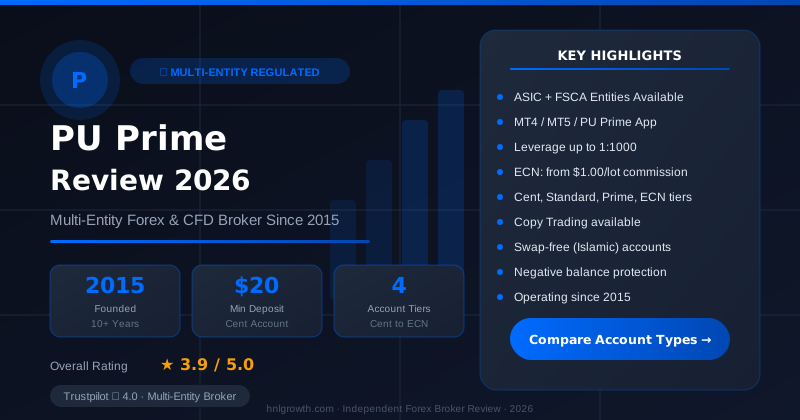
PU Prime — Multi-Entity Forex & CFD Broker
ASIC (AU) + FSCA (ZA) entities available · $20 min deposit (Cent) · MT4, MT5, PU Prime App · 4 account tiers
Forex (foreign exchange) trading is speculation on the value of one currency against another. You never buy a currency in isolation — you're always trading a pair, like EUR/USD, where the first currency (the base currency) is priced in terms of the second (the counter currency). If EUR/USD is trading at 1.0850, it means one euro costs 1.0850 US dollars.
A few terms you'll see everywhere:
- Pip — the smallest standard price movement for most pairs, usually the fourth decimal place (0.0001). If EUR/USD moves from 1.0850 to 1.0860, that's a 10-pip move.
- Spread — the gap between the buy (ask) price and sell (bid) price. It's how many brokers are compensated instead of, or alongside, a commission. Spreads float with market conditions and liquidity, so any figure you see quoted is indicative rather than fixed.
- Lot — a standardised trade size. A standard lot is 100,000 units of the base currency; a mini lot is 10,000; a micro lot is 1,000.
When you place a trade, you're not physically exchanging currency. Most retail forex trading happens through CFDs (contracts for difference), where you speculate on price movement without taking ownership of the underlying currency. That distinction matters for how positions are opened, closed, and costed, and it's worth understanding fully before you trade — see our companion guide on how CFDs work for the mechanics.
A worked example: one trade from entry to exit
Here's a simple, illustrative EUR/USD trade to show how the maths works. This is a hypothetical example for learning purposes only, not a recommendation or a forecast.
| Item | Detail |
|---|---|
| Pair | EUR/USD |
| Direction | Buy (long) |
| Entry price | 1.0850 |
| Exit price | 1.0900 |
| Position size | 0.1 lot (10,000 units) |
| Pip movement | 50 pips |
| Approx. pip value at this size | ~$1 per pip |
| Gross profit | ~$50 |
That $50 is gross — before spread and before any commission. If your broker's EUR/USD spread was 1.3 pips at entry (an indicative figure; always check live pricing in your platform since spreads move with market conditions), that cost is effectively deducted from your result. On some account types, the trade-off is a tighter spread plus a per-lot commission instead. PU Prime publishes its current spread, commission, and swap structure by account type on its spread and costs page, and you should check those figures directly — they are variable and not fixed per trade.
The other cost beginners frequently underestimate is the overnight swap charge. Most forex CFD positions accrue a financing cost for each night held open. Importantly, this charge can go either way: it is a debit on some pair-and-direction combinations and a small credit on others, depending on the interest rate differential between the two currencies and the direction of your trade. On a small account, spread plus a compounding swap cost can erode a meaningful share of capital even if your directional calls are reasonable — it's worth mapping out the expected holding cost for any position you plan to keep open for more than a day or two, not something to notice only after the fact.
Leverage and margin: the risk that catches beginners out
Leverage lets you control a larger position than your deposited capital would normally allow, by putting up a fraction of the trade's value (margin) rather than the full amount. It amplifies gains — and losses — by the same ratio. This is the single most misunderstood part of forex trading for beginners, so it deserves a concrete scenario rather than just a definition.
| Account size | Leverage | Position value controlled | Loss on a 1% adverse move | Loss on a 3% adverse move |
|---|---|---|---|---|
| $500 | 1:30 | $15,000 | $150 (30% of account) | $450 (90% of account) |
| $500 | 1:100 | $50,000 | $500 (100% of account) | Account likely closed out before this point |
| $2,000 | 1:30 | $60,000 | $600 (30% of account) | $1,800 (90% of account) |
These ratios are illustrative only. Actual leverage caps vary by jurisdiction, regulator, and instrument — confirm the exact leverage available on your account inside your platform rather than assuming any figure from a third-party source.
The pattern to take away is structural: the more leverage you use relative to your account size, the smaller the adverse price move needed to lose a large share — or all — of your deposited capital. A stop-loss on every trade is the primary tool for capping how far that scenario can run.
Verifying a broker is actually regulated
Every legitimate broker will state which financial authority licenses it, and you can independently confirm that on the regulator's own public register rather than relying on the broker's website alone. PU Prime publishes the specific authorities it is regulated by — including the Financial Services Authority of Seychelles (FSA), the Financial Services Commission of Mauritius (FSC), the Financial Sector Conduct Authority of South Africa (FSCA), and the Capital Market Authority of the UAE (CMA) — on its regulation page, where you can also see which entity applies to which region. To independently verify any of these, search for the broker by name or licence number directly on the relevant regulator's public register rather than following links from the broker's own site.
This matters because regulatory protections differ meaningfully by jurisdiction: a licence from one authority does not automatically mean the same investor protections apply if you're trading through a different regional entity. Check which entity you'd actually be onboarded to and what that entity's oversight covers before funding an account.
Who this is realistic for, and who should stay away for now
Forex trading, done properly, is a skill built over months of deliberate practice, not a side income you switch on. It can be a reasonable fit if you have spare capital you can afford to lose entirely without affecting your rent, bills, or savings goals; you're comfortable with volatility and can tolerate a losing streak without changing your process; and you're willing to spend real time learning before committing real money.
It's not a good fit — at least not yet — if you're trading with money you need for living expenses, you're looking for a guaranteed or predictable income stream, you have no tolerance for watching a position move against you, or you're drawn to it mainly because of stories of quick returns rather than a genuine interest in the mechanics. If any of those describe you, that's not a personal failing — it means this particular product isn't a match for your current situation, and there's no shame in stepping back to a lower-risk way of building financial knowledge first.
Mistakes that sink most beginners in the first few months
A handful of patterns account for most early account losses:
- Overleveraging. Using the maximum leverage available "because it's there," rather than sizing positions to what the account can actually absorb.
- No stop-loss. Leaving a position open with no predefined exit, hoping the market turns back in your favour.
- Ignoring holding costs. Keeping positions open for days or weeks without understanding how swap charges — which may be debits or, less commonly, credits depending on the pair and direction — affect the running cost of the trade.
- Chasing losses. Increasing position size after a loss to try to recover it quickly, which usually accelerates the drawdown instead.
- Skipping the regulatory check. Opening an account based on an ad or a social media tip without confirming the broker's licensing on the regulator's own register first.
- Treating demo success as proof. Assuming consistent demo results will carry over directly to a live account, without accounting for execution differences, market impact on a live account, or the emotional pressure of real money at stake.
Realistically, most retail traders who trade CFDs and leveraged forex lose money over time — that's not a scare tactic, it's why regulators in several markets require brokers to disclose loss statistics for retail clients. Going in with that expectation, rather than a profit target, tends to produce more disciplined decisions.
Practising without risking money: what a demo account does and doesn't teach you
A demo account lets you place trades using live or near-live market pricing with virtual funds, so you can learn how orders execute, how the platform displays your margin and leverage, and how price actually moves — without any financial consequence. It's the right starting point before funding a live account, and most brokers, including PU Prime, allow you to open one while a live account application is still being verified, per PU Prime's account-opening guide.
What demo trading cannot replicate is everything tied to real execution and real money: the emotional pull to abandon your plan when a live position is losing, the psychological difference between a virtual $50 loss and an actual one, and any gap between demo fill prices and the execution conditions you'd get on a funded account during fast-moving markets. Demo performance is evidence you understand the mechanics — it does not predict live results.
Note: Consistent demo performance is a useful signal that you understand the process. It is not a guarantee that live results will match, and past demo performance — like past live performance — does not predict future outcomes.
If you're mobile-first, check a few things in the app before relying on it even for demo practice: whether you can set a stop-loss and take-profit directly on the order ticket, whether margin and leverage are displayed clearly before you confirm a trade, and whether the order types you'd actually use (market, limit, stop) are all available on the mobile version rather than only on desktop.
A readiness checklist before moving to live, framed as general good practice:
- You've followed the same entry and exit process consistently across a reasonable run of demo trades — not just a lucky streak.
- You've had at least one demo trade hit its full stop-loss and were comfortable with the outcome, not tempted to move the stop after the fact.
- You understand how overnight holding costs would have affected your demo results if they'd been real money — including whether those swaps would have been debits or credits on your specific positions.
- You know exactly how much you're prepared to fund a live account with, and it's an amount that doesn't affect your day-to-day finances if it's lost in full.
Working through this checklist doesn't guarantee live results will match demo performance — it means you've done the groundwork rather than skipped it.
FAQ
How much money do I need to start? That depends on the broker and account type. PU Prime lists a minimum deposit of $20 for its Cent account and $50 for its Standard account, per its account-opening guide. A low minimum lowers the barrier to entry but doesn't change the underlying risk — a small account is still exposed to the same leverage and volatility as a larger one.
What's the real difference between demo and live accounts? A demo uses virtual funds against live or near-live pricing, so you can learn the platform and order mechanics with no financial risk. A live account uses real money, real execution, and carries emotional pressure a demo cannot replicate. Consistent demo performance is a useful signal, not a guarantee of live results.
How do I know a broker isn't a scam? Check the broker's stated regulator against that regulator's own public register rather than trusting the broker's website alone. Look for clear, verifiable licensing details, transparent fee disclosure, and a defined process for deposits and withdrawals. PU Prime lists the authorities it's regulated by, by entity and region, on its regulation page. Verify the licence number directly on the relevant regulator's register as an independent check.
Can I trade forex from my phone? Yes — most brokers offer a mobile app or a mobile version of platforms like MetaTrader. Before relying on it, confirm the app lets you set a stop-loss on the order ticket, shows your margin and leverage clearly, and supports the order types you actually plan to use.
Can I lose more than I deposit? Depending on the account and jurisdiction, some negative balance protections apply, but these vary by broker and region. Don't assume protection exists without confirming it for the specific entity and account you're using.
Can beginners actually make money? Most retail traders lose money over time once spread, commission, and holding costs are factored against inconsistent decision-making — and that's the realistic starting point for any honest assessment. A small number of beginners do develop consistently profitable processes, but it typically takes sustained effort, disciplined practice, and extended time in the market. Treat any plan for forex trading as a skill-building exercise with real downside, not a reliable income source.
Risk warning
Risk warning: CFDs and leveraged forex products are complex instruments and carry a high risk of losing money rapidly due to leverage. Consider whether you understand how these products work and whether you can afford to take the high risk of losing your capital. Check the entity, terms and protections that apply in your jurisdiction before trading.
Ready to Compare PU Prime Account Types?
PU Prime is a multi-entity broker — ASIC (Australia) and FSCA (South Africa) regulated entities offer stronger oversight, while most international clients are onboarded to the FSA Seychelles or FSC Mauritius entities. Four account tiers (Cent, Standard, Prime, ECN) range from a $20 minimum deposit to full ECN pricing.
Risk disclaimer: PU Prime is a live, regulated multi-entity broker — trading forex and CFDs is done with real capital under normal market risk (this is not a simulated prop-firm evaluation). PU Prime operates under multiple separate licenses (ASIC, FSCA, FSA Seychelles, FSC Mauritius); which entity holds your account depends on your country of residence and determines your leverage cap and protections — confirm this before funding. CFDs and leveraged forex products are complex instruments and carry a high risk of losing money rapidly due to leverage; 62.2% of retail investor accounts lose money when trading CFDs with this provider. Consider whether you understand how CFDs/forex work and whether you can afford the high risk of losing your money. Affiliate disclosure: HNL Growth earns a commission when you open a PU Prime account through links on this page.