How to Trade Commodities: Markets, Contracts and Costs
Commodities are raw physical goods — oil, gold, wheat, coffee — that trade on standardized terms so a buyer never has to inspect the exact barrel or bushel involved. You can get exposure to their...
Reviewed using our forex & CFD broker review methodology
Checked on: 2026-08-17 | Broker terms, regulation, and pricing can change. Always verify at the official PU Prime site before opening an account.
Affiliate Disclosure: HNL Growth may earn a commission if you open an account through our links, at no additional cost to you. Risk Warning: CFDs and leveraged forex products are complex instruments and carry a high risk of losing money rapidly due to leverage. 62.2% of retail investor accounts lose money when trading CFDs with this provider. Trading forex and CFDs may not be suitable for all investors. Consider your objectives, experience, and risk appetite before trading, and ensure you understand the risks involved. Broker Disclosure: PU Prime is a live, regulated multi-entity broker (not a simulated prop-firm evaluation) — trades are executed with real capital in live market conditions, subject to normal market risk. Which PU Prime entity holds your account depends on your country of residence and determines your leverage cap and protections.
Last verified: August 2026 | Editorial Team
How to Trade Commodities: Markets, Contracts and Costs
Commodities are raw physical goods — oil, gold, wheat, coffee — that trade on standardized terms so a buyer never has to inspect the exact barrel or bushel involved. You can get exposure to their prices without taking delivery by trading a CFD (contract for difference): you open a position that tracks the market price, put up a fraction of the value as margin, and your profit or loss depends on how far the price moves against your entry. This guide walks through what commodities actually are, how a trade works mechanically with one worked example, who this suits, the mistakes beginners make, and how to rehearse it all on a demo account first.
What a commodity actually is
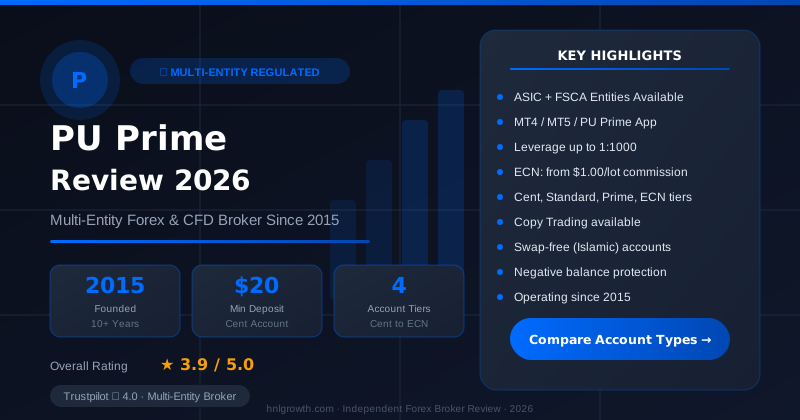
PU Prime — Multi-Entity Forex & CFD Broker
ASIC (AU) + FSCA (ZA) entities available · $20 min deposit (Cent) · MT4, MT5, PU Prime App · 4 account tiers
A commodity is a raw material that is essentially interchangeable regardless of who produced it. A barrel of West Texas Intermediate crude oil pumped in Texas is treated as equivalent to one pumped in North Dakota, provided it meets the same grade specification. This interchangeability — economists call it fungibility — is what lets commodities trade on standardized global markets instead of being negotiated deal-by-deal like a piece of real estate.
That standardization is also why commodity markets attract speculators, hedgers and long-term investors side by side: everyone is trading the same defined unit, so prices reflect global supply and demand rather than the reputation of an individual seller.
Commodities are usually grouped into four categories:
| Category | What it covers | Examples |
|---|---|---|
| Energy | Fuels used for power, heating and transport | Crude oil, natural gas |
| Metals | Mined materials, split between precious and industrial | Gold, copper |
| Agricultural | Crops grown on a seasonal cycle | Wheat, coffee |
| Livestock | Live animals raised for meat or dairy | Live cattle, feeder cattle |
Each category behaves differently, which is the next thing worth understanding before you look at price charts.
Hard vs soft commodities, and why it changes price behaviour
Hard commodities are extracted or mined — oil, gold, copper. Their supply is tied to geology, drilling schedules and mining output, so shortages tend to build up slowly and take time to resolve because new supply requires capital investment and lead time.
Soft commodities are grown or raised — wheat, coffee, cattle. Their supply resets every season, which means weather, planting decisions and disease can move prices sharply and quickly. A poor harvest cannot be fixed by opening a new well; the market has to wait for the next growing cycle.
This distinction matters practically: hard commodity prices often move on macro and geopolitical news (a pipeline disruption, a change in production policy), while soft commodity prices are more sensitive to a weather forecast or a crop report landing on a specific date. If you are watching a soft commodity, seasonal timing carries more weight than it does for a metal or energy market.
What actually moves the price
Four forces do most of the work, and they interact rather than acting in isolation:
Supply and demand. This is the baseline. When usable supply shrinks relative to demand, prices rise; when supply builds up, prices fall. Everything else on this list is really a way that supply or demand gets disrupted.
Geopolitical events. Commodities are extracted or grown in specific places, so political instability, sanctions or export restrictions in a producing region can remove supply from the market overnight, regardless of underlying demand.
Weather and seasonal shocks. A single cold spell can move more than one market at once: colder-than-expected weather increases heating demand (pushing natural gas higher) while simultaneously threatening winter wheat crops in the same region. The two markets look unrelated on paper, but they are responding to the same underlying event.
Currency sensitivity. Most globally traded commodities are priced in US dollars. When the dollar strengthens, a commodity becomes more expensive for buyers holding other currencies, which can dampen demand and pressure the price lower — even if nothing has changed in the physical market itself.
How a commodity trade works, step by step
When you trade a commodity CFD, you are not buying a barrel of oil or a bar of gold. You are opening a position that mirrors the market price, using margin rather than paying the full contract value upfront. Here is what that looks like mechanically.
1. Choose your market and direction. Decide which commodity to trade and whether you expect the price to rise (going long) or fall (going short).
2. Set your position size. CFDs let you trade in fractions of a standard contract (lots), so your position size determines how much your account gains or loses per point of price movement.
3. Post margin, not the full value. Because CFDs are leveraged, you only need to deposit a percentage of the total position value as margin. The rest is effectively borrowed exposure, which is why both gains and losses are magnified relative to a fully-paid position.
4. Set a stop-loss. This closes your position automatically if the price moves against you by a set amount, capping your loss at a level you chose in advance.
5. Hold or close. If you hold overnight, most CFD positions incur a daily financing charge (often called a swap or overnight funding cost), because you are effectively holding a leveraged position past the trading day. Swap rates vary by instrument, account type and market conditions. Check the current rates for your specific market on PU Prime's spreads and costs page before deciding whether to hold a position overnight — on a position held for days or weeks, these charges can accumulate meaningfully.
A worked example
The figures below are illustrative only, constructed to show how the mechanics fit together. They are not live quotes, current spreads, or confirmed margin rates. Spreads, margin requirements, overnight financing rates and contract specifications on any specific market change over time and vary by account type. Verify all current values on PU Prime's spreads and costs page before sizing a real position.
The example uses crude oil as a familiar market. Suppose you decide to go long at a hypothetical entry price of $80.00 per barrel, with a position covering 10 barrels, and a stop-loss set $2.00 below entry at $78.00.
| Item | Illustrative value |
|---|---|
| Entry price | $80.00 |
| Position size | 10 barrels (illustrative) |
| Stop-loss price | $78.00 |
| Stop-loss distance | $2.00 |
| Margin required (illustrative 5% rate — verify current rate) | $40.00 |
| Gross outcome if price rises to $82.00, before financing costs | +$20.00 |
| Gross outcome if stop-loss is hit at $78.00, before financing costs | −$20.00 |
Two things to notice. First, your maximum loss is defined before you enter — the stop-loss distance multiplied by your position size tells you the gross downside if the trade goes wrong (financing costs would adjust the final figure). Second, because margin is much smaller than the full notional exposure, a relatively small price move produces a proportionally larger swing in your account balance. That is the leverage effect working in both directions.
Sizing the position to your risk tolerance
A simple formula keeps the sizing decision grounded rather than arbitrary:
Position size = (account balance × risk % you are willing to lose on this trade) ÷ stop-loss distance
If your account balance is $2,000 and you decide never to risk more than 1% on a single trade, your maximum loss budget is $20. With a stop-loss distance of $2.00, that formula caps your position size at 10 units — which is exactly how the example above was sized. Decide your risk percentage first, then let the stop-loss distance determine your position size. This order matters: sizing from a risk budget rather than from a gut feeling about position size is one of the few habits that genuinely limits the damage a bad trade can do.
Disclosure: This page may contain affiliate links. We may earn a commission if you open an account through our links, at no extra cost to you.
Other ways to get exposure to commodities
CFDs are not the only route into commodity markets, and it is worth knowing the landscape even if you end up using only one of them. The table below is general market education — availability, cost structures, tax treatment and eligibility depend heavily on your broker and your country of residence. It does not represent the specific product range of any one broker; confirm what is actually available to you before trading.
| Instrument | Leverage | Typical cost structure | Generally suited to |
|---|---|---|---|
| CFD | Usually available; exact limits vary by regulator and account type | Spread and/or commission, plus overnight financing on held positions | Traders wanting flexible position sizing and short- to medium-term exposure without owning the underlying asset |
| ETF | Typically none when bought outright; limited if margin-traded | Fund management fee, brokerage commission | Investors seeking simpler, longer-term exposure without daily monitoring |
| Futures | Built into the standardized contract | Exchange fees, contract expiry and rollover considerations | Experienced traders comfortable with fixed contract sizes and expiry mechanics |
| Stocks of commodity producers | None unless traded as a CFD | Brokerage commission | Investors wanting indirect exposure via company performance rather than the raw commodity price |
| Spread bets | Usually available where offered | Built into the spread; tax treatment varies by jurisdiction | Traders in jurisdictions where this product is regulated — it is not globally available (notably offered in the UK) |
Check any broker's own product pages for exactly which instruments and markets it lists before assuming availability.
Who commodity trading suits, and who it does not
Before opening any position, an honest self-check against three questions is worth the few minutes it takes:
Time horizon. Leveraged commodity positions need monitoring. If you cannot check a position for days at a time, a sudden move against you can erode capital faster than a longer-term, unleveraged holding would.
Capital you can afford to risk. Margin lets you control a larger position with a smaller deposit, but losses are calculated on the full position size, not just the margin you put up. Only trade with money you can afford to lose entirely.
Comfort with leverage. If the idea of a loss exceeding your initial deposit feels deeply uncomfortable, leveraged CFDs are likely not the right instrument, regardless of which commodity you are considering.
This approach is generally not suitable for anyone seeking a passive, buy-and-hold way to gain commodity exposure, anyone who cannot actively monitor open positions, or anyone unwilling to accept that losses can happen quickly in a fast-moving market such as energy or agricultural contracts.
Common mistakes beginners make
Over-leveraging. Using maximum available leverage on every trade multiplies outcomes in both directions. Sizing positions using a fixed risk percentage, as shown above, keeps any single trade from doing disproportionate damage to the account.
Ignoring overnight financing costs. Holding a leveraged position past the end of the trading day typically incurs a swap charge. On positions held for days or weeks, these charges accumulate. Check the swap rate for your specific instrument before deciding to hold overnight, not after you have already held it.
Trading illiquid hours. Spreads widen and price gaps become more likely outside a market's primary trading session. Entering just before an illiquid period can mean a worse fill and a wider effective cost than expected.
Trading without a stop-loss. Skipping a stop-loss on the assumption the price will recover removes the one mechanism that defines your maximum loss in advance. It is among the most avoidable mistakes on this list.
Confusing hedging with speculation. A stated intention of "protecting against inflation" and a short-term directional bet are different strategies with different position-sizing and time-horizon requirements. Clarify which one you are actually doing before you open the trade, because the sizing logic differs.
Practising the mechanics on a demo account
Before any of the above involves real money, rehearsing the process itself is a sensible step. According to PU Prime's account opening guide, setting up a live account takes around 10 to 15 minutes of active work and requires a government-issued ID, proof of address, and the minimum deposit for your chosen account type. A demo account can typically be set up during or before that process, allowing you to practise with virtual funds while your live account verification is underway — confirm demo account availability directly with PU Prime, as the mechanics of demo funding and pricing are not detailed in the publicly available documentation.
A suggested rehearsal sequence:
- Register. Sign up with your name, email and password, and choose your platform (MetaTrader 4 or MetaTrader 5).
- Open a demo account. A demo account uses market pricing with virtual funds, so you can place trades, set stop-losses and watch margin requirements update in real time without any capital at risk.
- Place a practice trade. Pick a commodity, apply the position-sizing formula from earlier, set a stop-loss, and observe how the position's floating profit or loss moves with the price.
- Review before going live. Once you are comfortable placing and closing trades and understand how margin and overnight financing affect your demo balance, verifying your identity and funding a live account is the next step — full details are in PU Prime's guide to opening a trading account.
When evaluating any platform for this practice stage, the criteria that matter are regulation, cost transparency, the breadth of commodity markets on offer, and how easy it is to reach support if something goes wrong.
About PU Prime's regulation
PU Prime has operated since 2015 and is regulated by multiple financial authorities. Its regulation page lists the specific licences and the regulatory bodies that oversee the firm. The regulator and entity that applies to you — and the protections each one offers — depend on your country of residence. These vary materially: entities regulated in different jurisdictions operate under different capital requirements, client money rules and dispute resolution mechanisms. Confirm which entity you will be onboarded to before opening an account, and read that entity's terms rather than assuming protections from one jurisdiction apply in another.
FAQ
What actually moves commodity prices? Primarily supply and demand, disrupted by geopolitical events, weather and seasonal shocks, and currency strength — most commodities are priced in US dollars, so dollar movements affect the cost for non-dollar buyers.
Can I trade commodities without owning the physical asset? Yes. CFDs let you speculate on price movement without taking delivery of oil, metal or crops. Other instruments such as ETFs or futures have different ownership and delivery mechanics — check the specific product terms before trading.
How much capital do I need to start? This varies by broker and account type. PU Prime's account opening guide states a $20 minimum for its Cent account and $50 for its Standard account at the time of writing. Always confirm current minimums directly on the broker's site, as these may change.
What are the main risks of leveraged commodity trading? Losses are calculated on the full position size rather than just the margin deposited, so they can be larger than feels proportionate to the amount put up. Overnight financing charges add to the cost of held positions. Prices in some commodity markets can also move sharply around weather events, crop reports or geopolitical news.
Which platform is best for starting out? The right fit depends on which markets you want to trade, the account minimums and cost structure that suit your situation, and whether the broker is regulated in a way that is relevant to where you live. Compare those factors — regulation, spreads and financing costs, instrument range, and support quality — directly rather than relying on any single claim.
Risk warning
Risk warning: CFDs and leveraged forex products are complex instruments and carry a high risk of losing money rapidly due to leverage. Consider whether you understand how these products work and whether you can afford to take the high risk of losing your capital. Check the entity, terms and protections that apply in your jurisdiction before trading.
PU Prime operates under multiple regulatory entities. The entity that applies to you, and the client protections it offers, depend on your country of residence — these differ between jurisdictions. Review the full regulatory details on PU Prime's regulation page and confirm which entity governs your account before depositing any funds.
Ready to Compare PU Prime Account Types?
PU Prime is a multi-entity broker — ASIC (Australia) and FSCA (South Africa) regulated entities offer stronger oversight, while most international clients are onboarded to the FSA Seychelles or FSC Mauritius entities. Four account tiers (Cent, Standard, Prime, ECN) range from a $20 minimum deposit to full ECN pricing.
Risk disclaimer: PU Prime is a live, regulated multi-entity broker — trading forex and CFDs is done with real capital under normal market risk (this is not a simulated prop-firm evaluation). PU Prime operates under multiple separate licenses (ASIC, FSCA, FSA Seychelles, FSC Mauritius); which entity holds your account depends on your country of residence and determines your leverage cap and protections — confirm this before funding. CFDs and leveraged forex products are complex instruments and carry a high risk of losing money rapidly due to leverage; 62.2% of retail investor accounts lose money when trading CFDs with this provider. Consider whether you understand how CFDs/forex work and whether you can afford the high risk of losing your money. Affiliate disclosure: HNL Growth earns a commission when you open a PU Prime account through links on this page.