How to Trade Gold (XAUUSD) in 2026: Sessions, Costs and Risk
Trading gold as XAUUSD means speculating on the spot price of one troy ounce against the US dollar through a CFD contract. One standard lot equals 100 troy ounces, making each $1...
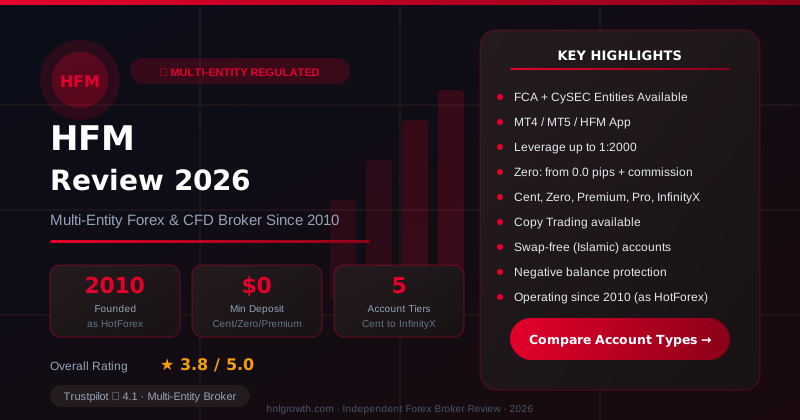
Checked on: 2026-08-08 | Broker terms, regulation, and pricing can change. Always verify at the official HFM site before opening an account.
Affiliate Disclosure: HNL Growth may earn a commission if you open an account through our links, at no additional cost to you. Risk Warning: CFDs and leveraged forex products are complex instruments and carry a high risk of losing money rapidly due to leverage. Between 65-95% of retail investor accounts lose money when trading CFDs, depending on the HFM entity and account type. Trading forex and CFDs may not be suitable for all investors. Consider your objectives, experience, and risk appetite before trading, and ensure you understand the risks involved. Broker Disclosure: HFM (HF Markets Group) is a live, regulated multi-entity broker (not a simulated prop-firm evaluation) — trades are executed with real capital in live market conditions, subject to normal market risk. Protections vary significantly by the specific legal entity that onboards your account.
How to Trade Gold (XAUUSD) in 2026: Sessions, Costs and Risk
Trading gold as XAUUSD means speculating on the spot price of one troy ounce against the US dollar through a CFD contract. One standard lot equals 100 troy ounces, making each $1 price move worth $100 per lot. Gold trades nearly 24 hours a day from Sunday evening to Friday close, but liquidity concentrates sharply during the London–New York overlap (13:00–17:00 GMT), where spreads tighten and volume peaks. Total trading cost depends on your account type—standard accounts bundle spread into the quote, while zero-spread accounts charge commission separately. Overnight positions incur swap financing. Before committing capital, quantify your round-trip cost at your intended lot size and holding period, then verify live conditions on a demo account.
In this guide:
- What XAUUSD Actually Is and How the Contract Works
- Gold Trading Sessions
- Breaking Down the Cost of Every Gold Trade
- Margin, Leverage, and Position Sizing
- What Moves Gold Prices
- Execution and Platform Considerations
- Short-Term Trading Approaches
- Managing Gold-Specific Risk
- Opening an Account and Placing Your First Trade
- FAQ
What XAUUSD Actually Is and How the Contract Works
HashHedge — Crypto Futures Prop Firm
Up to $200K funded accounts · 85% profit split · Instant USDT payouts · 160+ assets
Contract Specification: Lot Sizes, Point Values, and Tick Size
When you trade XAUUSD on HFM, you are trading a spot gold CFD—a contract that tracks the real-time price of gold without requiring physical delivery. The contract specification determines your exposure per lot:
| Lot Type | Lot Size (oz) | Pip Value (USD) | Example: $10 Move P&L | Margin at 1:2000 |
|---|---|---|---|---|
| Micro (0.01) | 1 oz | $0.01 per pip | $0.10 | ~$13* |
| Mini (0.1) | 10 oz | $0.10 per pip | $1.00 | ~$130* |
| Standard (1.0) | 100 oz | $1.00 per pip | $10.00 | ~$1,300* |
*Margin examples assume a gold price of ~$2,600 and 1:2000 leverage. Actual margin depends on your account entity and current leverage cap. Verify your applicable leverage in the HFM trading accounts page.
One pip in XAUUSD equals a $0.01 price increment. A move from $2,600.00 to $2,601.00 represents 100 pips. This point-value structure means gold's dollar exposure scales differently than forex pairs, where pip values are fixed per standard lot.
How Gold CFDs Differ from Forex Pairs in Practice
Gold behaves like a currency pair on your platform, but the underlying mechanics differ materially:
- Volatility magnitude: Gold's average daily range frequently exceeds $20–30 (2,000–3,000 pips), compared to 50–100 pips for major forex pairs. This demands wider stops and larger position buffers.
- Spread structure: XAUUSD spreads are quoted in points rather than pips, and they widen more aggressively during off-peak sessions and news events.
- Swap costs: Overnight financing on gold positions typically runs higher than on major forex pairs, making multi-day holds more expensive.
- Margin requirements: Gold often carries different leverage caps than forex, depending on your regulatory entity. HFM offers up to 1:2000 leverage on certain account types, but the applicable cap for XAUUSD varies by jurisdiction.
Gold Trading Sessions: When Liquidity, Spreads, and Volatility Change
Gold trades from Sunday 22:00 GMT through Friday 21:00 GMT, but conditions vary dramatically by session. Understanding these patterns is critical for execution timing.
Session Times and What Each Session Offers Gold Traders
| Session | Open (GMT) | Close (GMT) | Typical Spread Behaviour | Liquidity Rating | Best Strategy Type |
|---|---|---|---|---|---|
| Sydney | 22:00 | 07:00 | Wide, variable | Low | Avoid or reduce size |
| Tokyo | 00:00 | 09:00 | Moderate, stable | Low–Medium | Range-bound scalps |
| London | 08:00 | 17:00 | Tightens progressively | High | Breakouts, momentum |
| New York | 13:00 | 22:00 | Tightest during overlap | Highest | All strategies |
| London–NY Overlap | 13:00 | 17:00 | Tightest of the day | Peak | Scalping, news trades |
HFM notes that gold is traded most actively during the London trading session (08:00–18:00 GMT) due to high trading volume during these hours.
The London–New York Overlap: Why It Matters for XAUUSD
The 13:00–17:00 GMT window concentrates the highest volume of the trading day. Both European and American institutions are active, US economic data releases land at 13:30 or 15:00 GMT, and spread typically reaches its daily minimum. For scalpers and day traders, this window offers the best execution economics—tighter spreads reduce your breakeven threshold, and higher liquidity reduces slippage risk on market orders.
Asian Session Behaviour and When It Is Tradeable
The Sydney and Tokyo sessions see reduced gold liquidity. Spreads widen, and price action often consolidates into ranges. This environment can suit mean-reversion strategies on smaller timeframes, but position sizes should be reduced to account for the wider spread cost and lower fill reliability. High-impact news from China (PMI, trade balance) can briefly inject volatility during the Asian session.
Weekend Gaps: Frequency, Magnitude, and Position Management
Gold closes Friday at 21:00 GMT and reopens Sunday at 22:00 GMT. Weekend gaps occur when geopolitical events, central bank announcements, or macroeconomic shifts move the market while it is closed. Gaps can range from negligible ($1–2) to significant ($10–30+ during major events).
What this means for position management:
- Stop-loss orders do not protect against gaps—a stop set at $2,580 may fill at $2,550 if gold gaps down $40 over the weekend.
- If you hold positions over the weekend, size them as if your stop will not execute at your intended level.
- Check the economic calendar for scheduled weekend events (G7 meetings, geopolitical developments) before deciding to hold.
Breaking Down the Cost of Every Gold Trade
Every gold trade carries three potential cost components: spread, commission (on certain account types), and overnight swap financing. Your total cost depends on your account type, lot size, and holding period.
Spread by Account Type: Standard vs Zero-Spread
HFM offers multiple account types with different spread structures:
- Standard, Pro, Premium, Cent: Spread is bundled into the quoted price. Spreads on these accounts start from 0.6–1.4 pips on forex; XAUUSD spreads vary by session and market conditions.
- Zero Spread: Offers raw spreads from 0 on forex, with commission charged separately. XAUUSD raw spreads are tighter but incur a per-lot commission.
To compare account types quantitatively, check the live XAUUSD spread on each account type via the HFM platform or demo account before committing.
Commission on Raw-Spread Accounts and the Breakeven Comparison
On Zero Spread accounts, commission is charged per lot per side (open and close). The breakeven calculation determines whether the tighter raw spread plus commission costs less than the wider all-in spread on a Standard account.
Breakeven formula:
If (Zero account spread + round-trip commission) < Standard account spread → Zero account is cheaper
For high-frequency scalping, the Zero account typically wins because the spread saving per trade exceeds the commission. For swing trades held multiple days, the spread difference matters less relative to swap costs, and the Standard account's simplicity may be preferable.
Swap and Overnight Financing: What Holding Gold Actually Costs
Positions held past the daily rollover time (typically 22:00 GMT) incur swap charges. HFM provides a swaps calculator that shows current rates for any instrument and lot size.
Swap calculation formula (from HFM):
Swap fee = Contract size × Swap rate × Number of nights × Minimum price increment
Swap rates differ for long and short positions and can be positive (credit) or negative (debit). For gold, both sides are typically negative, meaning you pay to hold in either direction. Use the HFM swaps calculator to obtain current XAUUSD rates before entering multi-day positions.
Worked example structure: For a 1-lot XAUUSD position held 5 nights, input the current swap long or short rate from the calculator. If the swap rate were, for example, -5 points per night:
Swap fee = 100 oz × (-5) × 5 × $0.01 = -$25.00
Replace with actual rates from the calculator at time of trade.
Hidden Costs: Slippage and Spread Widening During News
During high-impact data releases (NFP, FOMC, CPI), XAUUSD spreads can widen 3–10x their normal level for seconds to minutes. Market orders placed during this window may fill at prices significantly different from the quoted price at click time. This slippage is not a broker-specific phenomenon—it reflects genuine liquidity withdrawal across the interbank market.
Mitigation approaches:
- Avoid entering market orders within 2 minutes of a high-impact release.
- Use limit orders to define your maximum acceptable fill price.
- If your strategy requires news-event execution, size positions assuming 2–3x normal spread.
Disclosure: This page may contain affiliate links. We may earn a commission if you open an account through our links, at no extra cost to you.
Before committing to a live account, verify current XAUUSD spreads, commission, and swap rates on a demo environment where you can observe real-time conditions without risk. Open a free HFM demo account to test gold trading conditions yourself.
Margin, Leverage, and Position Sizing for Gold
Margin Requirements and What They Mean for Capital Allocation
HFM offers maximum leverage up to 1:2000 on certain account types, though the applicable leverage cap for XAUUSD depends on your regulatory entity and jurisdiction. Leverage may be adjusted—refer to HFM's terms and conditions for your specific entity.
Margin calculation:
Required margin = (Contract size × Current price) / Leverage
For a 1-lot XAUUSD position at $2,600 with 1:2000 leverage:
Margin = (100 × $2,600) / 2000 = $130
This means $130 of your balance is locked as margin for that position. However, usable margin should be significantly higher than the minimum to absorb adverse price movement without triggering a margin call (set at 50% on most HFM account types, 20% on certain accounts).
ATR-Based Position Sizing: A Worked XAUUSD Example
Gold's volatility demands position sizing calibrated to its actual price range, not arbitrary lot sizes. The Average True Range (ATR) indicator provides this input.
Position sizing formula:
Lot size = (Account balance × Risk %) / (ATR in dollars × 100)
Worked example:
- Account balance: $10,000
- Risk per trade: 2% ($200)
- H4 ATR: $15 (150 pips)
Lot size = $200 / ($15 × 100) = $200 / $1,500 = 0.13 lots
At 0.13 lots, a $15 adverse move (one H4 ATR) costs you $195—approximately your 2% risk limit. The margin consumed at 1:2000 would be approximately $169 ($2,600 × 13 oz / 2000).
Minimum Viable Capital by Lot Size and Strategy
| Strategy Type | Typical Stop Distance | Recommended Lot Size on $5,000 Account | Margin Used (at 1:2000) |
|---|---|---|---|
| Scalping (M5) | $3–5 | 0.10–0.15 | ~$13–20 |
| Day trading (H1) | $10–15 | 0.05–0.10 | ~$7–13 |
| Swing (H4/D1) | $25–50 | 0.02–0.04 | ~$3–5 |
These are illustrative examples. Your actual position size must account for current ATR, spread cost, and margin headroom for adverse movement.
What Moves Gold Prices and How to Trade the Catalysts
Gold's price is driven by identifiable macroeconomic and geopolitical factors. For active traders, these drivers matter as calendar events that create tradeable volatility—not as long-term investment thesis.
The Dollar and Federal Reserve: Rate Decisions, Dot Plots, and Forward Guidance
Gold is inversely correlated with the US dollar. When the dollar strengthens, gold becomes more expensive for holders of other currencies, reducing demand. Federal Reserve rate decisions, FOMC meeting minutes, and Fed Chair speeches are among the highest-impact events for XAUUSD.
Real Yields and Inflation Data: CPI, PCE, and Jobs Reports
Gold pays no yield, making it less attractive when real yields (nominal yields minus inflation) rise. US CPI, PCE, and Non-Farm Payrolls data directly influence yield expectations and create sharp, immediate gold price reactions.
| Event | Typical Release Time (GMT) | Expected Volatility | Average XAUUSD Reaction | Recommended Approach |
|---|---|---|---|---|
| FOMC Rate Decision | 19:00 | Very High | $20–50+ | Wait 15 min post-release |
| US NFP (1st Friday) | 13:30 | Very High | $15–40 | Avoid market orders at release |
| US CPI | 13:30 | High | $10–30 | Trade the second move, not the spike |
| US PCE | 13:30 | Moderate–High | $8–20 | Use limit orders |
| Fed Chair Speech | Variable | Moderate | $5–15 | Monitor live, reduce size |
| Geopolitical Escalation | Ad hoc | High | $20–60+ | Cannot be pre-planned |
Geopolitical Shocks and Safe-Haven Flows
Gold's safe-haven status means it rallies during geopolitical crises, military escalations, and financial system stress. These moves can be violent and one-directional, with limited retracement in the immediate aftermath. Stop-losses may not execute at intended levels during extreme moves.
Central Bank Demand and Physical Market Dynamics
Central bank gold purchases provide a structural bid under the price but are less relevant for short-term trading. Gold's value can be stored in real terms during economic volatility and may provide a hedge against rising costs of living, though this framing applies more to investment horizons than active trading.
Execution and Platform Considerations for Active Gold Trading
MT4 vs MT5 for XAUUSD: Execution Model Differences
HFM offers gold trading across MetaTrader 4, MetaTrader 5, HFM WebTrader, and the HFM mobile app. Both MT4 and MT5 support market execution for XAUUSD, which means orders fill at the best available price at the time of execution—not necessarily the price displayed when you clicked.
Key platform differences for gold trading:
- MT5 offers depth of market (DOM) data, which can help gauge liquidity during volatile sessions.
- MT4 remains the more common choice for EA-based gold strategies due to broader community support and existing algorithm libraries.
- HFM WebTrader and App provide accessible charting and order management for discretionary traders who don't require advanced automation.
VPS and Latency: When Automated Gold Strategies Need Infrastructure
For EA-driven gold scalping strategies, execution latency matters. A VPS (Virtual Private Server) co-located near the broker's execution server reduces the round-trip time for order submission, potentially reducing slippage on market orders during fast-moving conditions. HFM's VPS offering and eligibility criteria should be confirmed directly with their support team or on your account dashboard.
EA Trading, Scalping Rules, and Strategy Restrictions
HFM permits Expert Advisors on MT4 and MT5 platforms. Scalping and automated strategies on XAUUSD are generally allowed, but specific restrictions—such as minimum holding times, maximum order frequency, or tick-scalping prohibitions—may apply depending on your entity and account type. Before deploying an automated gold strategy, confirm the current policy with HFM support or review the terms and conditions applicable to your account entity.
Short-Term Approaches to Trading Gold
Session Momentum: Trading the London Open and NY Open
Gold frequently establishes its daily directional bias during the London open (08:00 GMT) or the New York open (13:00 GMT). A session momentum approach involves:
- Identifying the pre-session range (the high and low of the prior 2–4 hours).
- Entering in the direction of the breakout once volume confirms the move.
- Targeting 1–1.5x the pre-session range as a profit objective.
- Placing stops beyond the opposite end of the pre-session range, adjusted for spread.
News-Event Execution: Entering and Exiting Around Data Releases
Trading gold around high-impact data releases requires accepting wider spreads and potential slippage. Two approaches:
- Pre-release entry: Place a position before the release with a defined stop and target. Higher risk due to unpredictable direction and spread widening, but captures the full move.
- Post-release fade or continuation: Wait 5–15 minutes after the release for the initial spike to settle, then enter in the direction of the sustained move or fade the overreaction. Lower spread risk but may miss the move entirely.
Neither approach eliminates risk. Spread widening during the release window can push your effective entry or exit price significantly beyond your intended level.
Technical Framework: Support, Resistance, and Volatility Bands on Gold
Gold respects technical levels on higher timeframes (H4, D1) more reliably than on scalping timeframes. Key reference points include:
- Prior day high, low, and close
- Weekly open and prior weekly close
- Round-number psychological levels (e.g., $2,600, $2,650)
- ATR-based volatility bands to define overbought/oversold extremes relative to recent range
Managing Gold-Specific Risk
Stop-Loss Placement Calibrated to Gold's Volatility
Gold's daily range regularly exceeds $20, meaning stops tighter than $5–10 on H1 or H4 trades are likely to be triggered by normal volatility rather than a genuine change in directional bias. Use ATR multiples as a guide:
- Scalps (M5–M15): 0.5–1.0x ATR
- Day trades (H1): 1.0–1.5x ATR
- Swing trades (H4–D1): 1.5–2.0x ATR
Correlated Exposure: When Gold and Dollar Positions Double Your Risk
If you are simultaneously long XAUUSD and short EURUSD (which is effectively long USD), a dollar rally creates losses on both positions. Before entering a gold trade, check your open positions for correlated USD exposure. Hedging or reducing size on correlated pairs prevents unintended concentration.
Gap Protection and Overnight Position Sizing
Stop-loss orders do not execute during the weekend market closure. If gold gaps past your stop level on Sunday open, your position will be closed at the first available price—which may be far worse than your intended exit. To manage this:
- Reduce position size on Friday if holding over the weekend.
- Check the weekend event calendar for scheduled announcements.
- Accept that gap risk cannot be fully eliminated—only sized appropriately.
Opening an Account and Placing Your First XAUUSD Trade
Choosing the Right HFM Account Type for Gold
HFM offers five account types, each with different spread structures, leverage, and minimum deposits:
- Cent: No minimum deposit, 1:2000 leverage, forex and gold only. Suitable for testing gold strategies with minimal capital.
- Zero Spread: From 0 spread on forex, commission-based. Best for high-frequency gold scalping where spread minimisation matters most.
- Pro: From 0.6 pip spread, $100 minimum deposit. A middle ground for experienced traders.
- Premium: From 1.4 pip spread, no minimum deposit. Full instrument access with standard spread.
- InfinityX: From 0.3 pip spread, $500 minimum deposit, unlimited leverage. For traders requiring maximum leverage flexibility.
Platform Setup: Adding XAUUSD and Configuring Your Charts
- Download MT4, MT5, or access the HFM WebTrader from your account dashboard.
- Log in with your trading account credentials.
- Add XAUUSD to your Market Watch (it may be listed under Metals or Commodities depending on the platform).
- Configure your chart timeframe, apply ATR and any preferred indicators.
Walkthrough: Placing, Managing, and Closing a Gold Trade
- Open an order: Right-click XAUUSD in Market Watch → New Order.
- Set your volume: Enter your lot size (e.g., 0.10 for a mini lot).
- Define risk: Set your Stop Loss and Take Profit levels based on your ATR-calibrated framework.
- Execute: Click Buy or Sell for market execution, or set a pending order at a specific price level.
- Monitor: Your open position appears in the Terminal/Toolbox window with real-time P&L.
- Close: Right-click the position → Close Position, or let your stop/target execute automatically.
HFM's onboarding process involves registering with a simple online form, completing KYC verification, and funding via supported methods.
Open a HFM live account or compare HFM account types to find the right fit for your gold trading strategy.
Frequently Asked Questions
Is gold trading profitable for retail traders?
Gold trading carries a high degree of risk. CFDs are complex instruments, and a significant percentage of retail accounts lose money when trading leveraged products. Gold's volatility, spread costs, and gap risk make it more demanding than major forex pairs. Whether gold trading is viable for you depends on your strategy edge, risk management discipline, and whether your expected returns exceed the total cost of execution. No strategy guarantees profitability.
What is the minimum deposit to trade gold on HFM?
HFM offers account types with no minimum deposit (Cent, Zero Spread, Premium), while the Pro account requires $100 and InfinityX requires $500. However, the practical minimum capital for gold trading depends on your lot size, leverage, and risk management rules. A $100 account trading 0.01 lots at 1:2000 leverage has limited margin headroom for gold's typical daily range.
Can I trade gold 24 hours a day?
Gold is available for trading from Sunday 22:00 GMT to Friday 21:00 GMT—approximately 23 hours per day, five days a week. It is not tradeable on weekends. Liquidity and spread conditions vary significantly by session, with the London–New York overlap offering the best conditions.
What leverage is available for XAUUSD?
HFM offers maximum leverage up to 1:2000 on several account types, though leverage may be adjusted based on your jurisdiction and entity. Confirm the specific leverage cap applicable to XAUUSD in your account before sizing positions.
Is scalping gold allowed on HFM?
HFM supports Expert Advisors and automated trading on MT4 and MT5. Scalping strategies are generally permitted, but specific restrictions may apply depending on your account entity and type. Confirm the current scalping and EA policy with HFM support or review your entity's terms and conditions before deploying automated strategies.
Risk warning: CFDs and leveraged forex products are complex instruments and carry a high risk of losing money rapidly due to leverage. Retail investor accounts lose money when trading CFDs with most providers; the exact percentage varies by HFM entity and account type. You should consider whether you understand how CFDs work and whether you can afford to take the high risk of losing your money. Check the entity, terms and investor protections that apply in your jurisdiction before opening an account or trading.
Ready to Start Your Funded Trading Journey?
Join traders backed by $11M+ in verified payouts and a 4.7/5 Trustpilot rating. Compare HashHedge challenge plans, drawdown rules, and payout terms — apply code ha25 for the current discount.
Risk disclaimer: Challenge fees are non-refundable if you breach the rules. Prop trading involves significant financial risk. Past performance in a simulated environment does not guarantee results on a funded account. Only purchase if you understand the rules fully and can afford to lose the fee. Affiliate disclosure: HNL Growth earns a commission when you purchase a HashHedge challenge through links on this page.