Is HFM a Scam? What the Regulatory Record Shows
## Short Verdict — Is HFM Legitimate or a Scam?
Checked on: 2026-08-17 | Broker terms, regulation, and pricing can change. Always verify at the official HFM site before opening an account.
Affiliate Disclosure: HNL Growth may earn a commission if you open an account through our links, at no additional cost to you. Risk Warning: CFDs and leveraged forex products are complex instruments and carry a high risk of losing money rapidly due to leverage. Between 65-95% of retail investor accounts lose money when trading CFDs, depending on the HFM entity and account type. Trading forex and CFDs may not be suitable for all investors. Consider your objectives, experience, and risk appetite before trading, and ensure you understand the risks involved. Broker Disclosure: HFM (HF Markets Group) is a live, regulated multi-entity broker (not a simulated prop-firm evaluation) — trades are executed with real capital in live market conditions, subject to normal market risk. Protections vary significantly by the specific legal entity that onboards your account.
Is HFM a Scam? What the Regulatory Record Shows
Short Verdict — Is HFM Legitimate or a Scam?
HashHedge — Crypto Futures Prop Firm
Up to $200K funded accounts · 85% profit split · Instant USDT payouts · 160+ assets
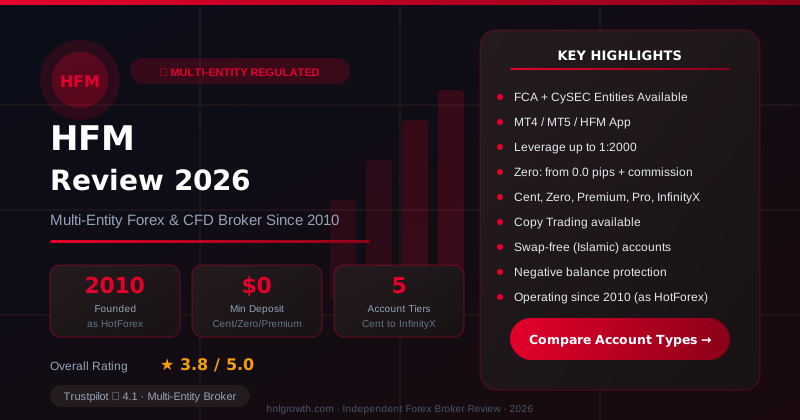
HFM is not a scam. The broker has operated since 2010 under verifiable regulatory licenses from the CySEC (license 183/12), FCA (reference 801701), FSCA (license 46632), FSA Seychelles (license SD015), and CMA Kenya (license 155). Client accounts are reported at over 3.5 million globally.
However, the scam question persists for structural reasons — not because of a single proven fraud event, but because HFM's multi-entity group assigns clients to different legal entities depending on their country. Tier-1 regulated clients (FCA, CySEC) receive compensation fund coverage and strict oversight. Offshore entity clients receive materially fewer protections and higher leverage. That gap is real and it is the honest reason some users describe their experience in scam-adjacent terms.
The sections below break down the full regulatory record, map your jurisdiction to its specific entity and protections, and categorize common complaints so you can reach your own conclusion.
The Regulatory Record — Every HFM Entity and License
HFM operates through a group of legal entities, each licensed in a different jurisdiction. The brand's regulatory disclosures list five regulatory jurisdictions. The table below summarizes each entity.
| Legal Entity | Regulator | License Number | Regulator Tier | Primary Client Jurisdictions | Compensation Scheme |
|---|---|---|---|---|---|
| HF Markets (UK) Ltd | FCA (UK) | 801701 | Tier 1 | UK residents | FSCS (£85,000) |
| HF Markets (Europe) Ltd | CySEC (Cyprus) | 183/12 | Tier 1 | EEA residents | ICF (€20,000) |
| HF Markets SA (PTY) Ltd | FSCA (South Africa) | 46632 | Tier 2 | South African residents | None (segregated accounts) |
| HF Markets (Seychelles) Ltd | FSA Seychelles | SD015 | Tier 3 / Offshore | Most international clients | None |
| HFM Investments Ltd | CMA Kenya | 155 | Tier 2 | Kenyan residents | None (segregated accounts) |
Source: HFM Regulatory Environment. License status should be independently verified on each regulator's public register before depositing.
Tier-1 Regulated Entities — FCA (UK) and CySEC (EU)
These are HFM's strongest licenses. HF Markets (UK) Ltd holds FCA authorization under firm reference number 801701. The FCA is widely regarded as one of the strictest financial regulators globally, requiring segregated client accounts, negative balance protection for retail clients, and participation in the Financial Services Compensation Scheme (FSCS), which covers eligible claims up to £85,000 per client in the event of broker insolvency.
HF Markets (Europe) Ltd is authorized by CySEC under license 183/12. As a Cyprus Investment Firm operating under MiFID II, it holds a cross-border license authorizing investment services across the European Economic Area. CySEC regulation requires client fund segregation, participation in the Investor Compensation Fund (ICF) covering up to €20,000 per client, and retail leverage caps of 1:30 on major forex pairs.
Both entities are subject to regular audits, capital adequacy requirements, and formal complaint escalation procedures through their respective regulators.
Regional Regulated Entities — FSCA (South Africa) and CMA Kenya
HF Markets SA (PTY) Ltd is authorized by the FSCA under license 46632. The FSCA supervises South Africa's non-banking financial services sector. Clients under this entity benefit from segregated accounts and local regulatory oversight, but there is no government-backed compensation fund equivalent to the FSCS or ICF.
HFM Investments Ltd holds CMA Kenya license 155 as a non-dealing online forex broker. This provides a local regulatory framework and dispute resolution channel, but again no compensation fund for client losses in the event of broker failure.
Both entities offer stronger protections than unregulated offshore operations but less comprehensive safety nets than Tier-1 jurisdictions.
Offshore Entity — FSA Seychelles
HF Markets (Seychelles) Ltd is registered in Seychelles (registration number 8419176-1) and regulated by the Seychelles FSA under Securities Dealer License SD015. The Seychelles FSA supervises non-bank financial services in the country.
This entity serves most international clients who do not reside in the UK, EEA, South Africa, or Kenya. While it operates under a regulatory framework, the Seychelles FSA does not provide a compensation fund, does not cap leverage at the levels enforced by Tier-1 regulators, and offers more limited dispute resolution options for clients.
The Comoros Question
Third-party review aggregators have referenced a Comoros-registered entity associated with the HFM brand. Comoros does not have a recognized financial services regulatory framework equivalent to the jurisdictions listed above. HFM's official regulatory disclosures do not list a Comoros entity. If you are onboarded under a Comoros-registered entity, you should treat this as effectively unregulated and request written confirmation of your contracting entity before depositing.
Which Entity Will You Actually Trade Under?
This is where most broker reviews fall short. Knowing HFM holds multiple licenses is not useful unless you know which one applies to your account. Your assigned entity determines your compensation coverage, leverage limits, dispute resolution path, and legal recourse.
Country-to-Entity Mapping
| Your Country / Region | Likely HFM Entity | Regulator | Protection Tier | Compensation Available |
|---|---|---|---|---|
| United Kingdom | HF Markets (UK) Ltd | FCA | Tier 1 | FSCS — up to £85,000 |
| EEA countries (EU + Norway, Iceland, Liechtenstein) | HF Markets (Europe) Ltd | CySEC | Tier 1 | ICF — up to €20,000 |
| South Africa | HF Markets SA (PTY) Ltd | FSCA | Tier 2 | None (segregated accounts) |
| Kenya | HFM Investments Ltd | CMA | Tier 2 | None (segregated accounts) |
| Most other countries (Asia, LATAM, Middle East, Africa excl. ZA/KE) | HF Markets (Seychelles) Ltd | FSA Seychelles | Tier 3 / Offshore | None |
Entity assignment is determined by HFM based on your country of residence at onboarding. Confirm your contracting entity in your account agreement before depositing.
What Your Assigned Entity Means for Your Protections
If you are a UK or EEA resident, you will likely contract with a Tier-1 regulated entity. This means segregated accounts, compensation fund eligibility, leverage caps designed to limit retail losses, and access to a formal regulatory complaints process (the Financial Ombudsman Service in the UK, or the Cyprus Financial Ombudsman for CySEC clients).
If you are outside these jurisdictions, you will almost certainly be onboarded under the Seychelles entity. This means your funds are held in segregated accounts — HFM's security of funds page states this applies across the group — but you have no compensation fund to fall back on if the entity fails. Your dispute resolution options are limited to Seychelles jurisdiction, which is materially harder to pursue from another country.
Where Your Money Goes — Fund Protections by Entity
HFM's fund protection disclosures describe several protection mechanisms that apply across the group. However, the strength and enforceability of these protections varies by entity.
| Protection Feature | FCA Entity (UK) | CySEC Entity (EU) | FSCA Entity (ZA) | CMA Entity (KE) | FSA Entity (Seychelles) |
|---|---|---|---|---|---|
| Segregated client accounts | Yes | Yes | Yes | Yes | Yes (stated) |
| Compensation fund | FSCS (£85,000) | ICF (€20,000) | None | None | None |
| Negative balance protection | Yes (mandatory, retail) | Yes (mandatory, retail) | Stated | Stated | Stated |
| Civil liability insurance | Per FCA requirements | €5,000,000 (stated) | Not confirmed | Not confirmed | Not confirmed |
| Leverage cap (retail forex) | 1:30 | 1:30 | Not specified | Not specified | Up to 1:2000 (stated) |
| Regulator dispute resolution | Financial Ombudsman | Cyprus Financial Ombudsman | FSCA complaints | CMA complaints | FSA Seychelles |
The €5,000,000 insurance figure is stated on HFM's security of funds page. Confirm which entity's clients are covered under the policy before relying on it.
Compensation Funds and What They Cover
The FSCS and ICF are not insurance against trading losses. They are last-resort compensation schemes that pay eligible clients if the broker becomes insolvent or is unable to return client funds. FSCS covers up to £85,000 per person per authorized firm. ICF covers up to €20,000 per covered client.
Eligibility matters. Not every account type qualifies. Professional clients, institutional accounts, and certain structured product holdings may be excluded. The specific claim process is administered by the compensation fund directly — not by HFM.
What Happens If HFM Becomes Insolvent?
For FCA-entity clients: client funds are held in segregated accounts at regulated banks. In an insolvency, those funds are not available to the broker's creditors. If a shortfall exists, eligible clients can claim from the FSCS.
For CySEC-entity clients: a similar segregation framework applies. The ICF covers eligible shortfalls up to €20,000. Pillar 3 disclosures for HF Markets (Europe) Ltd and HF Markets Holdings Ltd are published on the regulatory page, as required under EU capital adequacy rules.
For FSCA, CMA, and FSA Seychelles clients: segregated accounts provide a first layer of protection — your funds should be separate from company operating capital. However, there is no compensation fund to cover a shortfall. Your recourse would be through local insolvency proceedings, which may be slower, more expensive, and less predictable than Tier-1 compensation claims.
Disclosure: This page may contain affiliate links. We may earn a commission if you open an account through our links, at no extra cost to you.
If the fund protection evidence above meets your threshold, you can open a regulated HFM account and confirm your entity assignment during onboarding.
Complaint Audit — Separating Fraud Signals from Broker Friction
Online review platforms contain a range of complaints about HFM and its former brand HotForex. The table below categorizes the most common themes by severity to help you distinguish between genuine red flags and the operational friction common to most multi-jurisdictional brokers.
| Complaint Theme | Severity | Likely Root Cause | Entity-Specific? |
|---|---|---|---|
| Withdrawal delays during verification | Normal friction | AML/KYC requirements; standard across regulated brokers | All entities |
| Withdrawal denied or excessively delayed after verification | Yellow flag | Could indicate operational issues or bonus-linked restrictions | Reported more often under offshore entity |
| Slippage and requotes during volatile sessions | Normal friction | Market conditions; all CFD brokers experience this | All entities |
| Platform downtime during active trading | Yellow flag | Infrastructure issues; unverified reports allege execution failures | Unverified; not entity-specific |
| Bonus terms locking withdrawals | Yellow flag | Volume requirements attached to promotions; common industry practice but frequently under-communicated | More common under offshore entity |
| Inactivity fee charged without clear warning | Normal friction | HFM states a dormancy fee applies after a period of inactivity; check current terms | All entities |
| Funds lost due to broker insolvency or fraud | Red flag | No verified instance found for HFM regulated entities | N/A |
| Refusal to process withdrawal with no explanation | Red flag | If verified, this is a serious concern; no confirmed systemic pattern identified | Unverified |
Complaint themes are based on publicly available review platform signals. Individual reports are unverified. Regulated entities have formal dispute escalation channels; offshore entity clients have more limited recourse.
Withdrawal and Verification Complaints
The most common complaint category involves delays during the KYC/verification process. This is standard across regulated brokers — anti-money-laundering regulations require identity verification before processing withdrawals. Delays typically occur when submitted documents are incomplete or unclear. This is broker friction, not a scam signal.
More concerning are unverified reports of withdrawals being delayed after verification is complete. If you experience this, escalate through your entity's regulator complaints procedure. FCA and CySEC entities are required to respond to formal complaints within defined timeframes.
Execution Quality — Slippage, Requotes, and Platform Downtime
HFM offers MetaTrader 4 and MetaTrader 5, which operate on the broker's server infrastructure. Slippage during high-volatility events (news releases, market open/close) is a feature of CFD trading, not evidence of manipulation. However, unverified user reports allege platform downtime and incorrect trade closures during active sessions. These allegations have not been independently confirmed.
If execution quality is a priority, test the platform on a demo account during the market sessions you typically trade and monitor fill prices against independent data feeds.
Bonus Lock-In and Promotion-Related Complaints
Bonus offers are a common source of scam-adjacent complaints across the forex industry. When a broker credits bonus funds to your account, those funds typically come with volume requirements — you must trade a specified number of lots before the bonus (and sometimes your own deposited funds) becomes withdrawable.
HFM has offered various promotions over time. Before accepting any bonus, read the specific terms attached to it. Key items to check: required trading volume before withdrawal, whether the bonus locks your own deposit, and what happens if you request a withdrawal before meeting the volume threshold. These terms — not the bonus itself — are what generate complaints.
Inactivity Fees and Non-Trading Cost Surprises
HFM's terms include a dormancy or inactivity fee applied to accounts that have had no trading activity for a defined period. This is standard industry practice but often catches clients off guard. Check HFM's current terms and conditions for the specific fee amount and the dormancy threshold that triggers it.
The Offshore Account — What You Lose by Going Offshore
If you are onboarded under the FSA Seychelles entity (or any Comoros-registered entity, should one exist), you should understand concretely what you are giving up compared to Tier-1 regulated clients.
No compensation fund. If the entity becomes insolvent, there is no FSCS or ICF to cover shortfalls. Your recovery depends on Seychelles insolvency proceedings.
Unlimited leverage is a risk feature, not a benefit. HFM's offshore entity has offered leverage up to 1:2000 on certain products, including through its InfinityX account. At 1:2000 leverage, a 0.05% adverse price move wipes out your entire margin. Tier-1 regulators cap retail forex leverage at 1:30 precisely because higher leverage accelerates losses for the majority of retail traders.
Limited dispute recourse. Filing a complaint with the Seychelles FSA from outside the country is more difficult, slower, and less predictable than escalating to the Financial Ombudsman Service (UK) or the Cyprus Financial Ombudsman.
Fewer transparency requirements. Tier-1 entities must publish Pillar 3 capital disclosures, best execution reports, and detailed cost breakdowns. Offshore entities face less stringent reporting obligations.
If you choose an offshore account for the higher leverage, you are making a deliberate risk trade-off. Understand that the protection framework around your funds is materially different from the FCA or CySEC experience.
Getting Your Money Out — Withdrawal Process and Conditions
Withdrawal reliability is the single most important trust factor for most traders. HFM's security of funds page describes "seamless withdrawals" and a 24/7 withdrawal feature with instant processing.
The reality is more nuanced. Withdrawal processing involves two stages: the broker's internal approval and the payment provider's settlement time.
| Payment Method | Stated Processing | Typical Settlement | Fees | Conditions |
|---|---|---|---|---|
| E-wallets (Skrill, Neteller) | Instant (broker-side) | Minutes to hours | Check current terms | Must match deposit method |
| Bank wire transfer | 1–2 business days (broker-side) | 2–5 business days | Possible correspondent bank fees | Higher minimums may apply |
| Card withdrawal | 1–2 business days (broker-side) | 3–7 business days | Check current terms | Usually limited to deposit amount |
Processing times are broker-stated and have not been independently verified. Actual timelines depend on your entity, account verification status, and payment provider. Check current terms on hfm.com before depositing.
Key conditions to be aware of:
- Anti-money-laundering rules typically require withdrawals to return to the same method used for deposit.
- Accounts with active bonuses may have withdrawal restrictions until volume requirements are met.
- Unverified accounts cannot process withdrawals. Complete KYC before your first deposit request.
- Your entity may impose minimum withdrawal thresholds. Confirm these in your account terms.
HotForex Became HFM — Does the Rebrand Matter?
HFM was founded in 2010 and operated under the HotForex brand before rebranding to HFM. The official about page describes a continuous operating history since 2010 with no indication of a change in ownership or corporate structure.
The rebrand is primarily cosmetic — a shorter, more flexible brand name for global markets. The underlying corporate group, regulatory licenses, and operational infrastructure carried over. This means that historical "HotForex scam" search queries refer to the same corporate group that now operates as HFM. Complaints and reputation signals from the HotForex era are relevant to the current brand.
If anything, the rebrand has made it slightly harder for consumers to connect historical complaints with the current brand, which may partially explain why "is HFM a scam" queries persist independently of the HotForex-era reputation.
Verify It Yourself — A Pre-Deposit Checklist
Do not take any review — including this one — at face value. Before depositing with HFM, complete these verification steps:
Confirm your entity. When you register, your account agreement will name the legal entity you are contracting with. Check that this entity matches one of the regulated entities listed on HFM's regulatory page.
Verify the license on the regulator's register. Visit the official register for your entity's regulator (FCA, CySEC, FSCA, FSA Seychelles, or CMA Kenya). Search by license number. Confirm the entity name matches, the license is current, and the permissions include the services you are using.
Check the domain. Confirm you are on an official HFM domain. Cross-reference with the domains listed on HFM's official communications. Regional affiliate domains may exist that are not directly operated by the regulated group.
Read your account agreement. Identify your compensation coverage (if any), applicable leverage limits, withdrawal conditions, inactivity fees, and dispute resolution procedure.
Verify the bonus terms before accepting. If offered a promotion, read the full terms. Identify the volume requirement, withdrawal lock conditions, and what happens to your deposited funds if you request an early withdrawal.
Test with a small deposit. If proceeding, fund your account with an amount you can afford to lose and test a withdrawal before committing significant capital.
If you have completed these checks and the evidence satisfies your risk threshold, you can open an HFM account and begin with a small deposit to validate the process.
How HFM Compares on Safety vs. Alternatives
For context, here is how HFM's regulatory profile compares to other multi-jurisdictional CFD brokers commonly considered by the same audience.
| Broker | Tier-1 Licenses | Highest Compensation Coverage | Negative Balance Protection | Segregated Accounts |
|---|---|---|---|---|
| HFM | 2 (FCA, CySEC) | £85,000 (FSCS) | Yes (stated) | Yes (stated) |
| Comparable multi-regulated broker A | 2–3 | Varies by entity | Yes | Yes |
| Comparable multi-regulated broker B | 1–2 | Varies by entity | Yes | Yes |
This table provides structural comparison only. Specific protection levels depend on the entity you are assigned to. Always verify current license status on official regulator registers.
The key differentiator for HFM is the breadth of its entity structure — five regulated jurisdictions plus an offshore arm. This provides global reach but creates the entity-assignment ambiguity that drives much of the scam-query volume. Brokers with fewer entities have a simpler protection story but may not accept clients from as many jurisdictions.
Frequently Asked Questions
Is HFM regulated?
Yes. HFM operates through entities regulated by the FCA (UK), CySEC (EU), FSCA (South Africa), FSA (Seychelles), and CMA (Kenya). Your specific protections depend on which entity you are onboarded under.
Is HFM safe for beginners?
Clients onboarded under the FCA or CySEC entities benefit from leverage caps (1:30 for retail forex), compensation funds, and formal dispute resolution — all of which provide a more forgiving environment for inexperienced traders. Offshore entity clients face leverage of up to 1:2000 and no compensation fund, which amplifies risk significantly.
Is HFM legal in the United States?
HFM does not accept US-based clients. US residents must use brokers registered with the CFTC and NFA.
How long do HFM withdrawals take?
HFM states that withdrawals are processed instantly on the broker side via its 24/7 withdrawal feature. Actual settlement depends on the payment method: e-wallets are typically fastest (minutes to hours), while bank transfers can take several business days. These timelines are broker-stated and have not been independently verified.
Why do people say HFM is a scam?
Most scam-adjacent complaints relate to entity ambiguity (clients not realizing they are under an offshore entity with fewer protections), bonus terms that restrict withdrawals until volume requirements are met, and KYC verification delays. These are common friction points across the multi-jurisdictional broker model rather than evidence of fraud, but they understandably erode trust when not communicated clearly upfront.
What happened to HotForex?
HotForex rebranded to HFM. The company has operated continuously since 2010 under the same corporate group. The rebrand did not change the underlying regulatory structure or ownership.
What is the minimum deposit at HFM?
Minimum deposit requirements vary by account type and entity. Some HFM accounts advertise a $0 minimum. Check the current terms for your specific entity and account type on hfm.com.
Risk Warning
CFDs and leveraged forex products are complex instruments and carry a high risk of losing money rapidly due to leverage. Consider whether you understand how these products work and whether you can afford to take the high risk of losing your capital. Check the entity, terms and protections that apply in your jurisdiction before trading.
Risk warning: CFDs and leveraged forex products are complex instruments and carry a high risk of losing money rapidly due to leverage. Retail investor accounts lose money when trading CFDs with most providers; the exact percentage varies by HFM entity and account type. You should consider whether you understand how CFDs work and whether you can afford to take the high risk of losing your money. Check the entity, terms and investor protections that apply in your jurisdiction before opening an account or trading.
Ready to Start Your Funded Trading Journey?
Join traders backed by $11M+ in verified payouts and a 4.7/5 Trustpilot rating. Compare HashHedge challenge plans, drawdown rules, and payout terms — apply code ha25 for the current discount.
Risk disclaimer: Challenge fees are non-refundable if you breach the rules. Prop trading involves significant financial risk. Past performance in a simulated environment does not guarantee results on a funded account. Only purchase if you understand the rules fully and can afford to lose the fee. Affiliate disclosure: HNL Growth earns a commission when you purchase a HashHedge challenge through links on this page.