PU Prime Complaints and Withdrawal Issues: What the Record Shows
Quick verdict: is PU Prime a scam, and should you use it?
Reviewed using our forex & CFD broker review methodology
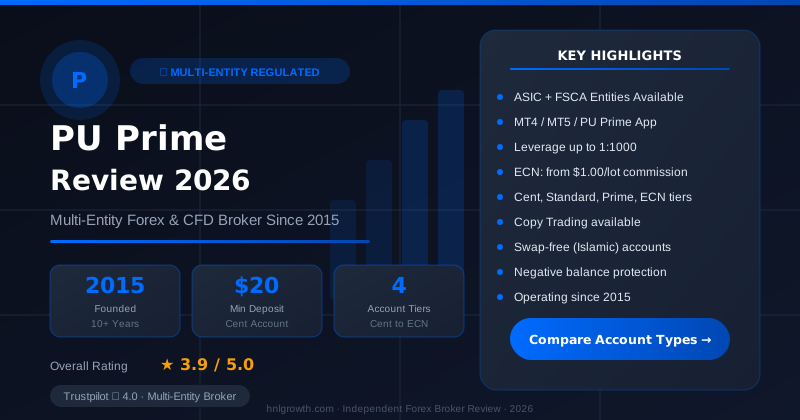
Checked on: 2026-08-17 | Broker terms, regulation, and pricing can change. Always verify at the official PU Prime site before opening an account.
Affiliate Disclosure: HNL Growth may earn a commission if you open an account through our links, at no additional cost to you. Risk Warning: CFDs and leveraged forex products are complex instruments and carry a high risk of losing money rapidly due to leverage. 62.2% of retail investor accounts lose money when trading CFDs with this provider. Trading forex and CFDs may not be suitable for all investors. Consider your objectives, experience, and risk appetite before trading, and ensure you understand the risks involved. Broker Disclosure: PU Prime is a live, regulated multi-entity broker (not a simulated prop-firm evaluation) — trades are executed with real capital in live market conditions, subject to normal market risk. Which PU Prime entity holds your account depends on your country of residence and determines your leverage cap and protections.
Last verified: August 2026 | Editorial Team
PU Prime Complaints and Withdrawal Issues: What the Record Shows
Disclosure: This page may contain affiliate links. We may earn a commission if you open an account through our links, at no extra cost to you.
Quick verdict: is PU Prime a scam, and should you use it?
PU Prime — Multi-Entity Forex & CFD Broker
ASIC (AU) + FSCA (ZA) entities available · $20 min deposit (Cent) · MT4, MT5, PU Prime App · 4 account tiers
No. Based on the evidence available, PU Prime is not a confirmed scam. It is a multi-entity CFD broker that publishes regulatory registrations, cost schedules, and withdrawal terms on its own site, and none of the sourced material shows fund theft or a fraud finding by a regulator. What the record does show is a real trust gap: PU Prime's regulatory strength varies sharply depending on which entity you are onboarded to, and a recurring set of user complaints centers on bonus-term disputes, account reviews, and withdrawal friction rather than outright disappearance of funds.
That distinction matters more than a one-word answer. "Not a scam" is not the same as "zero risk." Before you fund an account, you need to know which legal entity you would actually be contracted with, what that regulator does and doesn't guarantee, and how the deposit and withdrawal mechanics actually work. The rest of this article walks through that evidence in order, starting with regulation.
Which PU Prime entity are you actually trading with?
PU Prime's own regulation page states that the broker is authorised and regulated by four authorities: the Financial Services Authority of Seychelles (FSA), the Financial Services Commission of Mauritius (FSC), the Financial Sector Conduct Authority of South Africa (FSCA), and the Capital Market Authority of the UAE (CMA). Each regulator heading on that page includes a registered address and a license number for the entity operating under it. Because those identifiers can change and matter for verification, cross-check the current number shown on PU Prime's page against the regulator's own public register rather than relying on any third-party summary, including this one.
The page also carries a reverse-solicitation notice: it tells visitors from certain jurisdictions that "PU Prime and its affiliated entities are neither established nor operating in your home jurisdiction," and that access is on the visitor's own initiative rather than through marketing outreach. In practice, this means residents of some countries can view the site but are not being actively solicited, and any account opened from those locations sits outside the marketing protections that a locally authorised broker would offer.
Here's the functional difference between the four regulators, in plain terms rather than a "safe/unsafe" label:
| Regulator | Region focus | Functional tier | What it changes for you |
|---|---|---|---|
| FSA (Seychelles) | Global/offshore onboarding | Offshore, registration-based | Licensing exists, but formal compensation schemes and independent dispute-resolution infrastructure are generally thinner than onshore regimes |
| FSC (Mauritius) | Global/offshore onboarding | Offshore, registration-based | Similar profile to FSA Seychelles: oversight exists but enforcement and complaint-handling capacity is less established than tier-one regulators |
| FSCA (South Africa) | Southern Africa | Onshore conduct authority | Local conduct rules and active enforcement powers apply; complaint routes go through a domestic regulator with statutory authority |
| CMA (UAE) | UAE / Gulf | Onshore conduct authority | Regional oversight tied to UAE financial regulation, with local conduct standards |
A non-authorization or reverse-solicitation notice in a given country does not itself mean fraud. It means the broker has not sought (or been granted) a licence to actively market there, so residents of that country lose the specific protections tied to local authorisation, such as a domestic ombudsman or compensation fund. If you don't know which entity your account sits under, ask support to confirm it and check that entity's number against the regulator's register before funding.
What it actually costs to trade: spreads, commission, swaps
PU Prime runs four account types, and the account you pick changes your cost structure meaningfully. According to the official account-opening guide, the Standard account has spreads from 1.3 pips on EUR/USD with no commission, the Prime account offers raw spreads from 0.0 pips plus a $3.50 commission per lot per side, and the ECN account offers 0.0 pip spreads plus a $1.50 commission per lot per side. Swap (rollover) charges are calculated using a published formula based on contract size, lot size, and nights held, detailed on the fee and charges page; actual swap values fluctuate by instrument and are not fixed figures, so PU Prime directs traders to check live MT4/MT5 values rather than a static table, a caveat repeated on the spread and costs page.
Using only the disclosed spread and commission figures, here's what a round-turn (open and close) trade on 1 standard lot of EUR/USD would cost under each model, before any swap:
| Account type | Spread (stated) | Commission | Round-turn cost, 1 lot EUR/USD (illustrative) |
|---|---|---|---|
| Standard | From 1.3 pips | None | ≈$13, based on the published spread and a standard ~$10 pip value; actual cost varies with live spread |
| Prime | From 0.0 pips (raw) | $3.50 per lot per side | ≈$7 in commission (spread cost separate and variable) |
| ECN | From 0.0 pips (raw) | $1.50 per lot per side | ≈$3 in commission (spread cost separate and variable) |
These are calculations from the published rate cards, not measured results from a live account. Spreads move with market conditions, so treat the table as a way to compare account structures rather than a guaranteed price.
Account types compared: which one matches your capital and strategy
| Account type | Min deposit | Spread/commission model | Leverage | Best suited for |
|---|---|---|---|---|
| Cent | $20 | Same spreads/execution as Standard, balance shown in cents | Not consistently stated across the pages reviewed | Testing the platform or a strategy with minimal capital at risk |
| Standard | $50 | Spread-only, from 1.3 pips EUR/USD | Not consistently stated across the pages reviewed | New to intermediate traders who want simple, all-in pricing |
| Prime | $1,000 | Raw spread from 0.0 pips + $3.50/lot/side | Not consistently stated across the pages reviewed | Frequent traders who value tight spreads and can absorb commission costs |
| ECN | $10,000 | Raw spread from 0.0 pips + $1.50/lot/side | Not consistently stated across the pages reviewed | High-volume or professional traders trading meaningful size |
Leverage caps were not stated as a fixed figure across the pages reviewed; PU Prime's bonus pages reference a 1:1000 leverage scenario for illustrative margin calculations only, not a universal cap. Leverage available to you depends on your entity, country, and account type, so confirm the exact figure in your client portal before sizing a position.
Getting money in and out: methods, limits, and real timelines
This is usually the deciding factor for trust-checkers, so it deserves the most concrete numbers available. According to the fee and charges page, PU Prime does not charge deposit or withdrawal handling fees itself, though third-party providers (banks, e-wallets) may apply their own charges. For International Bank Transfer withdrawals specifically, PU Prime reimburses the bank fee on the first withdrawal each calendar month; any additional International Bank Transfer withdrawal within the same month incurs a 20-unit account-currency handling fee.
On minimums and maximums, the Help Center states there is no maximum withdrawal limit beyond your account balance. The minimum for a first International Bank Transfer withdrawal in a month is 50 units of account currency (to account for the fee waiver); a second International Bank Transfer withdrawal in the same month requires a minimum of 70 units, so that after the 20-unit fee, at least 50 remains payable.
On timing, the Help Center article on withdrawal receiving time is specific and worth quoting directly rather than rounding:
| Method | Stated processing time (after deduction from MT4/MT5) | Fee notes |
|---|---|---|
| International Bank Wire | 2-5 business days | First IBT withdrawal per month fee-waived; subsequent ones incur a 20-unit fee |
| Credit/Debit Card | 2-5 business days | Can be delayed further by the card issuer, outside PU Prime's control |
| E-wallets | Immediate | No stated fee from PU Prime |
| Indonesia, Malaysia, Vietnam, Philippines, Thailand Instant Bank Transfer | 1-3 business days | Region-specific instant transfer rails |
| South Korea Local Bank Transfer | Within 24 hours | — |
| South Africa, Nigeria Bank Transfer | 1-3 business days | — |
These are the broker's own stated timelines, not independently measured results. No third-party audit of actual withdrawal success rates or average real-world processing time was available for this review, so treat the table as what PU Prime commits to on paper and verify your own experience against it once you're funded.
If those numbers hold up for your payment method and region, the funding mechanics are the least ambiguous part of PU Prime's offering.
Open a PU Prime account to test the deposit and withdrawal process yourself at a size you're comfortable with before committing larger capital.
What the bonus terms actually say (and where disputes come from)
PU Prime runs a 100% deposit bonus up to $1,000 and a 50% deposit bonus up to $500. Both pages show worked margin examples at a 1:1000 leverage scenario: for example, a $1,000 deposit under the 100% bonus is shown producing a 14-lot bonus lot size and roughly $1,904 in required margin. Both pages state plainly that "Terms and Conditions apply," with a link to the full terms, but the specific withdrawal conditions and trading-volume requirements are contained in those full terms rather than the promotional page itself.
That's the gap worth naming directly: the headline mechanics (bonus percentage, cap, margin scenario) are officially published and verifiable, but the exact withdrawal restrictions and volume thresholds require reading the linked terms in full before opting in, not the summary shown on the promotional page. Separately, user reports on third-party review sites describe bonuses coming with restrictions they consider undisclosed. That is a user interpretation, not a confirmed gap in PU Prime's terms, since the published terms were not fully quoted in the material reviewed here. If you plan to accept a deposit bonus, read the full terms first and confirm the volume requirement and withdrawal condition in writing before you rely on being able to withdraw bonus-linked funds on demand.
Reading the complaints: what's a red flag and what's normal friction
User reports on public review platforms describe several recurring themes: bonus-term disputes, account reviews or restrictions tied to language like "bonus manipulation" or "arbitrage," fund deductions described as final, and slow escalation when a client disagrees with a decision. None of this is confirmed by PU Prime or a regulator as fact; it is an unverified pattern drawn from public user commentary, and it should be read as such.
| Complaint type | Likely root cause (analytical, unverified) | Where it would be addressed in official terms | Verification status |
|---|---|---|---|
| Bonus withdrawal restriction | Bonus-term breach or volume requirement not met | 100%/50% deposit bonus full terms (linked from the bonus pages) | Unverified pattern; terms exist but full text wasn't independently confirmed here |
| Account "under review" or restricted | AML/KYC hold, or bonus-abuse/arbitrage flag | Not found in the fetched official pages as a described escalation process | Unverified pattern; no official process found in the sources reviewed |
| Fund deduction with no further discussion | Terms-of-service discretion clause application | Not found in the fetched official pages | Unverified pattern; this is a documented gap, not a confirmed policy |
| Slow support response | Support capacity or ticket volume | Not addressed in the fetched official pages | Unverified pattern |
Two things stand out as genuine gaps rather than resolved questions. First, none of the official pages reviewed describe a formal appeal or escalation process for a client who disputes a fund deduction; that absence is itself worth flagging to PU Prime before you fund a larger account. Second, there's no independent data on how often account-restriction complaints resolve in the client's favor versus remain unresolved. Treat isolated complaints as a caution to ask specific questions, not as proof of a systemic pattern.
Who PU Prime suits, and who should look elsewhere
| Reader location | Regulatory tier likely available | Practical consideration |
|---|---|---|
| South Africa | FSCA (onshore) | Local conduct authority applies; complaint routes go through a domestic regulator |
| UAE / Gulf | CMA (onshore) | Regional oversight with local conduct standards |
| Countries without FSCA/CMA presence, onboarded offshore | FSA Seychelles or FSC Mauritius | Licensing exists but weaker compensation and dispute infrastructure; confirm entity and read terms carefully before funding above what you can afford to lose |
| Jurisdictions flagged in the reverse-solicitation notice | Not established/authorised locally | You are accessing the site on your own initiative; local marketing and compensation protections do not apply |
PU Prime is a reasonable fit for traders in FSCA- or CMA-covered regions who want multiple account tiers and a range of instruments, and for experienced traders anywhere who understand they are accepting an offshore-tier entity's terms in exchange for market access. It is a weaker fit for anyone who needs the compensation-scheme backstop of a tier-one onshore regulator, anyone uncomfortable with a broker's discretion clause where no public appeal process was found, or anyone planning to rely heavily on a deposit bonus without reading the full terms first.
Compare PU Prime account types and costs to match the account structure to your capital and trading frequency before you decide.
Opening an account, step by step
Per the official how-to-open-a-trading-account guide:
- Register on the PU Prime signup page with your name, email, phone number, and password. Choose your account currency and platform (MT4 or MT5).
- Upload documents for KYC: a valid government-issued ID (passport, national ID, or driving licence) and a proof-of-address document dated within the last three months, such as a utility bill or bank statement.
- Wait for verification. PU Prime states this usually takes a few hours during business days; a demo account is available while you wait.
- Fund your account and start trading. Minimum deposit is $50 for the Standard account or $20 for the Cent account. Card and e-wallet deposits typically arrive instantly; bank transfers can take 1-3 business days.
FAQ
Is PU Prime regulated in my country? It depends on the entity you're onboarded to. PU Prime lists FSA Seychelles, FSC Mauritius, FSCA South Africa, and CMA UAE on its regulation page. Confirm which entity applies to your country and cross-check the license number against that regulator's own register.
Can I actually withdraw my profits? PU Prime publishes specific processing timelines by method, ranging from immediate for e-wallets to 2-5 business days for bank wire and card, per the Help Center. No independent audit of real-world success rates was available, so verify the process yourself with a modest withdrawal before scaling up.
Why would PU Prime restrict or review my account? Common industry reasons include AML/KYC verification holds and bonus-term enforcement. The specific evidentiary process PU Prime uses for individual cases was not confirmed in the official pages reviewed, so this remains a gap rather than a documented policy.
Is a Seychelles or Mauritius entity riskier than an FSCA or CMA entity? Functionally, yes, in the sense that offshore registration-based regulators typically offer less compensation and dispute infrastructure than onshore conduct authorities. That is not proof of wrongdoing, but it is a real difference in the protections available to you.
What happens if I dispute a fund deduction? No formal escalation or appeal process for fund-deduction disputes was found in the official pages reviewed. Ask PU Prime support directly for their written dispute process before you fund an account, and keep records of any correspondence.
Risk warning
Risk warning: CFDs and leveraged forex products are complex instruments and carry a high risk of losing money rapidly due to leverage. Consider whether you understand how these products work and whether you can afford to take the high risk of losing your capital. Check the entity, terms and protections that apply in your jurisdiction before trading. Offshore-regulated entities, such as those overseen by FSA Seychelles or FSC Mauritius, carry different compensation and insolvency protections than onshore-regulated entities; this is a structural difference in oversight, not evidence of wrongdoing by any specific broker.
Ready to Compare PU Prime Account Types?
PU Prime is a multi-entity broker — ASIC (Australia) and FSCA (South Africa) regulated entities offer stronger oversight, while most international clients are onboarded to the FSA Seychelles or FSC Mauritius entities. Four account tiers (Cent, Standard, Prime, ECN) range from a $20 minimum deposit to full ECN pricing.
Risk disclaimer: PU Prime is a live, regulated multi-entity broker — trading forex and CFDs is done with real capital under normal market risk (this is not a simulated prop-firm evaluation). PU Prime operates under multiple separate licenses (ASIC, FSCA, FSA Seychelles, FSC Mauritius); which entity holds your account depends on your country of residence and determines your leverage cap and protections — confirm this before funding. CFDs and leveraged forex products are complex instruments and carry a high risk of losing money rapidly due to leverage; 62.2% of retail investor accounts lose money when trading CFDs with this provider. Consider whether you understand how CFDs/forex work and whether you can afford the high risk of losing your money. Affiliate disclosure: HNL Growth earns a commission when you open a PU Prime account through links on this page.