Is PU Prime Safe and Regulated in 2026?
Quick Answer: What Determines Whether PU Prime Is Safe for You
Reviewed using our forex & CFD broker review methodology
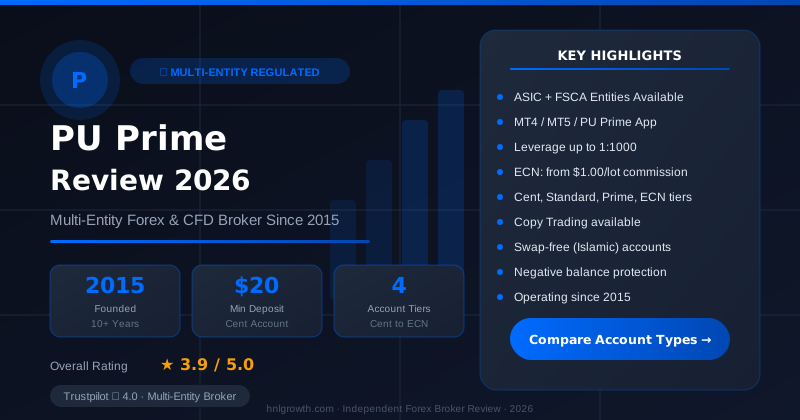
Checked on: 2026-08-17 | Broker terms, regulation, and pricing can change. Always verify at the official PU Prime site before opening an account.
Affiliate Disclosure: HNL Growth may earn a commission if you open an account through our links, at no additional cost to you. Risk Warning: CFDs and leveraged forex products are complex instruments and carry a high risk of losing money rapidly due to leverage. 62.2% of retail investor accounts lose money when trading CFDs with this provider. Trading forex and CFDs may not be suitable for all investors. Consider your objectives, experience, and risk appetite before trading, and ensure you understand the risks involved. Broker Disclosure: PU Prime is a live, regulated multi-entity broker (not a simulated prop-firm evaluation) — trades are executed with real capital in live market conditions, subject to normal market risk. Which PU Prime entity holds your account depends on your country of residence and determines your leverage cap and protections.
Last verified: August 2026 | Editorial Team
Is PU Prime Safe and Regulated in 2026?
Disclosure: This page may contain affiliate links. We may earn a commission if you open an account through our links, at no extra cost to you.
Quick Answer: What Determines Whether PU Prime Is Safe for You
PU Prime — Multi-Entity Forex & CFD Broker
ASIC (AU) + FSCA (ZA) entities available · $20 min deposit (Cent) · MT4, MT5, PU Prime App · 4 account tiers
Whether PU Prime is safe depends on which of its five regulatory entities governs your account—not on the brand as a whole. The Australian entity (ASIC) and South African entity (FSCA) operate under recognized, well-resourced regulators with enforceable client protection standards. The Seychelles (FSA) and Mauritius (FSC) entities are licensed but regulated under lighter-touch offshore regimes that carry fewer mandatory protections. A UAE entity (CMA) covers that region. Across all entities, PU Prime states that client funds are held in segregated accounts and that negative balance protection applies to retail accounts. The rest of this article documents what each entity actually provides, which entity is likely to govern your account by geography, and where genuine gaps in protection exist.
PU Prime's Regulatory Structure: Five Entities, Five Sets of Rules
PU Prime operates through multiple legal entities, each authorised by a different regulator. This structure is common among global brokers—it allows a single brand to serve clients across jurisdictions that require local licensing, while also serving other markets through offshore entities where local authorisation is not obtained.
The table below documents the entities as stated on PU Prime's regulation page. All licence numbers and registration statuses require direct verification against each official register before you rely on them—register statuses can change, and publication dates lag real-time updates.
Verification note: Entity and licence details are sourced from PU Prime's published regulation page. Readers should independently confirm current status on ASIC Connect, the FSCA FAIS register, the FSA Seychelles register, the FSC Mauritius register, and the UAE CMA register before depositing.
Entity Regulatory Tier Matrix
| Legal Entity | Regulator | Licence | Oversight Tier | Forex Leverage Cap | Segregated Accounts | Compensation Fund | Typical Eligible Regions |
|---|---|---|---|---|---|---|---|
| PU Prime Trading Pty Ltd | ASIC (Australia) | Verify on ASIC Connect | Tier 1 — strong | 30:1 retail | Yes (stated) | No formal scheme | Australia; some APAC |
| PU Prime (PTY) Ltd | FSCA (South Africa) | Verify on FSCA register | Tier 1-adjacent — recognized | Verify on FSCA register | Yes (stated) | No formal scheme | South Africa |
| PU Prime Financial Services L.L.C. | CMA (UAE) | Verify on CMA register | Tier 2 — recognized regional | Verify on CMA register | Yes (stated) | No formal scheme | UAE and MENA |
| PU Prime Limited | FSA (Seychelles) | Verify on FSA register | Offshore — light-touch | Up to 1,000:1 (verify current terms) | Yes (stated) | None | Many non-ASIC/FSCA regions |
| PU Prime Ltd | FSC (Mauritius) | Verify on FSC register | Offshore — light-touch | Verify on FSC register | Yes (stated) | None | Africa, parts of Asia |
What "tier" means in practical terms: ASIC and FSCA subject licensed firms to regular audits, capital adequacy requirements, and enforceable client money rules. Offshore regulators (FSA, FSC) impose basic licensing conditions—anti-money laundering standards, registration requirements, some operational rules—but do not mandate the same audit depth, capital buffers, or consumer recourse mechanisms. The leverage ceiling difference (30:1 under ASIC vs. up to 1,000:1 under some offshore entities) is a direct consequence of this regulatory gap: ASIC imposes the cap to protect retail traders; offshore regulators do not.
PU Prime also discloses membership of the Financial Commission since July 2024, an independent external dispute resolution (EDR) body. Eligible clients can access neutral mediation and a Compensation Fund of up to €20,000 per eligible complaint—separate from any regulatory compensation scheme. "Eligible" is defined by the Financial Commission's own rules; readers should confirm current membership status and eligibility conditions directly on the Financial Commission's website before treating this as a recourse mechanism.
Additionally, PU Prime states institutional coverage through Lloyd's of London of up to US$1,000,000 per eligible client for broker insolvency events, described as automatic and at no additional cost. Readers should review the specific policy terms—what "eligible client" means, which entities are covered, and what triggers a claim—before treating this as equivalent to a government-backed protection scheme.
Open a PU Prime account — review which entity applies to your country of residence before depositing.
Which Entity Governs Your Account
This is the question most trust-focused articles never answer clearly, and it matters more than any other single fact here.
PU Prime's entity assignment is primarily driven by the country of residence you declare during registration. Traders in Australia are served by PU Prime Trading Pty Ltd (ASIC). Traders in South Africa by PU Prime (PTY) Ltd (FSCA). Traders in the UAE by PU Prime Financial Services L.L.C. (CMA). Traders in most other regions—including large parts of Asia, Africa, Latin America, and the Middle East outside the UAE—are typically routed to the Seychelles (FSA) or Mauritius (FSC) entity.
Why this matters: PU Prime's website displays a geo-based acknowledgement notice for visitors from jurisdictions where the brand's entities are not locally established, confirming that access occurs on a "reverse solicitation" basis rather than through active local marketing. This is standard industry practice, but it has a direct implication: if you are in a jurisdiction without a local PU Prime entity, you are transacting with an offshore entity under lighter-touch regulation. Your declared country of residence at signup typically determines that assignment. Review your account agreement carefully to confirm which entity and regulatory framework governs your specific account—the entity name will be stated in the agreement.
If you are in the UK, USA, Canada, or EU: PU Prime does not hold FCA, CFTC, Canadian provincial, or ESMA-compliant licences. Residents of these jurisdictions are not eligible to open accounts, and PU Prime restricts access accordingly. This reflects the broker's decision not to obtain licences in those jurisdictions, which is common among multi-entity brokers operating through offshore structures—it is not a fraud indicator, but it is a firm boundary for those residents.
Simplified Regional Decision Path
| Your Country | Likely Entity | Regulator | Key Differences vs. ASIC Entity |
|---|---|---|---|
| Australia | PU Prime Trading Pty Ltd | ASIC | 30:1 forex leverage cap; stricter audit and capital requirements |
| South Africa | PU Prime (PTY) Ltd | FSCA | Recognized local regulation; no formal compensation scheme |
| UAE | PU Prime Financial Services L.L.C. | CMA | Regional regulatory oversight; verify leverage rules on CMA register |
| Most other regions | PU Prime Limited or PU Prime Ltd | FSA (Seychelles) or FSC (Mauritius) | Offshore; fewer mandatory protections; higher leverage available |
| UK / USA / Canada / EU | Not available | N/A | PU Prime does not hold local authorization in these jurisdictions |
What Each Regulator Actually Protects—and What It Does Not
Knowing that a licence exists is less useful than understanding what it requires.
Regulator Protection Comparison
| Regulator | Segregated Accounts Required | Negative Balance Protection | Formal Compensation Fund | Capital Adequacy Rules | Max Retail Forex Leverage |
|---|---|---|---|---|---|
| ASIC (Australia) | Yes — mandated | Required for retail clients | No statutory scheme | Yes — enforced | 30:1 |
| FSCA (South Africa) | Yes — mandated | Required under FSCA rules | No formal fund | Yes | Varies by product |
| CMA (UAE) | Yes | Verify on CMA rules | No formal fund | Yes | Verify on CMA register |
| FSA (Seychelles) | Typically required by licence | Often policy, not mandated | None | Minimal | Up to 1,000:1 (common) |
| FSC (Mauritius) | Typically required | Often policy, not mandated | None | Minimal | High (verify) |
Segregated accounts: PU Prime states across its published materials that all client capital is held in segregated trust accounts at AA-rated international banks, separate from company operational funds. What differs by entity is the regulatory enforceability of that claim: under ASIC and FSCA, segregation is a legal requirement backed by audit obligations and regulatory sanction power; under FSA and FSC, a requirement exists but enforcement mechanisms and audit depth are materially weaker. Segregation reduces commingling risk—it does not eliminate insolvency risk.
Negative balance protection: PU Prime states NBP applies to all retail trading accounts across entities. For ASIC-regulated retail clients, this is also a regulatory requirement. For offshore entities, it is stated broker policy—meaningful as a commitment, but not backed by the same regulatory enforcement. Review your entity's client agreement to confirm the exact scope and conditions.
Compensation fund: No PU Prime entity currently participates in a statutory government-backed compensation scheme equivalent to the UK FSCS or EU investor compensation directives. The Financial Commission's €20,000 per-complaint compensation fund is independent and member-funded—a meaningful recourse mechanism, but not equivalent to a statutory fund. The Lloyd's insurance of up to US$1,000,000 per eligible client specifically addresses insolvency scenarios; verify eligibility conditions in the policy terms before treating this figure as a simple guarantee.
What happens to your funds if PU Prime becomes insolvent? Under all entities, the stated first line of protection is segregation—your funds should not form part of PU Prime's estate. If segregation has been properly maintained, funds should be returnable. The secondary layer for eligible clients is the Lloyd's policy. The tertiary layer is the Financial Commission's fund for complaint-eligible amounts up to €20,000. There is no government backstop at any tier. This is standard for offshore and many ASIC-regulated brokers—it is not unique to PU Prime, but it is a material difference from FCA- or ESMA-regulated brokers where statutory schemes exist.
Regulatory Warnings: What They Mean and Which Entity They Affect
Several major regulators have issued notices referencing PU Prime. These require careful interpretation.
FCA (UK), AMF (France), DFSA (UAE), and Canadian provincial regulators have each issued "unauthorized firm" notices referencing entities trading as PU Prime. These notices state that the named entity is not authorized to operate in that jurisdiction. They are not findings of fraud, investigation outcomes, or sanctions. For any global broker that has not obtained a local licence in a given country, an unauthorized notice is the predictable regulatory response when the brand is marketed to residents there.
What to verify: Each warning names a specific legal entity. If the warning names the offshore FSA or FSC entity—not PU Prime Trading Pty Ltd (ASIC) or PU Prime (PTY) Ltd (FSCA)—it does not affect the regulated Australian or South African operations. Conflating a warning about the Seychelles entity with the ASIC entity is a common misread that leads to inaccurate conclusions in both directions. Check each official warning notice directly on the relevant regulator's website, note the exact legal entity name referenced, and compare it to the entity table above.
Reader action: If you are in a jurisdiction where a warning has been issued, PU Prime is not authorized to serve you directly. If you are in Australia or South Africa and considering the locally regulated entity, an unauthorized notice targeting a different legal entity does not change your regulatory position—though you should still verify your specific entity's current licence status on the official register.
Client Fund Protection: Segregation, Insolvency, and Compensation
PU Prime's published security framework, as stated on its platform security page, rests on five stated elements:
- Multi-jurisdictional regulation — five entities across five regulators
- Segregated client accounts — held at AA-rated international banks, separate from company operational funds
- Financial Commission membership — independent EDR since July 2024; up to €20,000 compensation per eligible complaint; confirm current membership status and eligibility conditions on the Financial Commission's website
- Lloyd's of London insurance — up to US$1,000,000 per eligible client for insolvency events; described as automatic coverage at no cost; verify eligibility conditions in the policy terms
- Negative balance protection — stated to apply to all retail accounts across entities
What to verify yourself before funding:
- Confirm which entity governs your account in your account agreement
- Check whether segregated account details (bank name, account type, custodian) are disclosed in your entity's client money policy
- Review what "eligible client" means under the Lloyd's policy terms and which entities are covered
- Confirm your entity's current registration status on the relevant official register
- Check whether the Financial Commission's compensation fund applies to your specific entity and complaint type
Withdrawals: Process, Timelines, and What Can Slow Them Down
PU Prime's account opening guide confirms support for credit and debit cards, bank wire, Skrill, Neteller, and several local payment methods.
Withdrawal Method Reference
| Method | Typical Broker-Side Processing | Common Compliance Triggers | Notes |
|---|---|---|---|
| Credit/Debit Card | Same-day to 24 hours (stated typical) | Large amounts, first withdrawal, address mismatch | Bank posting may add 1–5 business days |
| E-wallets (Skrill, Neteller) | Same-day to 24 hours (stated typical) | Account name mismatch, unusual pattern | Generally among the faster methods |
| Bank Wire | 1–5 business days (stated typical) | AML review, large amounts, first wire | SWIFT fees may apply depending on correspondent banks |
| Local payment methods | Varies by region | Method-specific compliance checks | Availability varies by entity |
Important caveat on timelines: The processing windows above reflect stated typical broker-side times from PU Prime's published account opening guide—not independently verified settlement data. Total time to funds in your bank account will also depend on your bank's own posting schedule, compliance status, and the payment method used. These are not guaranteed timelines.
What can extend withdrawal timelines:
- AML compliance review: Standard at all regulated brokers; triggered by large amounts, multiple accounts, unusual patterns, or first withdrawals above a threshold. This is a legal requirement, not a discretionary action.
- Bonus condition fulfilment: If a bonus has been accepted, withdrawal of associated funds may require meeting stated trading volume conditions. Read bonus terms in full before accepting.
- Account under review: If a compliance or account review is active, withdrawals may be paused pending resolution.
- Document verification pending: If KYC documents have not been fully verified, withdrawals may be restricted until the process is complete.
Account Review and Dispute Process
Multiple unverified user reports describe accounts being placed "under review" following profitable trading activity, with funds withheld pending investigation—sometimes citing alleged bonus abuse or prohibited trading strategies as the stated basis, but without trade-level evidence provided to the account holder at the time.
What published policy states: Account reviews are a standard compliance mechanism at regulated brokers. Typical triggers include AML flags, suspected strategy manipulation, bonus condition violations, or patterns consistent with prohibited trading practices as defined in a broker's client agreement. PU Prime's published terms define prohibited strategies and bonus conditions—these should be read in full before funding, not after a dispute arises.
What cannot be assessed from public information alone: Whether specific account actions in individual cases are consistent with published terms, or exceed what those terms permit, cannot be determined from unverified public reports. The pattern of reports is noted because it recurs across review platforms, but each report is unverified, individual circumstances vary, and the underlying facts in each case are not independently known.
Official escalation channels by entity:
- ASIC clients: Lodge a complaint with ASIC at asic.gov.au or contact the Australian Financial Complaints Authority (AFCA) if internal dispute resolution fails
- FSCA clients: Escalate to the FSCA via its official complaints process at fsca.co.za
- All entities: The Financial Commission is available as an external EDR body for eligible disputes (confirm current membership on the Financial Commission's website), with compensation up to €20,000 for eligible complaints
Before funding, locate PU Prime's internal dispute resolution procedure in your account agreement—confirm the process steps and stated timeframe. Traders who accept bonus terms should read prohibited strategy definitions in full, as these define the contractual basis on which profits may be subject to review.
Trading Conditions by Entity: Leverage, Spreads, Costs
Trading conditions differ depending on which entity governs your account. The ASIC entity's 30:1 forex leverage cap is a regulatory constraint, not a product option—it reflects ASIC's product intervention requirements for retail clients. Offshore entities (FSA, FSC) face no equivalent cap.
Higher leverage is not a trading advantage—it is a signal of reduced regulatory constraint. The same leverage that amplifies gains amplifies losses at an identical rate, and the risk of losing money rapidly increases proportionally. ASIC's cap exists specifically because research across multiple regulatory jurisdictions found that the majority of retail traders lose money on high-leverage CFD products. Access to higher leverage under an offshore entity comes alongside the corresponding reduction in the regulatory oversight that constrains it.
Account Type Conditions (Indicative — Verify Current Terms Before Trading)
| Account Type | Min. Deposit | Spread Type | Commission | ASIC Leverage | Offshore Leverage |
|---|---|---|---|---|---|
| Cent | $20 | Variable | None | 30:1 | Higher (verify current terms) |
| Standard | $50 | Variable from market | None | 30:1 | Higher (verify current terms) |
| Prime | $1,000 | Raw from 0.0 pips | ~$3.50/lot/side | 30:1 | Higher (verify current terms) |
| ECN | $10,000 | Raw from 0.0 pips | ~$1.50/lot/side | 30:1 | Higher (verify current terms) |
Minimum deposits, spread figures, and commission rates are sourced from PU Prime's own account description pages and reflect stated typical conditions, not guaranteed minimums. Actual spreads widen during low-liquidity periods and around major news events. All figures should be verified in the current account terms for your specific entity before trading.
Opening an Account: Steps, Documents, Timeline
Per PU Prime's account opening guide, the process involves four active steps and typically takes 10–15 minutes of active work, plus a waiting period for document verification.
Step 1 — Register: Complete the online signup form with your name, email, phone number, country of residence, account currency, and choice of platform (MT4 or MT5). Your country of residence at this step determines your entity assignment.
Step 2 — Upload documents: Provide a valid government-issued ID (passport, national ID card, or driving licence—not expired, showing full name and date of birth) and proof of address dated within three months (utility bill, bank statement, or equivalent showing your name and address). Photo quality matters: clear four-corner visibility, no glare, full text readable.
Step 3 — Verification: PU Prime's guide states compliance review typically takes a few hours during business days; allow up to 24–48 hours. A demo account is available immediately while you wait.
Step 4 — Fund and trade: Once verified, deposit via your chosen method. PU Prime's guide states card and e-wallet deposits are typically credited immediately; bank wires take 1–3 business days. Minimum deposit is $20 (Cent account) or $50 (Standard account).
What can delay verification: Blurred or cropped documents, expired ID, proof of address older than three months, name discrepancy between ID and account details, or elevated compliance review volumes. Ensuring document quality before submission is the most practical way to reduce delay.
Who PU Prime Suits and Who Should Look Elsewhere
PU Prime is a reasonable option to evaluate if you:
- Are based in Australia and want ASIC-regulated trading with segregated funds and a mandated 30:1 leverage cap
- Are based in South Africa and want FSCA oversight with a recognized local regulatory framework
- Are in the UAE and the CMA entity meets your jurisdiction requirements
- Are in an offshore-eligible region, understand the protection trade-offs—higher leverage, lighter regulation, no formal compensation fund—and are comfortable with that risk profile
- Want access to the Financial Commission's independent dispute resolution mechanism alongside your regulator
- Want a multi-asset CFD platform with MetaTrader 4/5 support and copy trading
PU Prime is not suited to you if:
- You require FCA (UK), CySEC (Cyprus/EU), or Canadian provincial authorisation—PU Prime does not hold these licences and does not serve residents of those jurisdictions
- You consider a government-backed statutory compensation fund (such as the UK FSCS) a non-negotiable condition of trading
- You are in a jurisdiction where PU Prime's reverse-solicitation acknowledgement applies and you are uncomfortable with the offshore entity's reduced protection level
- You want to verify independent third-party confirmation of the Lloyd's insurance coverage or Financial Commission membership before deciding—that direct verification step cannot be substituted by this article
Compare PU Prime account types and start your application — confirm which entity applies to your country of residence before depositing.
Frequently Asked Questions
Is PU Prime legit? PU Prime is a licensed broker operating under five regulatory entities. It is not an unlicensed or unregistered operation. The more precise question for any individual trader is which entity governs their account and what protections that entity actually provides.
Is PU Prime regulated? Yes, across five entities: ASIC (Australia), FSCA (South Africa), CMA (UAE), FSA (Seychelles), and FSC (Mauritius). The depth of that regulation varies materially—ASIC and FSCA impose stricter standards, audit requirements, and client money rules than the offshore FSA and FSC entities.
Which entity applies to my account? Primarily determined by your declared country of residence at signup. Australian residents are assigned to the ASIC entity; South African residents to the FSCA entity; UAE residents to the CMA entity; most other regions to FSA (Seychelles) or FSC (Mauritius). Review your account agreement to confirm the entity in your specific case.
What happens to my funds if PU Prime closes? PU Prime states funds are held in segregated accounts at AA-rated banks, separate from operational capital. For eligible clients, Lloyd's of London insurance is stated to cover up to US$1,000,000 per client for insolvency events—verify eligibility conditions and which entities are covered in the policy terms. The Financial Commission's compensation fund covers up to €20,000 for eligible complaints, subject to current membership status. There is no government-backed compensation scheme for any PU Prime entity.
How long do withdrawals take? Card and e-wallet withdrawals are typically processed within 24 hours on the broker side per PU Prime's published guide, with additional time for bank posting. Bank wires take 1–5 business days. Compliance reviews, pending document verification, or an active account review can extend these timelines. These figures are sourced from PU Prime's own materials; no independent settlement data has been verified for this article.
What is the minimum deposit? $20 for the Cent account; $50 for the Standard account, as stated on PU Prime's account opening page.
Does PU Prime have negative balance protection? PU Prime states NBP applies to all retail trading accounts. For ASIC clients, this is also a regulatory requirement. For offshore entity clients, it is stated broker policy. Confirm the specific scope and conditions in your entity's client agreement.
Can I dispute an account action? Internal dispute resolution should be the first step—locate PU Prime's published procedure in your account agreement. If unresolved, ASIC clients can escalate to AFCA; FSCA clients to the FSCA. All entities may access the Financial Commission's EDR process for eligible disputes, subject to current membership—confirm directly on the Financial Commission's website.
Verification Checklist: What to Confirm Before You Fund
No independent first-hand testing of PU Prime's operations has been conducted for this article. The following checklist identifies what you should verify directly before depositing:
- Confirm your entity's current registration status on the relevant official register (ASIC Connect, FSCA FAIS register, CMA register, FSA Seychelles register, or FSC Mauritius register)
- Read which entity name appears in your account agreement—confirm it matches the regulator you expect
- Review the client money policy for your entity: which bank holds your funds, and how is segregation maintained?
- Read bonus terms in full before accepting any bonus—understand volume conditions and prohibited strategy definitions
- Review the account review and termination clauses in your client agreement before funding
- Check whether any regulatory warning in your jurisdiction names your specific PU Prime entity
- Confirm current Financial Commission membership status and eligibility conditions directly on the Financial Commission's website
- Review the Lloyd's insurance policy terms—confirm the "eligible client" definition, which entities are covered, and what triggers a valid claim
- Verify any leverage, spread, or commission figures against the current terms published for your specific entity
Risk warning: CFDs and leveraged forex products are complex instruments and carry a high risk of losing money rapidly due to leverage. Consider whether you understand how these products work and whether you can afford to take the high risk of losing your capital. Check the entity, terms, and protections that apply in your jurisdiction before trading.
Ready to Compare PU Prime Account Types?
PU Prime is a multi-entity broker — ASIC (Australia) and FSCA (South Africa) regulated entities offer stronger oversight, while most international clients are onboarded to the FSA Seychelles or FSC Mauritius entities. Four account tiers (Cent, Standard, Prime, ECN) range from a $20 minimum deposit to full ECN pricing.
Risk disclaimer: PU Prime is a live, regulated multi-entity broker — trading forex and CFDs is done with real capital under normal market risk (this is not a simulated prop-firm evaluation). PU Prime operates under multiple separate licenses (ASIC, FSCA, FSA Seychelles, FSC Mauritius); which entity holds your account depends on your country of residence and determines your leverage cap and protections — confirm this before funding. CFDs and leveraged forex products are complex instruments and carry a high risk of losing money rapidly due to leverage; 62.2% of retail investor accounts lose money when trading CFDs with this provider. Consider whether you understand how CFDs/forex work and whether you can afford the high risk of losing your money. Affiliate disclosure: HNL Growth earns a commission when you open a PU Prime account through links on this page.