Lot Size Calculator: How to Size a Forex Position Correctly
A lot size calculator converts your account balance, risk tolerance, and stop-loss distance into a precise position size. The core formula is straightforward:
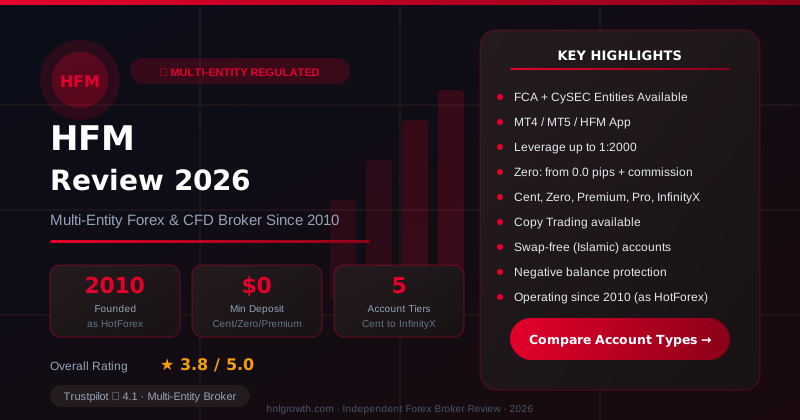
Checked on: 2026-08-10 | Broker terms, regulation, and pricing can change. Always verify at the official HFM site before opening an account.
Affiliate Disclosure: HNL Growth may earn a commission if you open an account through our links, at no additional cost to you. Risk Warning: CFDs and leveraged forex products are complex instruments and carry a high risk of losing money rapidly due to leverage. Between 65-95% of retail investor accounts lose money when trading CFDs, depending on the HFM entity and account type. Trading forex and CFDs may not be suitable for all investors. Consider your objectives, experience, and risk appetite before trading, and ensure you understand the risks involved. Broker Disclosure: HFM (HF Markets Group) is a live, regulated multi-entity broker (not a simulated prop-firm evaluation) — trades are executed with real capital in live market conditions, subject to normal market risk. Protections vary significantly by the specific legal entity that onboards your account.
Lot Size Calculator: How to Size a Forex Position Correctly
A lot size calculator converts your account balance, risk tolerance, and stop-loss distance into a precise position size. The core formula is straightforward:
Lot Size = (Account Balance × Risk %) ÷ (Stop-Loss Pips × Pip Value)
For a $10,000 account risking 1% with a 50-pip stop on EUR/USD, the calculation is: ($10,000 × 0.01) ÷ (50 × $10) = 0.20 lots. That translates to 20,000 units of the base currency, with exactly $100 at risk if the stop is hit.
This page explains the formula, shows how lot-size tiers (standard, mini, micro) map to different account sizes, and demonstrates how broker conditions—spreads, commissions, leverage—change the real cost of the same position across HFM account types.
How to Use the Position Size Formula
HashHedge — Crypto Futures Prop Firm
Up to $200K funded accounts · 85% profit split · Instant USDT payouts · 160+ assets
The tables below show how the formula works with a standard set of inputs. To apply it to your own trade, substitute your values into the formula in the section that follows. This is a static reference—figures do not update live.
Example inputs:
| Field | Example Value |
|---|---|
| Currency Pair | EUR/USD |
| Account Currency | USD |
| Account Balance | $10,000 |
| Risk per Trade (%) | 1% |
| Stop-Loss (pips) | 50 |
Calculated outputs:
| Output | Value |
|---|---|
| Recommended Lot Size | 0.20 lots |
| Pip Value | $10.00 per standard lot |
| Monetary Risk | $100.00 |
| Margin Required (at 1:500) | $40.00 |
How account type affects cost: HFM's trading accounts offer different spread structures. The Zero account provides spreads from 0.0 pips on forex pairs, while the Premium account offers variable spreads from 1.4 pips. Switching between them changes your all-in trade cost even though the lot size stays the same. See the cost comparison table below.
These figures are based on standard pip-value formulas. Actual pip values fluctuate with exchange rates for pairs where USD is not the quote currency. This does not constitute financial advice.
Affiliate disclosure: This site may receive compensation when you open an account through links on this page. This does not affect our analysis or recommendations.
Open a live HFM account and apply your calculated lot size
The Math Behind Your Lot Size
Breaking Down the Formula
Every variable in the lot size formula serves a specific purpose:
- Account Balance — your current equity, not your initial deposit. Always recalculate if you have open positions.
- Risk % — the percentage of your balance you are willing to lose on a single trade. The widely cited convention is 1–2% per trade as a ceiling.
- Stop-Loss Pips — the distance in pips between your entry price and your stop-loss order.
- Pip Value — the monetary value of one pip movement per lot, which depends on the currency pair, lot size, and current exchange rate.
Worked example:
| Parameter | Value |
|---|---|
| Account Balance | $10,000 |
| Risk | 1% ($100) |
| Stop-Loss | 50 pips |
| Pip Value (EUR/USD, standard lot) | $10 |
Step 1: Calculate risk amount — $10,000 × 0.01 = $100
Step 2: Divide by stop-loss distance — $100 ÷ 50 = $2 per pip needed
Step 3: Divide by pip value per standard lot — $2 ÷ $10 = 0.20 lots
The result: 0.20 standard lots, or 20,000 units of EUR. If price moves 50 pips against you, the loss is exactly $100.
Why Pip Value Is Not Always $10
The $10-per-pip figure applies only to pairs where USD is the quote currency (the second currency in the pair), and only for standard lots. Two factors change this:
Lot tier scales pip value proportionally:
| Lot Type | Units | EUR/USD Pip Value |
|---|---|---|
| Standard (1.00) | 100,000 | $10.00 |
| Mini (0.10) | 10,000 | $1.00 |
| Micro (0.01) | 1,000 | $0.10 |
Quote currency shifts pip value based on the exchange rate. When USD is not the quote currency, pip value must be converted:
For USD/JPY at an exchange rate of 150.00:
- Pip value per standard lot = (0.01 ÷ 150.00) × 100,000 = $6.67
- This means the same 0.20-lot position on USD/JPY has a pip value of $1.33 instead of $2.00
For cross-pairs like EUR/GBP, the calculation involves two conversions. The pip value in GBP is (0.0001 × 100,000) = £10 per standard lot, which then converts to USD at the prevailing GBP/USD rate.
Choosing the Right Lot Tier for Your Account
Standard, Mini, and Micro Compared
| Lot Type | Notation | Units | Pip Value (EUR/USD) | Typical Account Range | Margin at 1:500 |
|---|---|---|---|---|---|
| Standard | 1.00 | 100,000 | $10.00 | $10,000+ | $200 |
| Mini | 0.10 | 10,000 | $1.00 | $1,000–$10,000 | $20 |
| Micro | 0.01 | 1,000 | $0.10 | $100–$1,000 | $2 |
HFM's minimum trade size across all account types is 0.01 lots (one micro lot), with trade size increments of 0.01. Nano lots (0.001 lots, 100 units) are not available on HFM platforms.
The Cent account uses a contract size of 1,000 units per lot, meaning each "lot" in that account functions like a micro lot on a standard account. This structure allows finer risk granularity for smaller balances without requiring fractional lot sizes below the 0.01 minimum.
Sizing Strategy by Account Size
Small accounts ($100–$1,000): Micro lots are the practical ceiling. With a $500 balance and 1% risk ($5), a 50-pip stop on EUR/USD yields 0.01 lots—the minimum on most platforms. The Cent account can be useful here for finer granularity.
Mid-size accounts ($1,000–$10,000): Mini lots (0.10) become accessible. A $5,000 account at 1% risk with a 30-pip stop produces approximately 0.17 lots, which rounds to 0.17 on platforms with 0.01 step increments.
Larger accounts ($10,000+): Standard and mini lots offer the most flexibility. A $25,000 account at 1% risk with a 40-pip stop gives roughly 0.63 standard lots.
How Account Type Changes Your Real Trade Cost
The lot size tells you the position dimension. The account type determines how much you pay to hold it.
Spread and Commission: Worked Scenarios
Same trade parameters: $10,000 account, 1% risk, 50-pip stop, EUR/USD, 0.20 lots.
| Account Type | Spread | Commission | Spread Cost | All-in Cost | Cost as % of $100 Risk |
|---|---|---|---|---|---|
| Premium | From 1.4 pips | Included in spread | $2.80 | $2.80 | 2.8% |
| Zero | From 0 pips | Per-lot fee applies | $0.00 | Commission-dependent | See current rates |
| Pro | From 0.6 pips | Per-lot fee may apply | $1.20 | Commission-dependent | See current rates |
| InfinityX | From 0.3 pips | Per-lot fee may apply | $0.60 | Commission-dependent | See current rates |
| Cent | From 1.4 pips | Included in spread | $2.80 | $2.80 | 2.8% |
Spread cost = lot size × pip value × spread in pips (e.g., 0.20 × $10 × 1.4 pips = $2.80). Commission rates for the Zero, Pro, and InfinityX accounts are not available in the evidence underlying this page—consult HFM's official account specifications for current published rates. Zero account raw spreads are available on specific symbols per HFM's terms.
The key insight: the lot size stays the same regardless of account type, but the all-in cost shifts meaningfully. On a Premium account, the 1.4-pip spread costs $2.80 on this trade—2.8% of your $100 risk budget consumed before the market moves. On a Zero account, the spread cost approaches zero on eligible instruments, though a per-lot commission applies instead. Neither account's total cost can be fully compared without current commission figures.
View all HFM account types and current spreads
Leverage Caps Your Maximum Position
Leverage determines the largest position your balance can support—but maximum capacity is not the same as recommended risk.
Margin requirement formula: Margin = (Lot Size × Contract Size) ÷ Leverage
| Account Balance | Max Lot at 1:500 | Max Lot at 1:2000 | Recommended Lot (1% Risk, 50-pip Stop) |
|---|---|---|---|
| $1,000 | 0.50 | 2.00 | 0.02 |
| $5,000 | 2.50 | 10.00 | 0.10 |
| $10,000 | 5.00 | 20.00 | 0.20 |
| $25,000 | 12.50 | 50.00 | 0.50 |
| $50,000 | 25.00 | 60.00* | 1.00 |
HFM's maximum total trade size is 60 standard lots per position on most account types.
HFM offers leverage up to 1:2000 on Cent, Zero, Pro, and Premium accounts. The InfinityX account offers unlimited leverage; this applies only to that account type and is subject to HFM's terms and conditions and margin policies—unlimited leverage does not remove margin requirements or stop-out risk. Leverage limits also vary by regulatory jurisdiction: traders under EU (CySEC), UK (FCA), or UAE (DFSA) entities face lower maximum leverage caps imposed by local regulators.
The table above makes one point clear: leverage capacity vastly exceeds prudent risk-based sizing. A $10,000 account at 1:2000 leverage can technically open 20 standard lots, but the risk-based recommendation for the same account is 0.20 lots—a 100x difference. Sizing to maximum margin is the fastest route to a margin call.
Position Sizing Across Asset Classes
Gold and Commodities
Forex lot-size logic does not transfer directly to commodities. Contract sizes differ by instrument and must be verified for each broker:
- Gold (XAU/USD): Commonly 100 ounces per standard lot on most platforms. A $1 move in gold equals $100 per standard lot (at 100 oz/lot). Verify the actual contract size in HFM's MT4/MT5 platform specification window before sizing.
- Silver (XAG/USD): Contract size varies by broker and instrument. Do not apply a standard figure without first checking HFM's published instrument specification.
- Crude Oil: Contract sizes vary by broker and instrument specification.
Worked gold example (illustrative, assuming 100 oz/lot—verify before trading): You want to risk $100 (1% of a $10,000 account) with a $5 stop-loss on XAU/USD.
- Position size = $100 ÷ ($5 × $100 per lot) = 0.20 lots
- This controls approximately 20 ounces of gold if the contract is 100 oz/lot
Always verify the contract specification for each instrument in your platform's specification window before placing a trade.
Indices and CFDs
Index CFD lot definitions are not standardized across brokers. One lot may represent 1 contract, 10 contracts, or a different multiplier depending on the instrument and platform. For example, 1 lot on a US30 CFD might equal $1 per point on some platforms and $10 per point on others. Check the contract size in your platform's specification window before applying any position-sizing formula.
Four Sizing Mistakes That Inflate Risk
1. Sizing to margin instead of risk. If your platform allows a 5-lot position on a $10,000 account, that does not mean you should open one. Use the 1–2% risk rule to determine size, then verify that margin is sufficient—not the other way around.
2. Ignoring overnight financing on swing trades. Swap costs accumulate on positions held past the daily rollover. A trade sized correctly for a day session may consume an unplanned portion of your risk budget if held for several days or weeks. Check the swap rates displayed on your platform for each instrument. HFM offers swap-free accounts on specific trading instruments, subject to terms and conditions—check account documentation for eligibility.
3. Platform rounding. MT4 and MT5 both use a minimum lot step of 0.01. If your calculated lot size is 0.173, the platform rounds to 0.17. On a standard lot, that 0.003 difference represents roughly $0.30 per pip—minor on a single trade, but compounding across multiple positions.
4. Sizing correlated positions independently. If you open a long EUR/USD and a long GBP/USD, both positions carry USD exposure. Sizing each at 1% risk understates your total USD-denominated risk. Treat correlated pairs as partially overlapping exposures and reduce individual lot sizes accordingly.
Frequently Asked Questions
Can I use this lot size formula for gold, oil, or indices? The formula works for any instrument, but you must substitute the correct contract size and tick/pip value. For gold, the contract size is commonly 100 oz per standard lot—verify this in your platform's instrument window. For indices, check the contract multiplier before sizing.
How do I calculate lot size when USD is not the base or quote currency? Convert the pip value to your account currency using the relevant exchange rate. For example, if your account is in EUR and you trade EUR/USD, the pip value is in USD—convert it to EUR at the current EUR/USD rate.
What lot size should I use with a $100 account? At 1% risk ($1) with a 50-pip stop on EUR/USD, the formula gives 0.002 lots—below the 0.01 minimum on HFM platforms. Either widen your risk to 5% (not recommended long-term), use a wider stop-loss, or consider HFM's Cent account, where the contract size is 1,000 units per lot, giving finer granularity at small account sizes.
How does leverage affect my lot size? Leverage determines the maximum position your balance can support, not the position you should open. Use the risk-based formula first, then confirm that required margin is within your available leverage.
Do I need to adjust lot size for copy trading or signal following? Yes. If a signal provider trades 1.00 lots on a $100,000 account and you follow with $10,000, proportionally scaling to 0.10 lots maintains the same risk percentage. Do not copy the raw lot size without adjusting for your balance.
Why does my platform show a different pip value than the formula? Pip values for non-USD quote currencies fluctuate with live exchange rates. A formula using a static rate may differ slightly from real-time platform values. The discrepancy is usually small but widens during volatile sessions.
How do MT4 and MT5 handle lot size increments? Both platforms use a minimum step of 0.01 lots. HFM's trading accounts confirm a trade size increment of 0.01 across all account types. Neither platform natively calculates a risk-based lot size—you must calculate it externally and enter the result manually.
What fees should I factor in beyond spread? Commission (on Zero and certain other account types), overnight swap charges, and any deposit or withdrawal fees. Commission rates are published on HFM's official account specifications.
What This Page Cannot Do
This page provides a static formula reference, not a connected trading tool. It does not access live account equity, real-time spreads, or dynamic leverage tiers. Before each trade:
- Refresh your account balance to include unrealized P/L
- Verify the current spread on your chosen instrument
- Confirm your entity's leverage tier, as it may differ by jurisdiction
- Check the contract specification for the specific instrument you are trading
For entity-specific terms and regulatory disclosures—including retail CFD loss rates applicable to your jurisdiction—refer to HFM's official account specifications and the legal documentation for your region.
Open a live HFM account and trade with spreads from 0.0 pips
Risk warning: CFDs and leveraged forex products are complex instruments and carry a high risk of losing money rapidly due to leverage. Retail investor accounts lose money when trading CFDs with most providers; the exact percentage varies by HFM entity and account type. You should consider whether you understand how CFDs work and whether you can afford to take the high risk of losing your money. Check the entity, terms and investor protections that apply in your jurisdiction before opening an account or trading.
Ready to Start Your Funded Trading Journey?
Join traders backed by $11M+ in verified payouts and a 4.7/5 Trustpilot rating. Compare HashHedge challenge plans, drawdown rules, and payout terms — apply code ha25 for the current discount.
Risk disclaimer: Challenge fees are non-refundable if you breach the rules. Prop trading involves significant financial risk. Past performance in a simulated environment does not guarantee results on a funded account. Only purchase if you understand the rules fully and can afford to lose the fee. Affiliate disclosure: HNL Growth earns a commission when you purchase a HashHedge challenge through links on this page.