Lowest Spread Forex Brokers 2026: Real All-In Costs
Disclosure: This page contains affiliate links. We may earn a commission if you open an account through our links, at no extra cost to you.
Reviewed using our forex & CFD broker review methodology
Checked on: 2026-08-17 | Broker terms, regulation, and pricing can change. Always verify at the official PU Prime site before opening an account.
Affiliate Disclosure: HNL Growth may earn a commission if you open an account through our links, at no additional cost to you. Risk Warning: CFDs and leveraged forex products are complex instruments and carry a high risk of losing money rapidly due to leverage. 62.2% of retail investor accounts lose money when trading CFDs with this provider. Trading forex and CFDs may not be suitable for all investors. Consider your objectives, experience, and risk appetite before trading, and ensure you understand the risks involved. Broker Disclosure: PU Prime is a live, regulated multi-entity broker (not a simulated prop-firm evaluation) — trades are executed with real capital in live market conditions, subject to normal market risk. Which PU Prime entity holds your account depends on your country of residence and determines your leverage cap and protections.
Last verified: August 2026 | Editorial Team
Lowest Spread Forex Brokers 2026: Real All-In Costs
Disclosure: This page contains affiliate links. We may earn a commission if you open an account through our links, at no extra cost to you.
There's no single broker that's objectively "cheapest" for every trader, because raw spread numbers alone hide commission, account type and entity-specific conditions. The only defensible way to compare cost is to run the same trade, at the same lot size, through the same formula, across every account type or broker you're considering, then check who actually regulates the entity that would hold your money. This article walks through that formula using PU Prime's own published figures as a fully-sourced worked example, shows you how to run the identical comparison against any other broker, and flags exactly what we could not independently confirm.
This is a broker comparison framework built for active traders who already understand spread and commission mechanics and want a shortlist, not a glossary.
Verdict in one table
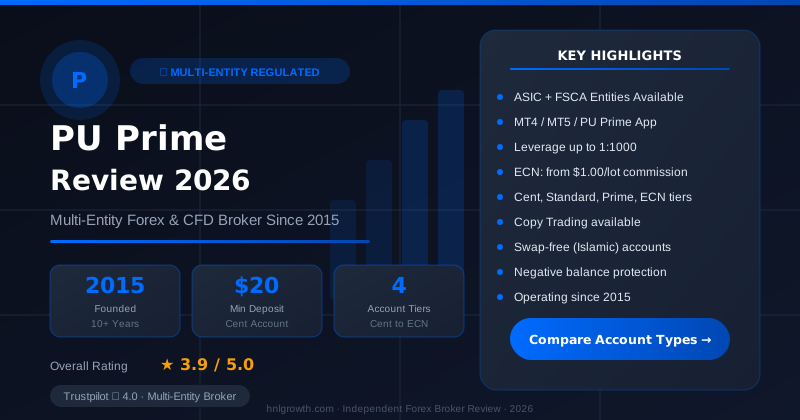
PU Prime — Multi-Entity Forex & CFD Broker
ASIC (AU) + FSCA (ZA) entities available · $20 min deposit (Cent) · MT4, MT5, PU Prime App · 4 account tiers
Because PU Prime publishes three distinct pricing structures under one brand, we can build a genuinely apples-to-apples comparison of its own tiers without guessing at marketing numbers. The figures below come from PU Prime's own Spreads and Costs page and account opening guide.
| Account type | EUR/USD spread (from) | Commission | Min deposit | Regulator / entity basis |
|---|---|---|---|---|
| Cent | Same as Standard | None | $20 | FSA Seychelles / ASIC / FSC Mauritius / FSCA / CMA (see Regulation section) |
| Standard | 1.3 pips | None | $50 | As above |
| Prime | 0.0 pips (raw) | $3.50 per lot, per side | $1,000 | As above |
| ECN | 0.0 pips (raw) | $1.50 per lot, per side | $10,000 | As above |
A note on "from 0.0 pips": that is the advertised floor, not a typical live spread. PU Prime's own spreads page states explicitly that listed values are "for reference only" and directs traders to check MT4, MT5 or the mobile app for live pricing. Treat any broker's "from 0.0" headline the same way.
Where this table stops short: it covers PU Prime's own account tiers only. It does not include Fusion Markets, Pepperstone, IC Markets, Interactive Brokers, Capital.com, CMC Markets, Saxo Bank, XTB, AvaTrade or eToro with specific figures, because current spread and commission data for those brokers was not pulled from each broker's own pricing page for this article. Any competitor figure you have seen elsewhere should be re-verified on that broker's current official page before you rely on it, since pricing pages change and third-party aggregator data lags. The all-in cost section below gives you the exact template to run that comparison yourself.
Execution model and scalping policy — important caveat for active traders: the account tier names (Standard, Prime, ECN) describe a pricing structure, not a confirmed execution routing architecture. We have not found a published, explicit statement from PU Prime describing its underlying execution model beyond the account tier names and their spread/commission structure. Similarly, the source pages reviewed for this article did not include a specific, documented scalping or expert-advisor policy. If you run automated strategies or high-frequency scalping, confirm the current policy directly with PU Prime, or in its account terms, before assuming any particular strategy is unrestricted. This gap applies to the verdict table: the ECN and Prime rows should not be read as confirming a specific execution technology.
Regulation and client protections
"Regulated" is not a single status. What matters for your funds is which legal entity you actually contract with and what that entity's regulator requires.
Per PU Prime's regulation page, PU Prime operates under multiple licences across different entities:
| Regulator | Jurisdiction | Notes |
|---|---|---|
| Financial Services Authority (FSA) | Seychelles, licence SD050 | Offshore-style licensing regime |
| Australian Securities and Investments Commission (ASIC) | Australia, licence 410681 | Onshore regulator with domestic conduct and disclosure requirements |
| Financial Services Commission (FSC) | Mauritius | Offshore-style licensing regime |
| Financial Sector Conduct Authority (FSCA) | South Africa | Regional regulator |
| Capital Markets Authority (CMA) | United Arab Emirates | Regional regulator |
Which entity applies to you: which of these entities you actually sign up under depends on your country of residence. Terms, protections, complaint routes and any applicable client fund rules differ by entity. Check which entity governs your specific account on the application itself, or contact PU Prime support, rather than assuming a single standard applies everywhere PU Prime operates.
Compensation schemes: offshore-style regulators such as the Seychelles FSA and Mauritius FSC do not operate a statutory investor compensation scheme equivalent to those run by some onshore regulators. Onshore regulators such as ASIC operate under their own domestic conduct rules, which are also not identical to compensation schemes in other jurisdictions. Do not treat any "regulated broker" label, from PU Prime or any competitor, as automatically equivalent to any other regulator's client protection level. If a specific compensation limit matters to your decision, confirm it on the regulator's own public register.
We have not independently verified the entity or regulator combination for any of the ten competitor brokers named in this piece, so we are not stating their regulatory setup here. Check each broker's own regulation or legal page before assuming FCA, ASIC or CySEC coverage applies to the specific account you would open.
All-in cost on the same trade
The formula: all-in cost per round trip = (spread in pips × pip value for your lot size) + (commission per lot × 2, if charged on both open and close).
For a standard lot (100,000 units) of a USD-quoted major pair, pip value is approximately $10. This is an approximation; actual pip value depends on your account currency and the live exchange rate.
Worked example: 1 standard lot EUR/USD, using PU Prime's published minimums
| Account type | Spread cost (from-minimum) | Commission (round trip) | All-in cost (from-minimum) |
|---|---|---|---|
| Standard | 1.3 pips × $10 = $13.00 | $0 | $13.00 |
| Prime | 0.0 pips × $10 = $0.00 | $3.50 × 2 = $7.00 | $7.00 |
| ECN | 0.0 pips × $10 = $0.00 | $1.50 × 2 = $3.00 | $3.00 |
Two things to hold in mind. First, the table uses the advertised minimum spread, so it represents a best case, not an average trading day. If the live spread on Prime or ECN sits at 0.2 pips instead of 0.0, the all-in cost rises by $2 per standard lot. Second, a XAUUSD worked example cannot be published with the same confidence, because PU Prime's spreads and costs page does not list a fixed reference spread figure for gold in the source reviewed, and the page itself says to check MT4/MT5 or the app for accurate values. The formula above applies identically to XAUUSD once you have a live spread figure and know the contract's pip or point value for the size you trade.
Why raw/ECN accounts can still cost more than Standard for infrequent traders: commission is charged per trade regardless of how small the price move is, whereas a Standard account trader pays only the spread, baked into the entry price. Frequency is what tips the math.
Session and spread variability: spreads widen around rollover, low-liquidity Asian-session hours and scheduled news releases on every broker's live pricing feed. That is a market-wide mechanic. If your strategy trades through those windows, the "from" figure in any comparison table is the wrong number to plan around; build your cost model on spreads observed during your actual trading hours.
Swap and overnight financing: overnight financing rates are not included in the worked example above and were not available in the source material reviewed. If you hold positions past rollover, swap charges can represent a material additional cost. Check current swap rates on the platform or contact PU Prime directly before assuming the all-in cost table above reflects your full holding cost.
Build your own comparison for other brokers: to compare PU Prime against Fusion Markets, Pepperstone, IC Markets, Interactive Brokers, Capital.com, CMC Markets, Saxo Bank, XTB, AvaTrade or eToro, pull each broker's current spread and commission figures from its own pricing page, apply the same formula above, and use the same lot size and pair for every row. Do not compare a Standard-style account's spread-only figure against a competitor's raw ECN spread without adding that competitor's commission back in.
Compare PU Prime account types to see the deposit and platform requirements for Standard, Prime and ECN before you commit capital.
Platforms and execution
PU Prime's account opening guide confirms support for MetaTrader 4 and MetaTrader 5, plus a PU Prime mobile app. We did not find a published cTrader or TradingView integration in the source pages reviewed for this article, so if multi-platform access matters to your workflow, confirm current platform availability directly on PU Prime's site before assuming it matches a competitor's offering.
As noted in the verdict section, the account tier names describe pricing structure rather than a confirmed execution routing architecture. No live-account latency measurements, fill-quality data or execution-speed benchmarks were conducted for this article. Any claim about execution speed in milliseconds, slippage rates or order rejection frequency that you encounter elsewhere should be treated as unverified unless the source discloses its own testing method and date.
Scalping and EA policy: the source pages reviewed for this article did not include a specific, documented scalping or expert-advisor policy for PU Prime. If you run automated strategies or high-frequency scalping, confirm the current policy directly with PU Prime or in its account terms before assuming any particular strategy is unrestricted.
Funding and withdrawal
Per PU Prime's account opening guide:
| Item | Detail |
|---|---|
| Minimum deposit | $20 (Cent), $50 (Standard), $1,000 (Prime), $10,000 (ECN) |
| Funding methods | Credit/debit card, bank transfer, Skrill, Neteller, and other local payment methods depending on region |
| Deposit processing | Card and e-wallet deposits typically arrive instantly; bank transfers can take 1 to 3 business days |
What is not confirmed here: the source material documents deposit timing but does not state a specific withdrawal processing time. Withdrawal speed is a separate and material consideration. Confirm current withdrawal processing times directly with PU Prime support or its funding page before depositing. Apply the same check to any competitor broker you are weighing against it.
Who should pick which account type
This maps trade frequency to PU Prime's own published account structure. It is not a claim about which broker is universally "best."
Occasional or swing trader (a handful of trades per week or fewer): the Standard account's no-commission, spread-only pricing is simpler to track and avoids paying a fixed commission on trades where the spread cost is already low relative to your holding period. The $50 minimum keeps entry cost low while you validate a strategy.
Frequent day trader (multiple trades most sessions): the math starts favouring Prime once per-trade spread savings outweigh the $7.00 round-trip commission on a standard lot. At higher trade counts that gap compounds, which is the argument for raw-spread pricing.
High-volume or professional-style trader: the ECN tier's lower per-side commission ($1.50 versus $3.50) only pays off against its $10,000 minimum deposit if your trade volume is high enough to make the smaller per-trade saving accumulate meaningfully. This tier is not a reasonable starting point for someone testing a new strategy with limited capital.
Who this comparison is not for: if you are new to trading and have not yet run a strategy on a demo account, account-tier cost optimisation is a secondary concern. Get comfortable with order execution and risk management first.
Once you have run the all-in cost formula for your own trade size and frequency, you can map the result to an account tier. Open a PU Prime account and select Standard, Prime or ECN based on the trade frequency you actually run.
What we could not verify
In the interest of not overstating what this article confirms, here is what remains unverified:
- Live, current spread and commission figures for Fusion Markets, Pepperstone, IC Markets, Interactive Brokers, Capital.com, CMC Markets, Saxo Bank, XTB, AvaTrade and eToro. None were pulled from each broker's own official pricing page for this article; any competitor figure you encounter elsewhere needs re-verification against that broker's live page.
- PU Prime's live spread on XAUUSD and other metals or commodities pairs. The published spreads and costs page does not include a fixed reference figure in the source reviewed, and directs traders to check MT4/MT5 for accurate values.
- PU Prime's withdrawal processing time. Deposit timing is documented in the source material; withdrawal timing is not.
- Swap and overnight financing rates for any pair, on PU Prime or any competitor named here.
- A documented scalping or expert-advisor policy for PU Prime.
- Any live execution latency, slippage or order-fill data for PU Prime or any competitor.
- Specific investor compensation scheme limits tied to PU Prime's FSA Seychelles, FSC Mauritius, FSCA or CMA licences.
- The entity and regulator combination that would govern a new account opened by a resident of the UK, EU, or Australia, or any other specific jurisdiction. Check which entity applies to your country of residence on the account application or with PU Prime support directly.
These gaps are listed rather than filled with guesses, because a wrong number in a cost comparison is worse than an honest disclosure.
FAQ
What counts as an "all-in cost" on a forex trade? It is the spread cost — converted to your account currency using pip value and lot size — plus any commission charged on the trade for both the open and close if the broker charges per side. Swap or overnight financing adds to that if you hold the position past rollover.
Are advertised "0.0 pip" spreads real? They are published minimums: the spread has reached that floor under some conditions, but this is not a typical or guaranteed figure. Treat any "from 0.0" or "from X pips" headline as a best case and check live pricing on the platform before building a cost model around it.
Is a raw or ECN account cheaper than a standard spread-only account? It depends on your trade frequency. Commission is charged per trade regardless of trade size relative to the spread, so infrequent traders often pay less on a no-commission spread-only account, while frequent traders can save more once volume offsets the fixed commission. Run the formula in the all-in cost section with your own numbers.
Does "regulated" mean the same protection everywhere? No. The specific entity that holds your account, and the regulator overseeing that entity, determines what protections and complaint routes actually apply to you. A single broker can operate multiple entities under different regulators with different standards. Confirm the entity tied to your specific country of residence rather than assuming a blanket regulatory label covers you.
Why doesn't this article name a single "lowest spread" winner? Because raw spread figures without commission, account type and entity context are not a fair basis for a winner claim, and current figures for the ten named competitor brokers were not independently verified for this article. The worked example and formula above are built so you can run the comparison yourself with current numbers.
Risk warning
Risk warning: CFDs and leveraged forex products are complex instruments and carry a high risk of losing money rapidly due to leverage. Consider whether you understand how these products work and whether you can afford to take the high risk of losing your capital. Check the entity, terms and protections that apply in your jurisdiction before trading.
Ready to Compare PU Prime Account Types?
PU Prime is a multi-entity broker — ASIC (Australia) and FSCA (South Africa) regulated entities offer stronger oversight, while most international clients are onboarded to the FSA Seychelles or FSC Mauritius entities. Four account tiers (Cent, Standard, Prime, ECN) range from a $20 minimum deposit to full ECN pricing.
Risk disclaimer: PU Prime is a live, regulated multi-entity broker — trading forex and CFDs is done with real capital under normal market risk (this is not a simulated prop-firm evaluation). PU Prime operates under multiple separate licenses (ASIC, FSCA, FSA Seychelles, FSC Mauritius); which entity holds your account depends on your country of residence and determines your leverage cap and protections — confirm this before funding. CFDs and leveraged forex products are complex instruments and carry a high risk of losing money rapidly due to leverage; 62.2% of retail investor accounts lose money when trading CFDs with this provider. Consider whether you understand how CFDs/forex work and whether you can afford the high risk of losing your money. Affiliate disclosure: HNL Growth earns a commission when you open a PU Prime account through links on this page.