Margin Calculator: How Much Margin a Trade Requires
Trading margin is the collateral your broker locks aside to open and hold a leveraged position — it is not a fee, and it is returned when the trade closes. The required margin is...
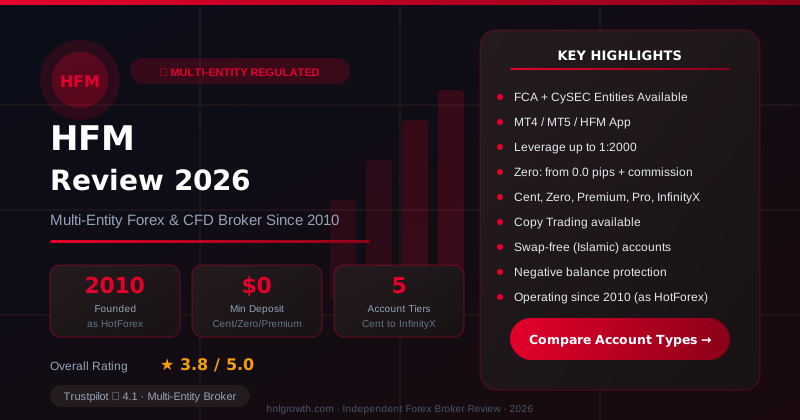
Checked on: 2026-08-09 | Broker terms, regulation, and pricing can change. Always verify at the official HFM site before opening an account.
Affiliate Disclosure: HNL Growth may earn a commission if you open an account through our links, at no additional cost to you. Risk Warning: CFDs and leveraged forex products are complex instruments and carry a high risk of losing money rapidly due to leverage. Between 65-95% of retail investor accounts lose money when trading CFDs, depending on the HFM entity and account type. Trading forex and CFDs may not be suitable for all investors. Consider your objectives, experience, and risk appetite before trading, and ensure you understand the risks involved. Broker Disclosure: HFM (HF Markets Group) is a live, regulated multi-entity broker (not a simulated prop-firm evaluation) — trades are executed with real capital in live market conditions, subject to normal market risk. Protections vary significantly by the specific legal entity that onboards your account.
Margin Calculator: How Much Margin a Trade Requires
Trading margin is the collateral your broker locks aside to open and hold a leveraged position — it is not a fee, and it is returned when the trade closes. The required margin is calculated as (Lot Size × Contract Size × Price) ÷ Leverage. For a 1-lot EUR/USD trade at 1.0850 with 30:1 leverage, that is $3,616.67. With 200:1 leverage, the same trade needs only $542.50. This page calculates required margin across forex, metals, indices, and energies, explains how leverage, lot size, and account currency interact, and shows the exact adverse move that would trigger a margin call or stop-out. It covers trading margin only — not business profit margin (selling price minus cost), which is a separate concept addressed briefly at the end.
Interactive Trading Margin Calculator
HashHedge — Crypto Futures Prop Firm
Up to $200K funded accounts · 85% profit split · Instant USDT payouts · 160+ assets
Tool specification (for front-end implementation). The calculator sits above the fold with no signup gate. Inputs: instrument dropdown (forex majors, minors, precious metals, indices, energies — each with its preset contract size), lot size (0.01–100), leverage ratio (slider 1:1 to 500:1), current price (manual entry with optional indicative feed), and account currency (USD, EUR, GBP, JPY, and others supported by the broker). Outputs: required margin in account currency, margin as a percentage of notional position value, and the adverse price move (in pips/points) that would hit the broker's stop-out level given a user-defined equity input. A secondary tab shows the same trade's margin under 30:1, 100:1, and 500:1 leverage side-by-side for jurisdiction comparison.
Example output (illustrative):
| Input | Value |
|---|---|
| Instrument | EUR/USD |
| Lot size | 1.00 |
| Leverage | 30:1 |
| Price | 1.0850 |
| Account currency | USD |
| Output | Value |
|---|---|
| Notional position value | $108,500 |
| Required margin | $3,616.67 |
| Margin as % of position | 3.33% |
Try the same inputs at 200:1 and the required margin drops to $542.50 — but the adverse move to liquidation shrinks from ~333 pips to ~50 pips. The calculator makes this tradeoff visible.
Disclosure: This page may contain affiliate links. We may earn a commission if you open an account through our links, at no extra cost to you.
Open a free HFM demo account to test these margin conditions with virtual capital
How Trading Margin Is Calculated
The Required Margin Formula
$$ \text{Required Margin} = \frac{\text{Lot Size} \times \text{Contract Size} \times \text{Price}}{\text{Leverage}} $$
- Lot size — the number of contracts you are trading (0.01 micro to 1.00 standard and above).
- Contract size — the number of units one lot represents for that instrument.
- Price — the current market price in the quote currency.
- Leverage — the ratio the broker applies (e.g., 30:1, 100:1, 500:1).
If your account currency differs from the quote currency, the result is converted at the prevailing rate before being reserved on your balance.
Worked Example: EUR/USD at 30:1
A trader opens 1 standard lot of EUR/USD at 1.0850 with 30:1 leverage.
- Lot size = 1
- Contract size = 100,000 units
- Price = 1.0850
- Position value = 1 × 100,000 × 1.0850 = $108,500
- Required margin = $108,500 ÷ 30 = $3,616.67
That $3,616.67 is reserved on the account until the position closes. Spread, commission, and overnight swap are separate transaction costs and are not part of margin.
Worked Example: Gold (XAU/USD) at 30:1
A trader opens 1 lot of XAU/USD at $2,340 with 30:1 leverage.
- Lot size = 1
- Contract size = 100 oz (standard gold contract)
- Price = $2,340
- Position value = 1 × 100 × 2,340 = $234,000
- Required margin = $234,000 ÷ 30 = $7,800
Gold requires more than double the margin of EUR/USD at the same leverage because the notional position value is higher. Always verify the broker's published contract size for metals and indices — they vary between providers.
Margin Requirements by Instrument Type
The table below uses HFM's published maximum leverage for its standard accounts (up to 1:2000 for the Pro, Zero, Premium, and Cent accounts, and unlimited for the InfinityX account, according to the broker's official trading accounts page) to show how the same notional exposure maps to different margin requirements at common leverage benchmarks. Actual per-instrument leverage caps may be lower than the account maximum — always confirm the margin schedule on the broker's platform before sizing a trade.
Forex Pairs
| Instrument | Contract Size | Position Value (indicative) | Margin @ 30:1 | Margin @ 100:1 | Margin @ 500:1 |
|---|---|---|---|---|---|
| EUR/USD | 100,000 units | $108,500 | $3,616.67 | $1,085.00 | $217.00 |
| GBP/USD | 100,000 units | $126,800 | $4,226.67 | $1,268.00 | $253.60 |
| USD/JPY | 100,000 units | ¥15,420,000 (~$100,000) | ~$3,333 | ~$1,000 | ~$200 |
Precious Metals and Energies
| Instrument | Contract Size | Position Value (indicative) | Margin @ 30:1 | Margin @ 100:1 |
|---|---|---|---|---|
| XAU/USD (Gold) | 100 oz | $234,000 | $7,800 | $2,340 |
| XAG/USD (Silver) | 5,000 oz | $145,000 | $4,833 | $1,450 |
| WTI Crude Oil | 1,000 barrels | $78,500 | $2,617 | $785 |
Index CFDs
| Instrument | Contract Size (typical) | Position Value (indicative) | Margin @ 30:1 | Margin @ 100:1 |
|---|---|---|---|---|
| US500 (S&P 500) | $1 × index | $54,200 | $1,807 | $542 |
| GER40 (DAX) | €1 × index | €18,300 | €610 | €183 |
| UK100 (FTSE 100) | £10 × index | £82,000 | £2,733 | £820 |
Index contract multipliers are broker-specific. Confirm HFM's current specifications on the broker's trading instruments or platform documentation pages.
Leverage and Margin: The Relationship
Leverage and margin are inverse expressions of the same concept. Higher leverage means lower margin required — but also a smaller adverse price move before liquidation. A trader using 500:1 leverage needs only $217 to control 1 lot of EUR/USD, but a 20-pip move against the position represents nearly 92% of the margin posted.
Leverage-to-Margin Conversion Table
Based on 1 standard lot of EUR/USD at 1.0850 ($108,500 notional).
| Leverage | Margin % | Required Margin |
|---|---|---|
| 1:1 | 100.00% | $108,500.00 |
| 5:1 | 20.00% | $21,700.00 |
| 10:1 | 10.00% | $10,850.00 |
| 20:1 | 5.00% | $5,425.00 |
| 30:1 | 3.33% | $3,616.67 |
| 50:1 | 2.00% | $2,170.00 |
| 100:1 | 1.00% | $1,085.00 |
| 200:1 | 0.50% | $542.50 |
| 500:1 | 0.20% | $217.00 |
Free Margin, Used Margin, and Margin Level
- Used margin — the total collateral currently reserved across all open positions.
- Free margin — Equity minus Used Margin. This is the capital available to open new positions or absorb adverse price moves.
- Margin level — (Equity ÷ Used Margin) × 100, expressed as a percentage. Brokers use this ratio to trigger margin calls and stop-outs.
Example: A $10,000 account with one open 1-lot EUR/USD position at 30:1 (margin $3,616.67) and no floating P/L has free margin of $6,383.33 and a margin level of 276.5%. If the trade moves against the trader by $3,000, equity drops to $7,000, free margin to $3,383.33, and margin level to 193.6% — still above typical stop-out thresholds, but approaching caution territory.
Margin Call and Stop-Out Mechanics
What Triggers a Margin Call
A margin call occurs when account equity falls to a broker-defined percentage of used margin. HFM's published levels, according to the broker's official trading accounts comparison table, are:
- Standard accounts (Cent, Zero, Pro, Premium): margin call at 50% margin level.
- InfinityX account: margin call at 20% margin level.
A margin call is a warning — the broker is notifying the trader that additional funds are needed or positions will be closed.
Stop-Out Level and Forced Liquidation
The stop-out level is the margin level at which the broker begins closing positions automatically, starting with the most loss-making. HFM's published stop-out levels:
- Standard accounts: 20% margin level.
- InfinityX account: 0% margin level.
Scenario table — 1 lot EUR/USD, entry 1.0850, account equity $5,000, 100:1 leverage ($1,085 margin).
| Stop-Out Level | Equity at Liquidation | Adverse Move (pips) | Loss at Liquidation |
|---|---|---|---|
| 50% (illustrative) | $542.50 | 4,458 pips | $4,457.50 |
| 20% (HFM standard) | $217.00 | 4,783 pips | $4,783.00 |
| 0% (HFM InfinityX) | $0 | 5,000 pips | $5,000.00 |
Higher leverage compresses these pip distances dramatically. At 500:1 (margin $217), a 20% stop-out on the same equity would trigger after approximately a 48-pip adverse move.
How to Reduce Liquidation Risk
- Use lower leverage. The margin requirement rises, but the buffer against adverse moves widens proportionally.
- Size positions relative to equity. A common risk-management rule is to risk no more than 1–2% of equity on any single trade.
- Maintain buffer equity. Free margin well above the margin-call threshold absorbs volatility without triggering automated closure.
- Use stop-losses sized to the instrument's typical range. A 10-pip stop on GBP/JPY will be hit by routine noise; a 60-pip stop may better reflect the pair's daily movement.
Demo accounts allow traders to observe how margin, equity, and stop-out mechanics interact under simulated market conditions without risking real capital. HFM offers a demo account with virtual funds for this purpose.
Leverage Caps by Jurisdiction
The leverage a trader can access depends on the regulator overseeing their broker entity, not simply the broker's global maximum. HFM operates through multiple entities; the offshore entity HF Markets (SV) Ltd (St. Vincent & the Grenadines) can offer higher leverage than would be permitted under EU, UK, or Australian regulation.
ESMA and FCA Limits
The European Securities and Markets Authority (ESMA) introduced binding leverage caps for retail CFD traders in 2018 (Product Intervention Measures), mirrored by the UK Financial Conduct Authority (FCA) under PS18/14:
| Asset Class | Maximum Leverage |
|---|---|
| Major forex pairs | 30:1 |
| Minor/exotic forex pairs | 20:1 |
| Gold and major indices | 20:1 |
| Other commodities and non-major indices | 10:1 |
| Individual equities | 5:1 |
| Cryptocurrencies | 2:1 (or banned, depending on jurisdiction) |
ASIC and Other Regulators
Australia's ASIC implemented substantially equivalent caps from March 2021 (ASIC Corporations (Product Intervention Order — Contracts for Difference) Instrument 2020/986), aligning with ESMA for retail clients. Japan's FSA caps forex leverage at 25:1 for retail traders.
Offshore Jurisdictions
Regulators in St. Vincent & the Grenadines, Seychelles, and similar jurisdictions do not impose retail leverage caps, which is why brokers registered there — including HFM's SVG entity — can advertise leverage up to 1:2000 or, in the case of HFM's InfinityX account, unlimited. Higher leverage reduces required margin but proportionally increases liquidation risk. Traders choosing an offshore entity for leverage access should treat the additional headroom as a risk-management variable, not a capital-efficiency gain.
Jurisdiction comparison — same 1-lot EUR/USD trade, $108,500 notional.
| Regulator | Max Leverage (Majors) | Required Margin |
|---|---|---|
| ESMA / FCA | 30:1 | $3,616.67 |
| ASIC | 30:1 | $3,616.67 |
| Japan FSA | 25:1 | $4,340.00 |
| HFM (SVG entity, Pro account) | Up to 2000:1 | From $54.25 |
Trading Margin vs. Business Profit Margin
The term "margin" appears in both trading and business contexts with entirely different meanings. This page covers trading margin exclusively; the table below clarifies the distinction for readers who arrived from a general search.
| Aspect | Trading Margin | Business Profit Margin |
|---|---|---|
| Definition | Collateral required to open a leveraged position | Revenue minus cost of goods sold |
| Formula | (Lot Size × Contract Size × Price) ÷ Leverage | (Revenue − Cost) ÷ Revenue × 100 |
| Purpose | Secure the broker against adverse price moves | Measure profitability of a product or business |
| Expressed as | Currency amount or % of notional | Percentage of revenue |
| Typical range | 0.2%–100% of position value | 5%–60% of revenue, sector-dependent |
If you are looking for a business profit-margin calculator, this is not the right tool. The calculators and formulae on this page apply only to leveraged forex and CFD trading.
Frequently Asked Questions
How is forex margin calculated? Multiply the lot size by the contract size (100,000 units for 1 standard lot) and the current price, then divide by the leverage ratio. Example: 1 lot EUR/USD at 1.0850 and 30:1 leverage requires $3,616.67.
What is the difference between margin and leverage? They are inverse expressions of the same concept. Leverage (e.g., 30:1) describes how much larger your market exposure is than your capital. Margin (3.33%) is the percentage of the position value you must post as collateral.
What is a margin call in trading? A margin call is a broker notification that account equity has fallen to a defined percentage of used margin. At HFM's standard accounts, the margin-call threshold is 50% margin level. It is a warning — positions are closed automatically only if equity falls further to the stop-out level.
What leverage should a beginner use? Lower leverage widens the buffer between entry price and liquidation. Beginners often start at 10:1 or 30:1 (the ESMA/FCA retail cap for major forex pairs), which allows a meaningful adverse move before stop-out while still providing capital efficiency.
How do I calculate free margin? Free Margin = Equity − Used Margin. If your account equity is $10,000 and open positions have reserved $3,616.67 in margin, your free margin is $6,383.33.
What is the margin requirement for 1 lot of EUR/USD? At 30:1 leverage and a price of 1.0850, the required margin is $3,616.67. At 100:1 it is $1,085. At 500:1 it is $217. The figure scales linearly with leverage.
Does margin change with account currency? The margin is first calculated in the instrument's quote currency, then converted to the account's base currency at the prevailing rate. A EUR-funded account trading EUR/USD will see margin reserved in EUR at the current USD/EUR rate.
What is the stop-out level? The stop-out level is the margin level at which the broker automatically closes open positions to prevent a negative balance. HFM's standard accounts stop out at 20% margin level; the InfinityX account stops out at 0%.
What to Verify Yourself Before Trading
Because margin conditions, contract specifications, and regulatory applicability vary by entity and change over time, verify the following directly on HFM's platform or with its support team before funding an account:
- The exact leverage cap and margin percentage applied to your specific instrument and account type.
- Contract sizes for metals, indices, and energies — these are broker-specific.
- Whether your account falls under the SVG entity or another entity within the HFM group, and the protections (or lack of protections) that apply as a result.
- The current margin-call and stop-out thresholds for your account tier.
- How margin is converted when your account currency differs from the trade's quote currency.
HFM's official trading accounts page lists account types, margin requirements, leverage ranges, and stop-out levels for each tier.
Compare HFM account types and open a live trading account
Risk warning: CFDs and leveraged forex products are complex instruments and carry a high risk of losing money rapidly due to leverage. Consider whether you understand how these products work and whether you can afford to take the high risk of losing your capital. Check the entity, terms and protections that apply in your jurisdiction before trading.
Risk warning: CFDs and leveraged forex products are complex instruments and carry a high risk of losing money rapidly due to leverage. Retail investor accounts lose money when trading CFDs with most providers; the exact percentage varies by HFM entity and account type. You should consider whether you understand how CFDs work and whether you can afford to take the high risk of losing your money. Check the entity, terms and investor protections that apply in your jurisdiction before opening an account or trading.
Ready to Start Your Funded Trading Journey?
Join traders backed by $11M+ in verified payouts and a 4.7/5 Trustpilot rating. Compare HashHedge challenge plans, drawdown rules, and payout terms — apply code ha25 for the current discount.
Risk disclaimer: Challenge fees are non-refundable if you breach the rules. Prop trading involves significant financial risk. Past performance in a simulated environment does not guarantee results on a funded account. Only purchase if you understand the rules fully and can afford to lose the fee. Affiliate disclosure: HNL Growth earns a commission when you purchase a HashHedge challenge through links on this page.