The Martingale Strategy in Forex: Why the Maths Fails
The martingale strategy doubles position size after every losing trade so the next win recovers all prior losses plus one base-unit profit. In forex, the mathematics fails for...
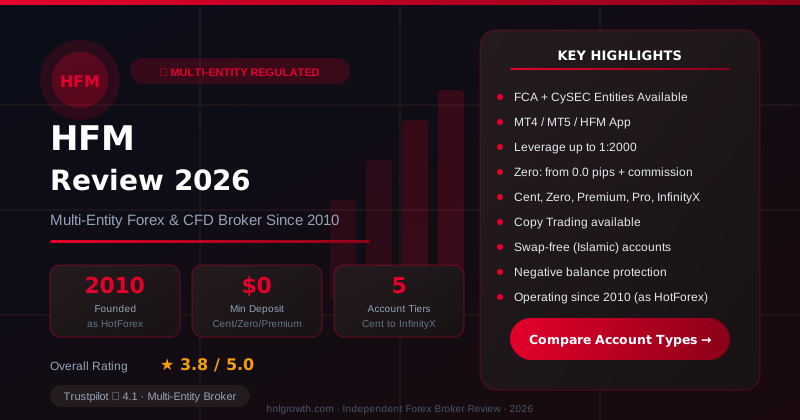
Checked on: 2026-08-05 | Broker terms, regulation, and pricing can change. Always verify at the official HFM site before opening an account.
Affiliate Disclosure: HNL Growth may earn a commission if you open an account through our links, at no additional cost to you. Risk Warning: CFDs and leveraged forex products are complex instruments and carry a high risk of losing money rapidly due to leverage. Between 65-95% of retail investor accounts lose money when trading CFDs, depending on the HFM entity and account type. Trading forex and CFDs may not be suitable for all investors. Consider your objectives, experience, and risk appetite before trading, and ensure you understand the risks involved. Broker Disclosure: HFM (HF Markets Group) is a live, regulated multi-entity broker (not a simulated prop-firm evaluation) — trades are executed with real capital in live market conditions, subject to normal market risk. Protections vary significantly by the specific legal entity that onboards your account.
Disclosure: This page may contain affiliate links. We may earn a commission if you open an account through our links, at no extra cost to you.
The Martingale Strategy in Forex: Why the Maths Fails
The martingale strategy doubles position size after every losing trade so the next win recovers all prior losses plus one base-unit profit. In forex, the mathematics fails for retail traders because exponential position growth collides with finite account equity, broker stop-out thresholds, spread costs that scale with lot size, and maximum lot-size ceilings — long before the sequence can guarantee recovery. No position-sizing system converts a negative-expectancy edge into a positive one. Martingale only redistributes the shape of outcomes: frequent small wins punctuated by rare but total losses. This guide explains the mechanics with forex-native examples, quantifies the constraints that break the sequence, and provides a decision framework for evaluating the approach against alternatives.
How the Martingale Sequence Works in Forex
HashHedge — Crypto Futures Prop Firm
Up to $200K funded accounts · 85% profit split · Instant USDT payouts · 160+ assets
The martingale system follows a single rule: after each losing trade, open the next position at double the previous lot size. When a trade finally wins, the larger position recovers every prior loss in the sequence plus a profit equal to one base unit.
In forex terms, start with 0.01 lots (one micro lot) on EUR/USD. Each trade targets a 20-pip stop loss. When the trade loses, the next position doubles to 0.02 lots, then 0.04, 0.08, and so on. At 1:1 payoff, the winning trade's pip gain should cover all accumulated losses plus $0.20 — the dollar value of 20 pips on the original 0.01 lot.
The table below walks through seven consecutive losses on EUR/USD, assuming a 1.2-pip spread:
| Step | Lot size | Trade loss (20 pips) | Cumulative loss | Spread cost (1.2 pips) |
|---|---|---|---|---|
| 1 | 0.01 | $0.20 | $0.20 | $0.12 |
| 2 | 0.02 | $0.40 | $0.60 | $0.24 |
| 3 | 0.04 | $0.80 | $1.40 | $0.48 |
| 4 | 0.08 | $1.60 | $3.00 | $0.96 |
| 5 | 0.16 | $3.20 | $6.20 | $1.92 |
| 6 | 0.32 | $6.40 | $12.60 | $3.84 |
| 7 | 0.64 | $12.80 | $25.40 | $7.68 |
The recovery trade — step 8 at 1.28 lots — needs 21 pips of favourable movement to cover all seven losses, all spread costs, and deliver the $0.20 target profit. That extra pip beyond the standard 20 exists because cumulative spread across the sequence erodes the recovery margin.
The Exponential Capital Problem
Doubling produces geometric growth in position size. After ten consecutive losses starting from 0.01 lots, the required position is 10.24 lots — over one full standard contract — to recover a sequence whose base profit is just $0.20.
| Consecutive losses | Required next lot | Cumulative loss |
|---|---|---|
| 1 | 0.02 | $0.20 |
| 2 | 0.04 | $0.60 |
| 3 | 0.08 | $1.40 |
| 4 | 0.16 | $3.00 |
| 5 | 0.32 | $6.20 |
| 6 | 0.64 | $12.60 |
| 7 | 1.28 | $25.40 |
| 8 | 2.56 | $51.00 |
| 9 | 5.12 | $102.20 |
| 10 | 10.24 | $204.60 |
For a strategy with a 50% win rate, six consecutive losses occur with probability 0.5⁶ — roughly once every 64 sequences. Over hundreds of trades, that is not a tail event; it is a near-certainty.
Traders comparing brokers should pay close attention to how account conditions affect the viability of this sequence. You can compare HFM account types to see how spreads, leverage, and lot limits differ across tiers.
Five Forex Constraints That Break the Theory
Most martingale explanations use casino analogies. Forex introduces five mechanical constraints that those examples ignore entirely.
Spread Cost Compounds With Every Doubling
Spread is paid per lot traded. As lot size doubles, so does the dollar cost of the spread. On EUR/USD with a 1.2-pip spread, the first trade costs $0.12 in spread; the seventh trade costs $7.68. Total spread paid across seven losing trades: $15.24.
The recovery trade at 1.28 lots pays another $15.36 in spread. That means $30.60 in total spread cost to chase a $0.20 target profit. Spread acts like a house edge — it compounds against you with each step and erodes the net recovery even when the sequence eventually wins.
Margin Call and Stop-Out as Hard Ceilings
Brokers automatically close positions when your margin level falls below a defined stop-out threshold. According to the published account specifications, HFM's Zero, Pro, and Premium accounts carry a margin call at 50% and a stop-out level at 20%. The InfinityX account operates differently, with margin call at 20% and stop-out at 0%.
On a $1,000 Pro account using 1:2000 leverage (the maximum available according to the HFM trading-accounts page), the sequence survives seven doublings before the eighth triggers stop-out. At that step, the required margin for 1.28 lots ($70.40) pushes the margin level below 100% after the cumulative $255.60 in losses.
Doublings Before Stop-Out: By Account Size and Leverage
The table below shows how many consecutive doublings survive before stop-out, using a 0.01-lot start with 20-pip losses. Calculations use the standard margin formula: Required Margin = (Lot Size × 100,000 × Price) / Leverage, with EUR/USD at 1.1000.
| Account size | 1:100 leverage | 1:500 leverage | 1:2000 leverage |
|---|---|---|---|
| $500 | 4 | 5 | 5 |
| $1,000 | 5 | 6 | 7 |
| $5,000 | 8 | 9 | 9 |
Even at maximum leverage on a $5,000 account, the sequence terminates after nine consecutive losses. Higher leverage extends the sequence by one or two steps but magnifies the terminal loss when it arrives.
Maximum Lot-Size Limits Cap the Sequence
According to the published HFM account specifications, most account types impose a maximum of 60 standard lots per position. The Cent account is limited to 1,000 Cent lots per position (equivalent to 10 standard lots).
Starting from 0.01 standard lots, the doubling sequence reaches 60 lots at step 13. In practice, margin exhaustion stops the sequence long before this on any standard-sized account. On the Cent account, however, the 1,000-lot per-position cap (step 7 equivalent) may constrain the sequence earlier than margin alone would dictate, depending on account equity.
Leverage: More Doublings, Bigger Terminal Loss
Leverage reduces the margin required per position, allowing more doublings. But it does not reduce cumulative losses — those grow identically regardless of leverage. Moving from 1:100 to 1:500 on a $1,000 account adds one doubling (from five to six), but the terminal loss at step six is $12.60 and at step seven is $25.40. Leverage extends the runway; it does not change the destination.
Slippage During Volatile Sessions
During major news releases and market-open windows, execution prices deviate from quoted prices. On a 0.01-lot trade, one pip of slippage costs $0.10. On the 1.28-lot recovery trade, that same pip costs $12.80 — more than the entire target profit of the sequence. Slippage is unmodelled in any static martingale calculation and worsens proportionally with position size.
Martingale vs. Anti-Martingale vs. Flat Sizing
Position sizing determines how risk is distributed across trades, not whether the underlying strategy is profitable. The table below compares three approaches across dimensions that matter for forex execution.
| Dimension | Martingale | Anti-martingale | Flat sizing |
|---|---|---|---|
| Risk per trade | Doubles after each loss | Doubles after each win | Fixed percentage of equity |
| Capital required | Very high (exponential) | Moderate | Low to moderate |
| Recovery speed | Single winning trade | Gradual | Gradual |
| Max single-sequence drawdown | Entire account | Capped at base unit | Fixed per trade |
| Best market condition | Range-bound, mean-reverting | Strong trending | All conditions |
| Worst market condition | Strong trending | Choppy, range-bound | None specifically |
| Edge requirement | None — does not create edge | None — does not create edge | None |
Anti-martingale — also associated with the Paroli system — inverts the logic: increase size after wins, decrease after losses. This caps drawdown at the base unit but requires sustained winning streaks to generate outsized returns. Flat sizing keeps risk constant and lets the strategy's edge determine results over time.
The fundamental point applies to all three: position sizing reshapes the distribution of outcomes but does not alter expected value. A negative-expectancy strategy remains negative regardless of how lot sizes change between trades.
When Doubling Aligns With Market Behaviour — And When It Does Not
Martingale logic has partial alignment with specific forex environments. Range-bound currency pairs that oscillate between support and resistance levels produce the mean-reverting price action where doubling after losses can recover before the next directional breakout. Positions that earn positive carry — the interest rate differential between the two currencies in a pair — accumulate swap income while the sequence waits for recovery, partially offsetting drawdown costs.
The strategy fails catastrophically in trending markets. A sustained directional move — driven by central bank policy divergence, geopolitical events, or macroeconomic shifts — produces the consecutive losses that exhaust margin before reversion occurs. News-driven volatility around Non-Farm Payrolls, CPI releases, or rate decisions widens spreads and triggers slippage precisely when the sequence is most capital-exposed.
No backtested or Monte Carlo simulation is referenced here; traders should validate any martingale-based approach on a demo account before committing equity.
Fractional Martingale: Reducing the Multiplier Below 2x
The exponential capital problem stems from the 2x multiplier. Reducing it to 1.5x or 1.3x slows position growth, but introduces a mathematical trade-off: the recovery trade can no longer cover all prior losses at the same 20-pip distance.
| Multiplier | Lots at step 5 | Cumulative loss (5 losses) | Lots at step 7 | Cumulative loss (7 losses) | Full recovery at 20 pips? |
|---|---|---|---|---|---|
| 2.0x | 0.16 | $6.20 | 0.64 | $25.40 | Yes |
| 1.5x | 0.08 | $3.70 | 0.23 | $10.50 | No — needs ~30 pips |
| 1.3x | 0.05 | $2.50 | 0.11 | $6.60 | No — needs ~43 pips |
Mathematically, full recovery at the same pip distance requires the recovery trade's pip gain to equal the cumulative loss. For any multiplier below 2.0, the required pip distance equals 20 ÷ (multiplier − 1). At 1.5x, that means 40 pips. At 1.3x, roughly 67 pips.
Fractional multipliers conserve capital during losing streaks but shift the recovery burden onto larger price movements. A 1.5x approach on a $1,000 account might survive two additional doublings compared to 2.0x, yet each recovery trade demands nearly double the pip distance. The trade-off is capital efficiency versus recovery reliability.
A Practical Risk Framework Before You Risk Real Capital
If you choose to explore martingale-type position sizing, set these guardrails before placing a live trade:
- Consecutive-loss cap. Limit any single sequence to four or five doublings maximum. Accept the loss and reset rather than continuing to chase.
- Session loss limit. Define a hard ceiling — for example, 5–10% of total equity — beyond which all trading stops for the session.
- Equity-per-sequence ceiling. Calculate the full capital commitment of your maximum sequence length before starting. If five doublings from 0.01 lots risks $6.20 plus spread, ensure that amount is acceptable.
- Demo testing period. Run the sequence on a demo account for at least 200 trades to observe how frequently your strategy produces consecutive losses in real market conditions.
- Cooling-off rule. After hitting your consecutive-loss cap, impose a mandatory pause before opening a new sequence.
The purpose of these rules is to cap the maximum drawdown at a survivable level rather than relying on the theoretical guarantee of eventual recovery.
If you want to test how the doubling sequence interacts with real spread and margin conditions, open a free HFM demo account and run the maths yourself before committing equity.
Which Broker Conditions Actually Matter for This Approach
If you are comparing brokers with martingale-type sizing in mind, generic feature comparisons are not useful. The conditions that directly affect sequence viability are specific and quantifiable.
| Condition | Why it matters |
|---|---|
| Spread on majors | Compounds with every doubling; lower spreads reduce recovery pip requirement |
| Minimum lot size | Sets the base unit; smaller minimums reduce capital at every step |
| Maximum lot size | Caps the sequence at a specific doubling step |
| Stop-out level | Determines when the broker forcibly closes positions; lower levels allow more doublings |
| Leverage tiers | Higher leverage extends the sequence but magnifies the terminal loss |
| Commission structure | Per-trade commissions compound like spread across the sequence |
HFM offers five account types — InfinityX, Cent, Zero, Pro, and Premium — each with different conditions relevant to this evaluation. According to the published account specifications, InfinityX provides spreads from 0.3 pips with a $500 minimum deposit, while the Zero account offers spreads from 0 pips on forex with commission applied. Stop-out levels are 20% on InfinityX and 20% on all other account types. Minimum trade size is 0.01 lots across all tiers, and maximum position size is 60 standard lots per position on standard accounts.
Traders evaluating whether these conditions suit their approach can open a HFM account to review the full terms for their jurisdiction.
Frequently Asked Questions
Is the martingale strategy legal in forex trading? Yes. Martingale is a position-sizing method, not a restricted trading practice. No major financial regulator prohibits doubling position size after losses. However, some brokers may restrict specific automated strategies that use martingale logic in their expert advisors.
How much capital do you need to use martingale in forex? The capital required depends on starting lot size, leverage, and the number of doublings you intend to sustain. Starting at 0.01 lots on a $1,000 account at 1:500 leverage, the sequence reaches stop-out after approximately six consecutive losses (cumulative loss: $12.60). Seven consecutive losses — a probability of roughly 1 in 128 on a 50% win-rate strategy — exhaust the sequence on most $1,000 accounts.
What is the difference between martingale and anti-martingale? Martingale doubles position size after losses and resets after a win. Anti-martingale increases size after wins and decreases after losses. Martingale seeks to recover drawdowns in a single trade; anti-martingale seeks to amplify winning streaks while limiting losses to the base unit.
Can martingale work on a small account? A small account limits the number of viable doublings. A $500 account at 1:2000 leverage sustains approximately five doublings before stop-out. Fewer available doublings means the sequence fails at a lower consecutive-loss threshold, making it less viable in practice.
Does martingale change your expected value? No. Position sizing redistributes when wins and losses occur but does not alter the mathematical expected value of the underlying strategy. A negative-expectancy strategy remains negative-expectancy under martingale — it simply produces more frequent small wins and less frequent but larger losses.
Risk Warning
CFDs and leveraged forex products are complex instruments and carry a high risk of losing money rapidly due to leverage. Consider whether you understand how these products work and whether you can afford to take the high risk of losing your capital. Check the entity, terms and protections that apply in your jurisdiction before trading. The martingale strategy amplifies drawdown severity and can result in the loss of your entire account balance in a single losing sequence. Position sizing does not create a trading edge where none exists.
Risk warning: CFDs and leveraged forex products are complex instruments and carry a high risk of losing money rapidly due to leverage. Retail investor accounts lose money when trading CFDs with most providers; the exact percentage varies by HFM entity and account type. You should consider whether you understand how CFDs work and whether you can afford to take the high risk of losing your money. Check the entity, terms and investor protections that apply in your jurisdiction before opening an account or trading.
Ready to Start Your Funded Trading Journey?
Join traders backed by $11M+ in verified payouts and a 4.7/5 Trustpilot rating. Compare HashHedge challenge plans, drawdown rules, and payout terms — apply code ha25 for the current discount.
Risk disclaimer: Challenge fees are non-refundable if you breach the rules. Prop trading involves significant financial risk. Past performance in a simulated environment does not guarantee results on a funded account. Only purchase if you understand the rules fully and can afford to lose the fee. Affiliate disclosure: HNL Growth earns a commission when you purchase a HashHedge challenge through links on this page.