Oil Trading Explained: Contracts, Spreads and Risk
Oil trading means speculating on whether the price of crude oil will rise or fall, without buying, storing, or delivering any physical barrels. Most retail traders do this through CFDs (Contracts for...
Reviewed using our forex & CFD broker review methodology
Checked on: 2026-08-17 | Broker terms, regulation, and pricing can change. Always verify at the official PU Prime site before opening an account.
Affiliate Disclosure: HNL Growth may earn a commission if you open an account through our links, at no additional cost to you. Risk Warning: CFDs and leveraged forex products are complex instruments and carry a high risk of losing money rapidly due to leverage. 62.2% of retail investor accounts lose money when trading CFDs with this provider. Trading forex and CFDs may not be suitable for all investors. Consider your objectives, experience, and risk appetite before trading, and ensure you understand the risks involved. Broker Disclosure: PU Prime is a live, regulated multi-entity broker (not a simulated prop-firm evaluation) — trades are executed with real capital in live market conditions, subject to normal market risk. Which PU Prime entity holds your account depends on your country of residence and determines your leverage cap and protections.
Last verified: August 2026 | Editorial Team
Oil Trading Explained: Contracts, Spreads and Risk
Disclosure: This page may contain affiliate links. We may earn a commission if you open an account through our links, at no extra cost to you. Our editorial content is independent of any commercial relationship.
Oil trading means speculating on whether the price of crude oil will rise or fall, without buying, storing, or delivering any physical barrels. Most retail traders do this through CFDs (Contracts for Difference) on Brent or WTI crude, using leverage to open a position larger than their deposit would otherwise allow. You never take delivery of oil. You're trading a contract that mirrors the price movement of the underlying market, and your profit or loss is the difference between your entry and exit price, minus costs like the spread. This guide walks through how that mechanically works, using one clearly labeled hypothetical example, plus the risks, common beginner mistakes, and how to practise before using real money.
If you want to explore the mechanics without risking real capital first, you can open a PU Prime demo account and practise placing positions on oil before deciding whether to fund a live account.
What Is Oil Trading? A Plain-Terms Explanation
PU Prime — Multi-Entity Forex & CFD Broker
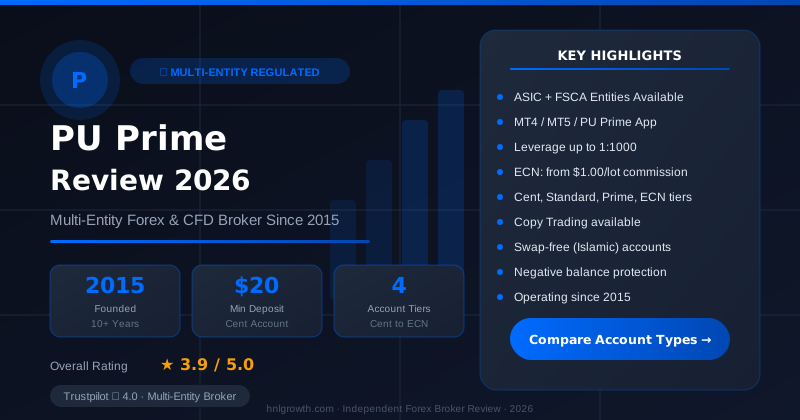
ASIC (AU) + FSCA (ZA) entities available · $20 min deposit (Cent) · MT4, MT5, PU Prime App · 4 account tiers
When you "trade oil" as a retail CFD trader, you're not buying a tanker of crude. You're opening a contract with your broker that tracks the price of a specific oil benchmark, usually Brent or WTI. If you think the price will rise, you open a long position (buy). If you think it will fall, you open a short position (sell). When you close the position, your gain or loss is calculated from the price difference, multiplied by your position size, adjusted for leverage, spread, and any overnight financing charges.
Three terms come up constantly for anyone new to this, so it's worth defining them plainly before going further:
- Leverage lets you control a position larger than your deposit. For example, if 1:20 leverage is available for a given instrument on your account, a $400 deposit could control an $8,000 position. Leverage amplifies both gains and losses, not just gains.
- Margin is the deposit your broker holds as security while your leveraged position is open. It is calculated from the position size and the leverage available on your account.
- Spread is the small gap between the buy price and the sell price of the instrument. It is built into every trade you open and close, and it is a routine cost of trading rather than a hidden fee, though it does reduce your result on small or short-term trades.
Available leverage and margin requirements depend on your account type and which regulatory entity oversees your account, since these differ by region. PU Prime operates under multiple regulators — the FSA in Seychelles, the FSC in Mauritius, the FSCA in South Africa, and the CMA in the UAE — and trading conditions including leverage limits and eligible instruments can vary between them. Check the PU Prime regulation page to confirm which entity and conditions would apply in your jurisdiction before assuming any specific leverage figure.
Brent and WTI: The Two Oil Prices You'll See Quoted
Almost every oil price you see quoted refers to one of two benchmarks: Brent crude or WTI (West Texas Intermediate) crude.
Brent is the international benchmark for crude extracted mainly from the North Sea, and it serves as the reference price across Europe, Africa, and much of Asia. WTI is the US benchmark, extracted primarily in the United States, and is the reference price most closely watched in North America. The two trade at different prices most of the time because they come from different regions, have slightly different chemical properties, and face different transport and storage costs to reach refineries.
For a beginner, the practical takeaway is simple: they are two separate instruments that usually move in the same direction, driven by similar global supply and demand forces, but they do not always move by the same amount, and the price of one is not the price of the other. Which one you trade depends on your broker's offering and your own preference.
Spread and margin figures change over time, so rather than treating any printed number as current, check PU Prime's own spreads and costs page directly for the latest instrument-level data on whichever oil CFD you are considering.
How an Oil Trade Works, Step by Step (Worked Example)
Here is the mechanical sequence for any CFD oil trade, long or short:
- You choose an instrument (for example, a WTI crude oil CFD) and decide on a direction — long or short.
- You choose a position size, usually expressed in lots.
- Your broker calculates the margin required to open the position, based on your leverage.
- You pay the spread as part of entering the trade.
- While the position is open, your profit or loss moves with the market price, and an overnight financing charge (swap) may apply if you hold the position past the daily rollover.
- When you close the position, your final profit or loss is settled to your account balance.
The table below is a hypothetical, illustrative example only. It does not reflect PU Prime's live pricing, current spreads, or any specific contract specification. Actual spreads, margin percentages, leverage, and swap charges vary by instrument, account type, regulatory entity, and market conditions. Always check your trading platform or the official PU Prime spreads and costs page for current figures before placing any real trade.
Worked Trade Walkthrough (hypothetical illustration only — not live pricing)
| Item | Illustrative value |
|---|---|
| Instrument | WTI crude oil CFD (long position) |
| Entry price | $80.00 per barrel |
| Position size | 0.1 lots (assumed 100 barrels for this illustration) |
| Leverage used (example only) | 1:20 |
| Position value | 100 barrels × $80.00 = $8,000 |
| Margin required | $8,000 ÷ 20 = $400 |
| Spread cost (illustrative) | 4 points ($0.04/barrel) × 100 barrels = $4 |
| Price moves to | $81.00 per barrel |
| Gross gain on the move | $1.00 × 100 barrels = $100 |
| Net result before any swap | $100 − $4 spread = $96 |
Two things to note about this example. First, the $400 margin is what is tied up while the position is open, not a cap on your maximum possible loss. If the price had moved against you instead, losses would be calculated the same way, and a larger adverse move can exceed the margin held depending on your account's terms. Second, this example excludes overnight financing charges. Swap costs apply if a position is held past the daily rollover cutoff and can add meaningfully to the total cost of a multi-day trade. Swap rates vary by instrument and direction (long or short) and are published on the PU Prime spreads and costs page.
The Real Risks of Oil Trading — and Who Should Think Twice
Oil is a genuinely volatile market. Prices can move sharply around OPEC production decisions and around inventory data releases such as US crude stock reports. These events are worth being aware of as causes of price swings. Reacting to a headline without a plan is a common way beginners get caught on the wrong side of a fast move.
The main risks to understand before opening any position:
- Leverage magnifies losses as well as gains. A small adverse price move can produce a loss that is large relative to your deposit.
- Overnight financing (swap) charges accumulate the longer you hold a position. These are disclosed on your broker's costs page and vary by instrument, direction, and account type.
- Whether you can lose more than your deposit depends on your account type and the regulatory entity governing your account. This varies between entities and jurisdictions — check the specific terms that apply to your account rather than assuming any blanket protection exists.
- Volatility around news events can widen the gap between your intended entry price and your actual execution price, particularly during fast-moving sessions.
Is oil trading right for you? A quick check
- Do you have risk capital you can afford to lose entirely, separate from essential living expenses? If not, oil CFD trading is not appropriate for you right now.
- Are you comfortable with a market that can move several percent in a single session? If not, this is likely too volatile for your current risk tolerance.
- Do you understand that leverage increases both potential gains and potential losses, not just gains? If you are unsure, revisit the leverage explanation above before opening any position.
- Do you have time to monitor an open position, or a clear exit plan such as a stop-loss order if you cannot watch the market continuously? If not, unmonitored leveraged positions carry added risk.
Oil CFD trading is not suitable for anyone seeking guaranteed returns, anyone who cannot tolerate the loss of their invested capital, or anyone without the time to set and manage a clear risk plan. No broker or strategy can promise safety, guaranteed withdrawals, or risk-free outcomes with a leveraged product. Any claim suggesting otherwise should be treated with caution.
Mistakes Beginners Commonly Make
A short list of the errors that appear most often when new traders start with oil CFDs:
- Oversizing the position. Choosing a lot size based on what looks like a small percentage move, without checking what that move actually costs in dollar terms if the market goes the wrong way.
- Trading without a stop-loss. Leaving a leveraged position open with no predefined exit point, then waiting and hoping the market recovers.
- Ignoring overnight financing costs. Holding a position for several days without accounting for the swap charge, then being surprised by how much it has reduced the final result.
- Trading the headline, not a plan. Jumping into a trade immediately after an OPEC announcement or an inventory report because the price is moving, without any predetermined entry point, exit level, or position size.
- Treating a demo win streak as proof of a strategy. Demo results and live results can differ substantially once real capital and real emotional pressure are involved.
How to Practise Oil Trading Without Real Capital
The lowest-risk way to learn how oil CFDs actually behave is to practise on a demo account before committing any real capital. A demo account uses virtual funds against live market pricing, so you can observe how spread, leverage, and price movement interact in conditions close to the real market.
According to PU Prime's own account-opening guidance, a demo account can be opened while a live account application is being processed, and it uses real market prices rather than simulated ones. For current registration steps, available instruments, and any applicable time limits on demo access, see the PU Prime guide to opening a trading account directly, since terms can be updated.
Demo trading is a useful way to learn platform mechanics, but it does not replicate the psychological pressure of risking real money. Use it as a structured learning tool — not as a performance forecast for what will happen once real funds are involved.
Verification Checklist Before You Open a Live Account
No independent audit of PU Prime's execution, withdrawal processing, or platform behaviour has been conducted for this article. Before funding a live account, consider verifying the following directly from official sources:
| What to check | Where to verify |
|---|---|
| Which regulatory entity governs your account and what leverage limits apply | puprime.com/regulation |
| Current spreads, swap rates, and margin requirements for oil instruments | puprime.com/spread-and-costs |
| Minimum deposit for your chosen account type | puprime.com/how-to-open-a-trading-account |
| Whether negative balance protection applies to your account | Your account agreement and the applicable entity's terms |
| Withdrawal methods, processing times, and any fees | PU Prime's official payments or FAQ page |
| Demo account terms, virtual balance, and duration | puprime.com/how-to-open-a-trading-account |
Independent broker review sites and community forums can supplement your research, but treat user-reported experiences as anecdotal rather than as verified fact.
FAQ
What is oil trading, in one sentence? Speculating on the rising or falling price of crude oil — usually Brent or WTI — through a CFD contract, without taking physical delivery of the commodity.
What is the difference between Brent and WTI? Brent is the benchmark for crude extracted mainly from the North Sea and referenced widely outside North America. WTI is the US benchmark. They usually move in the same direction but not always by the same amount, due to differences in origin, chemical properties, and transport economics.
How much leverage can I use to trade oil? This depends on your account type and the regulatory entity that governs your account, since leverage limits differ by jurisdiction. Check the PU Prime regulation page to confirm which entity and conditions apply to you before assuming any specific figure.
Can I lose more than I deposit trading oil CFDs? This depends on your account type and the regulatory entity governing it. Rather than assuming any blanket protection applies, check the specific terms that apply to your account before trading, and only ever use capital you could afford to lose in full.
Is oil more volatile than other markets? Oil can move sharply around events such as OPEC production decisions and inventory data releases. This makes it a genuinely volatile market, and that volatility is a factor to plan around through careful position sizing and the use of stop-loss orders, not something to react to without a plan.
What account types are available at PU Prime? PU Prime offers four main account types: Cent, Standard, Prime, and ECN. According to PU Prime's own account-opening guidance, the Cent account has a minimum deposit of $20 and the Standard account requires $50, though you should confirm current minimums directly as these can change. PU Prime lists commodities — including crude oil CFDs — among its tradable instrument categories alongside forex, indices, metals, shares, ETFs, and bonds. For a full current comparison of account conditions, see the PU Prime account-opening guide and the spreads and costs page.
Do I need prior experience to start trading oil? No prior experience is required to open an account, but understanding leverage, margin, and spread — as covered in this guide — before placing a real trade will help you avoid the most common beginner mistakes.
Should I start with a demo account? Practising the mechanics of opening and closing a position, and observing how spread and price movement affect your result, on a demo account before using real funds is a sensible way to build familiarity without financial risk.
Risk Warning
Risk warning: CFDs and leveraged forex products are complex instruments and carry a high risk of losing money rapidly due to leverage. Consider whether you understand how these products work and whether you can afford to take the high risk of losing your capital. Check the entity, terms and protections that apply in your jurisdiction before trading.
Ready to Compare PU Prime Account Types?
PU Prime is a multi-entity broker — ASIC (Australia) and FSCA (South Africa) regulated entities offer stronger oversight, while most international clients are onboarded to the FSA Seychelles or FSC Mauritius entities. Four account tiers (Cent, Standard, Prime, ECN) range from a $20 minimum deposit to full ECN pricing.
Risk disclaimer: PU Prime is a live, regulated multi-entity broker — trading forex and CFDs is done with real capital under normal market risk (this is not a simulated prop-firm evaluation). PU Prime operates under multiple separate licenses (ASIC, FSCA, FSA Seychelles, FSC Mauritius); which entity holds your account depends on your country of residence and determines your leverage cap and protections — confirm this before funding. CFDs and leveraged forex products are complex instruments and carry a high risk of losing money rapidly due to leverage; 62.2% of retail investor accounts lose money when trading CFDs with this provider. Consider whether you understand how CFDs/forex work and whether you can afford the high risk of losing your money. Affiliate disclosure: HNL Growth earns a commission when you open a PU Prime account through links on this page.