Pip Calculator: Work Out Pip Value on Any Pair
A pip calculator converts pip movements into monetary values based on the currency pair, lot size, and your account denomination. For most major pairs quoted to four decimal...
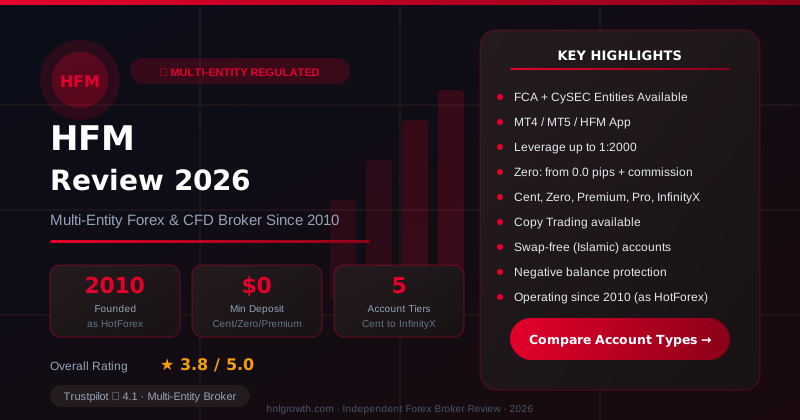
Checked on: 2026-08-10 | Broker terms, regulation, and pricing can change. Always verify at the official HFM site before opening an account.
Affiliate Disclosure: HNL Growth may earn a commission if you open an account through our links, at no additional cost to you. Risk Warning: CFDs and leveraged forex products are complex instruments and carry a high risk of losing money rapidly due to leverage. Between 65-95% of retail investor accounts lose money when trading CFDs, depending on the HFM entity and account type. Trading forex and CFDs may not be suitable for all investors. Consider your objectives, experience, and risk appetite before trading, and ensure you understand the risks involved. Broker Disclosure: HFM (HF Markets Group) is a live, regulated multi-entity broker (not a simulated prop-firm evaluation) — trades are executed with real capital in live market conditions, subject to normal market risk. Protections vary significantly by the specific legal entity that onboards your account.
Pip Calculator: Work Out Pip Value on Any Forex Pair
A pip calculator converts pip movements into monetary values based on the currency pair, lot size, and your account denomination. For most major pairs quoted to four decimal places, one pip equals 0.0001 of the quote currency. For JPY pairs quoted to two decimals, one pip equals 0.01.
The formula is straightforward:
Pip Value = (Pip Size ÷ Exchange Rate) × Lot Size in Units
When the quote currency matches your account currency, pip value stays constant regardless of the exchange rate. When it does not, a conversion step applies. Understanding pip value before entry lets you quantify exact monetary risk per trade, size positions correctly, and evaluate whether a broker's spread cost fits your strategy.
Calculate Your Pip Value
HashHedge — Crypto Futures Prop Firm
Up to $200K funded accounts · 85% profit split · Instant USDT payouts · 160+ assets
How to use this calculator: Select your currency pair, choose a lot size or enter custom units, set your account currency, and press calculate. The result shows the monetary value of one pip movement for your chosen position size.
HFM provides a built-in pip value calculator within its platform that uses live market rates. The calculations below use illustrative rates to explain the mechanics—always verify with live rates before trading.
Disclosure: This page may contain affiliate links. We may earn a commission if you open an account through our links, at no extra cost to you.
Test pip values with live HFM spreads on a demo account
What Is a Pip and Why It Matters
A pip—short for "percentage in point" or "price interest point"—is the standard unit of measurement for price movement in forex. It represents the smallest conventional price change a quoted exchange rate can make.
Spotting a Pip in Any Quote
For most currency pairs, the pip sits in the fourth decimal place:
- EUR/USD quoted at 1.0850 → the "5" is the pip digit
- A move from 1.0850 to 1.0851 = 1 pip
- A move from 1.0850 to 1.0860 = 10 pips
For Japanese yen pairs, the pip sits in the second decimal place:
- USD/JPY quoted at 149.50 → the "5" is the pip digit
- A move from 149.50 to 149.51 = 1 pip
- A move from 149.50 to 150.00 = 50 pips
This distinction matters because applying the wrong pip size produces incorrect calculations—always check whether your pair involves JPY.
Pip, Pipette, and Point—The Differences
| Term | Definition | Example (EUR/USD) |
|---|---|---|
| Pip | 4th decimal place (2nd for JPY) | 0.0001 |
| Pipette | Fractional pip; 5th decimal (3rd for JPY) | 0.00001 |
| Point | Smallest price increment on a platform; often equals one pipette | 0.00001 |
Many brokers, including HFM, quote prices to five decimal places (three for JPY pairs). The fifth digit is a pipette—one-tenth of a pip. When reading spread values or stop-loss distances, confirm whether your platform displays pips or points to avoid tenfold errors in position sizing.
The Pip-Value Formula Explained
How the Math Works
The pip-value formula has two cases depending on your account currency relative to the quote currency.
Case 1: Account currency = Quote currency (or quote currency is USD and account is USD)
Pip Value = Pip Size × Lot Size (in units)
Case 2: Account currency differs from the quote currency
Pip Value = (Pip Size ÷ Exchange Rate of quote-to-account pair) × Lot Size
Worked Example: EUR/USD Standard Lot
Assume EUR/USD at 1.0850 and a USD-denominated account.
- Pip size: 0.0001
- Lot size: 100,000 units (1 standard lot)
- Quote currency is USD; account currency is USD—Case 1 applies
Pip Value = 0.0001 × 100,000 = $10.00 per pip
For a 0.5-lot position (50,000 units): 0.0001 × 50,000 = $5.00 per pip
Worked Example: USD/JPY and the JPY Exception
Assume USD/JPY at 149.50 and a USD-denominated account.
- Pip size: 0.01(JPY pair)
- Lot size: 100,000 units
- Quote currency is JPY; account currency is USD—Case 2 applies
Step 1: Calculate pip value in JPY → 0.01 × 100,000 = 1,000 JPY per pip
Step 2: Convert to USD → 1,000 ÷ 149.50 = $6.69 per pip
Note that pip value for JPY pairs fluctuates as the exchange rate moves—a $6.69 pip value at 149.50 becomes approximately $6.58 at 152.00. This is different from USD-quoted pairs where pip value remains fixed.
When Your Account Currency Differs from the Quote
If your account is EUR-denominated and you trade EUR/USD (quote currency USD):
- Pip value in USD = 0.0001 × 100,000 = $10.00
- Convert to EUR using EUR/USD rate (assume 1.0850): $10.00 ÷ 1.0850 = €9.22 per pip
The conversion rate shifts with the market, so pip value in a non-matching account currency is not static throughout the trading day.
Pip Value Across Lot Sizes
Choosing the right lot size determines your per-pip exposure. The table below shows pip values for EUR/USD (where quote = account currency = USD) across standard tiers:
| Lot Tier | Units | Pip Value (EUR/USD, USD account) | Typical Suitability |
|---|---|---|---|
| Standard | 100,000 | $10.00 | Larger accounts, institutional-style sizing |
| Mini | 10,000 | $1.00 | Mid-sized accounts, moderate risk per trade |
| Micro | 1,000 | $0.10 | Smaller accounts, fine-tuned position sizing |
| Nano | 100 | $0.01 | Beginner testing, cent-account strategies |
HFM supports lot sizes starting from 0.01 lots (micro) on most account types, with increments that allow precise position sizing. Check the HFM account specifications for the exact minimum and maximum lot sizes available on your chosen account type.
Pips in Context: What Movements Mean in Money
For a 1 standard lot on a USD-quoted pair like EUR/USD:
| Pip Movement | Monetary Value |
|---|---|
| 1 pip | $10.00 |
| 10 pips | $100.00 |
| 25 pips | $250.00 |
| 50 pips | $500.00 |
| 100 pips | $1,000.00 |
Scale proportionally for other lot sizes: a 0.10-lot position multiplies each value by 0.1.
Special Cases: Gold, Silver, and Crypto CFDs
XAU/USD (Gold) Pip Conventions
Gold trades as XAU/USD, where 1 lot typically equals 100 ounces. The pip size is 0.01 (the second decimal place in a quote like 2,345.50).
- Pip value per standard lot: 0.01 × 100 = $1.00 per pip
However, many traders reference gold moves in full-dollar terms. A $1.00 move in gold (e.g., from 2,345.50 to 2,346.50) equals 100 pips or $100.00 per standard lot. Always confirm the contract size on HFM's platform, as specifications can vary by jurisdiction and account type.
XAG/USD (Silver) Pip Conventions
Silver (XAG/USD) typically uses a contract size of 5,000 ounces with a pip size of 0.001.
- Pip value per standard lot: 0.001 × 5,000 = $5.00 per pip
A move from 28.500 to 28.600 (100 pips) equals $500.00 per standard lot.
BTC/USD and ETH/USD Tick Values
Crypto CFD conventions vary significantly between brokers. For BTC/USD, a 1-lot contract may represent1 BTC, with price quoted to two decimal places. A "pip" in crypto is often treated as the smallest displayed increment (e.g., $0.01 for BTC/USD).
- If 1 lot = 1 BTC: pip value = $0.01 per pip ($1.00 per $1 move)
- If 1 lot = 10 ETH: pip value = $0.10 per pip ($1.00 per $0.10 move)
Important: Crypto CFD availability and contract specifications on HFM depend on your jurisdiction and the entity you are registered under. Verify current crypto CFD terms on HFM's platform before trading.
| Instrument | Pip Size | Typical Contract Size | Pip Value per Standard Lot |
|---|---|---|---|
| Major pairs (EUR/USD) | 0.0001 | 100,000 units | $10.00 |
| JPY pairs (USD/JPY) | 0.01 | 100,000 units | Varies with rate (~$6.69 at 149.50) |
| Gold (XAU/USD) | 0.01 | 100 oz | $1.00 |
| Silver (XAG/USD) | 0.001 | 5,000 oz | $5.00 |
| BTC/USD | 0.01 | 1 BTC (broker-dependent) | $0.01 |
Values above use standard industry conventions. Confirm HFM's specific contract specifications on the platform, as they may differ by entity and jurisdiction.
From Pips to Trade Decisions
Converting Stop-Loss Distance to Monetary Risk
Once you know your pip value, translating a stop-loss distance into monetary risk is simple multiplication:
Monetary Risk = Pip Value × Stop-Loss Distance in Pips
Example: You buy 0.5 lots EUR/USD (pip value $5.00) and set a 30-pip stop-loss.
Risk = $5.00 × 30 = $150.00
If price hits your stop, you lose $150. Knowing this before entry lets you decide whether the risk fits your account size and strategy.
Position Sizing from a Fixed Risk Budget
Many traders limit risk to 1–2% of account equity per trade. Pip value lets you calculate the exact lot size:
Lot Size (units) = Risk Budget ÷ (Stop-Loss in Pips × Pip Value per Unit)
Example: $10,000 account, 1% risk ($100), 25-pip stop on EUR/USD, USD account.
- Pip value per unit =0.0001 (for USD-quoted pair)
- Lot size = $100 ÷ (25 × 0.0001) = $100 ÷ 0.0025 = 40,000 units = 0.40 lots
This approach ensures consistent risk management regardless of the pair or stop distance.
How Spreads Affect Your Breakeven in Pips
Every trade starts in the negative by the amount of the spread. The breakeven in pips shows how far price must move in your favor just to cover this cost:
Breakeven Pips = Spread Cost in Currency÷ Pip Value
Example (illustrative spreads):
| Scenario | Spread (pips) | Pip Value (1 lot) | Spread Cost | Breakeven |
|---|---|---|---|---|
| Raw-spread account | 0.2 pips | $10.00 | $2.00 + commission | ~0.2 pips + commission equivalent |
| Standard account | 1.0 pips | $10.00 | $10.00 | 1.0 pips |
| Industry average (standard) | 1.5 pips | $10.00 | $15.00 | 1.5 pips |
On a Raw-spread account, spreads start from 0.0 pips with a separate commission per lot—check HFM's account conditions for current commission rates. On a Standard account, the spread is built into the price with no separate commission. The lower the breakeven in pips, the less distance price needs to move before your trade becomes profitable.
HFM's pip value calculator can help you compute these values using current platform rates.
See how HFM spreads compare—open a demo account to view live conditions
FAQ: Pip-Value Questions Answered
Does leverage change pip value?
No. Leverage determines how much margin you need to open a position, but pip value depends only on lot size, pip size, and the exchange rate. A 1-lot EUR/USD position has a $10 pip value whether you use 1:100 or 1:500 leverage. However, higher leverage allows larger positions with less capital, which increases your total per-pip exposure—a risk factor to manage carefully.
Why does pip value differ between pairs?
Pip value varies because it depends on the exchange rate between the quote currency and your account currency. When the quote currency is your account currency (e.g., trading EUR/USD with a USD account), pip value is fixed. When conversion is needed (e.g., trading USD/JPY with a USD account), pip value fluctuates with the JPY exchange rate.
Does pip value fluctuate as rates move intraday?
Yes, for pairs where the quote currency differs from your account currency. If you hold a USD account and trade GBP/JPY, pip value in USD shifts as both GBP/JPY and USD/JPY move during the session. For pairs where the quote currency matches your account currency, pip value remains constant.
How many pips should I risk per trade?
There is no universal answer—it depends on your strategy, stop-loss placement, and account size. The standard risk-management approach limits total monetary risk to 1–2% of account equity per trade, then calculates the lot size that makes your stop-loss distance equal that risk. The number of pips risked is a byproduct of your technical analysis (support, resistance, ATR), not a fixed target.
Can I use this calculator for indices or commodities?
Pip calculators are designed for forex pairs and instruments with defined pip conventions (gold, silver). Indices (like US30, NAS100) and energy (like WTI crude) use tick or point values with different contract sizes. While the principle is similar—point value × lot size = monetary value per point—the specific inputs differ. Check HFM's contract specifications for each instrument on the platform before calculating.
What to Verify Yourself
Since pip value calculations involve live exchange rates and broker-specific contract terms, confirm the following before placing trades:
- Current spreads on your HFM account type—use HFM's pip value calculator for live figures
- Contract specifications for metals, crypto, and CFDs, which may differ by jurisdiction and entity
- Account currency settings, as conversion rates affect pip value for non-USD accounts
- Minimum and maximum lot sizes available on your specific account type
- Commission structure on Raw-spread accounts to calculate true breakeven costs
Limitations and Who This Is Not For
This pip calculator and guide are designed for forex and CFD traders evaluating position sizing and risk. It does not apply to:
- Spot equity or bond trading, where price increments follow different conventions
- Futures contracts with exchange-defined tick values unrelated to forex pip conventions
- UK Personal Independence Payment (PIP) benefit calculations—an unrelated government program that shares the same abbreviation
Additionally, pip calculators provide theoretical values based on quoted rates. Actual profit and loss may differ slightly due to slippage, requotes, or spread widening during volatile market conditions.
Risk warning: CFDs and leveraged forex products are complex instruments and carry a high risk of losing money rapidly due to leverage. Retail investor accounts lose money when trading CFDs with most providers; the exact percentage varies by HFM entity and account type. You should consider whether you understand how CFDs work and whether you can afford to take the high risk of losing your money. Check the entity, terms and investor protections that apply in your jurisdiction before opening an account or trading.
Ready to Start Your Funded Trading Journey?
Join traders backed by $11M+ in verified payouts and a 4.7/5 Trustpilot rating. Compare HashHedge challenge plans, drawdown rules, and payout terms — apply code ha25 for the current discount.
Risk disclaimer: Challenge fees are non-refundable if you breach the rules. Prop trading involves significant financial risk. Past performance in a simulated environment does not guarantee results on a funded account. Only purchase if you understand the rules fully and can afford to lose the fee. Affiliate disclosure: HNL Growth earns a commission when you purchase a HashHedge challenge through links on this page.