Position Trading: Strategy, Timeframes and Risk
Position trading is a strategy where you hold a trade for weeks, months, or occasionally longer, based on a view about the major direction of a market rather than its short-term wiggles. You open far...
Reviewed using our forex & CFD broker review methodology
Checked on: 2026-08-17 | Broker terms, regulation, and pricing can change. Always verify at the official PU Prime site before opening an account.
Affiliate Disclosure: HNL Growth may earn a commission if you open an account through our links, at no additional cost to you. Risk Warning: CFDs and leveraged forex products are complex instruments and carry a high risk of losing money rapidly due to leverage. 62.2% of retail investor accounts lose money when trading CFDs with this provider. Trading forex and CFDs may not be suitable for all investors. Consider your objectives, experience, and risk appetite before trading, and ensure you understand the risks involved. Broker Disclosure: PU Prime is a live, regulated multi-entity broker (not a simulated prop-firm evaluation) — trades are executed with real capital in live market conditions, subject to normal market risk. Which PU Prime entity holds your account depends on your country of residence and determines your leverage cap and protections.
Last verified: August 2026 | Editorial Team
Position Trading: Strategy, Timeframes and Risk
Position trading is a strategy where you hold a trade for weeks, months, or occasionally longer, based on a view about the major direction of a market rather than its short-term wiggles. You open far fewer trades than a day or swing trader, you rely on both chart patterns and underlying fundamentals to build your thesis, and you accept that the position needs time — and room to breathe — to play out. It suits people who can tolerate drawdowns and don't need quick access to the capital tied up in the trade. It does not suit anyone looking for regular income, high liquidity, or low emotional exposure to price swings. The rest of this guide walks through the mechanics, the risks, and how to test the approach before committing real money.
What position trading actually means
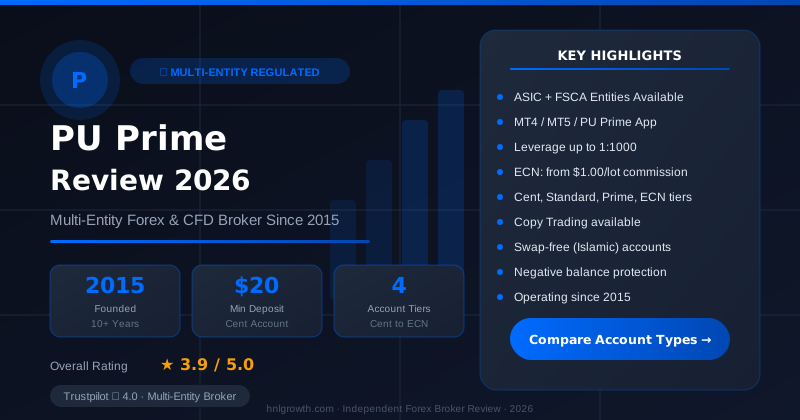
PU Prime — Multi-Entity Forex & CFD Broker
ASIC (AU) + FSCA (ZA) entities available · $20 min deposit (Cent) · MT4, MT5, PU Prime App · 4 account tiers
Think of trading styles as sitting on a timeline. Day traders close everything before the market shuts for the day. Swing traders hold for a few days to a couple of weeks, catching a chunk of a shorter-term move. Position traders sit at the far end: they hold through the daily noise, the occasional bad week, and sometimes through several economic cycles, because their thesis is built on the bigger trend rather than the next few candles.
That distinction matters because it changes what you're actually doing. A position trader isn't trying to predict tomorrow's move. They're trying to identify that a market has entered (or is about to enter) a sustained directional phase — driven by something structural, like a shift in interest rate expectations, a change in supply and demand for a commodity, or a re-rating of an asset class — and then stay in the trade long enough for that structural change to show up in price.
It's also worth separating position trading from buy-and-hold investing, because beginners often blur the two. A buy-and-hold investor buys an asset and generally holds regardless of trend, treating short-term price action as noise to be ignored. A position trader is still trend-based and still exit-driven: they're actively deciding when the trend that justified the trade has ended, and they will close the position — for a gain or a loss — when that happens. It's a long holding period, not a passive one.
The trade-off for the longer runway is trade frequency. A position trader typically places a handful of trades a year rather than several a day, which changes the entire rhythm of how you interact with markets: less screen time, but each decision carries more weight and more capital at risk for longer.
How a position trade plays out in practice
Here's an original illustration to make the mechanics concrete. Note that this is a simplified, hypothetical walkthrough to explain decision-making — not a recommendation to trade this specific market or a record of a real trade.
Suppose a trader is watching copper. Over several months, copper has traded in a wide sideways range while infrastructure spending announcements and reports of tightening mine supply build up in the background. The fundamental thesis is that demand is set to outstrip near-term supply. The technical trigger the trader is waiting for is a decisive break above the top of that multi-month range, ideally with price then holding above its rising 50-week moving average rather than falling straight back into the old range (a classic "breakout that fails" pattern).
When that break happens and price holds above the moving average for a couple of weeks, the trader opens a long position. They size it so that a full stop-out represents a small, predefined percentage of their account, not a number chosen after the fact. The stop-loss sits below the breakout zone and below the moving average, at a level that would only be reached if the original thesis — sustained demand outstripping supply — was actually wrong, not just because of a noisy down day.
From there, the trade is left alone. The trader might check in weekly rather than daily, looking for two things: confirmation the trend is intact (price staying above the moving average, no clean break of the trendline connecting recent higher lows), and any material change to the fundamental picture (a supply glut, a demand shock, a shift in the macro backdrop). Months pass. The position is held through several pullbacks that don't threaten the trendline. The exit trigger is defined in advance: either the price reaches a pre-set target based on a prior structural level, or the trendline and moving average are both broken with a weekly close, whichever comes first. When the trendline breaks on a weekly close, the trader exits — regardless of whether it "feels" premature — because the rule was set before emotions were involved.
That's the core loop: fundamental thesis, technical trigger, sized entry, a stop that reflects where the thesis is invalidated, minimal interference, and a pre-defined exit rule rather than a gut decision.
Here's how that holding pattern compares with other common styles:
| Approach | Typical holding period | Trade frequency | Day-to-day monitoring |
|---|---|---|---|
| Day trading | Minutes to hours, closed same day | Very high (often multiple trades daily) | Constant, during market hours |
| Swing trading | A few days to several weeks | Moderate (several trades a month) | Regular, daily or near-daily checks |
| Position trading | Weeks to months, sometimes longer | Low (often fewer than a dozen trades a year) | Periodic, weekly or less |
| Buy-and-hold investing | Years, often trend-independent | Minimal (occasional rebalancing) | Infrequent, not trend-driven |
The real risks — and who this doesn't suit
The biggest risk in position trading isn't a single bad trade, it's staying in a trend after it has actually reversed. Because position trades are held for a long time, the natural instinct is to give the trade "more room" when it moves against you, which is exactly how a manageable loss turns into a large one. A useful way to think about a reversal is as a decision point with three options, not just a threat: exit and accept the loss because the original thesis is invalidated, add to the position because the pullback is shallow and the thesis is intact, or hedge with a smaller offsetting position while you wait for clarity. What you should not do is simply freeze and hope the trend resumes.
Beyond reversal risk, there are three costs that are easy to underestimate:
- Capital tie-up and opportunity cost. Money committed to a months-long position isn't available for other opportunities, and it isn't quickly accessible if you need it for something else. If you might need that capital in the near term, position trading is the wrong vehicle.
- Holding costs on leveraged positions. CFD and leveraged forex positions typically carry overnight financing (swap) charges for positions held open past the daily rollover, and these accrue every night you hold a trade — which adds up over a multi-month position. The specifics vary by instrument and account type, so check current swap rates on PU Prime's spreads and costs page before opening or holding a position, rather than relying on a general assumption.
- Margin requirements on leveraged instruments. If you're trading CFDs rather than owning the underlying asset outright, a large adverse move can trigger a margin call or automatic close-out well before your original stop-loss level is reached, depending on your account's margin settings.
Given all this, position trading is genuinely not for everyone. It's not a fit if you need short-term income from trading, if you can't tolerate watching an open position sit in a drawdown for weeks without acting, if you require your capital to stay liquid, or if you find yourself compulsively checking prices — because that habit tends to produce exactly the kind of premature, emotion-driven exits that undermine the strategy.
A quick self-check before you consider it:
- Can this capital stay committed for months without you needing it elsewhere?
- Are you comfortable seeing an open position down 5–10% without closing it out of anxiety?
- Do you have the patience to check in weekly rather than daily?
- Can you define, in writing, what would prove your trade idea wrong before you open it?
If you answered "no" to more than one of these, a shorter-horizon style, or simply more practice first, is probably a better starting point than jumping straight into position trading with real money.
Mistakes beginners make with this approach
The most common mistake is opening a trade with a thesis but no written exit plan, so when the market moves, the trader is improvising under pressure instead of following a rule set in advance. Closely related is ignoring the stop-loss once it's placed — moving it further away "to give the trade room" is one of the fastest ways to turn a small, planned loss into a large, unplanned one.
Oversizing is another frequent error. Because position trades are held for a long time, even a well-reasoned thesis will be tested by pullbacks along the way, and a position sized too large for your account means those normal pullbacks feel unbearable, pushing you toward panic decisions.
Beginners also confuse position trading with passive buy-and-hold investing, assuming that "long-term" means "set it and forget it" indefinitely. Position trading still requires you to define what would end the trade and to actually act on that signal — it's a long holding period with an active exit discipline, not a walk-away strategy.
Finally, reacting to short-term noise defeats the purpose of the approach. Checking a position daily and reacting to every headline or single red candle reintroduces the stress and impulsiveness of day trading into a strategy that was supposed to reduce both.
Rehearsing position trading on a demo account
Because position trades take weeks or months to resolve, mistakes are expensive to learn from on a live account — you might not find out your stop placement or thesis-building was flawed until months of capital were tied up. A demo account, which uses real market prices without risking money, is a practical way to rehearse the decision-making before you commit capital.
Disclosure: This page may contain affiliate links. We may earn a commission if you open an account through our links, at no extra cost to you.
A useful rehearsal isn't just "watch a chart for a few weeks." Try running the full loop deliberately:
- Write the thesis first. Before entering, note the fundamental reason you expect a sustained trend and the specific technical trigger you're waiting for.
- Set the entry, stop, and target before you click. Decide where the trade is proven wrong (stop) and what would validate it fully (target), not after the position is already open.
- Log the trade. Record the reasoning, not just the price, so you can review whether your thesis held up or whether you were reacting to noise.
- Review on a fixed cadence. Check in weekly rather than daily, and only make a change if your pre-defined exit or add/hedge criteria are actually triggered.
Running a few of these cycles on a demo account before risking real capital lets you find out whether you actually have the patience the strategy demands, and whether your stop and target logic holds up over weeks rather than minutes. You can open a PU Prime demo account to practice this thesis-to-exit process with live market pricing and no capital at risk before deciding whether to fund a live account.
FAQ
What's the typical holding period for position trading? It varies by market and thesis, but position trades are generally held from several weeks to several months, and sometimes longer if the underlying trend remains intact. There's no fixed rule — the exit is determined by your predefined criteria, not a calendar date.
Is position trading profitable? There's no guaranteed outcome with any trading style, and results depend on the trader's skill, risk management, and market conditions at the time. The appeal of position trading is the potential to capture a large portion of a sustained trend with fewer trades, but that comes with the risk of larger drawdowns and the possibility that the trend reverses before your target is reached. Treat any profitability claim you see elsewhere with caution if it isn't paired with an equally clear discussion of the risk involved.
How much capital do I need to start? This depends on the instrument, the leverage available, and how you size your position relative to your account — there isn't a single correct figure. What matters more than the account size is that your position size reflects a small, predefined percentage of your capital at risk per trade, so a stopped-out position doesn't materially damage your account.
What markets suit position trading? Position trading can be applied to forex, indices, commodities, metals, and shares, among others — the common thread is that the market needs to be capable of sustaining a multi-week or multi-month directional move, which is more about the specific situation than the asset class itself.
Do I need a live account to learn this? No. Because the strategy plays out slowly, a demo account is a practical way to rehearse thesis-building, entry and stop placement, and exit discipline using live pricing without risking capital, before deciding whether to trade live.
Is PU Prime regulated? PU Prime operates under regulatory authorisation from several financial authorities, including bodies in Seychelles, Mauritius, South Africa, and the UAE. Regulatory coverage and the specific protections that apply can differ depending on the entity you're onboarded with and your jurisdiction, so check the details relevant to your region on the PU Prime regulation page before opening an account.
Risk warning
Risk warning: CFDs and leveraged forex products are complex instruments and carry a high risk of losing money rapidly due to leverage. Consider whether you understand how these products work and whether you can afford to take the high risk of losing your capital. Check the entity, terms and protections that apply in your jurisdiction before trading.
Ready to Compare PU Prime Account Types?
PU Prime is a multi-entity broker — ASIC (Australia) and FSCA (South Africa) regulated entities offer stronger oversight, while most international clients are onboarded to the FSA Seychelles or FSC Mauritius entities. Four account tiers (Cent, Standard, Prime, ECN) range from a $20 minimum deposit to full ECN pricing.
Risk disclaimer: PU Prime is a live, regulated multi-entity broker — trading forex and CFDs is done with real capital under normal market risk (this is not a simulated prop-firm evaluation). PU Prime operates under multiple separate licenses (ASIC, FSCA, FSA Seychelles, FSC Mauritius); which entity holds your account depends on your country of residence and determines your leverage cap and protections — confirm this before funding. CFDs and leveraged forex products are complex instruments and carry a high risk of losing money rapidly due to leverage; 62.2% of retail investor accounts lose money when trading CFDs with this provider. Consider whether you understand how CFDs/forex work and whether you can afford the high risk of losing your money. Affiliate disclosure: HNL Growth earns a commission when you open a PU Prime account through links on this page.