PU Prime Account Types 2026: Standard vs Prime vs ECN
PU Prime offers four account tiers—Cent, Standard, Prime, and ECN—each structured around a different cost model rather than a prestige hierarchy. The Standard account suits occasional traders who...
Reviewed using our forex & CFD broker review methodology
Checked on: 2026-08-17 | Broker terms, regulation, and pricing can change. Always verify at the official PU Prime site before opening an account.
Affiliate Disclosure: HNL Growth may earn a commission if you open an account through our links, at no additional cost to you. Risk Warning: CFDs and leveraged forex products are complex instruments and carry a high risk of losing money rapidly due to leverage. 62.2% of retail investor accounts lose money when trading CFDs with this provider. Trading forex and CFDs may not be suitable for all investors. Consider your objectives, experience, and risk appetite before trading, and ensure you understand the risks involved. Broker Disclosure: PU Prime is a live, regulated multi-entity broker (not a simulated prop-firm evaluation) — trades are executed with real capital in live market conditions, subject to normal market risk. Which PU Prime entity holds your account depends on your country of residence and determines your leverage cap and protections.
Last verified: August 2026 | Editorial Team
PU Prime Account Types 2026: Standard vs Prime vs ECN
PU Prime offers four account tiers—Cent, Standard, Prime, and ECN—each structured around a different cost model rather than a prestige hierarchy. The Standard account suits occasional traders who prefer zero commission and spreads-inclusive pricing from 1.3 pips. The Prime account targets active traders trading several lots per day, offering spreads from 0.0 pips plus a $3.50 per lot per side commission. ECN delivers the lowest total cost for high-volume traders at $1 per lot per side commission, also from 0.0 pips, but requires $10,000 minimum capital. Cent accounts mirror Standard or Prime spreads but denominate your balance in cents, useful for testing strategies with fractional exposure. The right account is the one whose total cost—at your actual trade frequency and lot size—produces the lowest annual fee burden, not the one with the most impressive name.
Quick Verdict: Which Account Type Fits Your Trading Strategy?
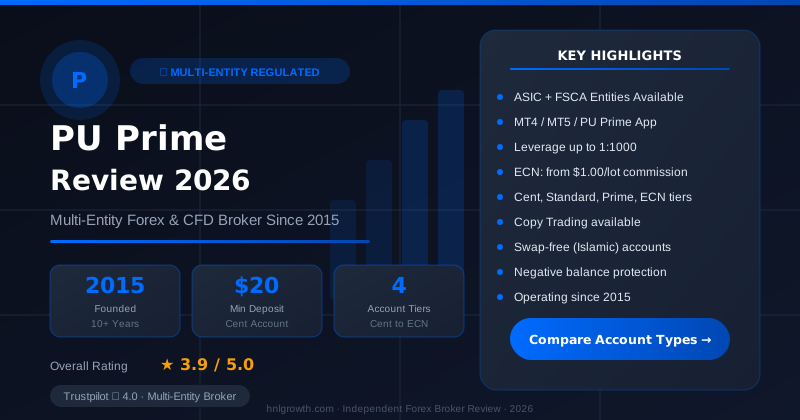
PU Prime — Multi-Entity Forex & CFD Broker
ASIC (AU) + FSCA (ZA) entities available · $20 min deposit (Cent) · MT4, MT5, PU Prime App · 4 account tiers
If you trade fewer than 20 standard lots per month and want simplicity, the Standard account keeps costs predictable with no commission and a $50 minimum deposit. Active traders executing 30–100 lots monthly save money with the Prime account ($1,000 minimum) because tighter spreads offset the $3.50 commission at moderate volume. Professional or institutional traders moving 200+ lots per month minimise total cost with the ECN account ($10,000 minimum), where the $1 commission and raw spreads become cheaper than any spread-only structure. The Cent account ($20 minimum) suits new traders or strategy testing: your balance displays in cents (1 USD = 100 USC) and micro-position sizing limits downside while you refine execution discipline.
Disclosure: This page may contain affiliate links. We may earn a commission if you open an account through our links, at no extra cost to you.
The Four Account Tiers at a Glance
| Feature | Cent | Standard | Prime | ECN |
|---|---|---|---|---|
| Minimum deposit | $20 | $50 | $1,000 | $10,000 |
| Spreads from | 1.3 pips | 1.3 pips | 0.0 pips | 0.0 pips |
| Commission | $0 | $0 | $3.50 per side/lot | $1 per side/lot |
| Max leverage (ASIC retail) | Up to 1:30 | Up to 1:30 | Up to 1:30 | Up to 1:30 |
| Max leverage (offshore) | Up to 1:1000 | Up to 1:1000 | Up to 1:1000 | Up to 1:1000 |
| Platforms | MT4, MT5, PU Web Trader, PU Prime App | MT4, MT5, PU Web Trader, PU Prime App | MT4, MT5, PU Web Trader, PU Prime App | MT4, MT5, PU Web Trader, PU Prime App |
| Tradable instruments | 1000+ | 1000+ | 1000+ | 1000+ |
| Islamic account eligible | Yes | Yes | Yes | Yes |
| EA / scalping permitted | Yes | Yes | Yes | Yes |
Source: PU Prime Account Types and Spread & Costs. Spreads are variable; figures shown are indicative. All account types access the full instrument range with no asset-class restrictions.
All four tiers support Expert Advisors, scalping, and hedging without restriction. Copy trading is available across all accounts. The platform suite—MT4, MT5, Web Trader, and mobile app—remains identical regardless of tier, so your choice hinges on cost structure and minimum capital, not feature availability.
Open a PU Prime account and choose your tier
Cent Account: Controlled Exposure for Strategy Testing
The Cent account displays your balance in cents (USC) at a 1:100 ratio to USD. A $20 deposit appears as 2,000 USC. Lot sizing scales proportionally: a 0.01 lot in a Cent account equals 0.0001 standard lots, so a 10-pip move on EUR/USD shifts your balance by approximately 1 USC (one cent).
Use case: New traders learning position sizing, algorithmic traders stress-testing EAs in live market conditions without risking significant capital, or swing traders experimenting with unfamiliar pairs. The Cent account replicates Standard account spreads and execution—there is no artificial restriction on order flow or fill quality—but losses stay fractional until you scale up.
When to graduate: When your strategy produces consistent monthly returns over three months and your deposit approaches $500, switching to a Standard account eliminates the mental friction of cent-denominated P&L and simplifies record-keeping for tax purposes. Some traders maintain a Cent account indefinitely for isolated testing while running larger positions in a Standard or Prime account.
Limitation: Because lot sizes are fractional, commission-based accounts (Prime, ECN) offer no cost advantage in a Cent structure. If you eventually trade high volume, you will need to switch to a USD-denominated account to access tighter spreads and lower commission tiers.
Standard Account: The No-Commission Baseline
The Standard account charges no commission. Your cost per trade is embedded in the spread, which starts at 1.3 pips on EUR/USD under normal market conditions. One standard lot (100,000 units) on a 1.3-pip spread costs $13 per round-trip, assuming a pip value of $10.
Who benefits: Retail traders executing fewer than 20 standard lots per month, position traders holding multi-day swings where spread cost is negligible relative to the intended profit target, and beginners who prefer transparent, predictable pricing without calculating per-lot commissions.
Cost transparency: If EUR/USD quotes 1.08500 / 1.08513, your buy entry is 1.08513 and your sell exit must exceed that level by more than the spread to reach breakeven. Because the spread is variable, your actual cost fluctuates with liquidity and volatility. During major news events or thin overnight sessions, spreads can widen temporarily.
Break-even vs Prime: At 20 standard lots per month, the Standard account costs approximately $260 (20 lots × $13 spread cost). The Prime account at the same volume costs roughly $140 in commission (20 lots × 2 sides × $3.50) plus spread cost, which averages 0.3 pips on EUR/USD ($6 per lot), totaling $200. Above 20 lots monthly, Prime becomes cheaper. Below that threshold, Standard's simplicity and zero-commission structure win.
Prime Account: Tighter Spreads with a Known Commission
The Prime account offers spreads from 0.0 pips on major pairs plus a $3.50 per side per lot commission ($7 round-trip per standard lot). Typical EUR/USD spread averages 0.3 pips during London and New York sessions, so total cost per standard lot is approximately $10 ($3 spread + $7 commission).
Target profile: Active day traders or scalpers executing 30–100 lots per month, mean-reversion or momentum strategies that rely on tight entry and exit levels where a 1.0-pip difference materially impacts profitability, and traders who value cost predictability—commission is fixed while spreads remain variable but narrower than Standard.
Cost advantage window: Between 30 and 150 lots per month, Prime delivers the lowest all-in cost. Below 30 lots, Standard's zero commission offsets its wider spread. Above 150 lots, ECN's $1 commission becomes cheaper despite identical spreads.
Minimum deposit: $1,000. This threshold ensures your account can withstand normal drawdown without triggering margin calls. At 1:100 leverage (common under non-ASIC entities), one standard lot on EUR/USD requires approximately $1,080 margin, leaving minimal buffer if you fund exactly $1,000. A practical starting balance is $2,000–$3,000 if you plan to hold multiple positions simultaneously.
ECN Account: Raw Spreads for High-Volume Traders
The ECN account charges $1 per side per lot ($2 round-trip) with spreads from 0.0 pips. On EUR/USD, typical mid-session spread is 0.1–0.3 pips, so total cost per standard lot ranges from $3 to $5. This is the lowest cost structure PU Prime offers, but the $10,000 minimum deposit restricts access to well-capitalised traders.
ECN model in one sentence: Your orders are routed to multiple liquidity providers—banks and financial institutions that quote bid and ask prices—and filled at the best available rate, with the broker earning only the fixed commission rather than marking up the spread.
Who it suits: Proprietary traders, hedge fund managers, or high-frequency algorithmic systems executing 200+ lots monthly where the $5 difference per lot between Prime and ECN compounds into thousands of dollars annually. At 200 lots per month, ECN saves approximately $1,000 versus Prime ($5 per lot × 200 = $1,000 monthly spread + commission advantage).
Limitation: The $10,000 minimum is non-negotiable. If your strategy generates 5% monthly return, your first month's profit is $500, and a 20% drawdown would still leave $8,000 in the account—manageable. But if you fund $10,000 and suffer a 30% drawdown in early trading, you risk falling below effective operating capital. Size your positions to keep drawdown under 15% at your strategy's historical maximum adverse excursion.
What Your Trades Actually Cost: A Worked Example
Assume you trade 1 standard lot of EUR/USD (100,000 units) at an entry price of 1.08500. Pip value is $10. You close the position after a 20-pip gain. Here is the cost breakdown by account type under typical mid-session conditions:
| Account | Indicative spread (pips) | Commission (round-trip) | Spread cost | Total cost per trade | Profit after costs | Cost at 100 trades/month |
|---|---|---|---|---|---|---|
| Cent | 1.3 | $0 | $13 | $13 | $187 | $1,300 |
| Standard | 1.3 | $0 | $13 | $13 | $187 | $1,300 |
| Prime | 0.3 | $7 | $3 | $10 | $190 | $1,000 |
| ECN | 0.2 | $2 | $2 | $4 | $196 | $400 |
Spreads are variable. Example uses indicative figures from PU Prime Spread & Costs page as of publication. Actual costs will differ based on market conditions, time of day, and liquidity.
Interpretation: At 100 trades per month, ECN saves $900 versus Prime and $900 versus Standard. If your average trade frequency is 10 trades per day (200 per month), ECN saves $1,800 monthly or $21,600 annually compared to Standard. That saving alone justifies the $10,000 minimum deposit if your strategy consistently produces that volume.
Break-Even Volume: When to Upgrade
| Upgrade path | Break-even lots/month | Assumption basis |
|---|---|---|
| Standard → Prime | ~20 lots | Standard costs $13/lot; Prime costs ~$10/lot. At 20 lots, total cost is $260 vs $200. Above 20 lots, Prime saves $60+ per month. |
| Prime → ECN | ~150 lots | Prime costs ~$10/lot; ECN costs ~$4/lot. At 150 lots, saving is $900/month. Below that, the $9,000 additional minimum deposit (from $1,000 to $10,000) could yield better returns if deployed elsewhere. |
These thresholds are indicative. Your personal break-even depends on the pairs you trade (exotic spreads are wider, amplifying the advantage of commission-based accounts) and session timing (Asian session spreads widen, favouring accounts with lower base spreads).
Leverage, Regulation, and What Your Entity Determines
PU Prime operates under multiple regulatory entities. Your jurisdiction determines which entity governs your account, what leverage cap applies, and which client protections you receive.
| Entity | Jurisdiction served | Leverage cap (retail) | Leverage cap (professional/offshore) | Client fund protection | License number |
|---|---|---|---|---|---|
| FSA (Seychelles) | Most international clients excluding restricted regions | Up to 1:1000 | Up to 1:1000 | Segregated accounts | SD050 |
| FSC (Mauritius) | African and Asian clients under Mauritius regulatory framework | Up to 1:1000 | Up to 1:1000 | Segregated accounts | C112011088 |
| FSCA (South Africa) | South African residents | 1:30 (retail per FSCA rules) | Up to 1:200 (professional) | Segregated accounts, negative balance protection | 47564 |
| CMA (UAE) | UAE residents | Varies by client classification | Varies by client classification | Segregated accounts | Not publicly listed on site |
Source: PU Prime Regulation. Verify your specific entity and protections before opening an account.
Leverage reality: A 1:1000 leverage ceiling does not mean you should use it. At 1:1000, one standard lot on EUR/USD requires $108 margin. A 108-pip adverse move wipes out $1,080 in equity—ten times your margin. Experienced traders rarely exceed 1:50 effective leverage regardless of the broker's maximum. Use leverage to improve capital efficiency (holding multiple uncorrelated positions with the same capital base) rather than to magnify single-position size.
Negative balance protection: Confirmed under FSCA (South Africa) regulation. Under FSA and FSC entities, PU Prime states segregated client funds and participation in dispute resolution schemes but does not explicitly guarantee negative balance protection on the regulation page. If trading under an offshore entity, verify this directly with PU Prime support before funding a high-leverage account.
Platforms and Trading Tools by Account
All four account types access the same platform suite:
- MetaTrader 4: Preferred for single-asset focus and EA-heavy strategies. Stable, widely documented, thousands of third-party indicators and scripts available.
- MetaTrader 5: Faster execution engine, multi-asset support (stocks, bonds, futures), built-in economic calendar, more timeframes and order types. Recommended unless you rely on MT4-exclusive custom EAs.
- PU Web Trader: Browser-based, no download required. Suitable for position monitoring or emergency trade management from a public computer.
- PU Prime App: iOS and Android. Full trade execution, chart analysis, deposit and withdrawal functions. Push notifications for price alerts and margin warnings.
Copy trading: Available on all account types through the PU Prime ecosystem. Minimum $25 per signal provider. Copy trading fees are separate from account-type spreads and commissions; check the copy trading terms for the performance fee structure.
Autochartist: Free on all accounts. Delivers pattern-recognition alerts and key level identification. Integrates with MT4 and MT5 as a plugin.
No account-level restrictions: We confirmed with PU Prime's help center that all four account types access the full 1000+ instrument range—forex, indices, commodities, metals, shares, ETFs, bonds, and synthetic indices—without tier-based exclusions.
Funding Your Account: Methods, Limits, and Timelines
| Method | Min deposit | Min withdrawal | Processing time (deposit) | Processing time (withdrawal) | Fee |
|---|---|---|---|---|---|
| Credit/Debit card | Account minimum ($20–$10,000) | $20 | Instant | 1–3 business days | $0 |
| Bank wire | Account minimum | $50 | 1–3 business days | 1–5 business days | Varies by bank |
| Skrill | Account minimum | $20 | Instant | 1 business day | $0 (PU Prime); Skrill may charge currency conversion) |
| Neteller | Account minimum | $20 | Instant | 1 business day | $0 (PU Prime); Neteller may charge conversion) |
Source: PU Prime Spread & Costs and account-opening documentation. Third-party processor fees (e.g., Skrill's 3.99% currency conversion spread) are outside PU Prime's control.
Currency conversion: PU Prime supports base currencies including USD, EUR, GBP, AUD, CAD, SGD, NZD, HKD, and JPY. If you deposit in a currency that does not match your account base currency, your card issuer or payment processor applies a conversion spread, typically 2–4%. To minimise this cost, open your account in the currency you will deposit most frequently.
Withdrawal policy: PU Prime processes withdrawals back to the original deposit method up to the total deposited amount (anti-money-laundering requirement). Profits can be withdrawn via bank wire or e-wallet. Most withdrawals are approved within 24 hours on business days; bank processing adds 1–3 days.
Compare account types and fund your account
Islamic Accounts: Swap-Free Eligibility and Fee Conditions
All four account types—Cent, Standard, Prime, and ECN—offer Islamic (swap-free) versions upon request. Instead of overnight swap interest (which Islamic finance prohibits), PU Prime charges an administrative fee.
How to request: During account opening, select "Islamic account" in the account-type dropdown, or contact support after opening a standard account to convert it. Conversion is usually processed within one business day.
Administrative fee structure: The fee amount and trigger conditions are not published on the main account types or regulation pages. According to the help center, Islamic account holders are "charged with an administration fee" in place of swap, but the exact rate per lot per day and whether it applies to all positions or only those held beyond a certain duration is not specified. Verify the fee schedule with PU Prime support before opening an Islamic account if you plan to hold positions for multiple days.
Eligibility: Islamic accounts are available to clients of Muslim belief in accordance with Shariah law. PU Prime may require a declaration or documentation of religious eligibility during the application process.
Switching, Upgrading, and Managing Multiple Accounts
Can you switch account types without re-opening? According to PU Prime's help center, account-type changes typically require opening a new account under the desired tier, then transferring funds between accounts via the client portal. You cannot convert an existing Standard account into a Prime or ECN account while preserving the same account number.
Multiple accounts: You can hold multiple live accounts simultaneously—for example, a Cent account for testing, a Standard account for long-term positions, and a Prime account for day trading. Each account operates independently with separate margin and P&L.
Internal transfers: Funds move between your PU Prime accounts instantly via the client portal. No fee applies to internal transfers. This allows you to segregate capital by strategy or risk tolerance without waiting for external withdrawal and deposit cycles.
Demo accounts: Available for all four account types. Demo accounts mirror live spreads and execution conditions. Default balance is $100,000 virtual funds. Demos remain active indefinitely as long as you log in at least once every 90 days; inactive demos may be archived and require reactivation through support.
How to Open a PU Prime Account: Steps and Timeline
Opening a PU Prime account takes approximately 10–15 minutes of active work plus a verification waiting period of a few hours to one business day.
Step 1: Register
Visit the PU Prime account opening page. Provide your full name, email, phone number, and create a password. Select your preferred account type (Cent, Standard, Prime, or ECN), base currency, and platform (MT4 or MT5).
Step 2: Upload documents
Submit a clear photo or scan of your government-issued ID (passport, national ID card, or driving licence) and proof of address dated within the last three months (utility bill, bank statement, or government tax notice). Ensure all four corners are visible and text is legible. Avoid glare or shadows.
Step 3: Wait for verification
PU Prime's compliance team reviews your documents, typically within a few hours on business days. You will receive an email when your account is approved.
Step 4: Fund and trade
Deposit via your preferred method. Card and e-wallet deposits arrive instantly; bank wires take 1–3 business days. Download MT4, MT5, or the PU Prime app, log in with your credentials, and start trading.
Document requirements: Valid ID and recent proof of address are mandatory under KYC (Know Your Customer) regulations. If your proof of address is older than three months or your ID is expired, your application will be delayed. Take new photos rather than using scanned copies from previous applications—phone camera images are usually sharper and faster to upload.
Estimated time to first trade: If you upload documents correctly and deposit via card or e-wallet, you can be trading within 4–6 hours of starting your application on a business day.
Frequently Asked Questions
What is the minimum deposit to start trading with PU Prime?
$20 for a Cent account, $50 for Standard, $1,000 for Prime, $10,000 for ECN. Source: PU Prime Account Types.
Are there any hidden fees or inactivity charges?
PU Prime does not publish an inactivity fee on its main cost or terms pages. Spreads, commissions, and swap (or Islamic administrative fee) are the primary costs. Currency conversion by your bank or payment processor is outside the broker's control. Verify whether an inactivity fee applies by reviewing the full terms of business or contacting support directly.
Can I use Expert Advisors and scalping strategies on all accounts?
Yes. All four account types permit EAs, scalping, and hedging without restriction, according to the account types page.
What leverage will I receive?
Up to 1:1000 under FSA (Seychelles) and FSC (Mauritius) entities, subject to your account balance and trading history. FSCA (South Africa) caps retail clients at 1:30. Your entity is determined by your country of residence. Check the regulation page to confirm which entity governs your account.
How do I know which account type to choose?
If you trade fewer than 20 standard lots per month, choose Standard. Between 20 and 150 lots monthly, choose Prime. Above 150 lots, choose ECN if you have $10,000 to deposit. For testing or learning, start with Cent.
Can I switch from Standard to Prime or ECN later?
Yes, by opening a new account under the desired type and transferring funds internally via the client portal. Your original account remains open unless you request closure.
Is my capital protected if PU Prime faces financial difficulty?
Client funds are held in segregated accounts separate from PU Prime's operational funds under all regulatory entities. Under FSCA (South Africa), negative balance protection is confirmed. For other entities, verify the specific client protections applicable to your jurisdiction by contacting support or reviewing the entity-specific terms.
How long do withdrawals take?
PU Prime processes withdrawal requests within 24 hours on business days. Card withdrawals take 1–3 business days for funds to appear; bank wires take 1–5 business days depending on your bank's processing speed. E-wallet withdrawals (Skrill, Neteller) typically arrive within one business day.
Are Islamic accounts available on all account types?
Yes. Cent, Standard, Prime, and ECN all offer Islamic (swap-free) versions. An administrative fee replaces swap interest, but the exact fee structure is not published on the website. Confirm the fee with support before opening an Islamic account.
Who PU Prime Accounts Suit—and Who They Do Not
Best for:
- Retail and semi-professional traders with $50–$100,000 capital seeking regulated access to global markets
- Day traders and scalpers who require tight spreads and fast execution on major pairs
- Algorithmic traders needing EA compatibility and VPS support across all account tiers
- Multi-strategy traders who benefit from holding separate accounts (testing in Cent, position trades in Standard, active trades in Prime)
Not ideal for:
- U.S. residents: PU Prime does not accept clients from the United States due to regulatory restrictions
- Traders requiring guaranteed fixed spreads: all PU Prime spreads are variable and widen during low liquidity or high volatility
- Stock investors seeking direct equity ownership: PU Prime offers share CFDs, not physical shares, so you do not receive dividends or voting rights
- Beginners with under $500 capital who cannot tolerate a 20–30% drawdown: the $50 Standard minimum is accessible, but effective risk management requires a larger buffer
Risk warning: CFDs and leveraged forex products are complex instruments and carry a high risk of losing money rapidly due to leverage. The majority of retail investor accounts lose money when trading CFDs. Consider whether you understand how these products work and whether you can afford to take the high risk of losing your capital. Check the entity, terms, and protections that apply in your jurisdiction before trading.
Ready to Compare PU Prime Account Types?
PU Prime is a multi-entity broker — ASIC (Australia) and FSCA (South Africa) regulated entities offer stronger oversight, while most international clients are onboarded to the FSA Seychelles or FSC Mauritius entities. Four account tiers (Cent, Standard, Prime, ECN) range from a $20 minimum deposit to full ECN pricing.
Risk disclaimer: PU Prime is a live, regulated multi-entity broker — trading forex and CFDs is done with real capital under normal market risk (this is not a simulated prop-firm evaluation). PU Prime operates under multiple separate licenses (ASIC, FSCA, FSA Seychelles, FSC Mauritius); which entity holds your account depends on your country of residence and determines your leverage cap and protections — confirm this before funding. CFDs and leveraged forex products are complex instruments and carry a high risk of losing money rapidly due to leverage; 62.2% of retail investor accounts lose money when trading CFDs with this provider. Consider whether you understand how CFDs/forex work and whether you can afford the high risk of losing your money. Affiliate disclosure: HNL Growth earns a commission when you open a PU Prime account through links on this page.