PU Prime Copy Trading 2026: How It Works and What It Costs
PU Prime offers copy trading through its mobile app, allowing you to automatically replicate the trades of experienced signal providers without manual execution. The platform operates under multiple...
Reviewed using our forex & CFD broker review methodology
Checked on: 2026-08-17 | Broker terms, regulation, and pricing can change. Always verify at the official PU Prime site before opening an account.
Affiliate Disclosure: HNL Growth may earn a commission if you open an account through our links, at no additional cost to you. Risk Warning: CFDs and leveraged forex products are complex instruments and carry a high risk of losing money rapidly due to leverage. 62.2% of retail investor accounts lose money when trading CFDs with this provider. Trading forex and CFDs may not be suitable for all investors. Consider your objectives, experience, and risk appetite before trading, and ensure you understand the risks involved. Broker Disclosure: PU Prime is a live, regulated multi-entity broker (not a simulated prop-firm evaluation) — trades are executed with real capital in live market conditions, subject to normal market risk. Which PU Prime entity holds your account depends on your country of residence and determines your leverage cap and protections.
Last verified: August 2026 | Editorial Team
PU Prime Copy Trading 2026: How It Works and What It Costs
PU Prime offers copy trading through its mobile app, allowing you to automatically replicate the trades of experienced signal providers without manual execution. The platform operates under multiple regulators—FSA Seychelles, FSC Mauritius, FSCA South Africa, ASIC Australia, and CMA UAE—with client protection levels varying by entity. Copy trading costs include your account's underlying spreads and profit-sharing with providers (up to 50%, settled weekly). No subscription fees or management fees apply. You can start with a $50 account deposit and allocate as little as $25 per signal provider across Standard (spread-only), Prime (commission + tight spreads), or ECN accounts. The model suits passive traders willing to monitor provider performance and accept the regulatory trade-offs inherent in multi-entity offshore structures.
Key Takeaways:
- Copy trading replicates signal provider trades automatically in your account
- Minimum $50 account deposit; $25 minimum allocation per provider
- Costs: spreads, profit-sharing (up to 50%), no subscription or management fees
- Available on Standard, Prime, and ECN account types
- Regulated by FSA, FSC, FSCA, ASIC, CMA with entity-specific protections
Quick Verdict: Should You Use PU Prime Copy Trading?
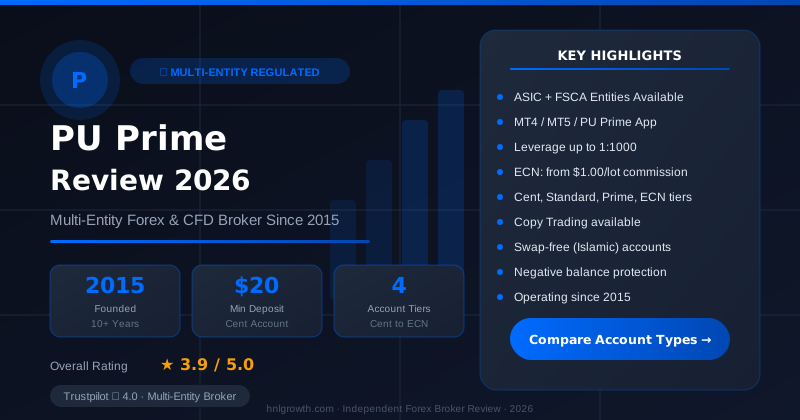
PU Prime — Multi-Entity Forex & CFD Broker
ASIC (AU) + FSCA (ZA) entities available · $20 min deposit (Cent) · MT4, MT5, PU Prime App · 4 account tiers
Use it if:
- You want market exposure without building your own strategy
- You can commit to weekly performance monitoring (not "set and forget")
- You accept offshore regulation (FSC Mauritius, FSA Seychelles) for most accounts
- You understand that provider past performance does not guarantee future results
- You have the discipline to diversify across 3–5 providers and limit per-trader allocation to 10–20%
Look elsewhere if:
- You require tier-1 regulation (FCA UK, CySEC Cyprus, BaFin Germany) with compensation schemes
- You expect independent audits of signal provider performance data
- You need systematic correlation analysis or risk-adjusted performance metrics (Sharpe, Sortino) built into the platform
- You want a managed account with fiduciary responsibility
- You live in the UK, France, UAE, or Canada—PU Prime entities face regulatory warnings in these jurisdictions
Copy trading reduces execution burden but does not eliminate risk. You remain exposed to provider strategy changes, drawdown clustering, slippage on copied orders, and leverage multiplication effects. Offshore regulation provides basic client fund segregation but lacks the compensation schemes and enforcement depth of tier-1 authorities.
What Copy Trading Is and Why Passive Replication Appeals to Strategy-Averse Traders
Copy trading is an automated method in which your trading account mirrors the buy and sell positions of another trader—the signal provider—in real time. When the provider opens a position, the platform proportionally replicates it in your account. When they close, yours closes too.
The appeal is straightforward: you gain market exposure without analyzing charts, timing entries, or managing positions yourself. The platform handles execution automatically.
Copy trading emerged around 2005 as traders began sharing algorithmic strategies. It evolved into a regulated broker feature that lets anyone access professional-level trading without independent execution skills.
Why traders choose copy trading:
- Low barrier to entry: No need to master technical analysis, fundamental research, or risk management frameworks before starting
- Time efficiency: No chart monitoring, news tracking, or manual order placement
- Learning by observation: Watch how experienced providers react to market conditions, manage risk, and adjust strategies
- Diversification potential: Allocate capital across multiple providers with different styles, instruments, and risk profiles
Copy trading is sometimes confused with social trading or mirror trading. Social trading is a community model where traders share ideas and insights. Mirror trading replicates an entire algorithmic strategy rather than following a specific individual. Copy trading sits between the two: you follow a specific trader, and their decisions are automatically mirrored proportionally in your account.
The distinction matters because your results depend entirely on the provider's decisions. You cannot override individual trades while copying is active, though you can stop copying at any time or manually close positions.
How PU Prime's Copy Trading Operates: Provider Discovery, Trade Execution, Slippage Handling, Multi-Provider Management
PU Prime's copy trading system involves three participants: the signal provider who executes trades, the copier who allocates capital to follow the provider, and the platform that handles real-time replication.
The Operational Flow
1. Provider discovery
Browse available signal providers through the PU Prime mobile app. Each provider profile displays:
- Return on investment (ROI) over multiple timeframes
- Maximum drawdown (the largest peak-to-trough decline)
- Win rate (percentage of profitable trades)
- Profit factor (gross profit divided by gross loss)
- Number of current followers
- Trading history length
Provider data is updated in real time. Performance figures are self-reported by the platform's tracking system, not independently audited by third parties.
2. Allocation and activation
Decide how much capital to allocate to each provider. The minimum is $25 per signal provider. You can copy multiple providers simultaneously with separate allocations.
Once you activate copying, the platform monitors the provider's account. When they open a trade, the system calculates a proportional position size for your account based on your allocation and their account balance.
3. Trade replication
Trades are replicated automatically via the MetaTrader 4 or MetaTrader 5 platform infrastructure. The copy ratio determines your position size relative to the provider's.
For example: if the provider trades 1 standard lot with a $10,000 account and you allocate $1,000 with a 1:1 copy ratio, your position will be 0.1 lots.
4. Slippage and execution
A brief delay exists between the provider's order execution and your replicated order. In fast-moving markets, this gap can result in slippage—your entry or exit price differs slightly from the provider's.
Slippage increases during high volatility, thin liquidity, or major news events. Your results will not perfectly match the provider's, even with identical strategy execution.
5. Closing and settlement
When the provider closes a position, yours closes automatically at the prevailing market price. Profit-sharing with the provider is calculated and settled every Saturday using the High Water Mark method (explained in the cost section).
You retain full control: you can stop copying at any time, manually close individual positions, or adjust your allocation without waiting for the provider to act.
Multi-Provider Management
You can copy multiple signal providers simultaneously. Each allocation operates independently. If one provider opens a long EUR/USD position and another opens a short EUR/USD position simultaneously, both trades execute in your account—potentially offsetting each other.
The platform does not provide correlation analysis between providers or aggregate risk metrics across your copied portfolio. You must manually track concentration risk, instrument overlap, and drawdown clustering across providers.
Regulatory Framework: Which Entity Regulates Your Account and What Protection That Provides
PU Prime operates through multiple legal entities, each regulated by a different authority. Which entity regulates your account depends on your country of residence. The regulatory protections, client fund segregation rules, and dispute resolution mechanisms differ significantly by entity.
Entity and Regulator Breakdown
| Entity | Regulator | Jurisdiction Tier | Client Fund Protection | Compensation Scheme | Dispute Resolution |
|---|---|---|---|---|---|
| PU Prime (Seychelles) | FSA Seychelles | Offshore (Tier 3) | Segregated accounts required | None | FSA Seychelles complaints process |
| PU Prime (Mauritius) | FSC Mauritius | Offshore (Tier 2) | Segregated accounts required | None | FSC Mauritius investor protection |
| PU Prime (South Africa) | FSCA | Emerging market (Tier 2) | Segregated accounts; FSCA capital requirements | Limited statutory protections | FSCA Ombud scheme |
| PU Prime (Australia) | ASIC | Tier 1 | Segregated trust accounts; ASIC capital adequacy | None (brokers not covered by AFCA compensation) | Australian Financial Complaints Authority (AFCA) |
| PU Prime (UAE) | CMA (pending/revoked—verify current status) | Regional | Dependent on CMA framework | None | CMA dispute mechanism |
Tier classification:
- Tier 1 (ASIC): Strict capital requirements, regular audits, enforceable conduct standards, independent dispute resolution. ASIC-regulated accounts are subject to leverage limits (1:30 for retail clients).
- Tier 2 (FSCA, FSC Mauritius): Moderate oversight with client fund segregation and licensing requirements, but limited enforcement resources and no compensation schemes comparable to tier-1 regulators.
- Tier 3 (FSA Seychelles): Basic licensing with minimal ongoing supervision, no compensation fund, limited public disclosure of enforcement actions.
Regulatory warnings:
- The UK Financial Conduct Authority (FCA) has issued warnings that PU Prime is not authorized to provide services to UK residents.
- The French Autorité des marchés financiers (AMF) lists PU Prime among unauthorized entities.
- The Dubai Financial Services Authority (DFSA) and UAE regulators have issued warnings regarding offshore brokers operating without local authorization for UAE residents.
- Canadian provincial securities regulators flag PU Prime as an unregistered entity.
What this means for you:
If you reside in the UK, France, UAE, or Canada, opening an account with PU Prime may violate local financial services laws. Even if the platform accepts your registration, you forfeit local regulatory protections and dispute resolution mechanisms.
If you reside in Australia and open an ASIC-regulated account, you benefit from tier-1 oversight but face leverage restrictions (maximum 1:30). Higher leverage (up to 1:500) is available only through offshore entities (FSC Mauritius, FSA Seychelles), which provide significantly weaker client protections.
Client fund segregation is required across all entities. Your deposited capital is held in separate accounts from the broker's operating funds. This reduces—but does not eliminate—the risk that client funds are misused. Segregation does not protect you from provider trading losses, platform insolvency, or disputes over trading rule enforcement.
Always verify the specific entity and regulator on your account agreement. Do not assume that marketing materials describing "regulation" apply to the entity actually serving your jurisdiction.
Finding and Vetting Signal Providers: Metrics to Assess, Red Flags to Avoid, Data Reliability Caveats
Choosing which signal provider to copy is the highest-impact decision in copy trading. Even with perfect risk controls, copying a poor provider will lose money.
Performance Metrics Displayed by PU Prime
Each signal provider profile shows:
- Return on Investment (ROI): Total percentage gain over a selected timeframe
- Maximum Drawdown: The largest peak-to-trough decline in account value
- Win Rate: Percentage of trades closed at a profit
- Profit Factor: Gross profit divided by gross loss (values above 1.5 are preferable)
- Number of Followers: How many users currently copy the provider
- Trading History Length: Duration of documented performance on the platform
Red Flags in Provider Performance
| Red Flag | Why It Matters | What to Look For |
|---|---|---|
| Short track record | Less than 6 months of live trading does not cover different market conditions | Minimum 12 months preferred; includes bull markets, corrections, volatility spikes |
| Inconsistent returns | Erratic monthly performance (e.g., +40%, -25%, +60%) indicates high-risk strategies or luck | Steady monthly returns with controlled drawdowns are more sustainable |
| Unrealistic risk-adjusted returns | Annual returns above 50% with drawdowns under 10% are statistically improbable without survivorship bias | Compare return to maximum drawdown; ratio should be reasonable (e.g., 30% return with 15% drawdown) |
| Strategy drift | Provider changes instruments, timeframes, or risk levels mid-track record | Check trading history for consistency in pairs traded, position sizes, hold times |
| Drawdown clustering | Multiple large drawdowns in short periods | Indicates poor risk management or over-leveraging |
| High follower count with recent poor performance | Many followers may be slow to react to strategy changes | Followers accumulated during good months may not reflect current strategy quality |
Data Reliability Caveats
No independent audit: Signal provider performance data on PU Prime is generated by the platform's tracking system. It is not verified by a third-party auditor. While the data reflects actual trades executed on the platform, you cannot verify whether the provider's account is their sole trading account or whether they operate other accounts with different results.
Self-selection bias: Providers with poor performance can stop offering signals at any time. The visible provider pool represents survivors, not all historical attempts. Past performance figures do not account for providers who failed and left the platform.
No forward-testing requirement: Providers can begin offering signals immediately after a successful demo or live period. There is no mandatory forward-testing phase to validate strategy robustness.
Limited risk metrics: The platform does not display Sharpe ratio, Sortino ratio, Calmar ratio, or correlation to market indices. You must calculate these manually if they matter to your decision.
Practical Vetting Framework
Before copying any provider, confirm:
- Minimum 12 months of live trading history covering at least one market correction or volatility spike
- Maximum drawdown under 25% (preferably under 15% for conservative profiles)
- Profit factor above 1.5 indicating the strategy wins more than it loses
- Consistency: monthly returns cluster within a predictable range, not wild swings
- Instrument focus: provider specializes in instruments you understand and accept exposure to
- Hold time: provider's average trade duration matches your monitoring capacity (scalpers require more attention than swing traders)
No single metric guarantees success. Combine quantitative screening with qualitative judgment about strategy sustainability.
What Copy Trading Costs: Account-Level Spreads and Commissions, No Copy Fees, Inactivity and Withdrawal Charges with Worked Examples
PU Prime's copy trading fee structure is straightforward: you pay the underlying account's trading costs (spreads, commissions if applicable, overnight swaps) plus profit-sharing with your signal provider. No subscription fees or management fees apply.
Fee Components
1. Spreads
Every trade incurs a spread—the difference between the buy and sell price of an instrument. Spreads are built into the quoted price, not charged separately.
Spreads vary by account type and instrument. Typical EUR/USD spreads:
- Standard account: 1.3 pips
- Prime account: 0.5 pips (plus $3.50 commission per lot per side)
- ECN account: 0.0 pips (plus $1.50 commission per lot per side)
2. Commissions
Standard accounts charge no commissions. Prime and ECN accounts charge a per-lot fee:
- Prime: $3.50 per lot per side ($7.00 round-turn)
- ECN: $1.50 per lot per side ($3.00 round-turn)
Copy trading is available on all three account types. Most beginners use Standard accounts to avoid tracking commission costs separately.
3. Overnight Swap Fees (Rollover Fees)
Positions held past 5 pm New York time incur a swap fee reflecting the interest rate differential between the two currencies or assets. Swaps can be positive (you earn a small credit) or negative (you pay a charge).
Swap fees accumulate if your signal provider holds positions for multiple days or weeks. Check the spreads and costs page for current swap rates by instrument.
4. Profit-Sharing with Signal Providers
Each signal provider sets a profit-sharing ratio up to 50%. You see this ratio on their profile before copying.
Profit-sharing is charged only on real new gains, not on recovering previous losses. This is enforced by the High Water Mark method:
- If your allocated balance grows from $1,000 to $1,200, that $1,200 is your new high water mark.
- If the balance then drops to $1,050, the provider earns nothing on that loss.
- The provider resumes profit-sharing only when your balance exceeds $1,200 for the first time.
Settlements occur every Saturday. If you stop copying or withdraw funds mid-week, profit-sharing is calculated immediately.
5. Non-Trading Fees
- Inactivity fee: $5 per month after 6 months of no trading activity
- Withdrawal fees: First withdrawal each month is free. Subsequent withdrawals may incur fees depending on payment method (check official terms for current structure).
- Deposit fees: No deposit fees charged by PU Prime (third-party payment processors may charge)
Worked Cost Example
Scenario:
- Starting allocation: $1,000
- Signal provider's gross return for the month: 20% ($200 profit)
- Profit-sharing ratio: 30%
- Trade frequency: Moderate (15 trades per month, average 1-day hold time)
- Account type: Standard (spread-only)
- Instrument: EUR/USD (1.3 pip spread)
Step 1 — Gross profit: $200
Step 2 — Spread costs
15 trades × average 0.1 lot size × 1.3 pip spread × $10 per pip per lot = approximately $19.50 in spread costs
Step 3 — Overnight swap fees
Average 1-day hold × 15 positions × approximately -$0.50 per position = approximately $7.50 in swap charges
Step 4 — Profit-sharing
Net profit before profit-sharing: $200 - $19.50 - $7.50 = $173
Provider receives 30%: $173 × 0.30 = $51.90
Your net return: $173 - $51.90 = $121.10 (12.1% return on $1,000)
The provider's gross 20% return translates to 12.1% net after all costs.
Cost Comparison Across Account Types
| Account Type | Minimum Deposit | Spread (EUR/USD) | Commission | Best For |
|---|---|---|---|---|
| Standard | $50 | 1.3 pips | None | Beginners; simple pricing |
| Prime | $100 | 0.5 pips | $3.50/lot/side | Moderate-volume traders |
| ECN | $1,000 | 0.0 pips | $1.50/lot/side | High-volume traders |
For most copy traders starting with $500–$5,000 allocations, the Standard account offers the simplest cost structure. Frequent traders (20+ trades per month) may save money on Prime or ECN accounts due to tighter spreads, but the commission structure adds complexity to profit calculations.
Disclosure: This page may contain affiliate links. We may earn a commission if you open an account through our links, at no extra cost to you.
Ready to explore PU Prime's copy trading? Compare account types and open a PU Prime account to start with as little as $50.
Risk Controls You Get vs. Risk Discipline You Must Maintain: Position Sizing, Leverage Multiplication, Correlation Management
Copy trading platforms provide some automated risk controls, but most risk management remains your responsibility. Understanding which protections are built-in and which require manual discipline prevents costly surprises.
Platform-Provided Risk Controls
1. Equity stop-loss
Set a maximum loss threshold. When your allocated balance drops to this level, copying pauses automatically. This prevents a single provider's losing streak from wiping out your entire allocation.
Configure equity stops in the PU Prime app before activating copying. Example: set a 20% equity stop on a $1,000 allocation. If your balance drops to $800, copying halts.
2. Margin call and stop-out levels
PU Prime enforces:
- Margin call at 50%: Warning notification when your margin level reaches 50%
- Stop-out at 20%: Positions automatically close when margin level falls to 20%
These are account-level protections, not provider-specific. If you copy multiple providers and your combined positions exhaust margin, stop-out affects all open trades.
3. Copy ratio adjustment
Adjust the proportion of the provider's position size you replicate. A 50% copy ratio means you open half the provider's position size relative to your allocation.
Lower copy ratios reduce exposure but also reduce potential gains.
Risk Disciplines You Must Maintain
1. Position sizing and allocation limits
The platform does not automatically diversify your capital. If you allocate 80% to one provider, you accept 80% concentration risk.
Recommended allocation framework:
- Limit each provider to 10–20% of total capital
- Copy 3–5 providers with different strategies and instruments
- Reserve 20–30% of capital as a buffer for drawdowns and new opportunities
2. Leverage multiplication
Leverage amplifies both gains and losses. If your signal provider uses 1:100 leverage and your account allows 1:500, you can replicate their positions. But if they over-leverage and face a margin call, your account mirrors that risk.
Check provider leverage usage: Providers trading 10% of their account per position are using far more leverage than those trading 1–2% per position. Higher leverage increases drawdown volatility.
3. Correlation and concentration risk
Copying five providers who all trade EUR/USD creates concentration, not diversification. If the euro drops sharply, all five may lose simultaneously.
Diversification checklist:
- Mix forex, commodities, indices, metals across providers
- Combine scalpers (short hold times) with swing traders (multi-day holds)
- Avoid providers who trade the same instruments with similar directional bias
4. Provider performance monitoring
Past performance does not predict future results. Signal providers change strategies, increase risk, or experience losing streaks.
Monitoring discipline:
- Review provider performance weekly
- Set personal drawdown limits (e.g., stop copying if provider loses 15% from peak)
- Watch for strategy drift: changes in instruments traded, position sizes, or hold times
- Compare provider results to your copied results—significant slippage indicates execution issues
5. Rebalancing and capital reserves
Do not allocate 100% of your account to copying immediately. Market conditions change. New providers emerge. Existing providers underperform.
Reserve 20–30% of capital for:
- Adding capital to successful providers during drawdowns
- Shifting allocation away from underperforming providers
- Covering swap fees and profit-sharing during flat months
Account Types for Copy Trading: Standard, Prime, ECN Compared for Passive Copier Profiles
PU Prime offers copy trading across three main account types. Each has different cost structures, minimum deposits, and suitability for different trader profiles.
Standard Account
Best for: Beginners and small allocations ($50–$5,000)
Features:
- Minimum deposit: $50
- Minimum per provider: $25
- Spread: 1.3 pips (EUR/USD)
- Commission: None
- Leverage: Up to 1:500 (entity-dependent)
Why choose Standard for copy trading:
Simple pricing with no commissions makes tracking costs straightforward. You pay only the spread, which is built into every trade. Ideal if you want to test copy trading with small capital or copy multiple providers without worrying about per-trade commission calculations.
Limitation: Wider spreads mean higher per-trade costs for frequent traders. If your signal provider executes 50+ trades per month, Prime or ECN accounts may offer better net returns despite commissions.
Prime Account
Best for: Moderate allocations ($1,000–$10,000) with moderate trade frequency
Features:
- Minimum deposit: $100
- Minimum per provider: $25
- Spread: 0.5 pips (EUR/USD)
- Commission: $3.50 per lot per side ($7.00 round-turn)
- Leverage: Up to 1:500 (entity-dependent)
Why choose Prime for copy trading:
Tighter spreads reduce slippage on each trade. Commissions are transparent and predictable. If your signal provider trades 20–50 times per month, the tighter spreads often offset the commission costs compared to Standard account spreads.
Cost comparison example (50 trades per month, 0.1 lot average):
- Standard: 50 trades × 1.3 pips × $10/pip = $650 in spread costs
- Prime: 50 trades × 0.5 pips × $10/pip = $250 in spreads + 50 × $7 commission = $600 total
Prime saves $50 per month in this scenario. The breakeven point depends on trade frequency and position size.
ECN Account
Best for: High-volume traders ($10,000+) or professional copiers managing large allocations
Features:
- Minimum deposit: $1,000
- Minimum per provider: $25
- Spread: 0.0 pips (raw interbank spreads)
- Commission: $1.50 per lot per side ($3.00 round-turn)
- Leverage: Up to 1:500 (entity-dependent)
Why choose ECN for copy trading:
Lowest total trading costs for high-frequency strategies or large position sizes. Raw spreads eliminate the markup applied to Standard and Prime accounts.
Limitation: $1,000 minimum deposit is a significant barrier for beginners. ECN accounts are best suited for experienced copy traders who have already tested providers on Standard or Prime accounts and are scaling up capital.
Cent Account (Micro Lots)
PU Prime offers a Cent account with a $20 minimum deposit. Your balance displays in cents (e.g., $20 shows as 2,000 USC). Position sizes and losses are scaled down proportionally.
Cent accounts use the same spreads and execution as Standard accounts but allow testing with lower risk. Useful for validating a new provider's strategy before committing larger capital.
Recommended Account Progression for Copy Trading
Step 1: Open a Standard account with $50–$500. Copy 2–3 providers with small allocations to test the mechanics.
Step 2: Monitor performance for 3–6 months. Track net returns after spreads, swaps, and profit-sharing.
Step 3: If net returns are positive and consistent, consider upgrading to a Prime account to reduce spread costs as your capital grows beyond $1,000.
Step 4: Scale to ECN only if your allocation exceeds $10,000 and your providers trade frequently enough to justify the lower commissions.
Most copy traders stay on Standard accounts indefinitely. The simplicity and low barriers outweigh the modest cost savings available on higher tiers for allocations under $5,000.
Funding Your Account: Methods, Limits, Timelines, First Withdrawal Free Policy
PU Prime supports multiple deposit and withdrawal methods. Processing speed and fees vary by payment method.
Deposit Methods and Processing Times
| Payment Method | Minimum Deposit | Processing Time | Fees |
|---|---|---|---|
| Credit/Debit Card | $50 | Instant | None (PU Prime); card issuer may charge foreign transaction fees |
| Bank Wire Transfer | $50 | 1–3 business days | None (PU Prime); intermediary bank fees may apply |
| E-Wallets (Skrill, Neteller) | $50 | Instant | None (PU Prime); e-wallet provider may charge conversion fees |
| Local Payment Methods | Varies by region | Instant to 24 hours | None (PU Prime); third-party processor fees may apply |
Recommended deposit method for copy trading: Credit/debit card or e-wallet for instant availability. Bank wire transfers take longer and may incur intermediary fees.
Withdrawal Process and Fees
First withdrawal each month: Free
Subsequent withdrawals: Fee structure varies by payment method and amount. Verify current fees on the official PU Prime fee schedule before withdrawing.
Processing timelines:
- E-wallets: 1–2 business days
- Credit/debit cards: 3–5 business days
- Bank wire: 3–7 business days
Withdrawal best practices:
- Consolidate withdrawals to one per month to avoid fees
- Withdraw to the same method you used for deposit (regulatory requirement for most payment methods)
- Allow 3–5 business days for processing during your first withdrawal (KYC verification may extend timelines)
First Withdrawal Free Policy
PU Prime waives fees on the first withdrawal each calendar month. This policy reduces withdrawal friction for regular profit-taking.
Example:
- Month 1: Withdraw $500 profit → no fee
- Month 1 (later): Withdraw $200 more → fee applies (second withdrawal)
- Month 2: Withdraw $800 profit → no fee (first withdrawal of new month)
Plan withdrawals around this policy to minimize costs.
Common Provider Selection Mistakes and Portfolio Concentration Risks
Even experienced traders make predictable errors when choosing signal providers. Avoid these common traps:
Mistake 1: Chasing Recent High Returns
A provider showing +80% returns over three months attracts followers. But extreme short-term performance often results from high-risk strategies or luck, not skill.
Solution: Prioritize consistency over peak returns. A provider with +15% annual returns and 8% maximum drawdown is more sustainable than +60% returns with 35% drawdown.
Mistake 2: Ignoring Maximum Drawdown
Win rate and profit factor matter, but maximum drawdown reveals how much pain you must endure during losing streaks.
A provider with 30% maximum drawdown means you must tolerate a 30% loss on your allocation before recovery begins. Can you psychologically handle that? Most traders panic and stop copying at the worst possible time.
Solution: Set personal drawdown limits (e.g., 15% maximum) and filter providers who exceed that threshold.
Mistake 3: Copying Too Many Providers
Diversification reduces concentration risk, but copying 10 providers dilutes returns and creates monitoring overload.
Solution: Copy 3–5 providers. More than five increases complexity without proportional risk reduction.
Mistake 4: Copying Correlated Strategies
Five providers trading EUR/USD with similar directional bias creates an illusion of diversification.
Solution: Mix instruments (forex, commodities, indices) and strategies (scalping, swing trading, position trading). Check whether providers' returns move together or independently across different months.
Mistake 5: Allocating Too Much to One Provider Too Quickly
Even a great track record does not guarantee future performance. Allocating 50% of your capital to one provider concentrates risk.
Solution: Start with 10–15% allocation per provider. Increase only after observing 3–6 months of consistent performance in your copied account.
Mistake 6: Forgetting About Leverage Multiplication
If your signal provider uses 1:100 leverage and you use 1:500, you can copy their positions—but you also amplify their risk.
Solution: Check provider position sizing as a percentage of their account. Providers risking 10% per trade are far more aggressive than those risking 2%.
Withdrawal Process and Friction Points: Fees, Timelines, Support Responsiveness, Dispute Escalation
Understanding withdrawal mechanics before you deposit prevents surprises when you want to take profits.
Standard Withdrawal Process
- Log into the PU Prime app or web platform
- Navigate to "Withdraw Funds"
- Select withdrawal method (must match deposit method for most payment types)
- Enter withdrawal amount
- Confirm and submit
First withdrawal each month incurs no fees. Subsequent withdrawals may incur fees depending on payment method.
Processing Timelines by Method
- E-wallets (Skrill, Neteller): 1–2 business days
- Credit/debit cards: 3–5 business days
- Bank wire transfer: 3–7 business days
First withdrawal: May take longer due to additional verification checks. Allow up to 5 business days for initial withdrawal processing.
Friction Points Reported by Users
Some users report withdrawal delays and account reviews during initial withdrawal attempts. While these reports are unverified and anecdotal, they highlight the importance of understanding the review process.
Account reviews may occur when:
- First withdrawal is significantly larger than deposit
- Trading activity appears inconsistent with stated experience level
- Platform detects unusual trading patterns (e.g., arbitrage, latency exploitation)
- Bonus terms and conditions are triggered or violated
What to expect during a review:
- Platform may request additional documentation (proof of funds, trading experience verification)
- Withdrawals may be paused until review is complete
- Communication timelines vary; some users report responses within 24 hours, others report multi-day delays
Your responsibilities:
- Read and understand bonus terms before accepting promotional offers
- Maintain documentation of all deposits, trading activity, and communication with support
- Respond promptly to verification requests to avoid processing delays
- Verify which trading strategies are prohibited in your account terms (e.g., arbitrage, hedging across accounts)
Dispute escalation pathway:
- Contact PU Prime support via live chat or email with specific withdrawal request details
- If unresolved, escalate to compliance team through official support channels
- If still unresolved, file a complaint with the regulatory authority overseeing your account entity:
- ASIC (Australia): Submit complaint through ASIC's online form
- FSCA (South Africa): Use FSCA Ombud mechanism
- FSC (Mauritius): File complaint with FSC investor protection division
- FSA (Seychelles): Contact FSA compliance department
Prevention: Verify withdrawal terms, bonus conditions, and prohibited trading strategies before depositing. Maintain your own records of all platform activity.
Account Reviews and Restrictions: What Triggers Them, Communication Expectations, Appeal Procedures
Some users report account restrictions with limited transparency. While specific claims are unverified, understanding platform enforcement helps you avoid common triggers.
Common Account Review Triggers
- Bonus abuse: Depositing, claiming a bonus, trading to meet turnover requirements, then withdrawing without further activity
- Arbitrage trading: Exploiting price discrepancies between brokers or instruments
- Latency arbitrage: Using high-speed connections to exploit price feed delays
- Hedging across multiple accounts: Opening offsetting positions across different accounts to lock in bonuses or manipulate terms
- Unusual withdrawal patterns: Large withdrawals immediately after first deposit
- KYC discrepancies: Identity or address verification documents that do not match account information
What copy trading users should know:
Copy trading itself does not trigger account reviews. However, if you copy a signal provider who uses prohibited strategies, your account may face restrictions even though you did not manually execute the trades.
Read the full terms and conditions before copying any provider, especially those with aggressive trading styles or unusually high return rates.
Communication Expectations During Reviews
Account reviews can take 24 hours to several days. Users report varying support responsiveness:
- Best case: Email or live chat response within 24 hours with clear explanation of review reason and required documentation
- Worst case: Generic emails citing "terms and conditions" without specific violations; delays of 3–5 days between responses
Recommended approach:
- Document all communication with timestamps
- Request specific reasons for restrictions rather than accepting generic explanations
- If the platform cites a terms violation, ask for the exact clause and evidence
- Escalate unresponsive support to compliance team or regulatory complaints channel
Appeal Procedures
If your account is restricted or funds withheld:
- Request written explanation: Ask support to identify the specific terms violated and provide evidence
- Provide counter-evidence: If you believe the restriction is incorrect, submit documentation supporting your position (trading logs, deposit records, communication history)
- Escalate internally: Request escalation to compliance or management team
- Regulatory complaint: If internal appeals fail, file a complaint with the entity regulating your account (FSA Seychelles, FSC Mauritius, FSCA South Africa, ASIC Australia)
Prevention is better than appeals: Avoid accepting large bonuses with unclear terms. Verify that copied providers' strategies comply with platform rules. Maintain your own records of all activity.
Who Should Use PU Prime Copy Trading and Who Should Look Elsewhere
Use PU Prime Copy Trading If:
- You want to gain market exposure without building independent trading strategies
- You have $50–$10,000 to allocate and can start with small per-provider allocations ($25–$100)
- You accept offshore regulation (FSC Mauritius, FSA Seychelles) for most accounts
- You commit to weekly performance monitoring and active portfolio management
- You understand that past provider performance does not guarantee future results
- You are comfortable managing leverage, correlation, and concentration risk manually
- You can tolerate moderate withdrawal processing timelines (1–7 days)
Look Elsewhere If:
- You require tier-1 regulation with compensation schemes (FCA UK, CySEC Cyprus, BaFin Germany)
- You expect independent third-party audits of signal provider performance
- You need built-in correlation analysis, risk-adjusted performance metrics, or portfolio-level risk dashboards
- You want a managed account with fiduciary responsibility for your capital
- You live in the UK, France, UAE, or Canada—PU Prime faces regulatory warnings in these jurisdictions
- You expect "set and forget" passive income without ongoing monitoring
- You cannot tolerate 15–30% drawdowns during provider losing streaks
Alternative approaches:
- Manual trading: Build your own strategy through education and demo practice if you have time and interest
- Robo-advisors or ETFs: Lower-risk, lower-return alternatives with regulatory protections and diversified exposure
- Tier-1 regulated copy trading platforms: Look for FCA or CySEC regulated alternatives with compensation schemes (eToro for UK/EU residents, for example)
- Managed accounts with fiduciary duty: Private wealth managers or licensed investment advisors with legal responsibility for your capital
Copy trading suits traders who want strategy automation without full management delegation. You remain responsible for provider selection, risk controls, and monitoring. If you prefer zero ongoing involvement, traditional managed accounts or passive index funds are more appropriate.
How to Open an Account for Copy Trading: Step-by-Step with Tier Selection Guidance
Opening a PU Prime copy trading account takes 10–15 minutes.
Step 1: Register on PU Prime
Visit the PU Prime account opening page.
Provide:
- Full name
- Email address
- Phone number
- Country of residence
- Account currency (USD recommended for most traders)
Create a strong password.
Step 2: Select Account Type
Choose Copy Trading as your account type. Then select the underlying account tier:
- Standard: $50 minimum, spread-only pricing, simplest for beginners
- Prime: $100 minimum, tighter spreads + commission, better for moderate volume
- ECN: $1,000 minimum, raw spreads + low commission, best for high volume
Recommendation: Start with Standard. You can open additional accounts later if you want to test Prime or ECN pricing.
Step 3: Complete KYC Verification
Upload:
- Government-issued ID: Passport, national ID card, or driver's license (must be valid, not expired)
- Proof of address: Utility bill, bank statement, or government letter dated within the last 3 months
Take clear photos with your phone. Ensure all four corners are visible and text is legible. Avoid glare or shadows.
Verification typically takes a few hours during business days.
Step 4: Fund Your Account
Minimum deposit: $50 for Standard account.
Deposit methods:
- Credit/debit card (instant)
- E-wallets like Skrill or Neteller (instant)
- Bank wire transfer (1–3 business days)
Recommended: Use credit card or e-wallet for instant availability.
Step 5: Download the PU Prime App
Copy trading is managed through the PU Prime mobile app (iOS and Android). Download it from the App Store or Google Play.
Log in with your account credentials.
Step 6: Browse and Select Signal Providers
Navigate to the Copy Trading section in the app. Browse providers by performance, drawdown, instrument focus, or follower count.
Review each provider's:
- ROI over 3, 6, 12 months
- Maximum drawdown
- Win rate and profit factor
- Trading history length
- Current follower count
- Profit-sharing ratio
Step 7: Allocate Capital and Activate Copying
Select a provider and choose your allocation amount (minimum $25 per provider).
Set your equity stop-loss (recommended: 20% below starting allocation).
Adjust copy ratio if you want to scale position sizes (1:1 is standard).
Activate copying. Trades will replicate automatically from that point forward.
Step 8: Monitor Weekly and Adjust as Needed
Check provider performance every week. Look for:
- Drawdowns exceeding your personal tolerance
- Strategy drift (changes in instruments or position sizing)
- Consistent underperformance relative to other providers
Stop copying or reduce allocation if a provider no longer meets your criteria.
You retain full control and can stop copying, close positions, or withdraw funds at any time.
Looking to start with confidence? Open your PU Prime copy trading account and explore live signal providers with as little as $50.
Frequently Asked Questions
Is PU Prime copy trading safe?
PU Prime operates under multiple regulatory entities (FSA Seychelles, FSC Mauritius, FSCA South Africa, ASIC Australia). Client funds are segregated from operating capital. However, offshore entities (FSC, FSA) provide lower client protection than tier-1 regulators (FCA, CySEC). Copy trading itself does not eliminate market risk—you are exposed to provider strategy performance and market volatility. Always verify which entity regulates your account and what protections apply in your jurisdiction.
What is the minimum deposit for PU Prime copy trading?
$50 to open a Standard account. Minimum allocation per signal provider is $25. You can copy multiple providers with a single $50 deposit (e.g., allocate $25 to two providers).
How much does PU Prime copy trading cost?
No subscription or management fees. Costs include: spreads on trades (1.3 pips on EUR/USD for Standard accounts), overnight swap fees for positions held past 5 pm NY time, and profit-sharing with signal providers (up to 50%, settled weekly). First withdrawal each month is free; subsequent withdrawals may incur fees.
Can I lose money with copy trading?
Yes. Copy trading does not guarantee profits. You are exposed to the same market risks as the signal provider. Providers can experience losing streaks, drawdowns, or strategy failures. Use equity stop-loss settings, diversify across 3–5 providers, and limit per-provider allocation to 10–20% of capital to manage downside risk.
How do I choose the best signal provider on PU Prime?
Prioritize: minimum 12 months of live trading history, maximum drawdown under 15–20%, profit factor above 1.5, consistent monthly returns, and instrument focus you understand. Avoid providers with short track records, extreme returns, or erratic performance. Monitor weekly and stop copying if performance deteriorates.
Can I stop copying a signal provider at any time?
Yes. You retain full control over your account. Stop copying through the PU Prime app instantly. Open positions remain active unless you manually close them. Profit-sharing is calculated and settled when you stop copying.
Does PU Prime audit signal provider performance?
No. Provider performance data is generated by PU Prime's tracking system and reflects actual trades on the platform, but it is not independently audited by a third party. You cannot verify whether the provider operates other accounts with different results. Treat performance data as indicative, not guaranteed.
What happens if my signal provider changes strategy?
You are not notified automatically if a provider changes instruments, position sizes, or risk levels. Monitor provider performance weekly and compare recent behavior to historical patterns. Stop copying if strategy drift increases risk beyond your tolerance.
How long do withdrawals take?
E-wallets: 1–2 business days. Credit/debit cards: 3–5 business days. Bank wire: 3–7 business days. First withdrawal may take longer due to verification. First withdrawal each month is free; subsequent withdrawals may incur fees.
What if my account is restricted or a withdrawal is delayed?
Contact PU Prime support immediately via live chat or email. Request a written explanation of the restriction reason. If unresolved, escalate to the compliance team or file a complaint with the regulator overseeing your account entity (ASIC, FSCA, FSC, FSA). Maintain documentation of all communication.
Can I copy multiple providers at the same time?
Yes. You can allocate separate capital amounts to multiple signal providers. Each allocation operates independently. Minimum $25 per provider. Recommended: diversify across 3–5 providers with different instruments and strategies.
What leverage is available for copy trading?
Up to 1:500 for offshore entities (FSC Mauritius, FSA Seychelles). ASIC-regulated accounts are limited to 1:30 for retail clients. Leverage amplifies both gains and losses. Check your signal provider's position sizing to understand their effective leverage usage.
Risk Warning
Risk warning: CFDs and leveraged forex products are complex instruments and carry a high risk of losing money rapidly due to leverage. The majority of retail investor accounts lose money when trading CFDs. Consider whether you understand how CFDs work and whether you can afford to take the high risk of losing your capital.
Copy trading does not eliminate market risk. Past performance of signal providers is not indicative of future results. You are responsible for monitoring provider performance, managing position sizing, setting stop-losses, and understanding the regulatory protections (or lack thereof) applicable to your account entity.
PU Prime operates through multiple legal entities with different regulatory oversight. Verify which regulator oversees your specific account and what client fund protections apply before depositing. Offshore regulation (FSC Mauritius, FSA Seychelles) provides basic client fund segregation but lacks compensation schemes and enforcement depth available under tier-1 regulators.
Residents of the UK, France, UAE, and Canada should note that PU Prime faces regulatory warnings in these jurisdictions and is not authorized to provide services to residents. Trading with an unauthorized entity may forfeit local regulatory protections and dispute resolution mechanisms.
Check the entity, terms, and protections that apply in your jurisdiction before trading.
Ready to Compare PU Prime Account Types?
PU Prime is a multi-entity broker — ASIC (Australia) and FSCA (South Africa) regulated entities offer stronger oversight, while most international clients are onboarded to the FSA Seychelles or FSC Mauritius entities. Four account tiers (Cent, Standard, Prime, ECN) range from a $20 minimum deposit to full ECN pricing.
Risk disclaimer: PU Prime is a live, regulated multi-entity broker — trading forex and CFDs is done with real capital under normal market risk (this is not a simulated prop-firm evaluation). PU Prime operates under multiple separate licenses (ASIC, FSCA, FSA Seychelles, FSC Mauritius); which entity holds your account depends on your country of residence and determines your leverage cap and protections — confirm this before funding. CFDs and leveraged forex products are complex instruments and carry a high risk of losing money rapidly due to leverage; 62.2% of retail investor accounts lose money when trading CFDs with this provider. Consider whether you understand how CFDs/forex work and whether you can afford the high risk of losing your money. Affiliate disclosure: HNL Growth earns a commission when you open a PU Prime account through links on this page.