PU Prime Spreads, Commission and Fees 2026
PU Prime runs two fundamentally different pricing models across its four account types. Standard and Cent accounts embed all trading cost in the spread — no commission line item, but wider spreads....
Reviewed using our forex & CFD broker review methodology
Checked on: 2026-08-17 | Broker terms, regulation, and pricing can change. Always verify at the official PU Prime site before opening an account.
Affiliate Disclosure: HNL Growth may earn a commission if you open an account through our links, at no additional cost to you. Risk Warning: CFDs and leveraged forex products are complex instruments and carry a high risk of losing money rapidly due to leverage. 62.2% of retail investor accounts lose money when trading CFDs with this provider. Trading forex and CFDs may not be suitable for all investors. Consider your objectives, experience, and risk appetite before trading, and ensure you understand the risks involved. Broker Disclosure: PU Prime is a live, regulated multi-entity broker (not a simulated prop-firm evaluation) — trades are executed with real capital in live market conditions, subject to normal market risk. Which PU Prime entity holds your account depends on your country of residence and determines your leverage cap and protections.
Last verified: August 2026 | Editorial Team
PU Prime Spreads, Commission and Fees 2026
Disclosure: This page may contain affiliate links. We may earn a commission if you open an account through our links, at no extra cost to you.
PU Prime runs two fundamentally different pricing models across its four account types. Standard and Cent accounts embed all trading cost in the spread — no commission line item, but wider spreads. Prime and ECN accounts charge a raw spread plus an explicit per-lot commission. For a 1-lot EURUSD round-trip with no overnight hold, the all-in cost ranges from $13 on Standard to approximately $8 on Prime to approximately $4 on ECN — a difference large enough to materially affect scalping and high-frequency strategies. Choosing the wrong tier for your trading frequency can cost two to four times more than necessary. The figures below are sourced from PU Prime's official spread and costs page and account types page; check those pages directly before depositing, as figures are subject to change.
How PU Prime Charges You: The Two Pricing Models
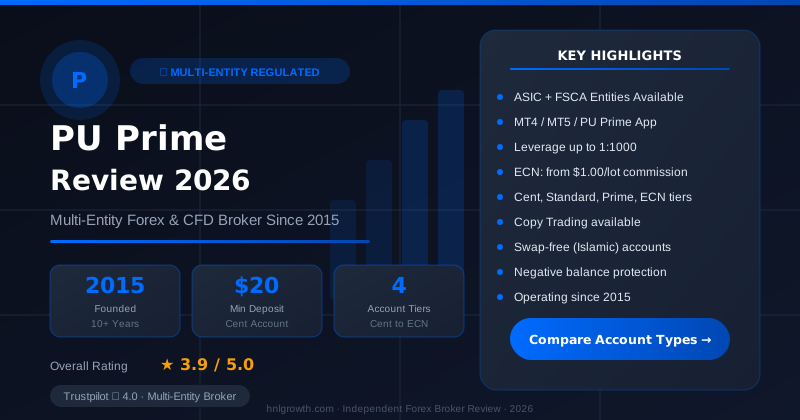
PU Prime — Multi-Entity Forex & CFD Broker
ASIC (AU) + FSCA (ZA) entities available · $20 min deposit (Cent) · MT4, MT5, PU Prime App · 4 account tiers
Every cost a CFD broker passes to you appears in one of two places: the spread, or the commission. PU Prime separates its four accounts cleanly along this line.
Spread-only model (Standard and Cent): The broker widens the spread above the interbank mid-price. You pay no commission ticket. The entire cost — liquidity markup, execution margin, broker revenue — is embedded in the spread you see quoted. Spreads on these accounts are wider by design.
Raw spread + commission model (Prime and ECN): The broker passes through a tighter raw spread sourced from its liquidity pool, then charges a separate per-lot commission on each side of the trade. The spread may display as 0.0 pips on liquid pairs under ideal conditions, but the commission is charged regardless of spread width. All-in cost = spread cost + (commission per side × 2).
The practical implication: for a low-frequency trader placing a handful of swing trades per week, Standard's wider spread may be cheaper in absolute dollar terms once you account for the $1,000 minimum deposit required to access Prime. For a scalper executing dozens of round-trips daily, Prime or ECN's commission model almost always wins on total cost per lot.
Account Tiers at a Glance
All figures sourced from the official account types page and spread and costs page. Verify before depositing — minimums and commissions can change.
| Account | Spread Type | EURUSD Indicative Min Spread | Commission (per lot/side) | Round-Turn Commission (1 lot) | Min Deposit | Leverage (ASIC retail / Offshore) | Best For |
|---|---|---|---|---|---|---|---|
| Standard | Spread-only | From 1.3 pips | $0 | $0 | $50 | 30:1 / Up to 1:1000 | Occasional traders, beginners |
| Prime | Raw + commission | From 0.0 pips | $3.50 | $7.00 | $1,000 | 30:1 / Up to 1:1000 | Active traders, moderate volume |
| ECN | Raw + commission | From 0.0 pips | $1.00 per side (verify current figure — see note) | $2.00–$3.00 (verify) | $10,000 | 30:1 / Up to 1:1000 | High-volume / professional traders |
| Cent | Spread-only | From 1.3 pips | $0 | $0 | $20 | 30:1 / Up to 1:1000 | Strategy testing, micro-lot trading |
Notes on this table:
EURUSD indicative spreads are published minimums under normal liquidity. Real spreads widen during news events and thin markets. XAUUSD indicative spreads are not rendered in the extracted source data available for this review; verify the current XAUUSD figure directly on the official spread-and-costs page before trading gold.
ASIC leverage cap of 30:1 on major FX pairs applies to retail clients under the Australian entity (AFSL 410681). Offshore entities (FSA Seychelles SD050, FSC Mauritius) permit up to 1:1000 for eligible clients. Both figures are confirmed from official sources.
ECN commission: the official account types page states $1.00 per side per lot for ECN. Some secondary sources have noted $1.50 per side. Confirm the current rate on the live spread-and-costs page before selecting the ECN account. The worked examples below use a $1.00/side figure but flag the discrepancy.
Cost Breakdown: Standard and Cent Accounts
Standard is the entry-level live account. No commission is charged. Your cost per trade is entirely determined by the spread at the moment of execution.
Indicative EURUSD spread: from 1.3 pips under normal market conditions. On a standard lot (100,000 units), 1 pip = $10. A 1.3-pip spread therefore costs $13 per round-trip on EURUSD — entry and exit combined, assuming similar spread width at close.
For XAUUSD (spot gold), check the current indicative spread on the official spread-and-costs page. It is not rendered in the source data reviewed here, and publishing a figure without official confirmation would mislead cost comparisons for gold traders.
The Cent account uses the same spread model as Standard. Positions are denominated in USC (US Cents). A $20 deposit displays as 2,000 USC, and position sizes are proportionally smaller, making Cent useful for testing an EA in a live execution environment without committing Standard-lot capital. There is no spread advantage versus Standard; the Cent denomination creates a ceiling on position size that limits scalability.
Overnight swap applies to both accounts. Positions held past the daily rollover (typically 5 pm New York time) incur a swap charge or credit depending on the interest rate differential of the pair and direction of your trade. Wednesday's rollover carries a triple swap to account for the weekend settlement. See the Overnight Costs section below.
Cost Breakdown: Prime Account
Prime is the inflection point for active traders. The raw spread starts from 0.0 pips on liquid pairs, but you pay $3.50 per lot per side — $7.00 round-turn on a standard lot — regardless of the spread at execution.
All-in formula: spread cost (pips × pip value) + $7.00 round-turn commission.
During the London–New York overlap under normal liquidity conditions, EURUSD raw spreads on commission-based accounts are commonly a fraction of a pip — but the official page does not publish an average. To illustrate the cost structure: at a 0.1-pip spread (illustrative only), the spread cost on 1 standard lot is $1. Add the $7.00 commission and total all-in cost is approximately $8 per round-trip, versus Standard's minimum of $13 at 1.3 pips. The 0.1-pip figure is for illustration of the formula only; your actual average spread during your trading session may differ. Check your platform's spread display during your typical trading hours.
The $1,000 minimum deposit is a hard gate. The cost advantage of Prime over Standard is real, but a trader with $300 cannot access Prime regardless of trading frequency.
Cost Breakdown: ECN Account
ECN offers the same raw-spread architecture as Prime but at a lower commission. The official account types page states $1.00 per lot per side, giving a $2.00 round-turn. Confirm this rate matches the current spread-and-costs page before depositing, as $1.50/side has been cited in secondary sources and the discrepancy has not been resolved from official documentation reviewed here.
Using the confirmed-minimum figure of $1.00/side: at a 0.1-pip illustrative spread on EURUSD, ECN round-trip all-in cost is approximately $1.00 (spread) + $2.00 (commission) = $3.00. This is the lowest all-in cost of any account tier, but the $10,000 minimum deposit gate means it is not accessible to most retail traders.
The cost advantage compounds at volume. A trader executing five lots per day round-trip saves approximately $25/day versus Prime (using $7 Prime vs $2 ECN commission, plus comparable spread costs) — roughly $500/month on 20 trading days. At low frequency, the $10,000 deposit opportunity cost outweighs the commission saving for most retail use cases.
All-In Trade Cost: Worked Examples
The table below shows the dollar cost of a 1-standard-lot round-trip with no overnight hold. Spread minimums are sourced from the official spread-and-costs page. Average spreads are not published by PU Prime; the 0.1-pip figure used for Prime and ECN is illustrative of the cost formula only. Actual costs will be higher during volatile sessions. Verify current figures before trading.
Table T2: All-In Cost Per Trade (No Overnight, 1 Standard Lot)
| Account | Instrument | Indicative Min Spread (pips) | Spread Cost Used (USD) | Round-Turn Commission (USD) | Total All-In (USD) | Notes |
|---|---|---|---|---|---|---|
| Standard | EURUSD | 1.3 | $13.00 | $0 | $13.00 | Spread-only; no commission |
| Prime | EURUSD | 0.0 min (0.1 illustrative avg) | $1.00 | $7.00 | ~$8.00 | Average spread not published; formula illustrated only |
| ECN | EURUSD | 0.0 min (0.1 illustrative avg) | $1.00 | $2.00–$3.00 | ~$3.00–$4.00 | Confirm commission per side before trading |
| Cent | EURUSD | 1.3 | $0.013* | $0 | $0.013* | *Per 0.01 lot in USC denomination |
| Standard | XAUUSD | Verify official page | — | $0 | Spread only | Check official spread-and-costs page for current figure |
| Prime | XAUUSD | From 0.0 (verify) | — | $7.00 | $7.00 + spread | Same commission structure as EURUSD Prime |
| ECN | XAUUSD | From 0.0 (verify) | — | $2.00–$3.00 | Confirm + spread | Confirm ECN commission rate |
On Prime and ECN average spreads: The official page confirms spreads "from 0.0 pips" but does not publish an average. During major data releases — NFP, CPI, FOMC — raw spreads on Prime and ECN can widen sharply, sometimes exceeding Standard in absolute pip terms because the raw spread widens directly with the liquidity pool. Assess spreads during your intended trading session in a demo or Cent account before committing to a commission-based tier.
Open a PU Prime account and choose your account type during registration
Tier Breakeven: When Does Upgrading from Standard to Prime Pay Off?
The decision framework is arithmetic:
Monthly saving from upgrading = (Standard all-in cost per lot − Prime all-in cost per lot) × monthly lots traded Break-even condition: Monthly saving ≥ opportunity cost of the additional $950 deposit (Prime $1,000 minimum − Standard $50 minimum)
Using the formula figures above (Standard $13/lot vs Prime ~$8/lot = $5 saving per round-trip lot at the illustrated average spread):
- 10 lots/month: $50 monthly saving
- 20 lots/month: $100 monthly saving
- 50 lots/month: $250 monthly saving
The $950 additional deposit required to meet Prime's minimum has an opportunity cost only you can quantify. For a trader executing 20 or more round-trip lots per month, the cost saving from Prime typically recoups the deposit difference within one to three months. Below 10 lots per month on Standard, the saving rarely justifies locking up the additional capital.
Substitute your own average spread (checked in-platform during your trading session) and your own monthly lot count before drawing a conclusion. The 0.1-pip average used here is illustrative; your actual average will determine the real breakeven.
Overnight and Time-Based Costs
Swaps
A swap (rollover fee) is charged on any position open at the daily rollover, which PU Prime processes at 5 pm New York time. The charge can be positive (a credit) or negative (a debit) depending on the interest rate differential between the two currencies and whether you are long or short.
Wednesday's rollover is triple-charged to cover the weekend. For a trader holding EURUSD long from Monday through Friday, the swap schedule runs: Mon −1×, Tue −1×, Wed −3×, Thu −1×, Fri −1×. That is 7 swap units over 5 calendar nights, not 5. This materially affects weekly swing strategies and should be factored into any position-sizing decision that involves multi-day holds.
The swap formula types used by PU Prime — in points, in currency, or as a percentage — vary by instrument. From the official fee-charges page:
- Swap in points = Swap (long or short) × Contract Size × 10^(−Digits) × Lot × Nights
- Swap in currency = Swap (long or short) × Lot × Nights
- Swap in percentage = Swap ÷ 100 ÷ 360 × Contract Size × EOD price × Lot × Nights
Do not use any illustrative rate for planning. Swap rates change daily with central bank rates and liquidity conditions. Retrieve live swap rates from MT4/MT5 (right-click any instrument → Specification → Swap Long / Swap Short) or from PU Prime's live spread-and-costs table.
Futures Rollover
For futures-style instruments (including CL-OIL, SP500ft, NAS100ft, DJ30ft, GER40ft and others listed on the fee-charges page), a rollover fee is charged at end of month. The same amount is credited back to maintain a net-neutral position. Rollovers can be monthly or quarterly depending on the instrument.
Islamic Account
PU Prime offers a swap-free Islamic account option in place of overnight interest, to comply with Halal trading principles. According to the official fee-charges page, an administrative fee applies instead of swap. The fee varies by instrument and liquidity provider. The specific rate schedule and instrument coverage are not detailed in the official sources reviewed here. Confirm the current administrative fee for your instruments directly with PU Prime before trading on an Islamic account — this is a material cost component that affects multi-day hold strategies.
Inactivity
PU Prime does not charge an inactivity fee. Accounts inactive for 90 days or more may be archived. Confirmed on the official fee-charges page.
Deposit, Withdrawal, and Transfer Costs
From the official fee-charges page:
| Method | PU Prime Fee | Processing Time (Indicative) | Notes |
|---|---|---|---|
| Deposit — card or e-wallet | None charged by PU Prime | Typically instant | Your card issuer or e-wallet provider may charge separately |
| Deposit — international bank wire | None charged by PU Prime | 1–3 business days | Your sending bank may charge a wire fee |
| Withdrawal — 1st international bank wire/month | Bank charge reimbursed by PU Prime | Business days; verify timeline | PU Prime covers bank charges on the first wire per calendar month |
| Withdrawal — additional bank wires in same month | 20 units of account currency (JPY and HKD accounts use USD 20 equivalent) | Business days; verify | Second and subsequent wires within the same calendar month |
| Withdrawal — e-wallets and cards | Confirm on official page | Typically faster than wire | Processing times vary by provider |
Currency conversion: PU Prime's fee-charges page does not explicitly list a currency conversion rate or markup. If your deposit currency differs from your account base currency, confirm in writing with PU Prime whether a conversion cost applies and what rate is used before transacting. This is an unconfirmed variable from UGC sources; treat it as a question to ask, not a confirmed cost.
Dividend adjustment: If you hold an overnight short position on certain dividend-paying share or index CFDs into the ex-dividend date, you will be charged the dividend component. This is confirmed on the fee-charges page and applies regardless of account tier.
Weekend withdrawal timing: PU Prime's stated processing timelines apply to business days. Factor this into liquidity planning if you require rapid access to funds over a weekend period.
Negative Balance Protection and Insurance
Negative balance protection is confirmed on PU Prime's fee-charges page for retail clients and elective professional clients. If your trading account balance falls below zero due to market conditions, PU Prime restores it to zero at no cost to you. Confirm that this applies to your specific contracted entity in your account agreement.
Lloyd's of London insurance: PU Prime's homepage states client fund insurance coverage up to $1,000,000 via Lloyd's. The exact scope, conditions, and which entities this coverage applies to are not detailed in the official sources reviewed here. Verify the coverage terms directly with PU Prime before treating this as a quantified protection.
Regulation, Entity, and What It Means for Your Account
PU Prime is authorised and regulated by multiple financial authorities. The entity you are assigned depends on your country of residence and affects your leverage cap, client asset protections, and recourse options.
| Client Location | Regulator | License Reference | Leverage Cap (Retail FX) | Compensation Scheme |
|---|---|---|---|---|
| Australia | ASIC | AFSL 410681 | 30:1 (major FX) | No formal scheme; AFCA dispute resolution available |
| South Africa | FSCA | FSP 52218 | Verify with entity | No formal scheme; FSCA oversight |
| UAE | CMA UAE | Verify current license | Verify with entity | Confirm with entity |
| Other / offshore | FSA Seychelles (SD050) or FSC Mauritius | Verify current numbers | Up to 1:1000 | No equivalent formal scheme |
Regulatory tier difference: ASIC is a Tier 1 regulator with mandatory conduct obligations, enforceable client money rules, and dispute resolution pathways via AFCA. FSA Seychelles and FSC Mauritius apply fewer mandatory client protections, do not operate a formal compensation scheme equivalent to ASIC's framework, and permit higher leverage. This is a factual structural difference, not an editorial ranking. Clients outside Australia and South Africa should confirm which entity they are contracting with, and review that entity's current regulatory status, before depositing.
ASIC leverage cap: ASIC's retail CFD leverage limits — 30:1 on major FX pairs, lower on indices, shares, and crypto — are a regulatory requirement under ASIC's product intervention order, not a broker discretion. Australian retail clients under the ASIC entity cannot access 1:1000 leverage regardless of account type. Offshore entities under FSA Seychelles or FSC Mauritius are not subject to this ASIC cap; eligible clients of those entities may access higher leverage.
Execution Rules: What Strategies Are Permitted
EA compatibility is confirmed across all four account types from the official account types page.
| Strategy Type | Standard | Prime | ECN | Cent | Notes |
|---|---|---|---|---|---|
| Expert Advisors (EAs) | Yes | Yes | Yes | Yes | Confirmed on official account types page |
| Hedging | Confirm with broker | Confirm with broker | Confirm with broker | Confirm with broker | Not explicitly confirmed in official sources reviewed |
| Scalping | Confirm with broker | Confirm with broker | Confirm with broker | Confirm with broker | See fair-use note below |
| Grid trading | Confirm with broker | Confirm with broker | Confirm with broker | Confirm with broker | Not explicitly confirmed in official sources reviewed |
| Copy trading | Confirmed available | Confirm conditions | Confirm conditions | Confirmed available | From $25/provider cited; per-account conditions vary |
| News trading | Confirm with broker | Confirm with broker | Confirm with broker | Confirm with broker | Dynamic spread widening at news events is a practical constraint regardless of policy |
Fair-use clause: PU Prime's terms include provisions that give the broker discretion in account reviews. The specific criteria that trigger a review — and the definitions of terms such as "bonus manipulation" and "arbitrage trading" within PU Prime's own terms — are not reproduced in publicly available official documentation reviewed here. If you plan to use an EA, a grid system, or any strategy that trades at or near news releases, request PU Prime's written policy on this before depositing and retain the response.
Bonuses, VPS, and Their Effect on Net Cost
Deposit bonus: PU Prime has offered a 50% deposit bonus on qualifying deposits. A bonus credited to your account is not equivalent to a cost reduction unless you can withdraw it. Bonus withdrawability is subject to a trading volume requirement. If the volume threshold required to unlock the bonus exceeds your planned activity, the bonus functions as a non-withdrawable margin buffer rather than a cash-equivalent benefit. Do not factor a bonus into your cost calculations until you have read the current terms and assessed whether the volume requirement is realistic for your strategy. Verify current bonus terms on the official promotions page.
Free VPS: A free virtual private server is available for traders meeting a minimum deposit and monthly notional volume threshold. The exact current thresholds are not confirmed in official sources reviewed here — secondary research indicates a $1,000 deposit and significant monthly volume, but these conditions change with promotions. Verify current eligibility at puprime.com before assuming access. For an EA trader who qualifies, free VPS eliminates a recurring infrastructure cost that would otherwise run $20–$50/month from a third-party provider.
Which Account Fits Which Trader
| Trader Profile | Suitable Account | Reasoning |
|---|---|---|
| Beginner or low-frequency swing trader, deposit < $1,000 | Standard | No commission complexity; $50 entry; swap cost is the main variable to manage |
| Active day trader or scalper, deposit ≥ $1,000, 20+ lots/month round-trip | Prime | Commission model beats Standard spread cost above roughly 15 lots/month |
| High-volume professional, deposit ≥ $10,000, 100+ lots/month | ECN | Lowest all-in cost per lot; deposit gate is the primary barrier |
| Strategy tester (EA or manual), minimal capital at risk | Cent | Live execution environment at micro-lot scale; same spreads as Standard |
| Multi-day or swing trader avoiding swap | Any account + Islamic option | Administrative fee replaces swap; confirm current rate schedule before using |
| Offshore client needing maximum leverage | Prime or ECN under offshore entity | 1:1000 available under FSA/FSC entity; understand the regulatory tier difference before proceeding |
Who should consider alternatives to PU Prime:
- Traders who require a formal government-backed compensation scheme — offshore entity clients have no equivalent to FSCS (UK) or SIPC (US), and Australian AFCA dispute resolution is not a compensation guarantee.
- Traders who cannot meet the $1,000 Prime minimum but need sub-$10 all-in costs per lot — Standard is the only option at that deposit level.
- Traders whose strategy depends on verified execution latency data — no independently verified execution latency figures are available from official sources reviewed here.
How to Open an Account
From the official account opening guide, the process takes approximately 10–15 minutes of active work, plus a verification waiting period.
Register. Go to the PU Prime signup page. Enter your name, email, phone number, and choose a password. Select your account currency (USD is most common) and your trading platform. MT5 is recommended for new accounts — it is newer and offers more features than MT4. This step takes approximately two minutes.
Complete suitability questions. PU Prime asks about trading experience and financial background as a regulatory KYC requirement. This step is not optional.
Upload documents. Submit a valid, unexpired government-issued photo ID (passport, national ID, or driving licence) and proof of address dated within the last three months (utility bill, bank statement, or equivalent government document). Use a phone camera for clear photos with all four document corners visible and no glare. Blurry or cropped submissions are the most common cause of verification delays.
Wait for verification. Typically a few hours during business days; up to 24–48 hours in some cases. A demo account is available to practise while your live account is reviewed.
Select your account type. Choose Standard, Prime, ECN, or Cent. This is the decision the cost analysis above is designed to inform.
Fund your account. Card and e-wallet deposits typically arrive instantly. Bank wire takes 1–3 business days. Minimum deposits: Cent $20, Standard $50, Prime $1,000, ECN $10,000.
Download the platform and verify your balance. Use MT4, MT5 from the official source, or the PU Prime mobile app. Log in with your credentials and confirm your account balance before placing any trade.
Compare PU Prime account types and open your account
Frequently Asked Questions
Is the 0.0 pip spread on Prime and ECN what I will actually get? No, not consistently. 0.0 pip is the published minimum under ideal liquidity. During most sessions, the raw spread on EURUSD will be a fraction of a pip above zero. During major news events — NFP, FOMC, CPI — spreads on all accounts widen significantly, including Prime and ECN, because the raw spread widens directly with the liquidity pool. The official page does not publish average spreads. Check the live spread display in your platform during your typical trading hours to get a realistic cost baseline.
Are demo spreads representative of live execution? Demo environments can show tighter spreads, less slippage, and faster fills than a live account. A 0.0 pip spread in a demo environment is not a guarantee of 0.0 pip execution on a live Prime or ECN account. If you need execution confirmation closer to live conditions, consider using the Cent account at very small lot sizes, which provides live market exposure at reduced capital risk.
What triggers an account review? The specific patterns that trigger PU Prime's account review process are not defined in the publicly available official documentation reviewed here. PU Prime's terms reference practices such as "bonus manipulation" and "arbitrage trading" as grounds for review, but these terms are defined within the broker's own terms of service rather than in a universally standardised way. If you use an EA, trade around news events, or hold a deposit bonus, request written clarification from PU Prime on what constitutes a reviewable pattern before depositing.
What are the currency conversion costs on deposits and withdrawals? PU Prime's fee-charges page does not explicitly list a currency conversion rate or markup. If your deposit or withdrawal currency differs from your account base currency, ask PU Prime in writing for the applicable conversion rate before transacting. This is an unconfirmed variable; treat it as a question to ask rather than an assumed zero cost.
Does the Islamic account really cost nothing extra? No. The Islamic account avoids swap charges, but an administrative fee applies instead. The fee varies by instrument and liquidity provider. It is a differently structured cost, not a zero-cost alternative. Confirm the current rate schedule with PU Prime directly before assuming the Islamic account reduces your holding costs.
Can I run an EA on all account types? Yes, according to the official account types page — EA compatibility is confirmed for all four tiers. However, EA use does not exempt a strategy from PU Prime's fair-use review provisions. If your EA logic trades at or around news events or employs patterns that could be characterised as arbitrage, request written confirmation from the broker before deploying on a live funded account.
What happens if my withdrawal is delayed? PU Prime's official processing timelines apply to business days. If you experience a delay beyond the stated timeline, contact PU Prime support and document your request in writing. Having full account verification completed before requesting a withdrawal reduces the likelihood of procedural delays.
What to Verify Before Depositing
- Current EURUSD and XAUUSD spreads on your specific account type, checked at the time of day you plan to trade
- ECN commission per side — confirm the current figure matches what is stated on the live spread-and-costs page
- Islamic account administrative fee rate for your specific instruments
- Which PU Prime legal entity you are contracting with and its current regulatory status
- Bonus terms and the lot volume required for withdrawal eligibility, if a bonus applies
- VPS current eligibility thresholds, if VPS is relevant to your setup
- Whether currency conversion applies to your deposit or withdrawal method and at what rate
Data referenced August 2026. Spreads, commissions, swap rates, and minimum deposits are subject to change. Always verify current figures at puprime.com/spread-and-costs, puprime.com/account-types, and puprime.com/fee-charges before making a deposit decision.
Risk warning: CFDs and leveraged forex products are complex instruments and carry a high risk of losing money rapidly due to leverage. Consider whether you understand how these products work and whether you can afford to take the high risk of losing your capital. Check the entity, terms and protections that apply in your jurisdiction before trading.
Ready to Compare PU Prime Account Types?
PU Prime is a multi-entity broker — ASIC (Australia) and FSCA (South Africa) regulated entities offer stronger oversight, while most international clients are onboarded to the FSA Seychelles or FSC Mauritius entities. Four account tiers (Cent, Standard, Prime, ECN) range from a $20 minimum deposit to full ECN pricing.
Risk disclaimer: PU Prime is a live, regulated multi-entity broker — trading forex and CFDs is done with real capital under normal market risk (this is not a simulated prop-firm evaluation). PU Prime operates under multiple separate licenses (ASIC, FSCA, FSA Seychelles, FSC Mauritius); which entity holds your account depends on your country of residence and determines your leverage cap and protections — confirm this before funding. CFDs and leveraged forex products are complex instruments and carry a high risk of losing money rapidly due to leverage; 62.2% of retail investor accounts lose money when trading CFDs with this provider. Consider whether you understand how CFDs/forex work and whether you can afford the high risk of losing your money. Affiliate disclosure: HNL Growth earns a commission when you open a PU Prime account through links on this page.