PU Prime Leverage and Margin 2026: Limits by Entity
PU Prime's available leverage depends directly on which regulatory entity your account is opened under — not just the account type you select. Traders onboarded through the ASIC-regulated Australian...
Reviewed using our forex & CFD broker review methodology
Checked on: 2026-08-17 | Broker terms, regulation, and pricing can change. Always verify at the official PU Prime site before opening an account.
Affiliate Disclosure: HNL Growth may earn a commission if you open an account through our links, at no additional cost to you. Risk Warning: CFDs and leveraged forex products are complex instruments and carry a high risk of losing money rapidly due to leverage. 62.2% of retail investor accounts lose money when trading CFDs with this provider. Trading forex and CFDs may not be suitable for all investors. Consider your objectives, experience, and risk appetite before trading, and ensure you understand the risks involved. Broker Disclosure: PU Prime is a live, regulated multi-entity broker (not a simulated prop-firm evaluation) — trades are executed with real capital in live market conditions, subject to normal market risk. Which PU Prime entity holds your account depends on your country of residence and determines your leverage cap and protections.
Last verified: August 2026 | Editorial Team
PU Prime Leverage and Margin 2026: Limits by Entity
Disclosure: This page may contain affiliate links. We may earn a commission if you open an account through our links, at no extra cost to you.
PU Prime's available leverage depends directly on which regulatory entity your account is opened under — not just the account type you select. Traders onboarded through the ASIC-regulated Australian entity face a maximum of 1:30 on major forex pairs under mandatory retail leverage limits. Traders onboarded through the FSA (Seychelles) or FSC (Mauritius) offshore entities can access leverage up to 1:1000 on major forex, subject to asset class and position size conditions. The FSCA (South Africa) and CMA (UAE) entities each operate under their own leverage frameworks. Identifying your entity before sizing positions is not optional — it is the foundational variable in your margin calculations.
What This Guide Covers and Who It Is For
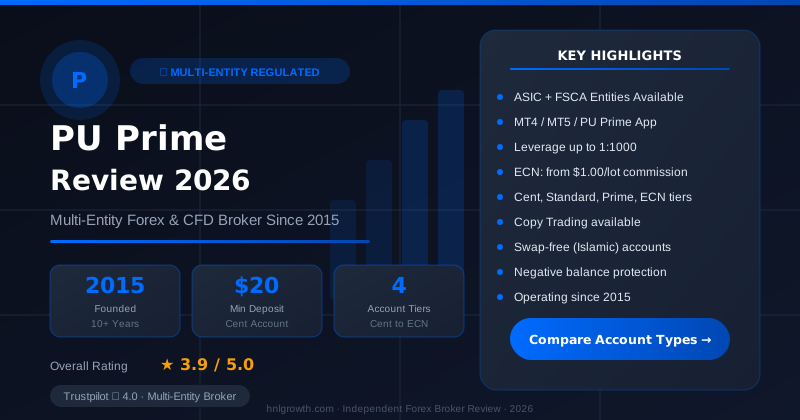
PU Prime — Multi-Entity Forex & CFD Broker
ASIC (AU) + FSCA (ZA) entities available · $20 min deposit (Cent) · MT4, MT5, PU Prime App · 4 account tiers
This article is for active traders — scalpers, day traders, and high-frequency EA operators — who already understand leverage mechanics and need to know exactly which limits apply to their PU Prime account based on jurisdiction and account tier. It covers the leverage ceiling per regulatory entity, margin requirement calculations with worked examples, dynamic leverage conditions, margin call and stop-out thresholds, regulatory protection tradeoffs, strategy allowances by account type, and a step-by-step account opening walkthrough.
If you are evaluating PU Prime for the first time and want a general broker overview, this is not that article. This is an execution-focused reference for traders who need numbers before committing capital.
Leverage Limits by Regulatory Entity
The single most important decision variable when opening a PU Prime account is which legal entity processes your registration. Four regulatory entities govern PU Prime accounts globally, each operating under different leverage caps mandated by their respective regulator.
Table T1 — Leverage by Entity and Asset Class
| Regulatory Entity | License | Major Forex | Minor Forex | XAUUSD (Gold) | Indices | Crypto | Equity CFDs |
|---|---|---|---|---|---|---|---|
| FSA — Seychelles | SD050 | Up to 1:1000 | Up to 1:500 | Up to 1:500 | Up to 1:200 | Up to 1:200 | Up to 1:200 |
| FSC — Mauritius | GB23202672 | Up to 1:1000 | Up to 1:500 | Up to 1:500 | Up to 1:200 | Up to 1:200 | Up to 1:200 |
| ASIC — Australia | AFSL 410681 | Up to 1:30 | Up to 1:20 | Up to 1:20 | Up to 1:20 | Up to 1:2 | Up to 1:5 |
| FSCA — South Africa | FSP 52218 | Up to 1:500 | Up to 1:200 | Up to 1:200 | Up to 1:100 | Up to 1:100 | Up to 1:100 |
Important notes on this table:
- ASIC leverage caps are mandated by ASIC's Product Intervention Order for retail CFD clients. The figures stated reflect typical regulatory caps for these asset classes; actual per-instrument limits should be verified with PU Prime, as implementation may vary by specific instrument.
- Offshore entity leverage figures (FSA/FSC) represent maximum advertised ceilings and may be subject to per-asset caps, dynamic adjustments based on position size, and time-of-day conditions. These figures are indicative; confirm instrument-specific leverage in your client portal before trading.
- CMA (UAE) leverage limits are governed by that authority's rules and are not included in this table. Check PU Prime's regulation page for current CMA entity details.
- All figures are subject to change. Verify against entity-specific T&Cs and the current spread and cost schedule at puprime.com/spread-and-costs/ before trading.
Why the entity determines your ceiling, not the account type alone. PU Prime's four regulatory entities are distinct legal entities operating under different regulatory frameworks. Selecting a Prime or ECN account does not override the leverage cap imposed by the regulator governing your account. A trader under ASIC opening an ECN account still faces 1:30 on EURUSD. A trader under FSA-Seychelles on a Standard account can access up to 1:1000 on the same pair. Account type and entity are independent variables — both matter.
Open a PU Prime account and select your entity
Account Type and Leverage Interaction
Within a given entity, PU Prime offers four account types. The account tier does not increase or decrease the entity's regulatory leverage ceiling, but it does affect your cost structure, which interacts directly with margin efficiency.
Table T2 — Account Type Comparison
| Account Type | Min Deposit | Typical Spread EURUSD | Commission per Lot per Side | Max Leverage (Offshore Entity) | Max Leverage (ASIC) | Best For |
|---|---|---|---|---|---|---|
| Cent | $20 | From 1.0 pip | None | Up to 1:1000 | Up to 1:30 | Strategy testing, micro-sizing, low-capital live practice |
| Standard | $50 | From 1.3 pips | None | Up to 1:1000 | Up to 1:30 | Straightforward pricing, no commission tracking |
| Prime | Confirm current | From 0.0 pips | Confirm current | Up to 1:1000 | Up to 1:30 | Active traders, tighter spreads, frequent execution |
| ECN | Confirm current | From 0.0 pips | Confirm current | Up to 1:1000 | Up to 1:30 | High-volume traders requiring lowest per-trade cost |
Important pricing note: Minimum deposit requirements, commission rates, and spread figures are subject to change. The official evidence pack shows ECN account commission stated as "$3.5 per side/lot" in the regulation excerpt but does not detail Prime account minimums or commission structures. Check puprime.com/spread-and-costs/ and puprime.com/fee-charges/ for the current schedule before selecting your account type, as these figures directly affect your per-trade cost and capital efficiency.
A common misconception: "ECN means higher leverage." ECN is an execution model and pricing tier. It does not modify your entity's regulatory leverage ceiling.
Margin Mechanics: Worked Examples
The following table translates leverage figures into actual margin requirements. These are illustrative calculations based on documented leverage levels and approximate exchange rates. Notional values use EURUSD ≈ 1.0850 and XAUUSD ≈ 2,650 as reference rates. Actual margin requirements will vary with live rates and any dynamic leverage adjustments in effect.
Table T3 — Margin Requirement Worked Examples (Illustrative)
| Instrument | Lot Size | Notional Value (USD) | Leverage | Required Margin (USD) |
|---|---|---|---|---|
| EURUSD | 1 standard lot | ~$108,500 | 1:30 (ASIC) | ~$3,617 |
| EURUSD | 1 standard lot | ~$108,500 | 1:500 (Offshore) | ~$217 |
| XAUUSD | 1 standard lot (100 oz) | ~$265,000 | 1:100 (Offshore) | ~$2,650 |
| XAUUSD | 1 standard lot (100 oz) | ~$265,000 | 1:500 (Offshore) | ~$530 |
Margin call and stop-out thresholds: Standard industry practice for margin call is typically 100% of required margin (warning issued but no automatic closure) and stop-out at 50% of required margin (automatic position closure begins). Confirm the exact thresholds that apply to your specific account type and entity in PU Prime's trading conditions documentation, as these figures may vary by entity or account configuration.
Negative balance protection (NBP): The official fee and charges page confirms PU Prime offers negative balance protection to retail clients and elective professional clients, meaning if your account balance falls below zero due to market conditions, it will be restored to zero. The scope of NBP — particularly whether it applies uniformly across all asset classes including crypto CFDs under offshore entities — should be confirmed in your entity-specific client agreement before trading high-volatility instruments.
Practical implication of the 1:30 vs. 1:500 gap: A scalper holding 3 simultaneous EURUSD standard lots under ASIC needs approximately $10,850 in free margin for those positions. The same 3 lots under a 1:500 offshore entity require only $651. For strategies requiring concurrent multi-pair exposure, the entity choice is a capital efficiency decision, not just a regulatory one.
Dynamic Leverage and Position Size Adjustments
Leverage is not static on any given account. PU Prime, in line with standard industry risk management practice, may apply dynamic leverage adjustments under specific conditions. These reductions can materially affect margin requirements for traders holding or intending to open positions during sensitive windows.
Conditions under which leverage may be reduced:
- High-impact economic events: Leverage on major forex pairs and indices may be reduced in the window preceding major data releases (NFP, ECB rate decisions, Fed FOMC announcements). The specific window duration and magnitude of reduction are subject to broker risk management discretion and may not be pre-announced with exact thresholds.
- Large open position sizes: Many brokers apply tiered leverage that steps down as position size increases. For example, a 1:1000 ceiling may apply to the first tier of exposure, with leverage reducing incrementally for positions above that tier. Confirm the current tiered schedule via the client portal or by contacting PU Prime before sizing large positions.
- Weekend and gap risk: Leverage on equity indices, crypto, and commodities may be reduced for positions held into the weekend close to manage gap risk at Monday open. Check your platform's margin requirements on Friday afternoon.
- Volatile instruments: Instruments with elevated volatility (certain exotic pairs, crypto CFDs) may carry lower leverage ceilings than major forex pairs even under offshore entities.
For scalpers: If your strategy depends on consistent maximum leverage availability, maintain a margin buffer above the minimum required and check platform margin requirements before entering positions near major event windows rather than assuming advertised maximums are always in effect.
Regulatory Entity Guide: What Each License Means for You
Table T4 — Regulatory Entity Protection Decoder
| Entity | Regulator | License ID | Max Retail Forex Leverage | Negative Balance Protection | Fund Segregation | Compensation Scheme | FCA Status |
|---|---|---|---|---|---|---|---|
| Pacific Union (Pty) Ltd | ASIC (Australia) | AFSL 410681 | 1:30 (major forex) | Yes (retail clients) | Required | No FSCS equivalent | Not applicable |
| Pacific Union Ltd | FSCA (South Africa) | FSP 52218 | Up to 1:500 | Stated for retail clients | Stated | No equivalent scheme | Not applicable |
| Pacific Union (Seychelles) Ltd | FSA (Seychelles) | SD050 | Up to 1:1000 | Stated for retail clients | Stated | No compensation scheme | Unauthorized — FCA warning issued |
| Pacific Union Ltd | FSC (Mauritius) | GB23202672 | Up to 1:1000 | Stated for retail clients | Stated | No compensation scheme | Not applicable |
Entity-by-entity plain-language summary:
ASIC (AFSL 410681): The most stringent regulatory framework PU Prime operates under. Retail leverage caps are mandated by ASIC regulation — these are not discretionary. Benefits include mandatory leverage caps that limit catastrophic loss from over-leveraging, stricter client money handling rules, and access to ASIC's external dispute resolution pathway. Australia does not operate a compensation scheme equivalent to the UK's FSCS, so fund recovery in an insolvency event is not government-guaranteed, but ASIC's oversight substantially raises operational standards.
FSCA (FSP 52218): South African regulation with leverage up to 1:500. The FSCA is a credible regulator operating under the Financial Sector Regulation Act. Complaint escalation can go to the FSCA directly. Confirm fund segregation and NBP specifics in the FSCA-entity client agreement.
FSA — Seychelles (SD050): Offshore licensing jurisdiction. Leverage up to 1:1000. The FSA is a functioning regulator with complaint procedures, but oversight standards and enforcement capacity are materially lower than ASIC or FSCA. Critical for UK residents: The FCA has issued an unauthorized firm warning against Pacific Union (Seychelles) Ltd — this entity is not authorized to conduct regulated activities in the UK. This does not affect the entity's legal standing in other jurisdictions, but UK-based traders should verify which PU Prime entity, if any, is available to them.
FSC — Mauritius (GB23202672): Offshore licensing similar in profile to Seychelles. Leverage up to 1:1000. No investor compensation scheme. Fund segregation is stated. Complaint escalation goes to the FSC Mauritius. Regulatory recourse is possible but more limited than ASIC or FSCA.
Additional protection statement: PU Prime states that client funds are protected with independent dispute resolution plus Lloyd's insurance coverage up to $1,000,000. Confirm the scope, exclusions, and claims process for this coverage directly with PU Prime, as insurance terms are separate from regulatory protections and have their own eligibility conditions.
Strategy Rules: What Is and Is Not Permitted
Table T5 — Strategy Allowance by Account Type
| Strategy / Behaviour | Cent | Standard | Prime | ECN |
|---|---|---|---|---|
| Scalping (short-hold duration) | Permitted | Permitted | Permitted | Permitted |
| Expert Advisors (EAs) | Permitted | Permitted | Permitted | Permitted |
| Hedging (opposing positions, same account) | Permitted | Permitted | Permitted | Permitted |
| Grid trading | Permitted | Permitted | Permitted | Permitted |
| News trading | Permitted | Permitted | Permitted | Permitted |
| Correlated pair stacking | Permitted | Permitted | Permitted | Permitted |
| Copy trading as signal provider | Confirm with PU Prime | Confirm with PU Prime | Confirm with PU Prime | Confirm with PU Prime |
Critical caveat on strategy permissions: PU Prime officially supports EAs, scalping, and hedging across account types. However, most broker T&Cs — including PU Prime's — contain risk management override clauses that grant the broker discretion to review accounts exhibiting patterns classified as arbitrage, latency exploitation, or bonus manipulation. This is standard industry practice, not unique to PU Prime.
The practical implication: "permitted" in the T&Cs is not the same as "will never trigger a review." If you intend to use EAs or scalping strategies, consider opening accounts without promotional bonuses — this removes a commonly cited trigger for account reviews documented in unverified user reports across the industry.
If you experience an account issue, the formal complaint path is: FSA Seychelles for SD050-entity accounts, ASIC/AFCA for AFSL 410681-entity accounts, FSCA for FSP 52218-entity accounts.
Who Benefits from PU Prime's Leverage Structure — and Who Does Not
PU Prime's offshore entity leverage structure suits:
- High-volume forex and gold traders who understand the regulatory tradeoff between leverage ceiling and oversight level, and who actively manage risk without relying on regulatory compensation schemes as a backstop
- Traders based in jurisdictions where ASIC or FSCA entity onboarding is not available, and who want access to high leverage with a multi-regulated broker
- EA operators and scalpers wanting flexible strategy execution without platform-level restrictions, combined with raw-spread pricing on Prime or ECN accounts
- Traders seeking significant margin capital efficiency for multi-pair concurrent strategies — the difference between 1:30 and 1:500 in freed capital is a real execution advantage for portfolio-approach strategies
PU Prime's ASIC entity suits:
- Traders who prioritize regulatory oversight quality over leverage ceiling and want access to AFCA dispute resolution
- Australian residents who are legally required to use ASIC-regulated services
- Traders who prefer the risk management discipline enforced by leverage caps
PU Prime may not suit:
- UK residents — the Seychelles entity (which offers high leverage) is flagged as unauthorized by the FCA. UK traders should verify which PU Prime entity, if any, is available to them and consider FCA-authorized alternatives
- Traders needing a compensation scheme equivalent to the UK FSCS — no PU Prime entity offers this
- Traders who require definitive publicly published dynamic leverage thresholds for pre-planning — this information is not fully detailed in public documentation
Compare PU Prime account types and open your account
How to Open an Account: Entity and Leverage Selection
Entity selection happens at the point of registration and is determined primarily by your country of residence. PU Prime routes accounts to the appropriate regulatory entity based on your jurisdiction. In most cases you do not manually select your entity from a dropdown — the broker's compliance process determines which entity's terms govern your account based on residency.
Step-by-step account opening:
Go to the account registration page at puprime.com/how-to-open-a-trading-account/. Fill in name, email, phone number, and password. Select account currency (USD is standard) and platform (MT4 or MT5 — MT5 is recommended for access to the wider instrument range and updated order types).
Select your account type. Choose from Cent, Standard, Prime, or ECN. The official evidence pack states Cent requires $20 minimum and Standard requires $50 minimum. Confirm current minimum deposit requirements for Prime and ECN accounts at the time of registration, as these are subject to change. Note that account type can typically be changed or additional accounts added post-registration, but entity assignment is tied to your residency documentation.
Complete KYC (Know Your Customer) verification. Upload a valid government-issued photo ID (passport, national ID, or driving licence — must be unexpired) and proof of address dated within the last three months (utility bill, bank statement, or equivalent). The official evidence pack states verification typically takes about 10 to 15 minutes of active work; allow a few hours during business days for compliance review, or up to 24–48 hours during high-volume periods.
Fund your account. Accepted methods include credit/debit card, bank wire transfer, Skrill, Neteller, and additional local payment methods depending on your region. Card and e-wallet deposits are typically instant. Bank transfers take 1–3 business days. The official evidence pack confirms PU Prime does not charge deposit handling fees; your payment provider may charge separately. For the first international bank withdrawal per month, PU Prime reimburses the bank charges — additional international bank transfer withdrawals within the same month incur a bank handling fee of 20 units of the account currency (JPY and HKD use the equivalent of USD 20).
Confirm your entity and leverage limit. After account approval, check the entity governing your account in the client portal or by contacting support. This confirms which leverage ceiling and regulatory protections apply to your account before you begin trading.
Can you switch entities after account opening? Entity assignment is tied to residency — switching entities is generally not a simple account-setting change and may require a new application under a different jurisdictional entity. Contact PU Prime support directly if your residency status changes or if you believe your entity assignment is incorrect.
Frequently Asked Questions
Does account type determine my maximum leverage? No. Your regulatory entity determines the leverage ceiling. Account type (Cent, Standard, Prime, ECN) affects your pricing structure and minimum deposit, not the maximum leverage available under your entity's regulatory rules.
Which PU Prime entity offers the highest leverage? FSA-Seychelles and FSC-Mauritius entities offer the highest available leverage — up to 1:1000 on major forex pairs. This comes with lower regulatory oversight compared to ASIC. The tradeoff between leverage and regulatory protection is the central entity decision.
What happens to my available leverage during high-impact news events? PU Prime, in common with most CFD brokers, may reduce leverage on affected instruments in the window before and during major scheduled events (NFP, central bank decisions). The exact reduction schedule is subject to broker discretion and may not be pre-published in full detail. Maintain a margin buffer and check platform requirements before entering positions near event windows.
Can I switch entities after opening my account? Entity assignment is linked to your verified residency. Changing entities after account opening is not a standard account setting and typically requires contact with PU Prime compliance. It is not guaranteed to be possible post-registration.
Does negative balance protection cover all instruments? PU Prime confirms NBP for retail clients and elective professional clients. However, the scope across all asset classes — particularly crypto CFDs and exotic instruments under offshore entities — should be confirmed in your specific entity client agreement. Do not assume universal coverage across every instrument without verifying your entity's T&Cs.
I accepted a bonus. What strategy restrictions apply? Bonus T&Cs define specific trading behaviors classified as arbitrage or manipulation. Review the exact definitions in PU Prime's bonus terms before trading with a bonus balance. If you do not want bonus T&C restrictions affecting your account, decline the bonus at signup.
Risk Warning
Risk warning: CFDs and leveraged forex products are complex instruments and carry a high risk of losing money rapidly due to leverage. Consider whether you understand how these products work and whether you can afford to take the high risk of losing your capital. Check the entity, terms, and protections that apply in your jurisdiction before trading.
The leverage figures, margin thresholds, and regulatory details in this article are drawn from official PU Prime sources and publicly available regulatory information as of the evidence pack date. Regulatory conditions, leverage limits, fee schedules, and entity terms are subject to change. Verify all figures directly with PU Prime and the relevant regulatory authority before opening an account or making any trading decision. This article does not constitute financial advice.
Ready to Compare PU Prime Account Types?
PU Prime is a multi-entity broker — ASIC (Australia) and FSCA (South Africa) regulated entities offer stronger oversight, while most international clients are onboarded to the FSA Seychelles or FSC Mauritius entities. Four account tiers (Cent, Standard, Prime, ECN) range from a $20 minimum deposit to full ECN pricing.
Risk disclaimer: PU Prime is a live, regulated multi-entity broker — trading forex and CFDs is done with real capital under normal market risk (this is not a simulated prop-firm evaluation). PU Prime operates under multiple separate licenses (ASIC, FSCA, FSA Seychelles, FSC Mauritius); which entity holds your account depends on your country of residence and determines your leverage cap and protections — confirm this before funding. CFDs and leveraged forex products are complex instruments and carry a high risk of losing money rapidly due to leverage; 62.2% of retail investor accounts lose money when trading CFDs with this provider. Consider whether you understand how CFDs/forex work and whether you can afford the high risk of losing your money. Affiliate disclosure: HNL Growth earns a commission when you open a PU Prime account through links on this page.