PU Prime Review 2026: Fees, Platforms, Safety & Verdict
PU Prime is not one broker with one regulator — it is a group of separately licensed entities, and which one holds your account depends on where you live. That single fact should shape your entire...
Reviewed using our forex & CFD broker review methodology
Checked on: 2026-08-17 | Broker terms, regulation, and pricing can change. Always verify at the official PU Prime site before opening an account.
Affiliate Disclosure: HNL Growth may earn a commission if you open an account through our links, at no additional cost to you. Risk Warning: CFDs and leveraged forex products are complex instruments and carry a high risk of losing money rapidly due to leverage. 62.2% of retail investor accounts lose money when trading CFDs with this provider. Trading forex and CFDs may not be suitable for all investors. Consider your objectives, experience, and risk appetite before trading, and ensure you understand the risks involved. Broker Disclosure: PU Prime is a live, regulated multi-entity broker (not a simulated prop-firm evaluation) — trades are executed with real capital in live market conditions, subject to normal market risk. Which PU Prime entity holds your account depends on your country of residence and determines your leverage cap and protections.
Last verified: August 2026 | Editorial Team
PU Prime Review 2026: Fees, Platforms, Safety & Verdict
Disclosure: This page may contain affiliate links. We may earn a commission if you open an account through our links, at no extra cost to you.
PU Prime is not one broker with one regulator — it is a group of separately licensed entities, and which one holds your account depends on where you live. That single fact should shape your entire evaluation. If you are onboarded to the ASIC-licensed entity, you get Australia's regulatory framework. If you are onboarded to the Seychelles or Mauritius entity, you get a materially lighter oversight regime. Costs are competitive on the Prime and ECN tiers for traders with sufficient volume, but the ECN account's $10,000 minimum puts it out of reach for most retail traders. This review works through entity, cost, and fit before drawing any conclusions.
Quick verdict: is PU Prime right for your situation?
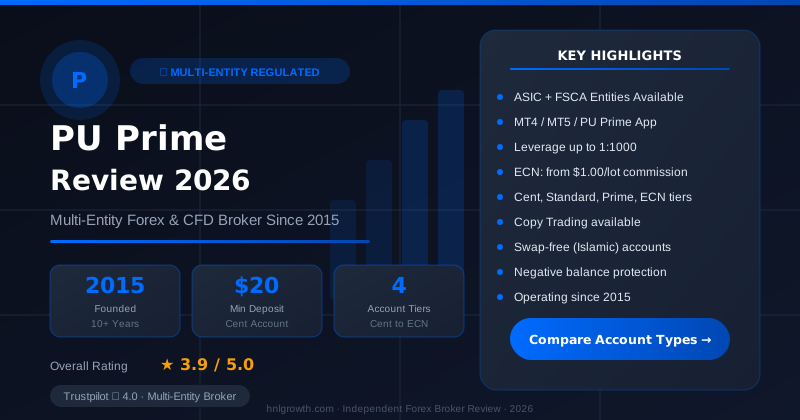
PU Prime — Multi-Entity Forex & CFD Broker
ASIC (AU) + FSCA (ZA) entities available · $20 min deposit (Cent) · MT4, MT5, PU Prime App · 4 account tiers
There is no single yes/no answer to "is PU Prime safe" — it depends entirely on which entity onboards you, which in turn depends on your country of residence and the account terms you are offered at signup.
What can be stated plainly:
- PU Prime operates under multiple separate regulatory licenses, not one unified global license. According to PU Prime's own regulation page, the group holds licenses with the Financial Services Authority of Seychelles (FSA), the Financial Services Commission of Mauritius (FSC), the Financial Sector Conduct Authority of South Africa (FSCA), and the Capital Market Authority of the UAE (CMA). A separate PU Prime blog post also references an Australian Securities and Investments Commission (ASIC) license; verify current status directly on ASIC's public register at asic.gov.au before relying on this, as it was not independently confirmed for this review.
- No single regulator supervises the entire PU Prime group. Each entity is a distinct legal company with its own license, its own terms, and its own client-protection framework. A trader onboarded to the Seychelles entity is not protected by South African or Australian rules, and vice versa.
- Costs are competitive on the Prime and ECN tiers, but only once you account for commission and swap alongside the headline spread. The Standard account is commission-free but carries wider spreads.
- The $10,000 ECN minimum is a real access barrier, not a marketing footnote. Most retail traders will use the Standard or Prime tier.
Who it fits: traders comfortable with a multi-entity regulatory group, who want a low entry point (Cent and Standard accounts from $20–$50), broad instrument access, and are prepared to verify their own entity's protections before funding.
Who should look elsewhere: traders in the UK, EU, or Canada who want the certainty of a domestic top-tier regulator — the FCA, a national EU regulator, or a Canadian provincial securities regulator — with established local complaint and compensation mechanisms. If regulatory certainty in your home jurisdiction matters more to you than pricing, a locally authorized broker is the more conservative choice.
Regulatory footprint: find your entity and what it means
The most important step before funding any account is confirming which legal entity you are contracting with. PU Prime's own regulation page lists the following licenses:
| Regulator | Jurisdiction | Note |
|---|---|---|
| Financial Services Authority (FSA) | Seychelles | License details published on puprime.com/regulation/ |
| Financial Services Commission (FSC) | Mauritius | License details published on the same page |
| Financial Sector Conduct Authority (FSCA) | South Africa | License details published on the same page |
| Capital Market Authority (CMA) | UAE | License details published on the same page |
| Australian Securities and Investments Commission (ASIC) | Australia | Referenced in PU Prime blog content; verify current status directly on ASIC's public register before relying on this — not independently confirmed for this review |
Editorial framing note. The terms "stronger oversight" and "lighter oversight" used below are editorial shorthand describing practical differences in supervisory resources, public enforcement records, and compensation frameworks between jurisdictions — not terms used by any of the regulators themselves.
- Regulators such as ASIC and FSCA operate more developed supervisory and enforcement frameworks, with public enforcement records and, in some cases, statutory compensation arrangements.
- Regulators such as the FSA (Seychelles) and FSC (Mauritius) are lighter-touch offshore regimes. They license and register firms but typically offer less in the way of investor compensation schemes or public enforcement transparency compared with ASIC or FSCA.
- The CMA (UAE) sits between these in terms of typical regulatory infrastructure; its scope and consumer protections differ from ASIC's framework.
What cannot be independently verified from public sources. PU Prime's homepage states that client funds are "safely segregated" and references "independent dispute resolution plus Lloyd's insurance coverage up to $1,000,000," per puprime.com. This is a broker-published statement, not an audited fact. No third-party audit document or insurer confirmation of scope and eligibility was available for review at the time of writing. This limitation applies throughout this review wherever the $1M figure or Lloyd's insurance is mentioned — in each case the source is PU Prime's own homepage. Treat it as an announced policy and ask PU Prime support directly to confirm which entity, account type, and circumstances the coverage applies to before relying on it.
Regulatory warnings in other markets. Some traders researching PU Prime will encounter references to regulator warnings in the UK, Canada, or the UAE (DFSA) regarding unauthorized activity. The original notices for these references were not located in the sources available for this review. If you are based in the UK, check the FCA's own warning list at fca.org.uk; if you are in Canada, check your provincial securities regulator's warning list; if you are in the UAE, check the DFSA's public register. Do this independently and directly, rather than relying on secondary commentary including this article.
Dispute resolution. Some community discussion references a dispute-resolution intermediary in connection with PU Prime complaints. No independent documentation of a formal dispute-resolution pathway was available in the official sources reviewed. Before funding, ask PU Prime directly to confirm the current written appeals and dispute process for your account's entity, and obtain this in writing.
If you are in the UK, EU, or Canada: PU Prime's published licenses do not include the FCA, an EU national regulator, or a Canadian provincial securities regulator. If you want the specific protections those regimes provide — statutory compensation schemes, domestic complaint bodies, local legal recourse — an FCA-authorized or CySEC-authorized broker is the more conservative choice for your jurisdiction.
How PU Prime's entity structure compares to the alternative
Traders evaluating PU Prime against FCA- or CySEC-regulated alternatives face a structural trade-off, not just a pricing one. The table below illustrates the difference at framework level; specific broker fees should be verified directly with each broker before making a comparison. The FCA and CySEC columns are illustrative of the regulatory framework only and do not represent any specific named broker.
| Feature | PU Prime (ASIC entity) | PU Prime (FSA Seychelles entity) | FCA-authorized broker (framework illustration) | CySEC-authorized broker (framework illustration) |
|---|---|---|---|---|
| Regulatory tier | ASIC (Australia) | FSA (Seychelles) — offshore | FCA (UK) — top-tier | CySEC (Cyprus/EU) — top-tier |
| Statutory compensation scheme | AFCA complaint scheme (Australia) | None confirmed | FSCS up to £85,000 (UK residents) | ICF up to €20,000 (eligible clients) |
| Negative balance protection (retail clients) | Required by ASIC | Not mandated by FSA | Required by FCA | Required under ESMA rules |
| Minimum deposit | From $20 (Cent), per PU Prime's account guide | From $20 (Cent), per PU Prime's account guide | Varies by broker | Varies by broker |
| Spreads and commission | Refer to live figures at puprime.com/spread-and-costs/ | Same platform; check per entity | Verify directly with broker | Verify directly with broker |
This table illustrates framework differences only. Actual cost comparisons require live spread and fee verification at the time of account opening.
True cost of trading: spreads, commission, and swaps by account tier
PU Prime publishes indicative spread, commission, and swap data by account type on its spreads and costs page, with the explicit caveat that "all values listed are for reference only" and traders should check MT4/MT5 or the mobile app for live figures. PU Prime's account-opening guide provides the deposit minimums used below.
| Account | Minimum deposit | Spread model | Commission | Best-fit profile |
|---|---|---|---|---|
| Cent | $20 | Standard spreads; balance displayed in cents | None | Testing strategies or the live environment with minimal capital |
| Standard | $50 | From 1.3 pips (broker reference figure; check live terminal) | None | Beginners who want simple, predictable pricing without a separate commission line |
| Prime | $1,000 | From 0.0 pips raw (broker reference figure; check live terminal) | $3.50 per lot per side | Frequent traders who can offset commission through tighter spreads |
| ECN | $10,000 | From 0.0 pips raw (broker reference figure; check live terminal) | $1.50 per lot per side | High-volume traders only — the deposit threshold excludes most retail accounts |
Spread values are broker-published reference figures that change with market conditions. Always check live spreads in your MT4/MT5 terminal or the PU Prime app before executing, as PU Prime itself instructs on its cost page.
Two things to model before assuming Prime or ECN is cheaper than Standard:
- Commission changes the breakeven point. A Prime account's $3.50 per lot per side commission means a round-turn trade costs $7.00 per lot before any spread is counted. The tighter spread only saves money if your trading frequency and volume are high enough to recover that fixed cost.
- Swap costs are a separate line item. PU Prime's cost page lists overnight swap rates across forex, indices, metals, commodities, shares, ETFs, bonds, and synthetic indices by account type. These rates change over time. Check the live swap table for your specific instrument at puprime.com/spread-and-costs/ before opening any multi-day position.
Worked example — how to think about total cost, not just spread. Suppose you open one standard lot of EUR/USD and hold it for five trading days:
- On a Standard account, your cost is the spread only (from 1.3 pips per the broker's reference figure), paid on entry via the spread, with no separate commission line.
- On a Prime account, your cost is a tighter spread (from 0.0 pips) plus $3.50 per lot per side commission ($7.00 round turn per lot), plus the live overnight swap rate applied for each of the five nights held.
- On an ECN account, spread is similarly tight and commission is $1.50 per side ($3.00 round turn per lot), plus the same swap exposure — but you need $10,000 to open this account.
A specific dollar total is deliberately omitted because spread and swap fluctuate with live market conditions and the instrument traded. Before funding any tier, pull the live spread and swap figures for your actual instrument from the MT4/MT5 terminal or the PU Prime app and multiply by your intended lot size and expected holding period. That is the only way to produce a cost figure you can rely on.
Inactivity and withdrawal fees. Specific, currently published figures for inactivity fees and a detailed withdrawal fee schedule were not confirmed in the official pages reviewed for this article. These charges, if applicable, will appear in PU Prime's account terms. Request the current fee schedule directly from PU Prime support or check your account dashboard before assuming any figure quoted elsewhere is still current.
Once you understand which entity applies to you and how the fee tiers compare for your trading frequency, the next step is matching an account type to your actual situation.
Compare PU Prime account types
Account tiers side by side: who each one actually fits
| Account | Minimum deposit | Pricing model | Realistic fit |
|---|---|---|---|
| Cent | $20 | Standard spreads, cent-denominated balance | Learning the live platform or testing an automated strategy with minimal capital exposure |
| Standard | $50 | Spread-only, no commission | Most beginners and casual traders who want a single, transparent cost line |
| Prime | $1,000 | Raw spread + $3.50/lot/side commission | Active traders with sufficient volume to offset commission through tighter spreads |
| ECN | $10,000 | Raw spread + $1.50/lot/side commission | Professional or high-volume traders only — this is an access barrier, not a pricing option available to typical retail traders |
The Cent and Standard accounts are the realistic starting point for the large majority of retail traders. Prime becomes worthwhile only once trading frequency and lot size are high enough that the narrower spread offsets the per-lot commission. ECN is effectively inaccessible to most retail accounts given the five-figure minimum.
Funding your account: methods, minimums, and what to verify
According to PU Prime's account-opening guide, deposits can be made via credit or debit card, bank wire, and e-wallets including Skrill and Neteller. PU Prime states that card and e-wallet deposits "usually arrive instantly," while bank transfers "can take 1 to 3 business days." These are broker-stated timelines, not independently verified figures.
Specific withdrawal processing times, withdrawal fee schedules, and any free-withdrawal allowance were not confirmed in the official pages available for this review. Before funding a live account, confirm the following directly with PU Prime support or in your account's terms:
- The current withdrawal processing timeline for your specific payment method
- Whether any withdrawal fee applies, and from which withdrawal onward
- Which entity's terms govern your account, since withdrawal terms can differ between the Seychelles, Mauritius, South African, UAE, and Australian entities
A note on user-reported experience. Community discussion around PU Prime and similar brokers sometimes includes reports of accounts placed under review, delayed withdrawal decisions, or disputes over trading activity flagged as prohibited. No specific incident has been independently verified for this article, and these reports should be treated as unverified anecdotal claims, not established facts about PU Prime's current practices. If a review process, appeals mechanism, or dispute-resolution path applies to your account, ask PU Prime directly for the current written policy before you fund, and keep records of your communications. This caution applies equally to community reports of positive experiences.
Platforms and tools: what you get and what to confirm
PU Prime's primary platforms are MetaTrader 4, MetaTrader 5, and a proprietary mobile trading app. Per PU Prime's MT5 page:
- MT5 supports Expert Advisors (EAs) for automated trading, installed via MetaEditor or the Experts folder in your MT5 directory.
- MT5 offers additional order types, an integrated news calendar, and a multi-asset strategy tester compared with MT4.
- Both platforms require a broker connection — you cannot access live markets on MT5 without a funded or demo account with a broker such as PU Prime. A free demo account is available to explore the platform before committing funds.
- MT5 and the mobile apps are free to download and use.
The trading app page confirms that account registration, funding, and trade monitoring are available from the mobile app. PU Prime also states 24/7 live support availability.
Instrument access. Per PU Prime's MT5 page and spreads and costs page, available asset classes include forex, global indices (including the S&P 500 and Nikkei 225), metals (including gold and silver), commodities (crude oil, copper, sugar, and others), shares (including major international companies), ETFs, bonds, and synthetic indices. PU Prime also references 24/7 gold trading (XAUUSD247) beyond standard market hours.
Copy trading. PU Prime's own blog content states that signal-provider performance data is "public, verified, and available for you to check before you copy anyone," that copying can start from $25 per signal provider, and that profit sharing is "up to 50%, settled every Saturday using the High Water Mark method." This is broker-published commentary, not a neutral third-party specification. The same source is explicit that copy trading does not guarantee income, that results depend heavily on which trader you copy, and that some traders lose their entire deposit — particularly those who chase high short-term returns without accounting for drawdown risk. Treat the risk characteristics of copy trading with the same seriousness as any other leveraged product.
What was not confirmed in official sources reviewed for this article. The following were not confirmed and should be verified directly with PU Prime before opening a live account: specific EA restrictions by account type; scalping and hedging policy by account tier; position limits by asset class; the Islamic account swap-free fee structure. If any of these are relevant to your trading style, a note of caution on the account-type table above is warranted — the table does not reflect these restrictions because they could not be confirmed from official sources.
Who should use PU Prime — and who should not
PU Prime may suit you if:
- You have confirmed which specific entity will hold your account and are comfortable with that entity's regulator and its practical protections
- You want a low minimum deposit — Cent from $20, Standard from $50 — to start with limited capital
- You trade frequently enough that a Prime or ECN commission structure could offset tighter spreads, or you prefer Standard's simpler spread-only pricing
- You want access to MetaTrader 4/5 and a mobile app, with optional copy-trading functionality
- You are prepared to independently verify segregation, negative balance protection, and dispute-resolution terms directly with PU Prime, rather than relying on marketing statements or third-party summaries including this one
Look elsewhere if:
- You are based in the UK, an EU member state, or Canada and want the assurance of a domestic top-tier regulator with an established local complaints and compensation framework. An FCA-authorized broker provides UK residents with access to the Financial Ombudsman Service and FSCS protection up to £85,000; a CySEC-authorized broker provides EU-resident retail clients with ICF coverage up to €20,000. These are structural protections that PU Prime's current license portfolio does not replicate for traders in those jurisdictions.
- You need documented, independently audited detail on fund segregation and negative balance protection before funding — PU Prime's public pages announce these protections but no third-party audit confirmation was available in the sources reviewed
- You want ECN pricing but cannot meet the $10,000 minimum
- You are not comfortable with a multi-entity structure in which protections differ depending on which legal entity onboards you
Opening an account: the verification steps in order
Based on PU Prime's own step-by-step guide, the process runs as follows:
- Register on PU Prime's signup page with your name, email address, phone number, and password; choose your account currency and trading platform (MT4 or MT5). MT5 is newer and offers more asset classes and order types than MT4.
- Upload identity documents — a valid, unexpired passport, national ID, or driving licence, plus proof of address dated within the last three months (utility bill or bank statement). Take clear photos with your phone: all four corners visible, sharp text, no glare. Poor-quality photos are a common cause of verification delays.
- Wait for verification. PU Prime states this "usually takes a few hours during business days," with some cases taking up to 24–48 hours. A demo account is typically available during this period, per PU Prime's published guidance on MT5. Note that demo availability during verification is described in PU Prime's own content but was not separately confirmed as a universal account condition — confirm this with PU Prime if it is important to your onboarding plan.
- Fund your account via card, bank wire, or e-wallet per the broker-stated deposit timelines above, then download MT4/MT5 or the PU Prime app to begin trading.
PU Prime states the registration form takes approximately 10–15 minutes of active work, with a funded, tradable account potentially accessible within a few hours depending on verification speed and deposit method. These are broker-stated timelines.
If you have confirmed your applicable entity, reviewed the cost structure for your likely account type, and are comfortable with the trade-offs described in this review, you can begin the verification process directly.
Frequently asked questions
Is PU Prime regulated? PU Prime states it holds licenses with the FSA (Seychelles), FSC (Mauritius), FSCA (South Africa), and CMA (UAE), per its regulation page, with a separate blog reference to ASIC (Australia) whose current status was not independently confirmed for this review. These are separate entities with separate terms — no single regulator oversees the whole group. Confirm which entity applies to your account and verify current license status on the relevant regulator's own public register before funding.
Is PU Prime a scam? Operating under multiple licensed entities since 2015 is not consistent with an unregulated operation, but licensing alone does not guarantee any specific outcome for an individual trader. The more useful question is which entity governs your account and whether you are comfortable with that entity's level of oversight and practical protections. Verify current license status directly on the regulator's public register and review the account terms that apply to your jurisdiction before drawing conclusions. If you encounter references to regulator warnings, check those directly on the relevant regulator's own warning list.
What is the minimum deposit? $20 for a Cent account and $50 for a Standard account, per PU Prime's account guide. Prime requires $1,000 and ECN requires $10,000.
Which account type should I choose? Most beginners fit the Standard account — no commission, simple spread-only pricing, and a $50 minimum. Cent suits traders who want to test strategies or the live environment with minimal capital. Prime and ECN suit high-frequency traders who can offset per-lot commission through tighter spreads and who can meet the respective deposit minimums.
Does PU Prime offer negative balance protection and segregated client funds? PU Prime's public pages state that client funds are segregated and reference "independent dispute resolution plus Lloyd's insurance coverage up to $1,000,000" on its homepage. This is a broker-published statement; no third-party audit or insurer document confirming scope or eligibility was available in the sources reviewed. Ask PU Prime directly to confirm in writing how these protections apply to your specific entity and account type before relying on this claim.
Can I use Expert Advisors (EAs) and automated strategies? MT5 supports EAs via MetaEditor or the Experts folder, per PU Prime's MT5 page. Specific restrictions on scalping, hedging, or high-frequency EA use by account type were not confirmed in the official sources reviewed — confirm current policy directly with PU Prime before deploying automated strategies on a live account.
How do withdrawals work? PU Prime's published guide describes deposit methods and general deposit timelines but does not itemize withdrawal fees or processing timelines for each method in the pages reviewed. Confirm current withdrawal terms with PU Prime support before funding. Some traders have reported delays or disputes in community forums; these reports are unverified anecdotal claims and should not be treated as representative of typical outcomes, either positively or negatively.
Should UK, EU, or Canadian residents use PU Prime? PU Prime's published licenses do not include the FCA, an EU national regulator, or a Canadian provincial securities regulator. If you are in one of these jurisdictions and want the specific protections of your domestic regulatory regime — statutory compensation, domestic complaint bodies, local legal recourse — an FCA-authorized or CySEC-authorized broker is the more conservative choice. Check those regulators' own public registers for a list of authorized firms.
Risk disclosure and verification checklist
Risk warning: CFDs and leveraged forex products are complex instruments and carry a high risk of losing money rapidly due to leverage. Consider whether you understand how these products work and whether you can afford to take the high risk of losing your capital. Check the entity, terms and protections that apply in your jurisdiction before trading.
What to verify yourself before funding an account:
- Confirm which specific PU Prime entity will onboard you, based on your country of residence, directly with PU Prime support or in your account agreement
- Check that entity's license status on the relevant regulator's own public register — FSA Seychelles, FSC Mauritius, FSCA South Africa, CMA UAE, or ASIC Australia (asic.gov.au) — rather than relying on any broker or third-party summary including this article
- If you are in the UK, check the FCA's warning list at fca.org.uk; if you are in Canada, check your provincial securities regulator; if you are in the UAE, check the DFSA's public register — independently and directly
- Request the current, itemized fee schedule (spread, commission, swap, inactivity fee, and withdrawal fee) for your intended account type directly from PU Prime, since published reference figures change with market conditions
- Ask for the current written dispute-resolution and appeals policy before funding, particularly if you plan to trade at volume or use automated strategies
- If negative balance protection and fund segregation matter to your decision, ask PU Prime support to confirm in writing which entity and account type they apply to and under what conditions
- If you intend to use copy trading, review the signal provider's full performance history — not just headline returns — including maximum drawdown and duration of track record, before allocating capital
- If you intend to use EAs, scalping strategies, or hedging, confirm current permitted use by account type directly with PU Prime, as this was not confirmed in the official sources reviewed
This review is based on PU Prime's own published pages at the time of writing. Fee schedules and regulatory status can change; verify current figures and license status before making any funding decision.
Ready to Compare PU Prime Account Types?
PU Prime is a multi-entity broker — ASIC (Australia) and FSCA (South Africa) regulated entities offer stronger oversight, while most international clients are onboarded to the FSA Seychelles or FSC Mauritius entities. Four account tiers (Cent, Standard, Prime, ECN) range from a $20 minimum deposit to full ECN pricing.
Risk disclaimer: PU Prime is a live, regulated multi-entity broker — trading forex and CFDs is done with real capital under normal market risk (this is not a simulated prop-firm evaluation). PU Prime operates under multiple separate licenses (ASIC, FSCA, FSA Seychelles, FSC Mauritius); which entity holds your account depends on your country of residence and determines your leverage cap and protections — confirm this before funding. CFDs and leveraged forex products are complex instruments and carry a high risk of losing money rapidly due to leverage; 62.2% of retail investor accounts lose money when trading CFDs with this provider. Consider whether you understand how CFDs/forex work and whether you can afford the high risk of losing your money. Affiliate disclosure: HNL Growth earns a commission when you open a PU Prime account through links on this page.