Swap Calculator: Overnight Financing Costs Explained
Every position you hold past the daily rollover cutoff attracts a swap charge—or credit—based on interest rate differentials between the two currencies (or the financing terms of...
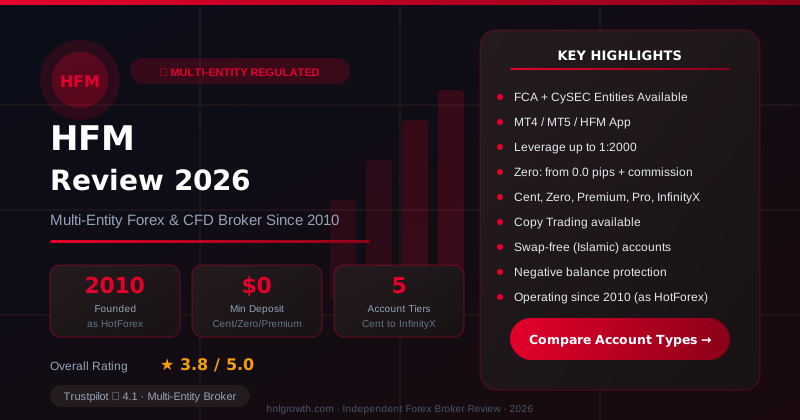
Checked on: 2026-08-09 | Broker terms, regulation, and pricing can change. Always verify at the official HFM site before opening an account.
Affiliate Disclosure: HNL Growth may earn a commission if you open an account through our links, at no additional cost to you. Risk Warning: CFDs and leveraged forex products are complex instruments and carry a high risk of losing money rapidly due to leverage. Between 65-95% of retail investor accounts lose money when trading CFDs, depending on the HFM entity and account type. Trading forex and CFDs may not be suitable for all investors. Consider your objectives, experience, and risk appetite before trading, and ensure you understand the risks involved. Broker Disclosure: HFM (HF Markets Group) is a live, regulated multi-entity broker (not a simulated prop-firm evaluation) — trades are executed with real capital in live market conditions, subject to normal market risk. Protections vary significantly by the specific legal entity that onboards your account.
Swap Calculator: Overnight Financing Costs Explained
Every position you hold past the daily rollover cutoff attracts a swap charge—or credit—based on interest rate differentials between the two currencies (or the financing terms of a CFD contract). A swap calculator lets you model these overnight costs before you commit capital, showing exactly how much a trade will cost or earn per night, and in total across your planned holding period.
On this page, you'll find an interactive calculator framework, asset-class-specific formulas with worked examples, a triple swap day schedule, and a strategy-impact analysis that quantifies swap as a share of typical trade P&L. Use these tools to decide whether a position's expected return justifies its financing cost—and whether the broker's applied rate is competitive.
Interactive Tool Placeholder Embed the HFM Swaps Calculator widget here: instrument dropdown, lot size input, number of nights, account currency selector. Outputs: long swap value, short swap value, cumulative cost/credit.
The official HFM Swaps Calculator is updated daily to reflect the rates charged for the current session.
How Overnight Rollover Fees Work
HashHedge — Crypto Futures Prop Firm
Up to $200K funded accounts · 85% profit split · Instant USDT payouts · 160+ assets
When you trade a leveraged position, you're effectively borrowing one side of the pair to finance the other. At the end of each trading day, the broker rolls that position forward—settling the interest owed on the borrowed currency and crediting interest earned on the currency you hold. The net result is the swap.
Interest Rate Differentials and Broker Markups
The base swap is derived from the interest rate gap between two central banks. If the Reserve Bank of Australia pays 4.35% and the Bank of Japan pays 0.10%, the raw differential on AUD/JPY is roughly 4.25% annualised. In theory, a long AUD/JPY position earns that spread.
In practice, brokers add an administration fee (markup) to the interbank differential. This is standard across the retail CFD industry and is how brokers cover financing overhead. The markup converts what might be a modest positive carry into a smaller credit—or even a debit—on certain pairs. HFM applies swap rates as point values per lot per night, which already incorporate any applicable markup. Always verify the live rate on your platform before assuming a theoretically positive carry translates into a retail credit.
Earning vs. Paying: Directional Bias
- Positive swap (credit): Your position earns more on the bought side than it pays on the sold side, net of the broker's markup. The amount is credited to your balance at rollover.
- Negative swap (debit): The financing cost exceeds the interest earned. The amount is debited nightly.
Direction matters. On EUR/USD, for example, the short side may carry a positive swap while the long side attracts a charge—or both sides may be negative if the broker's markup exceeds the differential. Never assume direction based on headline central bank rates alone.
Formulas by Asset Class
HFM uses a point-based formula that varies slightly depending on the instrument type.
Standard Forex Pairs
Swap Fee = Contract Size × Swap Rate (points) × Number of Nights × Point Size
| Variable | Definition |
|---|---|
| Contract Size | Lot size in units (1 standard lot = 100,000 units of the base currency) |
| Swap Rate | Broker-applied points per lot per night (long or short) |
| Number of Nights | How many rollover periods the position spans |
| Point Size | Minimum price increment (0.00001 for most forex pairs) |
Worked Example — EUR/USD Short
Using HFM's published example structure:
- Instrument: EUR/USD, short direction
- Swap short rate: 1.5 points
- Nights held: 2
- Contract size: 1 lot = 100,000 units
- Point size: 0.00001
Swap = 100,000 × 1.5 × 2 × 0.00001 = 3.00 USD
If USD is your account currency, 3.00 USD is debited (or credited, depending on sign convention) directly to your balance.
This example follows the formula published on HFM's official Swaps Calculator page. Live rates change daily; always confirm on the platform.
Metals, Energy, and Index CFDs
For non-forex CFDs, the formula adjusts to account for contract specifications that differ from currency pairs:
Swap Fee = Contract Size × Swap Rate (points) × Number of Nights × Point Size
The variables remain structurally the same, but the contract size and point size differ:
| Asset Class | Example Instrument | Contract Size | Typical Point Size |
|---|---|---|---|
| Metals | XAU/USD (Gold) | 100 oz | 0.01 |
| Energy | US Crude Oil | 1,000 barrels | 0.01 |
| Indices | US500 (S&P 500) | Varies by broker | 0.1 or 1.0 |
The swap rate itself is set by the broker based on interbank financing benchmarks for that specific contract, plus the broker's markup. Because CFD contract specifications vary, always confirm the contract size for the specific instrument on your platform before running the calculation manually.
Disclosure: This page may contain affiliate links. We may earn a commission if you open an account through our links, at no extra cost to you.
Open a demo account with HFM to check live swap rates across all instrument categories before committing capital.
Scenario Accumulation: How Swap Compounds Over Time
A single night's swap may look trivial. Over weeks or months, it compounds into a material cost or credit. The table below models cumulative swap for illustrative rates at 1 standard lot.
| Nights Held | 1 Night | 7 Nights | 30 Nights | 90 Nights |
|---|---|---|---|---|
| EUR/USD (rate: -1.5 pts, debit) | -$0.15 | -$1.05 | -$4.50 | -$13.50 |
| GBP/USD (rate: -2.0 pts, debit) | -$0.20 | -$1.40 | -$6.00 | -$18.00 |
| USD/JPY (rate: +0.8 pts, credit) | +$0.08 | +$0.56 | +$2.40 | +$7.20 |
| XAU/USD (rate: -3.5 pts, debit) | -$0.35 | -$2.45 | -$10.50 | -$31.50 |
Figures use the HFM formula with illustrative point values for demonstration. Actual rates fluctuate daily and vary by account type. Verify live rates on your platform.
For a 10-lot position, multiply each figure by 10. A 30-day swing trade on 10 lots of GBP/USD at the illustrative rate above would cost approximately $60 in swap alone—a meaningful deduction that must be offset by price movement.
Leverage-Adjusted Swap Cost
Swap is charged on the full notional value of the position, not on the margin you posted. If you open 1 lot of EUR/USD (notional: $100,000+) at 1:500 leverage, your margin requirement is roughly $200. But the swap is calculated on 100,000 units.
This means the effective financing cost as a percentage of margin used can be substantial:
Effective Rate = (Total Swap Charged / Margin Posted) × 100
For the 30-night EUR/USD example above ($4.50 swap on ~$200 margin), the effective financing cost is approximately 2.25% of margin over 30 days—comparable to an annualised rate exceeding 25%. Higher leverage amplifies this effect.
Triple Swap Days: The Timing Trap
Most forex and metals contracts roll on a T+2 settlement cycle. This means a position held through Wednesday evening (server time) settles on Friday, covering two calendar days. The result: Wednesday is triple swap day for most forex pairs and metals—three nights of swap are applied in a single rollover.
For other CFD asset classes (energy, indices, some stock CFDs), triple swap day may fall on a different day of the week, often Friday, because those instruments follow different settlement conventions.
| Asset Class | Typical Triple Swap Day | Notes |
|---|---|---|
| Forex (majors, minors, exotics) | Wednesday | T+2 settlement; Wednesday rollover covers Fri–Sun |
| Metals (XAU, XAG) | Wednesday | Follows forex settlement convention |
| Energy (crude oil, natural gas) | Friday (varies) | Different settlement cycle; confirm on platform |
| Indices (US500, GER40) | Friday (varies) | Settlement conventions differ by exchange |
Key detail: HFM's rollover time is tied to server time, which typically aligns with 00:00 server time (often EET/UTC+2 or UTC+3 depending on daylight saving). Any position open at the rollover cutoff attracts that night's swap—whether you held it for five minutes or five hours.
What to verify yourself:
- Confirm your platform's exact server time zone and rollover cutoff.
- Check which day of the week triple swap applies for each instrument you trade.
- Close positions before the Wednesday (or Friday) cutoff if the triple charge would erode your edge.
Swap Impact by Trading Strategy
Not all traders face the same swap exposure. The table below segments the impact.
| Strategy | Typical Hold | Nights Exposed | Swap as % of Typical P&L | Priority |
|---|---|---|---|---|
| Scalping | Minutes | 0 | 0% | Irrelevant |
| Intraday | Hours | 0–1 | < 1% | Low; close before rollover |
| Swing (multi-day) | 2–10 days | 2–10 | 2–8% | Moderate; factor into target |
| Position / Carry | Weeks to months | 30–90+ | 10–40%+ | Critical; primary cost driver |
Intraday and Scalping
If you close every position before the daily rollover cutoff, swap never touches your account. Day traders should still know the cutoff time to avoid accidental overnight exposure—especially on volatile sessions where a trade runs longer than planned.
Multi-Day Swing Trading
A swing trade spanning 3–7 nights will accumulate meaningful swap, particularly on pairs where both directions carry a debit. Before entering, calculate the total expected swap for your planned hold and add it to your breakeven target. If your swing target is 30 pips and swap costs the equivalent of 3 pips over 5 nights, your gross target must be 33 pips to net the same result.
Carry Trade and Position Trading
Carry traders specifically seek positive swap: buying high-yielding currencies against low-yielding ones and holding for weeks or months to accumulate the daily credit. This strategy works when the broker's applied retail rate remains positive after markup—a condition that narrows the list of viable pairs.
Limitations: Broker markups can turn a theoretically positive interbank differential into a negative retail swap. Central bank rate cuts or hikes shift the differential unpredictably. And the position remains exposed to adverse price movement, which can overwhelm months of accumulated swap credit in a single session.
Compare HFM account types and trading conditions to see which account structure suits a carry or swing strategy.
Swap-Free and Islamic Account Options
HFM offers swap-free accounts for traders who require Sharia-compliant trading conditions, where earning or paying interest is prohibited. On these accounts, overnight swap is waived on eligible instruments.
Key points to understand:
- Availability is jurisdiction-dependent. Swap-free accounts are not offered by every HFM entity or in every region. Eligibility depends on the entity you register under.
- Instrument restrictions apply. As noted in HFM's account comparison, swap-free status applies only to specific trading instruments, and terms and conditions govern eligibility.
- Alternative cost structures may apply. While overnight interest is waived, brokers commonly apply administration fees, adjust spreads, or impose maximum holding periods on swap-free positions to offset the financing cost they absorb. Review the specific terms before assuming swap-free trading is cost-free.
- Not a universal workaround. Swap-free accounts are designed for traders with genuine religious requirements. They are not a mechanism to avoid financing costs on carry trades.
What to verify yourself:
- Confirm swap-free availability in your jurisdiction by contacting HFM support or checking your account opening options.
- Read the specific terms: which instruments qualify, whether admin fees apply, and any maximum holding period restrictions.
Why Calculator Results May Differ From Your Statement
Traders frequently report that calculator outputs don't exactly match the swap line on their trading statement. Common reasons include:
- Floating rates. Swap rates are recalculated daily based on current interbank conditions and may change between when you check the calculator and when the rollover executes.
- Triple swap timing. If your holding period spans a triple swap day, one of those nights carries 3× the standard charge.
- Account currency conversion. If your account is denominated in EUR but the swap is calculated in USD, the final amount is converted at the prevailing rate at rollover—introducing minor variance.
- Exact entry timing. A position opened seconds before the rollover cutoff still attracts a full night's swap.
- Central bank decisions. Rate changes mid-week can shift swap rates for affected pairs immediately or at the next rollover.
These are structural features of how overnight financing works, not calculation errors.
Frequently Asked Questions
Can I earn positive swap on HFM? Positive swap is possible when the interest earned on the bought currency exceeds the cost of the sold currency, after the broker's markup. However, broker markups reduce the net credit, and rates change daily. Check live rates on the platform for the specific pair and direction you're considering.
Do swap rates differ between HFM account types? HFM offers multiple account types—including Premium, Zero, Pro, Cent, and InfinityX—and swap rates may vary between them. The account comparison page outlines structural differences. Confirm the applicable swap schedule for your specific account type on the platform.
What happens to swap on weekends? Forex markets are closed on weekends, but positions still attract swap for Saturday and Sunday. This is handled via the triple swap day mechanism (typically Wednesday for forex), where three nights are charged in a single rollover to cover the weekend.
Is swap charged on hedged positions? Treatment of hedged positions (simultaneous long and short on the same pair) varies by broker and platform. On some platforms, swap is charged on both legs; on others, it may be netted. Verify HFM's hedging swap policy in your platform's contract specifications or by contacting support.
How does HFM's swap compare to other brokers? Swap rates are a competitive differentiator, but direct comparison requires checking the same instrument, direction, lot size, and account type on the same day—since rates fluctuate. Use the HFM Swaps Calculator alongside competitor calculators for a same-day snapshot.
Does higher leverage increase swap costs? Leverage does not change the swap amount (which is based on full notional value), but it does increase the effective financing cost as a percentage of your posted margin. At 1:1000 leverage, you post less margin for the same position, making swap a larger share of your capital at risk.
Related Trading Tools
Understanding swap is one part of managing trade costs. Consider modelling these alongside:
- Margin calculator — determine the exact margin required for a position at your chosen leverage.
- Pip value calculator — convert pip movements into your account currency to set precise profit targets.
- Profit/loss calculator — model expected P&L net of spread, commission, and swap before entering a trade.
Risk warning: CFDs and leveraged forex products are complex instruments and carry a high risk of losing money rapidly due to leverage. Retail investor accounts lose money when trading CFDs with most providers; the exact percentage varies by HFM entity and account type. You should consider whether you understand how CFDs work and whether you can afford to take the high risk of losing your money. Check the entity, terms and investor protections that apply in your jurisdiction before opening an account or trading.
Ready to Start Your Funded Trading Journey?
Join traders backed by $11M+ in verified payouts and a 4.7/5 Trustpilot rating. Compare HashHedge challenge plans, drawdown rules, and payout terms — apply code ha25 for the current discount.
Risk disclaimer: Challenge fees are non-refundable if you breach the rules. Prop trading involves significant financial risk. Past performance in a simulated environment does not guarantee results on a funded account. Only purchase if you understand the rules fully and can afford to lose the fee. Affiliate disclosure: HNL Growth earns a commission when you purchase a HashHedge challenge through links on this page.