Treasury Notes vs Bonds: Key Differences for Traders
Affiliate disclosure: This page contains affiliate links to PU Prime. If you open an account through our links, we may earn a commission. This compensation does not influence our editorial analysis....
Reviewed using our forex & CFD broker review methodology
Checked on: 2026-08-17 | Broker terms, regulation, and pricing can change. Always verify at the official PU Prime site before opening an account.
Affiliate Disclosure: HNL Growth may earn a commission if you open an account through our links, at no additional cost to you. Risk Warning: CFDs and leveraged forex products are complex instruments and carry a high risk of losing money rapidly due to leverage. 62.2% of retail investor accounts lose money when trading CFDs with this provider. Trading forex and CFDs may not be suitable for all investors. Consider your objectives, experience, and risk appetite before trading, and ensure you understand the risks involved. Broker Disclosure: PU Prime is a live, regulated multi-entity broker (not a simulated prop-firm evaluation) — trades are executed with real capital in live market conditions, subject to normal market risk. Which PU Prime entity holds your account depends on your country of residence and determines your leverage cap and protections.
Last verified: August 2026 | Editorial Team
Treasury Notes vs Bonds: Key Differences for Traders
Affiliate disclosure: This page contains affiliate links to PU Prime. If you open an account through our links, we may earn a commission. This compensation does not influence our editorial analysis. PU Prime is a CFD broker; it does not offer direct treasury note or bond purchases. CFD trading is not suitable for all investors.
Treasury notes and treasury bonds are both interest-paying debt securities issued by the U.S. government, but they sit at different points on the maturity spectrum. Notes mature in 2, 3, 5, 7, or 10 years; bonds mature in 20 or 30 years. Both pay a fixed coupon every six months and return your principal at maturity. The practical difference that matters most is duration: the longer the maturity, the more a security's market price moves when interest rates change. Notes suit medium-term goals; bonds suit long-horizon income planning. Which fits your situation depends on your time horizon, your view on rates, and how much liquidity you need along the way.
Before exploring any specific instrument or trading vehicle, note that CFDs and leveraged products carry a high risk of losing money rapidly. Full risk details are in the risk warning at the end of this article.
If you are already familiar with the mechanics and want to explore CFD-based exposure to bond price movements, PU Prime's account types and conditions are covered in the account opening guide. Otherwise, read on for the full framework before making any decisions.
What treasury notes and bonds actually are
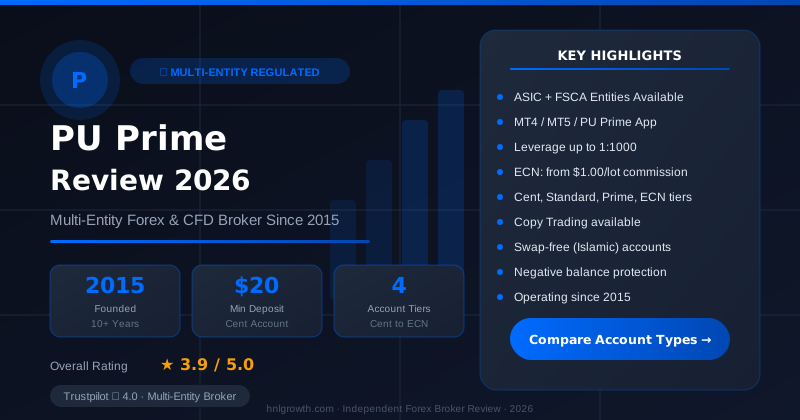
PU Prime — Multi-Entity Forex & CFD Broker
ASIC (AU) + FSCA (ZA) entities available · $20 min deposit (Cent) · MT4, MT5, PU Prime App · 4 account tiers
Treasury notes (T-notes) and treasury bonds (T-bonds) are issued by the U.S. Department of the Treasury to fund government spending. They belong to the same family as treasury bills (T-bills), but the family splits by maturity:
- Treasury bills: mature in one year or less, sold at a discount to face value, and pay no periodic interest — you receive the face value at maturity.
- Treasury notes: mature in 2, 3, 5, 7, or 10 years, pay a fixed coupon every six months, and return face value at maturity.
- Treasury bonds: mature in 20 or 30 years, pay a fixed coupon every six months, and return face value at maturity.
The coupon mechanics are identical for notes and bonds — the structural difference is how long your money is committed and, consequently, how sensitive the security's market price is to interest rate changes. Both carry the direct backing of the U.S. government's full faith and credit. This refers specifically to credit risk: the U.S. government's obligation to repay principal and interest. It does not mean price stability — a note or bond held in a brokerage account can lose market value before maturity if rates move against you, and historical events such as U.S. debt-ceiling standoffs and rating-agency reviews illustrate that even sovereign credit carries political and institutional risk alongside pure default probability.
It is also worth separating these from Series EE and Series I savings bonds, which are a distinct retail product with their own purchase limits, redemption rules, and rate structures. Notes and bonds trade in an active secondary market; most savings bonds generally do not.
Maturity ranges, auction schedules, and minimum purchase amounts are sourced from TreasuryDirect.gov. Verify current details directly with the U.S. Treasury, as these may change.
How they work: auction, coupons, and a worked example
Both instruments are sold at regular auctions through the U.S. Treasury. According to TreasuryDirect.gov, notes with 2, 3, 5, and 7-year maturities are auctioned monthly, while the 10-year note and both bond maturities are auctioned quarterly, with reopenings in between. Confirm the current auction calendar at TreasuryDirect.gov, as schedules are subject to change.
The following worked example illustrates the mechanics only. The coupon rate used is illustrative; it does not represent current market yields, which change with every auction cycle. Verify current rates at TreasuryDirect.gov or the U.S. Treasury's published yield curve before making any allocation decision.
Assume a 5-year treasury note with a face value of $10,000 and an illustrative coupon rate of 4%:
- You pay approximately $10,000 at auction (the actual price may be slightly above or below par depending on auction results).
- Every six months for five years, you receive a coupon payment of $200 (4% annual rate, split into two payments).
- At the end of year five, you receive your final coupon plus the $10,000 face value.
Over five years, you collect ten semiannual payments totalling $2,000 in interest, in addition to recovering your original principal. A 30-year bond follows identical mechanics, extended across a much longer timeline: more coupon payments overall, but your principal is committed far longer and exposed to more cumulative inflation and rate risk.
Notes vs bonds: the structural comparison
| Feature | Treasury Notes | Treasury Bonds |
|---|---|---|
| Maturity options | 2, 3, 5, 7, 10 years | 20, 30 years |
| Interest payment frequency | Semiannual | Semiannual |
| Yield relationship | Generally lower than bonds in a normal curve; can be higher during inversions | Generally higher than notes in a normal curve, compensating for longer duration risk |
| Price sensitivity to rate changes | Lower (shorter duration) | Higher (longer duration) |
| Secondary market activity | Generally liquid; notes trade frequently | Liquid, but typically less active than shorter maturities |
| Minimum purchase (TreasuryDirect) | $100, in $100 increments | $100, in $100 increments |
| Federal tax treatment | Interest taxable | Interest taxable |
| State/local tax treatment | Exempt | Exempt |
| Auction frequency | Monthly (2/3/5/7-year); quarterly (10-year) | Quarterly |
Verify current auction schedules and minimum purchase amounts at TreasuryDirect.gov. Secondary market liquidity descriptions are general in nature; actual conditions vary with market environment and are not sourced from volume statistics.
The yield relationship deserves a caveat: in a normal upward-sloping yield curve, longer maturities pay more because investors demand compensation for committing money longer and for the greater risk that inflation or rates rise unexpectedly. Yield curves do not always slope upward. The 2023–2024 period is cited here as a recent illustration of an extended inversion, during which shorter-term instruments yielded more than longer ones — not as a description of today's conditions. Check the U.S. Treasury's published daily yield curve rates before drawing any conclusion about which maturity currently offers the higher yield.
Real yields — what you earn after adjusting for inflation — are also worth considering, particularly for long-duration bonds. A 30-year bond's nominal coupon may look attractive in a given year, but if inflation runs persistently above that coupon rate across the holding period, your real return could be negative. Treasury Inflation-Protected Securities (TIPS) are a separate product designed to address this and are discussed briefly in the tax section below.
Interest rate risk: why duration matters more for bonds
Every fixed-rate note or bond loses market value when interest rates rise, because newly issued securities offer a more attractive coupon, making existing securities less desirable at par. The size of that price move depends on duration — a measure of how long, on average, it takes to recoup the security's cash flows, weighted by their present value. The longer the maturity, the higher the duration, and the larger the price swing for a given change in rates.
The following figures are theoretical approximations derived from standard bond-pricing formulas. They are not empirically measured values and are not sourced from live market data. They illustrate the concept directionally; actual results differ depending on coupon rate, remaining maturity, yield curve shape, and whether the rate change is parallel or uneven across the curve.
As a rough illustration: a 10-year note may carry a modified duration in the approximate range of 8–9, while a 30-year bond's duration may run closer to 18–20. Applying those approximations under a simplified, parallel 1-percentage-point rate rise: a 10-year note priced at $100 might fall to roughly $92, while a 30-year bond priced at $100 might fall to roughly $82. To make the scale concrete on a larger position: an illustrative $100,000 in a 30-year bond would show a paper loss of approximately $18,000 on a mark-to-market basis under those theoretical assumptions if sold at that point.
These are illustrative only. A parallel 1-point rate move is a simplification; real-world rate changes are rarely uniform across the curve, and actual price outcomes will vary from these approximations.
The asymmetric case is also worth noting: if rates fall, the same duration logic works in reverse — longer-maturity securities appreciate more in price. A seller in that environment may receive more than face value on the secondary market.
Consider a secondary-market scenario for context: suppose you buy a 10-year note at par and 18 months later need to sell it in an environment where rates have risen 1 percentage point since your purchase. Based on the illustrative duration figures above, the note's market price may have fallen to roughly $92 on a $100 face-value basis. Selling at that point realises a capital loss. Had you held to maturity, you would have recovered full face value regardless of interim price movements. This is not a prediction of outcomes — it illustrates why the commitment horizon matters before purchase.
The key takeaway: both instruments carry interest rate risk. The difference is magnitude, not presence or absence. If you hold either to maturity, interim price swings do not affect what you receive back — face value is returned at redemption regardless. The risk materialises only if you need to sell before maturity in a higher-rate environment.
Where to access treasury notes and bonds
There are several distinct ways to gain exposure, and they are not interchangeable products.
TreasuryDirect is the U.S. government's own platform for buying notes and bonds directly at auction. There are no purchase fees, and the minimum is $100 in $100 increments. You hold the security to maturity or use the platform's limited transfer features. For a buy-and-hold investor who does not need active trading flexibility, this is the zero-fee route. Visit TreasuryDirect.gov for current account setup requirements, auction calendars, and supported redemption options.
Brokerage accounts let you buy notes and bonds either at auction (many brokers pass through auction orders) or on the secondary market. This adds convenience — consolidated statements, faster secondary-market execution, and potential access to off-the-run issues — but may involve markups, commissions, or transaction fees. Fee schedules differ materially between providers and must be confirmed directly with each broker before placing an order. TreasuryDirect charges no purchase fee for direct auction purchases; that is a meaningful baseline for a straightforward buy-and-hold strategy, though brokerage convenience may justify fees for investors who actively use the added features.
CFD trading on bonds is a fundamentally different mechanism and should not be confused with either of the above.
Important: CFD trading carries a high risk of losing money rapidly due to leverage. Understand these risks fully before proceeding.
A contracts-for-difference (CFD) position on a bond does not involve owning the underlying security, collecting its coupon, or holding it to maturity. You are speculating on price movement, typically using leverage, and you can close the position at any time rather than waiting for a fixed redemption date.
Several CFD-specific mechanics are important to understand before trading:
- No coupon income: because you do not own the underlying bond, you do not receive semiannual coupon payments.
- Contract duration and rollovers: CFD contracts may have a set expiry date, or they may roll over automatically. A rollover involves closing the expiring contract and opening a new one; this process typically incurs a financing or rollover cost. Check the specific instrument's terms in the platform before opening a position.
- Financing (overnight) charges: leveraged CFD positions held overnight generally incur a daily financing charge based on the notional value of the position. These charges accumulate over time and can represent a significant cost for positions held for extended periods.
- Leverage and margin calls: leverage amplifies both potential gains and potential losses. If the market moves against your position, your broker may issue a margin call, requiring you to add funds or have the position liquidated. Depending on how quickly the market moves, liquidation can occur at a loss greater than your initial margin.
- Regulatory protections: the protections that apply to a CFD position — including client fund arrangements, compensation schemes, and dispute mechanisms — depend on the entity through which the position is held and the jurisdiction in which you are located. These differ materially from the protections that apply to holding a U.S. Treasury security directly.
Maximum leverage available for CFD products varies by jurisdiction and regulatory entity. For example, leverage restrictions apply to retail traders in the EU under ESMA rules. Restrictions vary in other regions; check which limits apply in your jurisdiction before opening a position.
CFDs suited to traders expressing a short-term view on rate-driven price movements are not a substitute for coupon income or a hold-to-maturity allocation strategy. They are a different product category with a different risk profile.
PU Prime is a CFD broker that lists bond CFDs among its tradable instruments, allowing traders to take leveraged positions on debt-security price movements without taking delivery of the underlying. PU Prime notes on its spread and costs page that all listed instrument values are for reference only and that traders should check the MT4/MT5 platform or the PU Prime mobile app for the most accurate current figures. PU Prime states on its regulation page that it operates under the oversight of several financial authorities and has been operating since 2015; these claims are self-published by the broker and have not been independently verified by this site. Verify which regulated entity covers your jurisdiction before proceeding — the protections differ materially between regulatory regimes, and the entity serving your country may not be the same as the one prominently described on the broker's website.
Building an allocation strategy: matching maturity to goals
A practical way to choose between notes and bonds is to work backward from what you need the money for and when.
- Under 2 years: treasury bills are generally a better fit — they mature in one year or less, are sold at a discount to face value, and carry less interest rate risk. For current T-bill rates and auction details, check TreasuryDirect.gov.
- 2–10 years (notes): college tuition planning, a business capital reserve, or a medium-term savings goal where you want predictable income and a known principal return date.
- 20–30 years (bonds): retirement income planning where the long horizon matches a drawdown phase still years away, or a deliberate long-duration allocation as a counterweight to equity risk — though that horizon also means greater cumulative inflation exposure if rates and inflation diverge from expectations.
A simple decision framework:
- Time horizon — Do you need the principal back within 10 years? If yes, notes are the more appropriate maturity range.
- Rate outlook — If you expect rates to rise further, shorter durations reduce the mark-to-market hit if you need to sell early. If you expect rates to fall, longer durations lock in today's yield and can appreciate more in price.
- Liquidity needs — If you might need to trade in and out, notes generally offer deeper secondary market activity than bonds.
- Inflation sensitivity — If protecting real purchasing power is a priority, consider whether TIPS or a nominal note or bond is more appropriate. Check current TIPS yields at TreasuryDirect.gov or the U.S. Treasury's website to compare the inflation breakeven against nominal yields before deciding.
Laddering is a common approach for investors who want predictable, staggered cash flow rather than a single lump-sum maturity. As an illustration: splitting $50,000 evenly across 2, 4, 6, 8, and 10-year notes ($10,000 each) means one position matures roughly every two years. As each matures, you reinvest at whatever the prevailing rate then is.
This illustration uses a simplified, static structure for clarity. If rates fall significantly between reinvestment dates, each new rung locks in a lower yield — for instance, if a $10,000 rung that was earning an illustrative 4% must be reinvested at 2%, annual income from that rung halves from $400 to $200. If rates rise, reinvestment is more favourable. The ladder reduces timing concentration but does not eliminate reinvestment risk. If you need to liquidate a rung before maturity in a higher-rate environment, that position may be worth less than face value on the secondary market. This example does not represent a performance projection and is not stress-tested against any specific historical rate environment.
Tax treatment
Interest earned on both treasury notes and bonds is subject to federal income tax in the year it is received, but is exempt from state and local income taxes under federal law. This exemption applies to the interest income itself; it does not cover capital gains realised if you sell on the secondary market at a price above your purchase cost.
Treasury Inflation-Protected Securities (TIPS) are a related but distinct product: their principal adjusts with inflation, and the inflation adjustment is taxable at the federal level in the year it accrues, even though you do not receive it in cash until maturity — a feature sometimes called "phantom income." Standard notes and bonds do not share this characteristic. TIPS have their own purchase and rate structures; visit TreasuryDirect.gov for full details before treating them as equivalent to standard notes or bonds.
Tax treatment for CFD positions on bond instruments is not necessarily the same as for direct treasury ownership. The character of income or gains from CFD trading — and how those are taxed — depends on your jurisdiction, the specific regulatory treatment in that jurisdiction, and your individual circumstances. Do not assume that CFD gains and losses on bond-related instruments follow the same tax rules as holding the underlying treasury security. Consult a qualified tax professional familiar with your jurisdiction before trading.
For authoritative details on direct treasury ownership, refer to IRS Publication 550 (Investment Income and Expenses) and the U.S. Treasury's own tax guidance, available through their respective official websites. Reporting mechanics vary by platform — TreasuryDirect and broker accounts may present tax documents differently — so confirm with your provider at year end. Holding either instrument inside a tax-advantaged retirement account changes the timing of tax recognition rather than the underlying statutory treatment. Individual tax circumstances vary; consult a qualified tax professional for advice specific to your situation.
Common mistakes to avoid
- Mismatching maturity to goal. Buying a 30-year bond for a goal five years away locks up capital far longer than needed and exposes you to more price risk if you have to sell early.
- Underestimating duration risk. Longer maturities can look attractive for their higher yield, but if rates continue rising after purchase, the mark-to-market value can fall meaningfully before maturity.
- Ignoring inflation and real returns. A bond with a 4% nominal coupon in a higher-inflation environment may produce a negative real return. Nominal yield alone does not tell the full story for long-duration commitments.
- Assuming higher yield always means better fit. A bond's higher coupon is less useful if you need the money back before maturity and face selling at a loss.
- Paying avoidable fees for a simple hold-to-maturity strategy. TreasuryDirect charges no purchase fee for direct auction purchases; brokerage convenience is worth the cost only if you actively use the added features.
- Confusing CFD exposure with direct ownership. A leveraged CFD position on bond prices is not the same as holding a note or bond to maturity for coupon income. They are separate strategies with separate risk profiles, costs, regulatory protections, tax treatment, and mechanics — including rollover costs and financing charges that do not apply to direct treasury ownership.
- Ignoring CFD rollover and financing costs. Overnight financing charges and rollover costs can accumulate significantly on leveraged positions held for more than a few days. Factor these into any cost comparison between CFD trading and direct purchase.
- Selling mid-ladder without checking current market price. In a rising-rate environment, liquidating a note or bond before maturity can produce a capital loss even on a U.S. government security. Plan each rung's timeline before committing capital.
Who this comparison is not for
If you need your money back within two years, treasury bills or a money market fund are a more appropriate fit for that horizon. If you want guaranteed short-term liquidity with no mark-to-market fluctuation risk, a bank deposit or similar instrument removes interest rate risk entirely, typically at the cost of lower returns.
If you are seeking leveraged, short-term exposure to rate-driven price movements rather than income generation and principal preservation, CFD-based instruments address that goal — but they are a different product category with a different cost structure, different regulatory protections, and a high risk of losing money rapidly due to leverage. These two approaches should not be treated as equivalent alternatives for the same financial objective.
Understanding CFD trading on bond price movements
For traders interested in leveraged exposure to rate-driven price movements rather than direct ownership, CFDs offer a distinct mechanism. Before opening any funded position, understand the product mechanics, the regulatory framework that applies in your jurisdiction, and the differences between demo and live trading.
A CFD demo account simulates market conditions using virtual funds. It can help you:
- Familiarise yourself with platform navigation, order types, and position management before risking capital.
- Observe how leverage and position sizing affect a simulated account balance under different scenarios.
- Understand how CFD instruments on bonds are quoted and how positions are closed.
Opening a demo account does not reduce CFD trading risk when you transition to a funded account. Demo environments do not replicate the liquidity conditions, slippage, or execution dynamics of live markets. They also remove the psychological pressure that accompanies real capital at risk. Demo performance does not indicate future live results. Treat demo trading as a tool for learning platform mechanics, not as a reliable predictor of live account outcomes.
PU Prime offers account types including Standard, Prime, and ECN, with differing spreads, commissions, and minimum deposit requirements. PU Prime's account opening guide states that the Standard account requires a minimum deposit of $50, a Cent account is available from $20, and the registration process typically takes 10 to 15 minutes, requiring a government-issued ID and proof of address. These figures are sourced directly from PU Prime's published guidance; confirm current requirements on their website, as minimums and processes can change. Before opening a live account, confirm which regulatory entity and protections apply in your jurisdiction; full regulatory information is published at puprime.com/regulation/.
FAQ
What is the minimum investment for treasury notes or bonds? Through TreasuryDirect, the minimum is $100, purchased in $100 increments, per TreasuryDirect.gov. Minimums through a brokerage account vary by provider and should be confirmed directly with each broker.
Which pays more interest, notes or bonds? In a normal yield curve environment, bonds typically pay a higher coupon because of their longer duration and the extra compensation investors require for that risk. During yield curve inversions, shorter-term notes can temporarily yield more than longer bonds. Check current published yield data at the U.S. Treasury's daily yield curve page before assuming which pays more at any given time.
What happens if I sell before maturity? Both instruments trade on the secondary market, so early sale is possible. The price you receive depends on where rates have moved since you bought. If rates have risen, you may receive less than face value; if rates have fallen, you may receive more. The difference between your purchase price and your sale price is a capital gain or loss, taxable at the federal level, separate from the interest income.
Can I buy both at TreasuryDirect, or do I need a broker? Both notes and bonds can be purchased directly through TreasuryDirect at auction with no purchase fee, per TreasuryDirect.gov. Brokers offer an alternative with added convenience, potential secondary market access, and consolidated reporting, but fees vary and should be confirmed directly with each provider.
Are these suitable for retirement planning? Bonds' 20–30 year maturities can align with a long retirement horizon, particularly for generating predictable income. Notes can complement this by covering medium-term needs within the same portfolio. Neither instrument is a substitute for a complete retirement plan tailored to your individual circumstances. A qualified financial adviser can help assess appropriate allocation, tax treatment, inflation exposure, and sequencing risk across different account types.
How does PU Prime fit into this? PU Prime does not offer direct treasury note or bond purchases. It offers bond CFDs for traders seeking leveraged exposure to price movements rather than coupon-based ownership. CFD trading carries a high risk of losing money rapidly due to leverage. If you are building a buy-and-hold treasury allocation, TreasuryDirect or a conventional brokerage account is the appropriate route. If you are interested in trading rate-driven price swings with leverage, review PU Prime's account conditions on its spread and costs page and confirm the regulatory entity that applies in your jurisdiction before proceeding.
Risk warning
Risk warning: CFDs and leveraged forex products are complex instruments and carry a high risk of losing money rapidly due to leverage. Consider whether you understand how these products work and whether you can afford to take the high risk of losing your capital. Check the entity, terms and protections that apply in your jurisdiction before trading.
Ready to Compare PU Prime Account Types?
PU Prime is a multi-entity broker — ASIC (Australia) and FSCA (South Africa) regulated entities offer stronger oversight, while most international clients are onboarded to the FSA Seychelles or FSC Mauritius entities. Four account tiers (Cent, Standard, Prime, ECN) range from a $20 minimum deposit to full ECN pricing.
Risk disclaimer: PU Prime is a live, regulated multi-entity broker — trading forex and CFDs is done with real capital under normal market risk (this is not a simulated prop-firm evaluation). PU Prime operates under multiple separate licenses (ASIC, FSCA, FSA Seychelles, FSC Mauritius); which entity holds your account depends on your country of residence and determines your leverage cap and protections — confirm this before funding. CFDs and leveraged forex products are complex instruments and carry a high risk of losing money rapidly due to leverage; 62.2% of retail investor accounts lose money when trading CFDs with this provider. Consider whether you understand how CFDs/forex work and whether you can afford the high risk of losing your money. Affiliate disclosure: HNL Growth earns a commission when you open a PU Prime account through links on this page.