What Are Indices? Trading the Major Stock Indices
An index is a statistical measure that tracks the combined performance of a defined group of securities, such as the 500 largest US companies or the 100 biggest firms on the London Stock Exchange. It...
Reviewed using our forex & CFD broker review methodology
Checked on: 2026-08-17 | Broker terms, regulation, and pricing can change. Always verify at the official PU Prime site before opening an account.
Affiliate Disclosure: HNL Growth may earn a commission if you open an account through our links, at no additional cost to you. Risk Warning: CFDs and leveraged forex products are complex instruments and carry a high risk of losing money rapidly due to leverage. 62.2% of retail investor accounts lose money when trading CFDs with this provider. Trading forex and CFDs may not be suitable for all investors. Consider your objectives, experience, and risk appetite before trading, and ensure you understand the risks involved. Broker Disclosure: PU Prime is a live, regulated multi-entity broker (not a simulated prop-firm evaluation) — trades are executed with real capital in live market conditions, subject to normal market risk. Which PU Prime entity holds your account depends on your country of residence and determines your leverage cap and protections.
Last verified: August 2026 | Editorial Team
What Are Indices? Trading the Major Stock Indices
An index is a statistical measure that tracks the combined performance of a defined group of securities, such as the 500 largest US companies or the 100 biggest firms on the London Stock Exchange. It exists to represent a market, sector, or economy in a single number, so investors and traders can gauge overall direction without analysing every individual stock. You cannot buy an index itself — it is a calculation, not an asset. Instead, you gain exposure through products built to track it: exchange-traded funds (ETFs), index funds, futures contracts, or CFDs. Each route has different costs, leverage characteristics, and tax treatment, which is why choosing the right one matters as much as choosing the right index.
Disclosure: This page may contain affiliate links. We may earn a commission if you open an account through our links, at no extra cost to you.
What an index actually represents
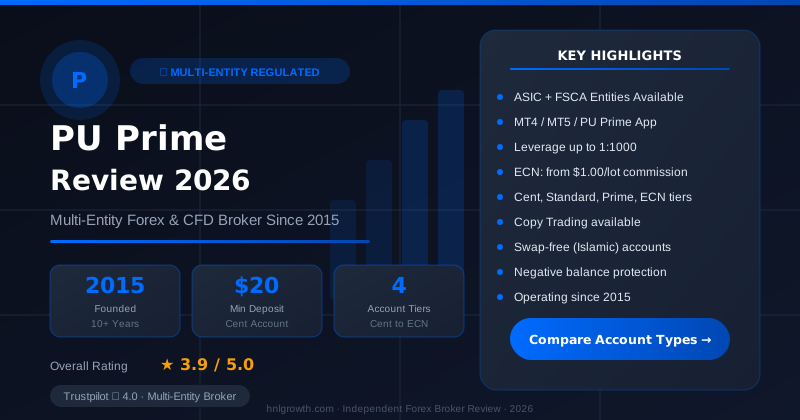
PU Prime — Multi-Entity Forex & CFD Broker
ASIC (AU) + FSCA (ZA) entities available · $20 min deposit (Cent) · MT4, MT5, PU Prime App · 4 account tiers
Think of an index as a snapshot of a defined basket of stocks, recalculated continuously (or at set intervals) as the prices of its constituents change. The S&P 500 reflects how the 500 largest US listed companies are performing, on average, weighted by size. The FTSE 100 does the same for the UK's largest listed companies. Neither index is a company you can invest in directly — it is a reference point, similar to how a thermometer reading is not the weather itself but a measurement of it.
Indices matter to two different groups for different reasons:
- Long-term investors use them as diversification benchmarks. Buying a fund that tracks a broad index spreads risk across hundreds of companies in a single transaction, rather than picking stocks one by one.
- Active traders use index-tracking instruments to speculate on short-term market direction, hedge existing positions, or trade around specific sectors and economic events, often with leverage.
Both uses are legitimate, but they call for different products, holding periods, and risk tolerance — a distinction that gets lost in a lot of beginner content.
How index values are constructed
Not all indices are calculated the same way, and the method used materially changes which stocks move the index most.
Price-weighted indices give more influence to stocks with a higher share price, regardless of the company's overall size. The Dow Jones Industrial Average and Japan's Nikkei 225 both use this method.
Worked example: imagine an index made of three stocks priced at $10, $50, and $200. If the $200 stock rises 5% (to $210), it adds $10 to the sum of prices. If the $10 stock rises 50% (to $15), it only adds $5 — even though its percentage move was ten times larger. In a price-weighted index, the high-priced stock dominates the index's movement no matter how small the company actually is.
Market-cap weighted indices give influence based on the total value of a company (share price × shares outstanding, usually adjusted for free float). The S&P 500, FTSE 100, and DAX 40 all use this approach.
Using the same three companies, but now weighted by market capitalisation: if the $10 stock belongs to a company worth $500 billion and the $200 stock belongs to a company worth $20 billion, the $10 stock's 50% move will shift the index far more than the $200 stock's 5% move, because it represents a much larger share of the total market value being measured.
This is the core reason two indices covering similar markets can behave differently: a price-weighted index can be swung by one expensive stock, while a market-cap weighted index is driven by the companies with the largest aggregate value — which are often, though not always, the most recognisable names to investors.
Major global indices at a glance
| Index | Region | Constituents | Weighting Type | Rebalancing Frequency | Approx. Launch |
|---|---|---|---|---|---|
| S&P 500 | USA | 500 | Market-cap (float-adjusted) | Quarterly, with interim changes as needed | 1957 |
| FTSE 100 | UK | 100 | Market-cap (float-adjusted) | Quarterly | 1984 |
| DAX 40 | Germany | 40 | Market-cap (free-float, capped) | Quarterly | 1988 (expanded to 40 in 2021) |
| Nikkei 225 | Japan | 225 | Price-weighted | Annual review, with periodic special replacements | 1950 |
Sector composition and top constituents shift over time as company valuations and index reviews change, so treat any specific sector-weighting figure as a snapshot rather than a fixed fact — check the index provider's current factsheet before relying on it for a decision.
Concentration: why constituent count doesn't equal diversification
A common assumption is that a 500-stock index is automatically well diversified and a 40-stock index isn't. In practice, weighting method matters more than headline count. In market-cap weighted indices, a relatively small number of the largest companies can account for a disproportionate share of total index value. The S&P 500's top holdings typically represent a meaningfully smaller share of the index than the top holdings in the FTSE 100 or DAX 40, where fewer constituents and sector concentration — financials in the UK, industrials and automakers in Germany — mean the largest names carry more combined weight. The practical implication: an index with more constituents is not necessarily more diversified than one with fewer, and two indices with similar constituent counts can carry very different concentration risk depending on sector mix and weighting rules.
Access methods: ETFs, CFDs, futures, and direct shares
| Product | Typical Minimum | Cost Structure | Leverage | Tax Treatment | Optimal Horizon | Liquidity |
|---|---|---|---|---|---|---|
| ETF / index fund | Price of one unit (often low) | Ongoing charge (OCF), typically a small annual percentage | None (unless using a margin account separately) | Varies by jurisdiction; often capital gains and dividend tax apply | Long-term, buy-and-hold | Exchange trading hours |
| CFD on an index | Varies by broker and account type | Spread and/or commission, plus overnight funding on positions held past the daily cut-off | Available, subject to regulatory limits in your jurisdiction | Varies by jurisdiction; may differ from direct share/ETF ownership | Short to medium-term | Often extended hours on cash index CFDs |
| Index futures | Contract-specific margin requirement | Spread plus exchange/clearing fees; no daily overnight funding in the same way as CFDs, but contracts expire and must be rolled | Built into contract margin | Varies by jurisdiction | Short to medium-term, active trading | Exchange trading hours, generally deep liquidity |
| Buying constituent shares directly | Price of shares purchased | Brokerage commission per trade, no ongoing tracking fee | Not applicable unless using margin | Standard share dividend and capital gains rules | Long-term | Exchange trading hours |
Tax treatment differs significantly between countries and between account types (for example, tax-advantaged wrappers in some jurisdictions), so treat the table above as a framework for comparison, not a substitute for checking your own jurisdiction's rules.
Choosing an access method for your strategy
The right product depends on three questions: how long you plan to hold the position, whether you want leverage, and how sensitive you are to ongoing costs.
- Buy-and-hold, long time horizon, no interest in leverage: an ETF or index fund is generally the more cost-efficient route, since its ongoing charge is a small annual percentage rather than a cost that compounds daily.
- Short-term directional views, comfortable with leverage and its risks: a CFD lets you take a position without owning the underlying shares, but overnight funding charges accumulate the longer you hold, which erodes the cost advantage for multi-month positions.
- Active trading with defined expiry and no daily funding drag: futures suit traders who want leveraged exposure without a daily financing charge, but they require understanding contract specifications, margin calls, and rollover dates.
- Direct ownership of specific constituents: buying individual shares gives full control over which companies you hold but forgoes the instant diversification an index product provides.
Why holding period matters — illustrative mechanism, not a quote: a CFD position on an index typically incurs a spread cost at entry, plus a funding charge for each day the position remains open past the platform's daily rollover cut-off. Held for a few days around a specific event, that cumulative funding cost is usually small relative to the potential price move. Held for six or twelve months, however, the accumulated funding charges can exceed what an ETF's annual ongoing charge would have cost over the same period. This describes the mechanism only — actual spreads, commissions, and funding rates differ by instrument, account type, and market conditions, so check current values directly in your trading platform before comparing costs for any specific position.
How PU Prime provides access to index CFDs
PU Prime offers CFD access to global indices, including instruments referencing the S&P 500 and Nikkei 225, alongside forex, commodities, metals, shares, ETFs, bonds, and synthetic indices. The broker has been operating since 2015 and holds regulatory authorisations from several financial authorities; the applicable entity and protections depend on your country of residence. Full details are on the PU Prime regulation page, and you should confirm which entity and terms apply to your specific jurisdiction before opening an account, since conditions are not identical across entities.
Current spreads, commissions, and swap charges for index instruments are listed on the PU Prime spreads and costs page; values shown there are for reference and can change, so confirm live figures in your trading platform before opening a position.
Account opening takes approximately 10 to 15 minutes and requires a government-issued ID, proof of address, and a minimum deposit that varies by account type (the Cent account starts at $20; the Standard account starts at $50, according to PU Prime's account opening guidance). MT4 and MT5 are both supported. If you want to explore index instruments and test platform functionality before committing capital, PU Prime's demo and live account page describes the available account types and registration process.
How and when indices are rebalanced
Index providers periodically review which companies qualify for inclusion, based on criteria like market capitalisation, liquidity, and free float. Companies that no longer meet the criteria are removed, and qualifying companies are added, at scheduled review dates (commonly quarterly for the S&P 500, FTSE 100, and DAX 40, and on a different review cycle for the Nikkei 225).
Rebalancing matters to traders for two reasons. First, funds and CFD providers that track the index need to adjust their holdings to match the new composition, which can temporarily increase trading volume and volatility in the affected stocks around the effective date. Second, if you are holding a position through a rebalancing event, liquidity conditions in individual constituents can shift briefly, which is worth factoring into entry and exit timing rather than treating rebalancing as a non-event.
The main risks, and who this isn't for
Trading indices through leveraged products carries real risk that should not be minimised:
- Leverage cuts both ways. A leveraged CFD position amplifies both gains and losses relative to your capital outlay. A market move against your position can result in losses that exceed your initial deposit in some account structures, and margin calls can force position closures at unfavourable prices.
- Overnight funding compounds. Holding a leveraged index CFD for weeks or months accumulates funding charges that can materially affect returns, independent of price direction.
- Concentration risk is real even in "broad" indices. As covered above, a handful of large constituents can dominate index movement, so an index is not automatically a substitute for diversified portfolio construction.
- Rebalancing and event risk. Scheduled reviews, macroeconomic announcements, and earnings seasons can increase short-term volatility in index-tracking instruments.
This type of trading is generally not suitable for someone seeking guaranteed capital preservation, anyone who cannot tolerate the possibility of losing their full deposit, or anyone unwilling to actively monitor a leveraged position. Long-term investors focused purely on passive accumulation are usually better served by low-cost ETFs or index funds rather than leveraged CFDs or futures.
Common mistakes to avoid
- Assuming all indices offer equivalent diversification. Constituent count alone does not reveal concentration risk — check weighting methodology and sector exposure first.
- Ignoring overnight funding costs when planning a holding period. A strategy that looks profitable on price movement alone can be eroded by accumulated funding charges if held longer than intended.
- Trading through a rebalancing date without checking for it. Liquidity and volatility can shift briefly around scheduled review dates.
- Chasing recent performance. Past index moves do not indicate what will happen next, and building a strategy purely around recent strength is a common behavioural pitfall.
- Mixing up cash and futures-based pricing. A cash index CFD typically tracks the prevailing index level, whereas a futures-based instrument prices in expectations about dividends and time remaining to contract expiry — which can produce a visible price difference between the two even when both reference the same underlying index.
Practising before committing capital
Because leverage risk is asymmetric — losses can happen faster than gains — practising in a controlled environment before trading with real money is a reasonable step for anyone new to index CFDs. A demo account, funded with virtual balance and using live market pricing, lets you observe how different indices behave, how leverage affects account equity, and how overnight funding accumulates over a real holding period, without financial risk.
Compare PU Prime account types and explore a demo account to trial index CFDs, forex, and other instruments before deciding whether to fund a live account.
What to verify yourself before trading
Since actual costs and conditions can change and vary by entity, confirm the following directly rather than relying on any third-party summary:
- Which specific index instruments are available on your account type and platform (MT4/MT5).
- Current spreads, commissions, and swap rates for the index you intend to trade, via the PU Prime spreads and costs page.
- Which regulatory entity and jurisdiction-specific terms apply to your account based on your country of residence — details are on the PU Prime regulation page. PU Prime operates under several regulatory authorities, and the entity that governs your account, along with the protections and leverage limits that apply, will depend on your jurisdiction.
- Any regional restrictions that may apply before opening an account.
- Your local tax treatment of CFD trading versus ETF or share ownership, which varies by country.
FAQ
Can I buy an index directly? No. An index is a calculated measure, not a tradable asset. You gain exposure through products designed to track it, such as ETFs, index funds, futures, or CFDs.
What is the difference between a cash index and a futures-based index instrument? A cash index CFD typically reflects the current level of the underlying index, while a futures-based instrument incorporates the cost of carry and the time remaining until the contract expires. This can produce a visible price gap between the two even when both reference the same underlying index — a point worth checking before assuming the prices should match.
Which weighting method is "better," price-weighted or market-cap weighted? Neither is inherently better — they measure different things. Price-weighted indices are more influenced by high-priced stocks regardless of company size; market-cap weighted indices are more influenced by the largest companies by total value. Know which method an index uses before assuming you understand what is driving its movement.
How often do major indices rebalance? It varies by provider. The S&P 500, FTSE 100, and DAX 40 typically undergo quarterly reviews, with additional changes made outside the schedule when a company no longer meets inclusion criteria. The Nikkei 225 uses a different, less frequent review cycle. Always check the index provider's current methodology document for the exact schedule.
Is trading index CFDs suitable for beginners? It can be, but only with a clear understanding of leverage, overnight funding costs, and the possibility of losing your full deposit. Starting on a demo account before using a live account is a practical way to build familiarity with how the instruments behave without risking capital.
Does PU Prime offer all major global indices? PU Prime lists index CFDs, including instruments referencing indices such as the S&P 500 and Nikkei 225, on its spreads and costs page. Exact instrument availability can vary, so check your trading platform for the current list before assuming a specific index is offered.
Risk warning
Risk warning: CFDs and leveraged forex products are complex instruments and carry a high risk of losing money rapidly due to leverage. Consider whether you understand how these products work and whether you can afford to take the high risk of losing your capital. Check the entity, terms and protections that apply in your jurisdiction before trading.
Ready to Compare PU Prime Account Types?
PU Prime is a multi-entity broker — ASIC (Australia) and FSCA (South Africa) regulated entities offer stronger oversight, while most international clients are onboarded to the FSA Seychelles or FSC Mauritius entities. Four account tiers (Cent, Standard, Prime, ECN) range from a $20 minimum deposit to full ECN pricing.
Risk disclaimer: PU Prime is a live, regulated multi-entity broker — trading forex and CFDs is done with real capital under normal market risk (this is not a simulated prop-firm evaluation). PU Prime operates under multiple separate licenses (ASIC, FSCA, FSA Seychelles, FSC Mauritius); which entity holds your account depends on your country of residence and determines your leverage cap and protections — confirm this before funding. CFDs and leveraged forex products are complex instruments and carry a high risk of losing money rapidly due to leverage; 62.2% of retail investor accounts lose money when trading CFDs with this provider. Consider whether you understand how CFDs/forex work and whether you can afford the high risk of losing your money. Affiliate disclosure: HNL Growth earns a commission when you open a PU Prime account through links on this page.