What Are Junk Bonds? Yield, Risk and How to Trade Them
Junk bonds are debt securities issued by companies or governments that credit rating agencies consider more likely to default than average. Because the risk of not getting paid back is higher,...
Reviewed using our forex & CFD broker review methodology
Checked on: 2026-08-17 | Broker terms, regulation, and pricing can change. Always verify at the official PU Prime site before opening an account.
Affiliate Disclosure: HNL Growth may earn a commission if you open an account through our links, at no additional cost to you. Risk Warning: CFDs and leveraged forex products are complex instruments and carry a high risk of losing money rapidly due to leverage. 62.2% of retail investor accounts lose money when trading CFDs with this provider. Trading forex and CFDs may not be suitable for all investors. Consider your objectives, experience, and risk appetite before trading, and ensure you understand the risks involved. Broker Disclosure: PU Prime is a live, regulated multi-entity broker (not a simulated prop-firm evaluation) — trades are executed with real capital in live market conditions, subject to normal market risk. Which PU Prime entity holds your account depends on your country of residence and determines your leverage cap and protections.
Last verified: August 2026 | Editorial Team
What Are Junk Bonds? Yield, Risk and How to Trade Them
Disclosure: This page may contain affiliate links. We may earn a commission if you open an account through our links, at no extra cost to you.
Junk bonds are debt securities issued by companies or governments that credit rating agencies consider more likely to default than average. Because the risk of not getting paid back is higher, issuers have to offer a higher yield to attract buyers. That's the whole trade-off in one sentence: more income, in exchange for a real chance of losing some or all of your principal. Formally, these are called "high-yield" or "speculative-grade" bonds, and they sit below the investment-grade cutoff on the scales used by S&P Global Ratings, Moody's and Fitch. This guide breaks down what "junk" actually means, walks through a worked numerical example, flags who should avoid this asset class entirely, and explains how a beginner can explore the concept on a demo account before committing real money.
If you want to see how bond price and yield mechanics behave in practice, you can open a PU Prime demo account and explore available instruments without committing real funds. Before using the demo for bond-related instruments specifically, check the current spreads and trading costs page to confirm which instruments are listed and what conditions apply to your account type, since availability and spreads vary.
What Are Junk Bonds, in Plain Terms?
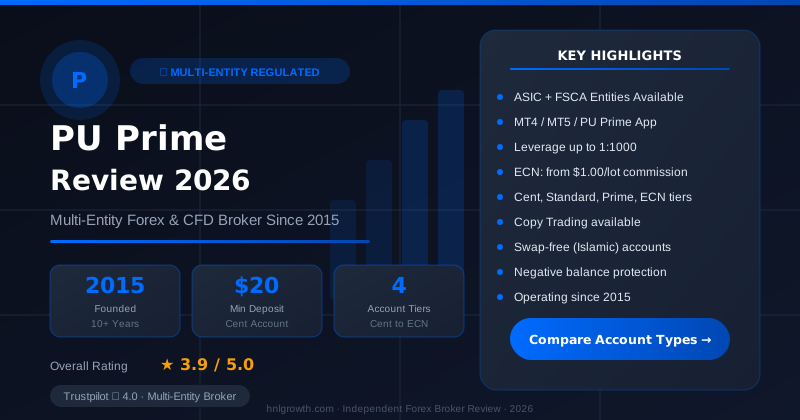
PU Prime — Multi-Entity Forex & CFD Broker
ASIC (AU) + FSCA (ZA) entities available · $20 min deposit (Cent) · MT4, MT5, PU Prime App · 4 account tiers
A bond is essentially an IOU. A company or government borrows money from investors, promises to pay a fixed interest rate (the coupon) at set intervals, and agrees to return the original amount (the principal, or "face value") when the bond matures.
The catch is that not every borrower is equally likely to keep that promise. Credit rating agencies assess issuers and assign a letter grade that reflects how creditworthy they are. Bonds rated above a certain threshold are called "investment-grade" — these are issuers agencies consider relatively safe. Anything below that threshold is "speculative-grade," commonly known as a junk bond.
The cutoff points, as published by the major agencies, are roughly:
| Rating tier | S&P / Fitch scale | Moody's scale | Category |
|---|---|---|---|
| Lowest investment-grade | BBB- | Baa3 | Investment-grade (last rung) |
| Highest speculative-grade | BB+ | Ba1 | Junk / high-yield (first rung) |
| Deep speculative-grade | CCC and below | Caa and below | Substantial risk of default |
General market reference based on the standard letter-grade frameworks published by S&P Global Ratings, Moody's and Fitch Ratings. This is not real-time data. Individual issuer ratings can be upgraded or downgraded at any time; always check the current rating before drawing conclusions about a specific bond.
The word "junk" is a bit unfair, in the sense that it doesn't mean the issuer is about to collapse. It just means the agency has flagged a materially higher chance of missed payments or default compared with an investment-grade issuer. Plenty of large, recognizable companies carry junk ratings simply because of high debt loads, a cyclical business, or a recent restructuring — not because they're on the verge of failure.
Two specific situations come up often enough that it's worth naming them:
- Fallen angels — bonds that used to be investment-grade but got downgraded into junk territory, usually after a deterioration in the issuer's finances.
- Rising stars — the opposite: junk-rated bonds that get upgraded into investment-grade as the issuer's credit profile improves.
Both matter because the rating change itself, not just the underlying business, tends to move the bond's price. A downgrade can trigger forced selling from funds mandated to hold only investment-grade paper, and an upgrade can do the reverse.
How Junk Bonds Actually Work: A Worked Example
The mechanics of a junk bond are the same as any other bond — coupon, price, yield, maturity — but the numbers behave differently because the market prices in default risk. The table below uses round numbers for illustration only; it does not represent a real bond issue, a live instrument, or any quoted price.
Suppose a company issues a bond with:
- Face value: $1,000
- Coupon rate: 8% per year (fixed)
- Maturity: 5 years
- Current market price: $950 (trading below face value)
| Item | Hypothetical figure | What it means |
|---|---|---|
| Annual coupon payment | $80 (8% of $1,000) | Fixed cash paid to the bondholder each year, assuming no default |
| Purchase price | $950 | You pay less than face value, so your effective return is higher than the coupon rate |
| Current yield | ≈ 8.4% ($80 ÷ $950) | Annual income relative to what you actually paid |
| Yield to maturity (approx.) | Higher than current yield | Also accounts for the $50 gain if the bond is redeemed at $1,000 face value at maturity |
| Default scenario | Coupon stops; principal partly or fully at risk | If the issuer defaults, you may recover only a portion of your $950 through the bankruptcy or restructuring process, or potentially very little |
All figures are purely illustrative and hypothetical. They do not represent any real bond issue, quoted price, or trading outcome.
Compare that with a hypothetical investment-grade bond from a stable issuer paying a 4% coupon at close to face value. The junk bond offers roughly double the income in this illustration, but that extra spread exists specifically because the market is pricing in a meaningfully higher probability that the coupon or principal doesn't get paid in full. This is the risk-return trade-off in its most literal form: yield is compensation for risk, not a bonus that appears out of nowhere.
A higher yield is not free money. If it were reliably free money, every investor would buy junk bonds and ignore investment-grade debt, and the yield gap would disappear. The gap persists because defaults on speculative-grade debt do occur across a large enough pool of issuers that the extra yield reflects the market's collective pricing of that risk — not a guaranteed extra return for any single bondholder. For dated default-rate figures by rating category, the rating agencies themselves publish periodic default studies; checking those directly is the appropriate source for specific probabilities, since default rates shift with the economic cycle and agency methodology.
It also helps to separate junk bonds from equities conceptually, since beginners sometimes lump them together as "risky assets." A bond, junk or not, has a fixed coupon and a defined maturity date, and bondholders are generally repaid ahead of shareholders if a company is liquidated. A stock has no fixed payment and no maturity, and shareholders sit behind bondholders in a liquidation. Junk bonds carry more default risk than investment-grade bonds, but they still occupy a different position in the capital structure than shares of the same company, and their risk profile should not be treated as interchangeable with equity risk.
The Real Risks — and Who Should Steer Clear
The core risk is default: the issuer fails to make a coupon payment or repay principal at maturity. Rating agencies group issuers into risk tiers partly because default outcomes are meaningfully different across the rating spectrum — a CCC-rated issuer presents a materially different risk profile than a BB-rated one, even though both sit in speculative-grade territory. For specific, dated default-rate data, consult the rating agencies' own published default studies, since those figures move with the economic cycle and vary by methodology and time period.
Beyond default, junk bonds carry a few risks that are easy to underestimate:
- Price volatility. Junk bond prices swing more than investment-grade bonds, especially when economic sentiment shifts. In a downturn, junk bond prices often fall sharply as investors reprice default risk higher, even before any actual default occurs.
- Interest rate sensitivity. Like all fixed-rate bonds, junk bond prices generally move inversely to interest rates: when rates rise, existing fixed-coupon bonds become less attractive and their prices tend to fall, all else equal.
- Liquidity risk. Many individual junk bond issues trade less frequently than government or large-cap investment-grade bonds, which can widen the bid-ask spread and make it harder to exit a position at a fair price when you want to.
- Concentration risk. Junk bonds are not one uniform risk bucket. A BB-rated issuer and a CCC-rated issuer both count as "junk," but their default probabilities are meaningfully different. Treating the whole category as equally risky — or equally rewarding — is a mistake covered in more detail below.
Given all that, junk bonds are generally not suitable for:
- Anyone with a short time horizon who might need to access the capital on a fixed date, since exiting early may mean selling at a price shaped by current market sentiment rather than face value.
- Anyone with low risk tolerance or who would be seriously unsettled by a double-digit paper loss during a downturn.
- Anyone prioritising capital preservation over income, such as money held as an emergency fund or earmarked for a near-term expense.
- Beginners who haven't yet built a habit of checking credit ratings and reading what they actually mean before buying, rather than being drawn in purely by the headline yield number.
None of this means junk bonds are inherently a bad instrument. It means they occupy a specific, higher-risk slot in a portfolio, and they're a poor fit for money that needs to be safe and available on short notice.
Common Mistakes Beginners Make With High-Yield Bonds
A few patterns show up repeatedly among people new to this asset class:
Yield-chasing without checking the rating. Seeing an attractive coupon and buying without first confirming which rating tier the issuer sits in, or how recently that rating was reviewed, is the single most common mistake. The yield number tells you the market's price for the risk; it doesn't tell you what that risk actually is until you check the rating.
Treating all junk bonds as one homogeneous risk bucket. A BB+ issuer just below the investment-grade cutoff is a very different risk than a CCC issuer deep in speculative territory, even though both get called "junk." Lumping them together leads to either overestimating or underestimating the risk of a specific position.
Ignoring liquidity and interest-rate sensitivity. Beginners often focus entirely on default risk and forget that junk bond prices also move with broader rate cycles and can be harder to sell quickly than more liquid instruments. A bond you cannot exit at a reasonable price when you need to is not behaving like safe income, regardless of its coupon.
Never stress-testing against a downturn. It's easy to look at a coupon in isolation and forget to ask what happens to this position's price — and the issuer's ability to pay — if the economy weakens. Junk bond performance tends to be more sensitive to recession risk than investment-grade debt, and skipping that mental stress test is how beginners get caught off guard by a price drop that, in hindsight, was a fairly predictable market reaction.
Assuming direct bond ownership is the only route in. Individual bonds, bond funds and ETFs, and CFDs on bonds are all different vehicles with different liquidity, minimum sizes, and ways of gaining exposure to price and yield movements. None of them changes the underlying credit risk of the issuer, but they do change how easily you can enter, exit, and size a position. It's worth knowing these alternatives exist before assuming you have to pick individual issuers yourself.
How to Practise Exploring Bond Behaviour on a Demo Account
Reading about yield mechanics is a reasonable starting point, but watching price and yield actually move gives you a more concrete sense of how these instruments behave day to day. A demo account — which uses live market prices but virtual funds — is a low-pressure way to observe that behaviour without risking real capital while you're still building your understanding.
Before setting up a demo specifically to explore bond-related instruments, check the platform's current instrument list to confirm which bond CFDs or bond-related instruments are actually available. PU Prime lists Bonds as a trading category, but the specific symbols offered and their trading conditions vary. The spreads and trading costs page shows reference figures for each account type, and the platform itself displays live pricing. Do not assume that a general category name means every bond type you're interested in is listed.
Once you've confirmed an instrument is available, a practical way to use the demo:
- Pull up a bond instrument or bond-related CFD and observe how its price reacts over a few sessions, particularly around interest rate announcements or broader risk-on/risk-off shifts in the market.
- Compare that price behaviour with a more stable, investment-grade-style instrument over the same period, to get a feel for the difference in volatility rather than relying on the concept in the abstract.
- Track how yield and price tend to move in opposite directions as market sentiment changes, since that inverse relationship is one of the more counterintuitive parts of bond mechanics for beginners.
- Note that a demo account mirrors live pricing but doesn't involve real settlement, funding, or withdrawal steps, so it is a tool for observing mechanics, not for assessing execution quality or live account processes.
You can open a PU Prime demo account to get started. According to PU Prime's own account-opening guidance, the registration process takes approximately 10 to 15 minutes, and the demo uses real market prices without requiring a funded account.
FAQ
What makes a bond "junk" instead of investment-grade? The rating assigned by an agency such as S&P, Moody's or Fitch. Bonds rated BBB-/Baa3 or above are investment-grade; bonds rated BB+/Ba1 or below are speculative-grade, commonly called junk or high-yield.
Why do junk bonds pay a higher yield? Because investors demand extra compensation for taking on a higher probability of missed payments or default compared with investment-grade issuers. The higher yield is the market's price for that added risk, not a benefit unrelated to risk.
Can I lose all my money in a junk bond? It's possible, though outcomes vary by case. If an issuer defaults, bondholders typically go through a recovery process that can include partial repayment, restructured terms, or in severe cases very little recovery. The specific outcome depends on the issuer, the terms of the bond, and how the default or bankruptcy process plays out.
Are junk bonds basically the same risk as stocks? No. Junk bonds have a fixed coupon and a maturity date, and bondholders generally rank ahead of shareholders in a liquidation. That gives them a different risk position than equities in the same company, even though both can be considered higher-risk assets in a broad sense.
Do I have to buy individual junk bonds myself? No. Funds, ETFs, and CFDs on bonds are alternative ways to gain exposure to bond price and yield movements without necessarily selecting individual issuers. Each vehicle has its own liquidity, cost, and access characteristics, which is a separate research step from understanding the underlying credit risk.
What is a fallen angel and a rising star? A fallen angel is a bond that was downgraded from investment-grade into junk territory. A rising star is the reverse: a junk-rated bond upgraded into investment-grade. Both types of rating change tend to move the bond's price, sometimes sharply, independent of the coupon itself.
Is PU Prime regulated, and does that vary by region? PU Prime states on its regulation page that it operates under multiple regulatory licences depending on the entity, and lists oversight from several financial authorities. Which entity and licence apply to you depends on your country of residence. Check the regulation page for the details relevant to your jurisdiction rather than assuming one licence applies globally; terms and protections differ by entity.
What to Verify Yourself Before Trading
This is an educational overview and not a first-hand test of any specific product. Use the following checklist before treating any bond or bond-related instrument as tradable on a given platform:
- Confirm the exact instrument is listed on the platform's current instrument list, rather than assuming availability from a general category name.
- Check the specific spread, commission, and swap conditions for that instrument under your account type on the spreads and costs page. The values shown there are reference figures; the platform itself shows the most accurate live numbers.
- Verify which regulatory entity applies to your country of residence on the regulation page, since terms and protections differ by entity.
- Check the current credit rating of any specific issuer you're researching directly with the relevant rating agency, since ratings can change and the thresholds in this article are general reference points, not a live feed.
- For dated default-rate data by rating category, consult the rating agencies' own published default studies rather than relying on general descriptions in educational content.
Risk Warning
Risk warning: CFDs and leveraged forex products are complex instruments and carry a high risk of losing money rapidly due to leverage. Consider whether you understand how these products work and whether you can afford to take the high risk of losing your capital. Check the entity, terms and protections that apply in your jurisdiction before trading. Junk bonds themselves carry a distinct set of risks — including issuer default and price volatility — that exist independently of any leverage used to trade related instruments. Nothing in this article should be read as a guarantee of yield, income, or capital protection.
Ready to Compare PU Prime Account Types?
PU Prime is a multi-entity broker — ASIC (Australia) and FSCA (South Africa) regulated entities offer stronger oversight, while most international clients are onboarded to the FSA Seychelles or FSC Mauritius entities. Four account tiers (Cent, Standard, Prime, ECN) range from a $20 minimum deposit to full ECN pricing.
Risk disclaimer: PU Prime is a live, regulated multi-entity broker — trading forex and CFDs is done with real capital under normal market risk (this is not a simulated prop-firm evaluation). PU Prime operates under multiple separate licenses (ASIC, FSCA, FSA Seychelles, FSC Mauritius); which entity holds your account depends on your country of residence and determines your leverage cap and protections — confirm this before funding. CFDs and leveraged forex products are complex instruments and carry a high risk of losing money rapidly due to leverage; 62.2% of retail investor accounts lose money when trading CFDs with this provider. Consider whether you understand how CFDs/forex work and whether you can afford the high risk of losing your money. Affiliate disclosure: HNL Growth earns a commission when you open a PU Prime account through links on this page.